
Retrofitting Hydronic Heating in Melbourne: The 2026 Professional Guide
What if you could enjoy the silent, sun-like warmth of radiant heating without the dust and noise of an old ducted system, even if your Melbourne home wasn’t originally built for it? Many homeowners believe that retrofitting hydronic heating in Melbourne is a disruptive ordeal reserved only for major renovations. You’ve likely felt the frustration of uneven temperatures in high-ceilinged rooms or the sting of rising gas tariffs while your current heater circulates allergens through every room. It’s a common struggle in our local climate where older infrastructure often fails to meet modern comfort and health standards.
Our expert 2026 roadmap promises to show you how to seamlessly integrate energy-efficient, allergy-friendly warmth into your existing space with minimal fuss. You’ll discover how to future-proof your home against Victoria’s gas phase-outs by transitioning to advanced electric heat pumps that offer significantly lower running costs. We’ll preview the essential steps for a professional installation, from selecting premium radiator panels to ensuring your pipework is ready for a high-performance upgrade. By the end of this guide, you’ll have a clear path toward a silent, dust-free sanctuary that increases your property value and your daily wellbeing.
Key Takeaways
- Learn why modern radiant warmth is the preferred choice for Melbourne families looking to eliminate the dust and allergens circulated by traditional ducted systems.
- Understand the technical feasibility of retrofitting hydronic heating in Melbourne through professional assessments of sub-floor access, ceiling cavities, and wall types.
- Compare the long-term benefits of high-efficiency gas boilers against modern electric heat pumps to future-proof your home’s energy consumption.
- Discover how professional heat load calculations and custom system designs ensure even temperatures and maximum efficiency during the coldest Victorian winters.
- Find out how proactive maintenance, including specialised power flushing, protects your investment from internal sludge and ensures your system remains under warranty.
The Evolution of Hydronic Installation in Melbourne
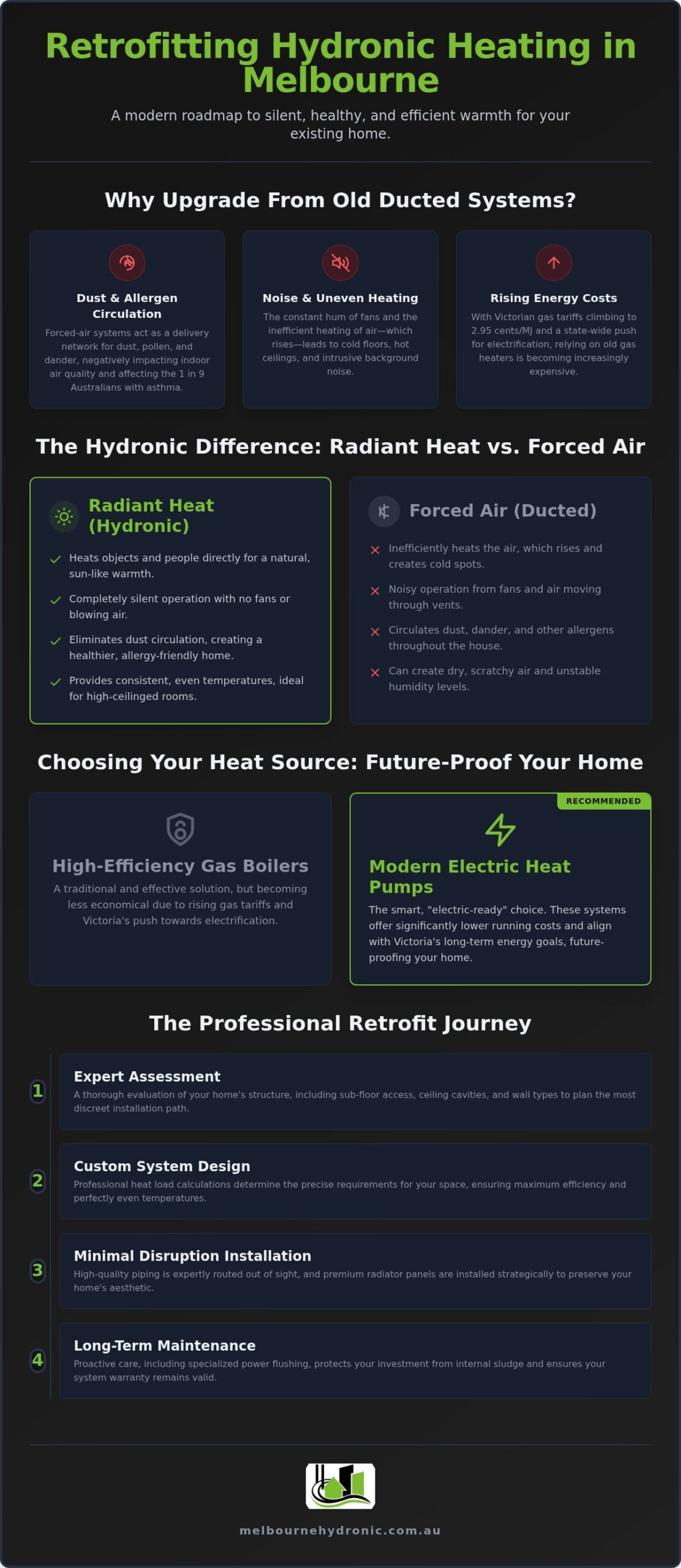
Modern hydronic systems are a far cry from the noisy, inefficient heaters of the past. At its core, the technology involves a closed-loop network of pipes that circulate heated water to radiators or underfloor coils. This method, known technically as Hydronics, provides a gentle, consistent warmth that doesn’t rely on blowing air around your living spaces. In 2026, many Melbourne homeowners are choosing to replace their aging ducted gas units with these sophisticated systems. The motivation is clear: gas tariffs in Victoria have climbed to 2.95 cents per megajoule, while the state continues its aggressive push toward residential electrification. It’s no longer just about luxury; it’s about making a smart, future-proof choice for your property.
Beyond the economics, the health implications are profound. Traditional ducted systems often act as a delivery mechanism for dust mites, pollen, and pet dander. Because hydronic systems use radiant heat rather than forced air, they eliminate this “dust-storm” effect entirely. For the one in nine Australians living with asthma, this change creates a significantly cleaner indoor environment. It’s the gold standard for retrofitting hydronic heating melbourne homes where air quality is a top priority for families.
Radiant Heat vs. Forced Air
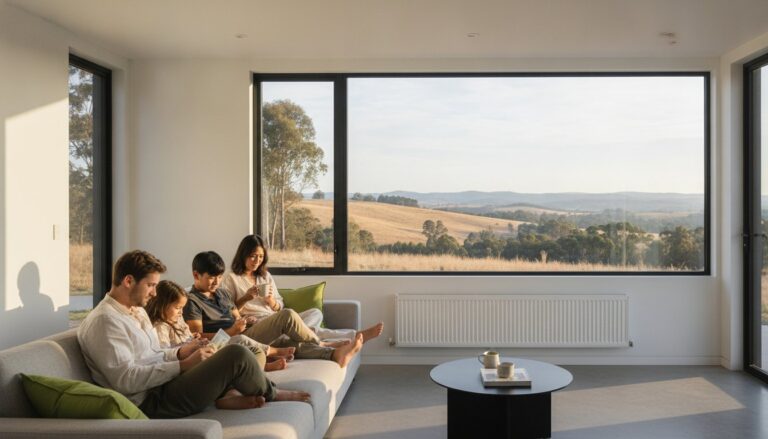
Radiant heat works by warming objects and people directly, much like the sun on a winter day. Forced-air systems simply heat the air, which then rises to the ceiling, leaving your floors cold and your head hot. This is a particular problem in Melbourne’s iconic high-ceilinged Victorian homes where heat loss is a constant battle. By retrofitting hydronic heating, Melbourne residents can maintain stable humidity levels and superior air quality without the intrusive noise of fans or the dry, scratchy throat often caused by split systems. The result is a natural, silent warmth that feels integrated into the home rather than forced upon it.
Energy Efficiency and Thermal Mass
Water is a far more effective conductor of heat than air. It retains thermal energy longer, which means your heat pump or boiler doesn’t have to work as hard to maintain your desired temperature. Modern installations allow for precise zoning, so you don’t waste energy heating a guest room or a formal dining area that isn’t in use. While the initial investment for retrofitting hydronic heating melbourne properties is higher than a standard ducted replacement, the long-term ROI is found in reduced energy bills and the increased premium value of your property. Choosing a system that is “electric-ready” ensures your home remains compliant with Victoria’s evolving energy standards for decades to come.
Retrofitting Methods: Tailoring Installation to Your Home
Every Melbourne home has a unique architectural DNA, from Edwardian weatherboards in Yarraville to mid-century brick veneers in Glen Waverley. Successfully retrofitting hydronic heating melbourne properties requires a surgical approach that respects these structural differences. We begin by assessing your home’s “skeleton” to determine the most discreet path for installation. Sub-floor crawl spaces are a technician’s best friend, allowing us to run high-quality barrier piping entirely out of sight. If your home sits on a concrete slab, we look toward ceiling cavities or internal wall voids. While a professional retrofit is a multi-day project, our team focuses on minimizing disruption, ensuring your daily routine remains as undisturbed as possible.
Choosing the right delivery method depends on your existing flooring and insulation. This Sustainability Victoria comparison highlights how different systems perform in our local climate, which is essential data when planning your upgrade.
Wall Radiator Panels: The Preferred Retrofit Choice
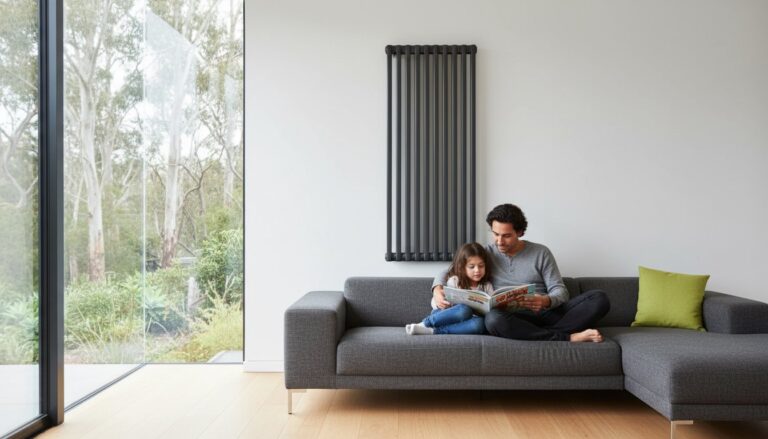
For most existing Victorian homes, hydronic heating panels offer the most straightforward path to premium comfort. These panels act as heat emitters that we can strategically place to combat cold spots. By utilizing sub-floor access, we route the pipework beneath the floorboards and bring it up directly behind the panel. This keeps the installation incredibly clean and preserves the aesthetic of your rooms. You can choose from classic styles that enhance heritage features or sleek, minimalist designs for modern renovations. If you’re unsure which style fits your space, you can consult with our specialist design team for a tailored recommendation.
Retrofitting Underfloor Heating
Many homeowners assume underfloor warmth is only for new builds, but that’s a myth. Retrofitting hydronic heating melbourne homes with underfloor systems is entirely possible with the right expertise. If you have a suspended timber floor with adequate sub-floor clearance, we can use the joist-and-plate method. This involves fitting aluminium heat transfer plates and piping between the joists from underneath. For those renovating over concrete, thin-bed screed systems allow for underfloor heating in Melbourne without significantly raising the floor height. It’s a precise process that works beautifully with engineered timber, tiles, or polished concrete, providing that “barefoot comfort” even on the frostiest July mornings.
Choosing the Heat Source: Gas Boilers vs. Heat Pumps
Victoria’s energy landscape is shifting rapidly. As we move through 2026, the choice between a traditional gas boiler and a modern electric heat pump has become the central decision for anyone retrofitting hydronic heating melbourne systems. While new residential gas connections face restrictions starting in 2027, owners of existing homes still have the flexibility to choose the technology that best fits their current infrastructure and long-term goals. With gas tariffs now reaching 2.95 cents per megajoule, the economic argument for electrification is stronger than ever, but technical suitability remains the most important factor.
Selecting the right energy source requires a balance of upfront investment and projected running costs. For a comprehensive look at how different technologies stack up, the Australian Government’s guide to heating and cooling provides an excellent baseline for efficiency standards. Ultimately, your choice will determine your home’s carbon footprint and energy independence for the next two decades.
The Rise of Air-to-Water Heat Pumps
Air-to-water heat pumps are the gold standard for homeowners committed to a gas-free future. These units operate with a Coefficient of Performance (COP) typically between 3.5 and 4.0; this means they deliver up to four kilowatts of heating energy for every one kilowatt of electricity they consume. Even during Melbourne’s frostiest winter mornings, modern heat pumps are designed to extract ambient heat from the outside air with remarkable efficiency. When you integrate heat pump hydronic heating with a solar PV system, you can achieve near-zero running costs by using your own generated power to warm your home. Installation does require a suitable outdoor space with plenty of airflow and consideration for acoustics to ensure the unit operates quietly near property boundaries.
High-Efficiency Boiler Upgrades
If your property has limited outdoor space or very high peak heating demands, a high-efficiency condensing boiler remains a powerful alternative. These modern units are significantly more advanced than the standard boilers of ten years ago. They capture latent heat from exhaust gases that would otherwise be wasted, which can reduce your gas consumption by approximately 30%. Swapping an old, failing unit for a condensing model is often the fastest way to improve a legacy radiator network. It’s an excellent solution for heritage homes where external modifications are restricted. Regardless of the heat source you choose, retrofitting hydronic heating melbourne is a strategic move that transforms your living environment into a sanctuary of consistent, healthy warmth.
The Professional Installation Journey in Melbourne
The transition to a premium heating system is a methodical engineering process that begins long before a single pipe is laid. We start with a comprehensive heat load calculation, which involves measuring the thermal efficiency of every room in your home. This ensures your system is perfectly sized for Victorian winters; an oversized unit wastes energy, while an undersized one will struggle during a July frost. Once the design is finalised, we map out pipe runs and manifold locations to ensure optimal water flow. This level of precision is why retrofitting hydronic heating melbourne properties requires a specialist touch. Our technicians work through a two-stage process: the rough-in, where infrastructure is hidden within floors or walls, and the fit-off, where your elegant radiators and heat source are mounted and connected.
Victorian Compliance and Safety Standards
Safety and legality are non-negotiable when upgrading your home’s infrastructure. In Victoria, any specialist plumbing work, including retrofitting hydronic heating melbourne, must be performed by VBA licensed plumbers. For any installation valued over $750, you’ll receive a formal Compliance Certificate. This document is your guarantee that the work meets all Australian Standards; it’s essential for maintaining your home insurance and manufacturer warranties. Energy Safe Victoria (ESV) mandates strict protocols for all gas and electrical connections, ensuring your new heat pump or condensing boiler operates safely from day one. You can contact our licensed team to ensure your project meets every local regulatory requirement.
System Balancing and Manifold Setup
The manifold acts as the central “brain” of your heating network, distributing warm water to each zone of your home. In double-storey Melbourne properties, achieving consistent warmth across both levels requires expert calibration. Technicians use the manifold to manage the pressure and flow for each individual circuit. System balancing is the adjustment of flow rates to ensure uniform heat distribution across all zones. Without this step, radiators closest to the heat source would be scalding while those in upstairs bedrooms remain lukewarm. Once the system is balanced and pressure-tested, we conduct a full customer handover, showing you how to manage your new sanctuary of comfort.
Maintenance: Protecting Your Investment from Sludge
Even the most advanced heating system requires professional oversight to maintain its peak performance. The primary threat to your comfort is a hidden enemy known as magnetite. This black, metallic sludge forms through natural oxidation inside your pipes and radiators over time. If you don’t address it, the sludge settles at the base of your panels, creating cold spots and forcing your heat source to work harder. When retrofitting hydronic heating melbourne properties, it’s vital to ensure the water quality is managed from day one. We use high-grade corrosion inhibitors to balance pH levels, which shields your heat exchanger from premature failure and keeps your energy bills low.
Protecting your manufacturer warranty is another key reason to stay on top of your schedule. Most premium brands require proof of an annual hydronic heating service in Melbourne to remain valid. At Melbourne Hydronic Heating, we’ve spent over 30 years refining our maintenance protocols to match the specific challenges of Victorian water conditions. We view ourselves as your long-term partner in home wellness, ensuring your investment provides silent, reliable warmth for decades.
Power Flushing: Extending System Life by 10+ Years
Power flushing is a heavy-duty cleaning procedure that goes far beyond a standard drain-and-refill. We connect a specialised high-velocity pump to your system to circulate cleaning chemicals at high pressure. This process dislodges years of accumulated debris and magnetite. You’ll know it’s time for a flush if your radiators are cold at the bottom while the top is hot, or if your boiler starts making banging noises. While we always recommend a flush during the process of retrofitting hydronic heating melbourne, a standard system should undergo this deep clean every 5 to 10 years to maintain maximum efficiency.
Annual Maintenance Checklist
A yearly check-up is a proactive way to catch minor mechanical issues before they lead to a mid-winter breakdown. Our technicians follow a rigorous protocol during every visit to ensure your system remains in top condition:
- System Pressure: We verify the sealed system is at the correct bar pressure to prevent air locks and pump strain.
- Expansion Tanks: Checking the internal air charge to ensure the tank can handle water expansion as the system heats up.
- Pump Operation: Testing for vibration or noise that indicates a failing bearing or blockage.
- Zoning Controls: Calibrating thermostats and manifolds to ensure you aren’t wasting energy in unoccupied rooms.
- Mechanical Inspection: A thorough look at the heat pump or boiler for any signs of physical wear, corrosion, or electrical faults.
Future-Proof Your Melbourne Home with Radiant Comfort
Investing in your home’s infrastructure shouldn’t involve compromises on air quality or energy efficiency. Retrofitting hydronic heating melbourne is a surgical upgrade that transforms heritage and modern properties into sanctuaries of silent, radiant warmth. Whether you choose the cutting-edge efficiency of an electric heat pump or the robust power of a condensing boiler, the result is a dust-free environment that supports your family’s long-term wellbeing. You’re not just installing a heater; you’re adopting a premium lifestyle choice that increases property value and daily comfort.
With over 30 years of Victorian experience, our team of VBA licensed plumbers specializes in high-efficiency heat pump integration and custom system design. We ensure every component, from the central manifold to the radiator panels, is calibrated for Melbourne’s unique climate and your specific floor plan. Don’t leave your comfort to chance when you can rely on local expertise and technical precision. If you’re ready to transition to a cleaner, more efficient home, Request a Professional Hydronic Installation Quote for Your Melbourne Home. We look forward to helping you achieve the gold standard in home heating.
Frequently Asked Questions
How long does a typical hydronic heating installation take in Melbourne?
A typical project for retrofitting hydronic heating melbourne homes usually spans three to seven business days. This timeframe depends on your property’s size and the complexity of the pipe routing. While a new build allows for easy access, it’s a fact that retrofits require a surgical approach to hide infrastructure within existing sub-floors or wall cavities. Our team works methodically to ensure the rough-in and final fit-off are completed with technical precision and minimal impact.
Can I install hydronic heating in a double-storey existing home?
Yes, we successfully install systems in double-storey Melbourne properties every week. Our technicians utilize clever routing through wardrobes, internal wall voids, or ceiling spaces to connect the upper floor to the central manifold. We focus on system balancing to ensure that radiators on the second level heat up just as quickly as those on the ground floor. This ensures a consistent, radiant warmth throughout your entire home regardless of the architectural layout or ceiling height.
Is hydronic heating more expensive to install than a split system?
The initial investment for a hydronic system is higher than a standard split system because it involves a permanent network of pipes and premium radiator panels. While the upfront cost is significant, you’re investing in a system with a lifespan often exceeding 25 years. Beyond the durability, the health benefits are unmatched. Many Melbourne families choose this path to eliminate the dust and allergens that forced-air systems circulate, making it a superior choice for long-term wellbeing.
Do I need to upgrade my electrical switchboard for a hydronic heat pump?
It’s likely you’ll need a dedicated circuit, and potentially a switchboard upgrade, when transitioning to an electric heat pump. These high-efficiency units require a stable power supply to extract ambient heat from the air. During our initial consultation, we’ll assess your current electrical capacity to ensure your home is ready for the upgrade. This step is crucial for safety and ensures your new system operates at peak performance throughout the coldest Victorian winters.
What is the best time of year to install hydronic heating in Melbourne?
Spring and summer are the most practical times for an installation. By scheduling your upgrade during the warmer months, you avoid the discomfort of being without a heater during a cold snap. Our team also has more flexibility in their schedule before the peak winter rush begins in May. Planning ahead ensures your system is commissioned, balanced, and ready to provide silent, dust-free warmth the moment the first Melbourne frost arrives in late autumn.
Are there government rebates available for switching to electric hydronics in Victoria?
In 2026, Victorian homeowners can access several incentives for moving away from gas. The Victorian Energy Upgrades (VEU) program offers rebates for replacing old gas heaters with efficient electric heat pumps, with some discounts reaching up to $5,530. Additionally, Solar Victoria provides hot water rebates that can apply to certain heat pump configurations. These programs are designed to support the state’s transition toward electrification and help offset the initial cost of your premium infrastructure upgrade.
Can hydronic heating also provide cooling for my home?
Standard radiator panels only provide heating, but you can achieve cooling by installing fan coils. When paired with a reversible electric heat pump, fan coils can circulate chilled water to lower the indoor temperature during Melbourne’s summer heatwaves. This setup provides a versatile, all-in-one climate solution. It’s a popular choice for those who want the health benefits of hydronics year-round while ensuring their home remains a sanctuary of comfort in every season.
How much disruption is involved in retrofitting radiator panels?
We’ve designed our process for retrofitting hydronic heating melbourne properties to be as non-intrusive as possible. Most of the heavy work occurs in sub-floor crawl spaces or ceiling voids where pipework is tucked away from view. We typically work room-by-room, so you don’t need to vacate your home during the installation. While there is some noise during the rough-in stage, our professional team prioritizes cleanliness and technical precision to ensure your living environment remains functional.