
Hydronic Panel Heating: The Complete 2026 Melbourne Homeowner’s Guide
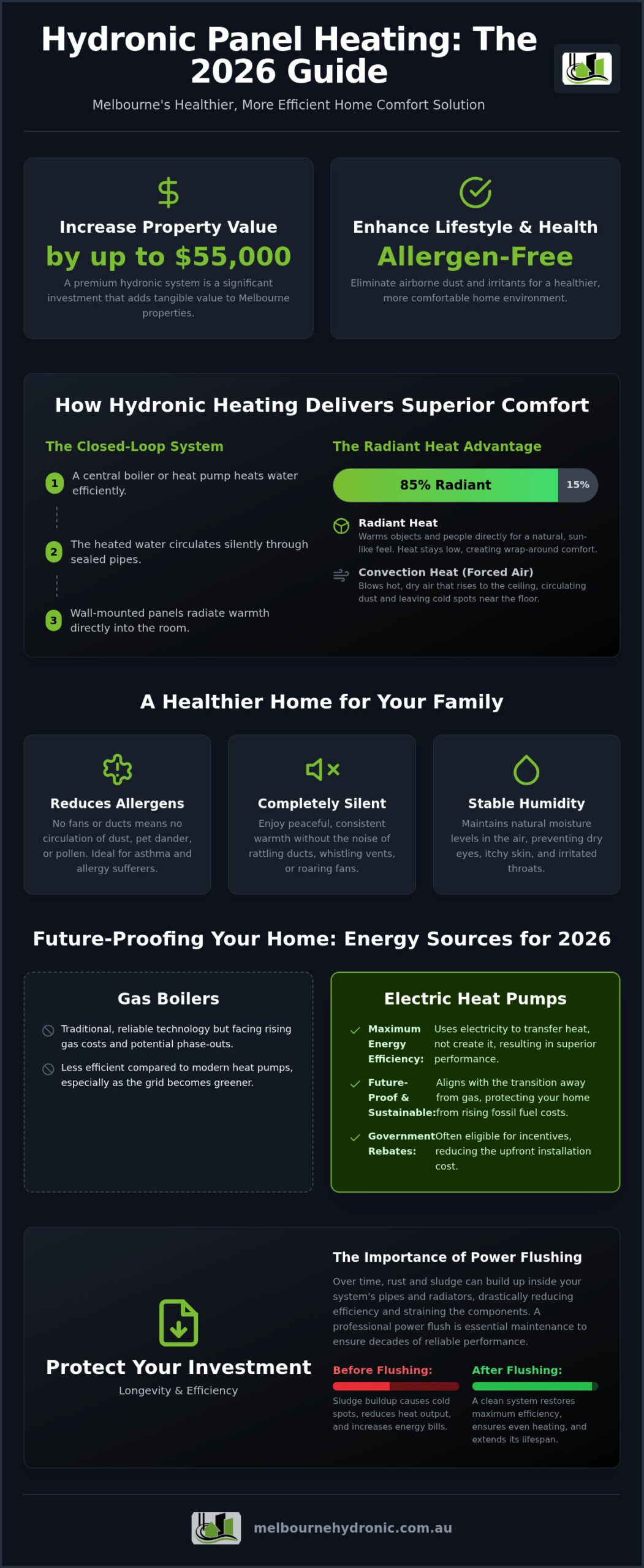
Did you know that a premium hydronic system can increase a Melbourne property’s value by as much as $55,000? While the financial return is impressive, most local homeowners find the lifestyle and health benefits even more valuable. If you’ve noticed your allergies flaring up every time the heater kicks on, you’re likely dealing with the dust and allergens circulated by traditional forced-air systems. Hydronic panel heating changes the game by using radiant heat, which means no fans, no drafts, and no airborne irritants. It’s the gold standard for creating a silent, healthy sanctuary in everything from drafty Victorian terraces to modern open-plan homes.
You probably agree that keeping a Melbourne home comfortable shouldn’t mean choosing between high energy bills and cold spots in the hallway. This guide promises to help you master the 2026 heating market by choosing a system that’s both sustainable and incredibly efficient. We’ll walk through the latest electric heat pump integrations, the benefits of professional power flushing to extend your system’s life, and how to future-proof your living space for a cleaner, gas-free future. It’s time to discover how silent, consistent warmth can transform your family’s well-being.
Key Takeaways
- Understand how radiant heat eliminates dust circulation to create a healthier, allergen-free environment for your family.
- Learn how to correctly size hydronic panel heating to ensure consistent warmth across every room, regardless of your home’s layout.
- Discover the most effective ways to retrofit modern systems into Melbourne’s diverse architecture, from heritage Victorian terraces to new builds.
- Evaluate the benefits of transitioning to electric heat pumps to maximize energy efficiency and future-proof your home against rising gas costs.
- Identify how specialized maintenance like power flushing can protect your investment and extend your heating system’s life for decades.
What is Hydronic Panel Heating and How Does it Work?
At its core, hydronic panel heating is a sophisticated closed-loop system designed for consistent, luxurious warmth. It works by circulating heated water from a central source through specialized wall-mounted steel panels. Unlike traditional systems that rely on noisy fans to push air around, this method uses water as a highly efficient medium to transport thermal energy directly into your living spaces. When exploring What is hydronic heating?, it’s best to think of it as a series of thermal anchors that maintain a steady, comfortable temperature regardless of the erratic Melbourne weather outside.
Victoria’s winters are notorious for being both damp and bone-chilling. Standard forced-air heating often dries out the air, making your home feel stuffy and uncomfortable. Hydronic systems solve this by providing completely silent operation. There are no rattling ducts, whistling vents, or sudden blasts of air. You simply experience a quiet, reliable warmth that matches the premium feel of a well-crafted home. It’s a “set and forget” solution that respects the peace of your domestic environment.
Radiant vs. Convection Heat: The 85/15 Split
The magic of these systems lies in how they distribute energy. While split systems blow hot air that quickly rises to the ceiling, leaving your feet cold, hydronic panels operate on a precise 85/15 split. This means 85% of the warmth is radiant heat, while only 15% is convection. Radiant heat is the primary energy transfer method in hydronics, warming objects and people directly rather than just the air between them. This is why the warmth feels more natural, mimicking the gentle heat of the sun on a clear winter morning.
Because the system doesn’t rely on heavy airflow, it minimizes convection currents. This significantly reduces the amount of dust, pet dander, and lint circulating through your rooms. By warming the structure of the house itself, the heat stays where you need it most, creating a wrap-around comfort that convection-based systems simply can’t replicate.
Health Benefits for Asthma and Allergy Sufferers
For many Melbourne families, the choice of heating is a health decision, not just a technical one. Understanding the lifestyle benefits of hydronic heating is crucial for long-term well-being. Since there’s no moving air, the common triggers for asthma and hay fever remain settled on the floor rather than being constantly recirculated and inhaled. This creates a “breathable” atmosphere that’s noticeably fresher.
Maintaining consistent humidity is another significant advantage. Forced-air systems often strip essential moisture from the air, leading to dry eyes, itchy skin, and irritated throats. Hydronic panels keep the indoor environment stable. It’s a clean, dust-free solution that supports your family’s respiratory health while providing the most efficient heat available in the 2026 market.
Choosing the Right Hydronic Radiator Panels for Your Home
Selecting the hardware for your hydronic panel heating system is a balance of engineering and interior design. It’s not just about picking a style that matches your floorboards; it’s about ensuring each room has the specific thermal capacity to stay warm on a 5°C Melbourne morning. We start by calculating the heat loss of every room, measuring window sizes, ceiling heights, and insulation levels. This determines the required wattage or BTU (British Thermal Units) for each panel. Getting this calculation right is vital. If a panel is undersized, the room will never reach a comfortable temperature, while an appropriately sized panel allows the system to run more efficiently at lower water temperatures.
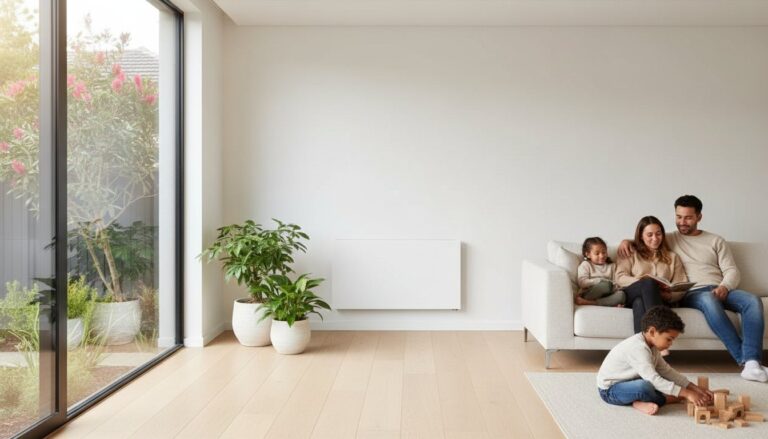
Material choice is equally important for long-term performance. High-quality steel is the industry standard in 2026 because it offers excellent heat conductivity and exceptional durability. These panels are engineered to be safe for every member of the family. Unlike old-fashioned space heaters or exposed elements, hydronic panels have low surface temperatures. They feel warm to the touch but won’t cause burns, making them the ideal choice for homes with curious toddlers or pets. To maximize your comfort, we equip each unit with Thermostatic Radiator Valves (TRVs). These allow you to set different temperatures for every room, ensuring your bedroom stays cool for sleep while your living area remains perfectly cozy.
Standard vs. Designer Radiator Panels
For most Melbourne homeowners, standard steel panels are the go-to choice for bedrooms and hallways. They provide cost-effective efficiency and a clean, unobtrusive look. However, modern architecture often demands more creative solutions. Designer radiators have become increasingly popular, offering vertical configurations that save precious wall space in compact urban builds. You don’t have to stick with classic white, either. Many residents now opt for textured anthracite or matte black finishes to turn their heating into a sophisticated design feature. If you’re unsure which style fits your layout, you can consult with a local specialist to see the latest 2026 range.
Specialized Options: Towel Rails and Trench Heating
Standard panels are just the beginning of a complete home solution. Many Melbourne bathroom renovations now include hydronic towel rails as a standard feature. They do more than just dry your towels; they provide a dedicated heat source that keeps the bathroom warm and helps prevent mold growth. For homes with floor-to-ceiling glass walls, trench heating is the perfect answer. These units sit flush within the floor, creating a curtain of warm air that stops cold drafts right at the glass. In larger open-plan areas that require a rapid boost in temperature, we can also integrate fan coils to provide the responsiveness that traditional radiant panels might lack during a sudden cold snap.
Retrofitting Hydronic Panels in Existing Melbourne Homes
Retrofitting hydronic panel heating into an existing Melbourne home is more straightforward than many people realize. Whether you live in a classic Victorian terrace in Carlton or a modern open-plan home in Brighton, the installation can be tailored to the specific architecture. For homes with accessible sub-floors, we typically route pipework underneath to keep it completely hidden. If your home is built on a concrete slab, we use discreet through-wall routing or decorative bulkheads. The goal is always to minimize structural impact while delivering maximum thermal performance.
If you’re upgrading from an old gas ducted system, you don’t need to worry about the existing infrastructure. While we don’t remove the old ducts, which is often unnecessary and costly, we help you transition to a dust-free environment. Once the panels are active, you can simply seal off the old floor or ceiling vents. This shift immediately eliminates the “burnt dust” smell and the noisy fan operation of your previous system, replacing it with the silent, healthy warmth that defines modern hydronic solutions.
Pipework and Manifold Setup
We use advanced multi-layer pipe technology that includes an oxygen barrier to prevent internal corrosion. This ensures a leak-proof system that’s designed to last for decades. All these pipes lead back to a central manifold, which acts as the “brain” of your heating distribution. By strategically placing this manifold, we ensure even water pressure and temperature to every radiator in the house. Our 30 years of local experience allows us to find the most efficient paths through your home’s unique framework with surgical precision, keeping the installation clean and unobtrusive.
Installation Costs and Timelines
A typical retrofit usually takes between 3 to 5 days, depending on the complexity of the floor plan. We pride ourselves on a “no-mess” installation promise; our technicians treat your home with the same respect as their own, using drop sheets and thorough cleaning protocols. The final investment depends on the number of panels, the total pipe length, and your choice of heat source. Professional design is the most critical factor here. Without it, you risk “cold room” syndrome where certain areas never reach the desired temperature. Our expert consultants ensure every room is balanced for consistent, wrap-around comfort.
Energy Sources: Gas Boilers vs. Electric Heat Pumps in 2026
In 2026, the heart of your hydronic panel heating system is defined by the choice between traditional gas reliability and the rapid shift toward electrification. With Victorian gas prices rising by 18% since 2024, many homeowners are seeking long-term stability and lower running costs. While gas boilers remain a powerhouse for high-demand properties, the market is pivoting toward sustainable alternatives that integrate seamlessly with modern home infrastructure. Choosing the right energy source depends on your property’s specific thermal needs and your goals for future-proofing.
Running costs are a major factor in this decision. For a typical 200m² Melbourne home, annual costs for a hydronic system with a high-efficiency gas boiler currently sit between $1,400 and $1,800. In contrast, an electric heat pump can lower those costs to between $900 and $1,300. Some homeowners even choose hybrid systems, utilizing gas for peak winter performance and electric for the milder shoulder seasons, ensuring they always have the most economical source of warmth available.
The Rise of Electric Heat Pumps in Victoria
The shift to heat pump hydronic heating is driven by incredible energy efficiency. These units don’t create heat through combustion; instead, they extract ambient energy from the outside air and transfer it to your home’s water loop. With a Coefficient of Performance (COP) of 4.0, a heat pump produces four units of heat for every unit of electricity it consumes. When you pair this technology with rooftop solar, your running costs can drop toward near-zero during daylight hours. The Victorian government’s Gas Substitution Roadmap and the Victorian Energy Upgrades (VEU) program also provide significant incentives for residents moving away from residential gas in 2026.
Choosing the Best Boiler for Your System
Despite the push for electric, high-efficiency condensing gas boilers are still the right choice for many existing homes. They excel in properties with extremely high peak heating demands or where the electrical switchboard isn’t yet ready for a full heat pump conversion. A condensing boiler captures heat that would otherwise escape through the flue, maximizing every megajoule of gas used. It’s essential to focus on choosing the best hydronic boiler by accurately sizing the unit to the total panel load of your house. An oversized boiler wastes energy, while an undersized one will struggle to keep you cozy during a July cold snap.
Ready to see which energy source fits your property’s unique layout? Speak with our expert consultants for a tailored efficiency assessment of your home.
Maintaining Your System: Longevity and Power Flushing
Investing in hydronic panel heating is a commitment to long-term comfort, and with the right maintenance, your system can provide reliable warmth for 25 years or more. While the steel panels themselves are incredibly durable, the water circulating through them requires attention to prevent the “Hidden Cost of Sludge.” Over time, internal corrosion can create magnetite, which is a black, metallic debris that settles in your radiators and pipework. This buildup forces your pump to work harder and reduces heat transfer, eventually destroying the energy efficiency you invested in.
Annual servicing is the best way to protect your infrastructure. During a visit, a technician checks the system’s chemical balance and adds specialized inhibitors to neutralize corrosion. They’ll also inspect the expansion vessel and safety valves to ensure everything operates within the correct parameters. This proactive approach doesn’t just prevent unexpected breakdowns; it ensures your energy bills stay as low as possible throughout the life of the system. It’s a small step that safeguards the premium lifestyle hydronics provide.
What is Hydronic Power Flushing?
Power flushing is a specialized deep-cleaning process that restores your system to its original performance levels. If you notice cold spots at the bottom of your radiators or hear strange “kettling” noises coming from your boiler, it’s a clear sign that sludge has accumulated. By circulating high-velocity water and cleaning chemicals through the loop, we remove every trace of debris. This service is typically recommended every five years and can extend the life of your entire system by up to a decade, ensuring your hydronic panel heating continues to run as quietly as the day it was installed.
DIY Maintenance Tips for Homeowners
While major work requires a professional hydronic heating service, there are simple tasks you can handle yourself to keep things running smoothly. These minor checks help you catch potential issues before they require a call-out.
- Bleed your radiators: If a panel is cold at the top but hot at the bottom, there’s likely trapped air. Use a radiator key to open the valve slightly until water appears.
- Monitor system pressure: Check the gauge on your boiler or heat pump regularly. For most Melbourne homes, it should sit between 1.0 and 1.5 bar. If it drops frequently, you may have a minor leak.
- Inspect for leaks: Take a quick look at the valves and pipe joins once a season. Catching a small drip early prevents floor damage and pressure loss.
Knowing when to call a professional is just as important as these DIY steps. If you’re constantly topping up the pressure or noticing uneven heat across different rooms despite bleeding the radiators, it’s time for a comprehensive expert check-up. This ensures your home remains the dust-free, healthy sanctuary you expect in the 2026 market.
Secure Your Home’s Future with Radiant Comfort
Choosing hydronic panel heating is more than just a technical upgrade; it’s a long-term investment in your family’s health and your property’s value. We’ve explored how these systems eliminate dust circulation, making them the premier choice for Melbourne families living with asthma or allergies. Whether you’re retrofitting a heritage Victorian home or integrating a modern electric heat pump with rooftop solar, the transition to radiant warmth offers a level of silent, consistent comfort that traditional forced-air systems can’t match.
As a family-owned business with over 30 years of experience in Melbourne and Geelong, we understand the specific climate challenges of Victoria. We specialize in high-efficiency electric heat pump systems and are committed to helping you navigate the 2026 energy market with confidence. You don’t have to let another damp winter compromise your indoor air quality or your energy budget. It’s time to experience the premium lifestyle that only a professionally designed hydronic system can provide.
Get a Professional Hydronic Heating Quote for Your Melbourne Home and start your journey toward a warmer, healthier sanctuary today. We look forward to helping you create the perfectly tempered environment your home deserves.
Frequently Asked Questions
Is hydronic panel heating more expensive to run than ducted heating?
Hydronic systems are typically 20% to 35% cheaper to run than traditional gas ducted systems in a standard Melbourne home. When you transition to an electric heat pump, these savings increase further. While gas ducted systems lose energy through leaky vents and ceiling space, hydronic panel heating delivers warmth directly into the room. This efficiency is why many local homeowners are switching to radiant solutions to combat rising energy tariffs in 2026.
Can I install hydronic panels in an existing double-storey home?
Yes, retrofitting hydronic panels in a double-storey Melbourne property is entirely possible and quite common. Our technicians use specialized techniques to route pipework through wall cavities, wardrobes, or ceiling voids to reach the upper level. Every home has a unique framework, so we design a custom layout that minimizes structural impact. This ensures you enjoy consistent, silent warmth across both floors without the need for major renovations or messy construction.
How long does a typical hydronic heating installation take in Melbourne?
A standard installation for a three to four bedroom home in Melbourne typically takes between 3 to 5 days. This timeline includes the placement of all radiator panels, the installation of the central manifold, and the connection of your chosen heat source. We pride ourselves on a professional, no-mess approach, using drop sheets and thorough cleaning protocols. Our goal is to have your new system fully operational with minimal disruption to your daily family routine.
Are hydronic radiators hot to the touch and dangerous for children?
No, hydronic radiators are engineered with safety in mind and are perfectly safe for households with children and pets. Unlike electric bar heaters or wood fires, these panels have relatively low surface temperatures. They feel warm and comforting to the touch but don’t reach levels that cause burns. This radiant technology makes them a preferred choice for nurseries and playrooms, providing a safe and healthy environment for your most vulnerable family members.
What is the best temperature to set my hydronic heating thermostat?
For maximum comfort and efficiency, most Melbourne residents find that setting their thermostat between 18°C and 21°C is ideal. Because radiant heat warms objects and people directly, you’ll likely feel comfortable at a slightly lower temperature than you would with a blowing air system. Every degree you turn the thermostat up can increase energy consumption by approximately 10%, so finding your personal “sweet spot” within this range helps keep your 2026 running costs manageable.
Do I need to service my hydronic heating system every year?
Yes, we strongly recommend an annual service to ensure your system continues to operate at peak efficiency. During a routine check, our technicians inspect the water pressure, test the chemical inhibitor levels, and check the safety valves. This proactive maintenance prevents internal corrosion and helps your hydronic panel heating achieve its expected 25 year lifespan. It’s a small investment that protects your home’s infrastructure and ensures your family remains warm throughout the coldest Victorian winters.
Can I use my existing solar panels to run a hydronic heat pump?
Absolutely, pairing your existing solar array with an electric heat pump is one of the most sustainable ways to heat a home in 2026. By running the heat pump during daylight hours, you use your own generated electricity to warm the water in your system. This combination can lead to near-zero running costs for your heating. You can learn more about Tally Energy Group to see how solar power can support this as a key strategy for Melbourne homeowners looking to future-proof their properties against rising gas prices and move toward total electrification.
If your panels are cold at the bottom but hot at the top, it’s a classic symptom of magnetite or black sludge buildup. This heavy debris settles at the lowest point of the radiator, preventing hot water from circulating effectively. While cold spots at the top usually mean you just need to bleed out trapped air, cold bottoms require a professional power flush. This process removes the debris and restores the full heat output of your system.