
Heat Pump Hydronic Heating: The 2026 Melbourne Homeowner’s Guide
By the start of 2026, the traditional gas-fired Melbourne home will be a relic of the past as Victorian gas connection fees continue to climb by up to 20% annually. It’s a shift that has many homeowners feeling the pressure to find a sustainable, cost-effective alternative. You probably already know that the era of cheap gas is over, and you’re likely tired of the dry air and noisy fans that come with traditional split systems. Transitioning to heat pump hydronic heating is no longer just a luxury for new builds; it’s the most effective way to future-proof your existing home against rising energy prices while enjoying a silent, allergy-friendly environment.
We promise to clear up the confusion surrounding 3-phase versus single-phase power requirements, ensuring you choose a system that fits your current electrical switchboard without unnecessary upgrades. You’ll discover how integrating your heating with a standard 6.6kW solar array can reduce your winter running costs by as much as 70% compared to old gas boilers. This guide provides a clear roadmap for Melbourne residents to achieve a premium, all-electric lifestyle. We’ll examine the latest European technology designed for our local climate, the specific installation steps for 2026, and how to eliminate dust-circulating fans for good.
Key Takeaways
- Understand the “heat harvester” technology that allows heat pump hydronic heating to move warmth into your home with far greater efficiency than traditional gas boilers.
- Decode efficiency metrics like COP to see how an air-to-water system can slash your energy bills while providing a whisper-quiet, dust-free environment.
- Compare the long-term savings and environmental impact of all-electric systems against gas, including a breakdown of running costs for a typical Cheltenham home in A$.
- Use our practical readiness checklist to evaluate your home’s insulation and determine if your existing hydronic heating panels are compatible with low-temperature heat pump technology.
- Discover why a custom-engineered design from local Melbourne experts is essential to ensure your system handles the coldest Victorian nights without inflated power bills.
What is Heat Pump Hydronic Heating and Why is Melbourne Switching?
Heat pump hydronic heating represents the most significant shift in Victorian home climate control since the introduction of natural gas. At its core, this is an air-to-water system. Instead of burning a fuel source to generate heat, it extracts ambient thermal energy from the outside air and transfers it into a sealed water circuit that circulates through your home. This water then warms your rooms via floor pipes or wall-mounted panels.
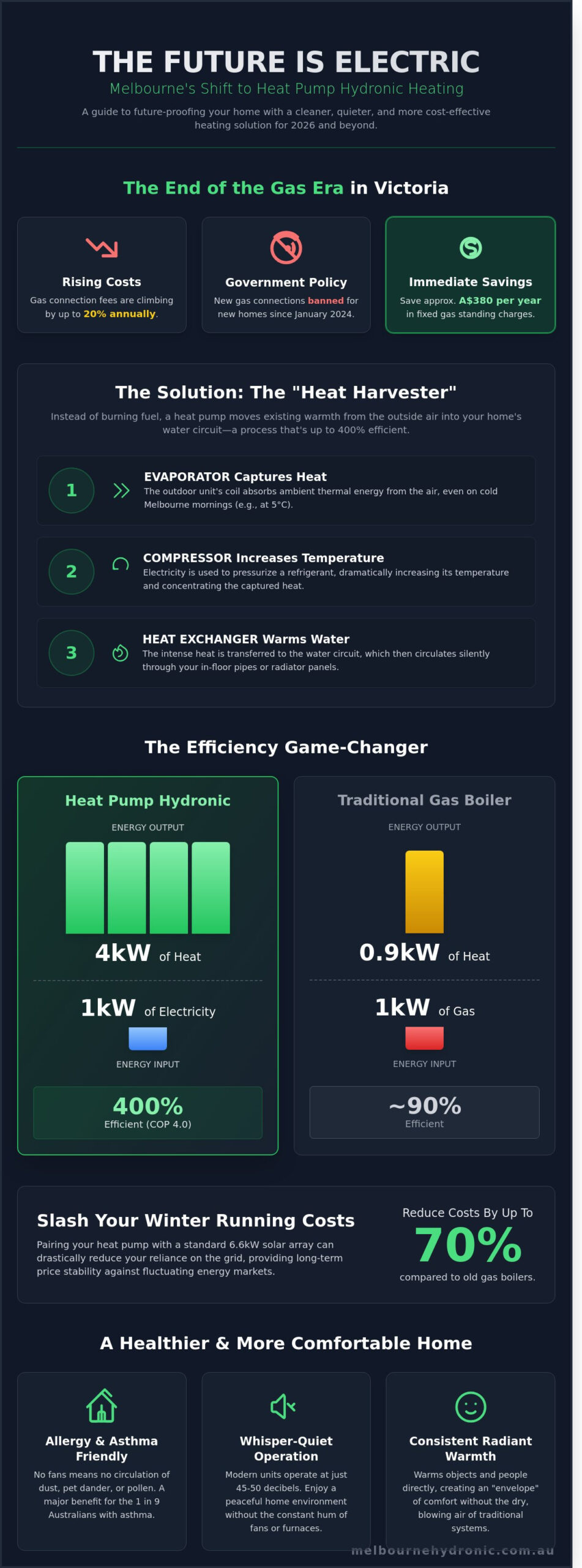
Think of the system as a “heat harvester” rather than a furnace. Traditional gas boilers create heat through combustion, which is inherently limited in efficiency. Modern heat pumps use a refrigeration cycle to move existing heat from one place to another. By understanding how heat pumps work, you can see why they achieve efficiencies of 300% to 400%, meaning for every 1kW of electricity used, you get 3kW to 4kW of heat. Even when Melbourne temperatures drop to 5°C on a July morning, there’s still plenty of thermal energy in the air for the system to collect and concentrate.
The move away from gas is no longer just a personal preference; it’s a state-wide transition. Since January 2024, the Victorian Government has banned new gas connections for new homes requiring a planning permit. With the state’s renewable energy target set to reach 65% by 2030, switching to an electric system ensures your home’s heating becomes cleaner every year as the grid decarbonises. For homeowners weighing their options, our detailed guide on electric hydronic heating in Melbourne provides a comprehensive comparison of air-to-water heat pumps and electric boilers to help you choose the right technology for your property.
The Shift from Gas Boilers to Electric Heat Pumps
Melbourne’s energy profile is changing rapidly. Transitioning to electric systems allows homeowners to disconnect from the gas network entirely, instantly saving approximately A$380 per year in fixed daily standing charges. This Melbourne Heat Pumps guide highlights how local residents are pairing these systems with solar PV to achieve near-zero running costs. Unlike gas prices, which have seen 20% fluctuations in recent years, solar-supported electric heating provides long-term price stability and a significantly lower carbon footprint.
Health and Lifestyle Benefits for Local Families
For the 1 in 9 Australians living with asthma, heat pump hydronic heating is a transformative health choice. Unlike ducted reverse-cycle systems, hydronic heating doesn’t rely on fans to move air. This means there’s no circulation of dust, pet dander, or pollen throughout your living spaces. The system provides radiant heat, which warms objects and people directly. In a draughty Victorian terrace or a high-ceilinged modern build, this creates a consistent “envelope” of warmth without the noise of blowing air. Modern units operate at roughly 45 to 50 decibels, making them whisper-quiet additions to a peaceful suburban street.
How Hydronic Heat Pumps Work in Melbourne’s Climate
Understanding heat pump hydronic heating starts with a simple concept: it is a refrigerator working in reverse. Instead of pushing heat out to keep your food cold, it extracts ambient heat from the Melbourne air and moves it into your home’s water circuit. The process relies on three primary components working in a closed loop:
- The Evaporator: A coil that captures low-grade heat from the outside air, even on chilly mornings.
- The Compressor: This part uses electricity to pressurize a refrigerant gas, which rapidly increases its temperature.
- The Heat Exchanger: This component transfers that intense heat into the water that circulates through your floor pipes or radiators.
Because these energy-efficient heat pump systems move heat rather than burning fossil fuels to create it, they offer a dust-free, allergen-friendly environment. This is a significant health benefit for Victorian families, as it eliminates the dry, forced air that often circulates dust and mites in traditional ducted systems.
Understanding COP and SCOP
Efficiency in these systems is measured by the Coefficient of Performance (COP). If a unit has a COP of 4.0, it produces 4kW of heat for every 1kW of electricity consumed. While some homeowners worry about performance dropping in the cold, Melbourne’s typical winter days usually sit between 8°C and 14°C. These temperatures are actually the “sweet spot” for maintaining high COP levels. We prefer to look at Seasonal COP (SCOP), which calculates average efficiency across the entire Victorian winter. A system designed for our local climate ensures your power bills remain low even when the Antarctic winds hit Port Phillip Bay, typically delivering 300% to 400% efficiency year-round.
Defrost Cycles and Extreme Cold
When temperatures drop toward 2°C in the Dandenongs or a frosty morning hits the Mornington Peninsula, moisture can freeze on the unit’s outdoor coils. Modern heat pump hydronic heating units handle this through an automated defrost cycle. The system briefly reverses its flow to melt the ice. This process is so fast and efficient that you won’t notice any dip in your indoor comfort.
The secret to this stability is the modern “Inverter” compressor. Unlike older models that simply turn on or off at full power, an inverter acts like cruise control for your heating. It modulates its output to match the exact heat loss of your home. This prevents the energy spikes associated with constant cycling and reduces wear on the hardware. If you want to see how this technology integrates with your specific home layout, you can consult with our local engineering team for a detailed performance map. We always prioritize units engineered for Australian humidity levels rather than generic European imports to ensure your system never struggles during a July cold snap.
Heat Pump vs. Gas Boiler: The Real Comparison for 2026
Choosing between a gas boiler and heat pump hydronic heating in 2026 is no longer just about the environment. It’s a calculated financial decision for your Cheltenham home. While gas boilers have been the Victorian standard for decades, the landscape has shifted. Gas prices in Melbourne have climbed by 25% since 2022, making the operational efficiency of electricity far more attractive. A gas boiler is essentially a controlled fire in a box, whereas a heat pump works like a refrigerator in reverse, moving heat rather than creating it.
The upfront investment for a heat pump is higher, often double that of a premium condensing gas boiler. You’re paying for advanced compressor technology and weather-compensated controllers that maximize efficiency. However, the Australian government recognizes this shift, highlighting highly efficient heat pump water heaters and space heaters as the primary path to decarbonization. Reliability remains high for both, but our 30 years of experience shows that while a gas boiler might last 12 to 15 years, a well-maintained heat pump system can easily reach the 20-year mark because it avoids the corrosive effects of constant combustion.
The Financial Breakdown
To understand the true cost, we must look beyond the quote. For a standard 3-bedroom home in the Bayside area, the 10-year total cost of ownership (TCO) now favors electricity. This is especially true when you factor in the “Solar Bonus.” If you have a 6.6kW PV system, you can program your heat pump hydronic heating to “buffer” heat into your floors or radiators during the day, effectively running your winter heating on sunshine.
| Metric (10-Year Outlook) | Gas Condensing Boiler | Air-to-Water Heat Pump |
|---|---|---|
| Initial Installation | A$6,500 – A$9,500 | A$14,000 – A$21,000 |
| Annual Service Cost | A$280 (incl. safety check) | A$350 (refrigerant/filter check) |
| Annual Fuel Bill (Est.) | A$2,400 | A$950 (A$300 with Solar) |
| 10-Year Total Cost | A$33,300 | A$27,000 (A$20,500 with Solar) |
When planning your budget, don’t forget the distribution side. You can find a detailed breakdown of radiator heater cost in Melbourne to see how the terminal units affect your total project price.
Physical Footprint and Installation Complexity
Installing a heat pump in a compact Bayside backyard requires strategic planning. Unlike a wall-mounted gas boiler that hides in a cupboard, a heat pump needs an outdoor unit about the size of a large air conditioner. It requires at least 300mm of clearance for airflow to operate at peak COP (Coefficient of Performance). If you’re retrofitting an older home, we often need to install a buffer tank. This tank ensures the system has enough water volume to prevent the compressor from “short-cycling,” which extends the unit’s life. New builds are easier to manage as we can design a dedicated plant room or garage nook to house these components discreetly from the start.
Is Your Home Ready? A Practical Readiness Checklist
Transitioning to heat pump hydronic heating involves more than just swapping a unit; it requires a holistic look at your home’s “thermal envelope.” If your house isn’t sealed, you’re essentially pumping expensive heat into a sieve. In Melbourne, where 1970s weatherboard homes are common, we recommend a minimum of R4.0 ceiling insulation and R2.0 wall batts to ensure the system operates at peak efficiency. Without these, even the most advanced heat pump will struggle to keep up during a 2°C July morning.
Your choice of emitters also changes with this technology. Gas boilers typically blast water through pipes at 70°C, but heat pumps are far more efficient at lower temperatures. Because the water is cooler, your hydronic heating panels usually need to be 20% to 30% larger than those used in gas systems. This increased surface area allows the system to radiate the same amount of warmth into the room without needing scalding water temperatures.
Thermal mass is another critical factor. Underfloor heating remains the gold standard for heat pump technology. A concrete slab acts like a giant thermal battery, absorbing heat during the day and slowly releasing it at night. This synergy allows the heat pump to run at its lowest, most efficient setting for longer periods.
The Low-Temperature Heating Secret
The secret to high performance lies in the flow temperature. While gas systems are “on-off,” modern heat pumps modulate. Running water at 45°C instead of 70°C allows the unit to achieve a Coefficient of Performance (COP) of 4.0 or higher. This means for every 1kW of electricity used, you get 4kW of heat. Professional hydronic heating installation in 2026 focuses on precision sizing to ensure your living room stays at a steady 21°C, even with these lower water temperatures.
Electrical and Solar Synergy
Before installation, check your switchboard. A typical residential heat pump requires a dedicated 15-Amp to 32-Amp circuit. If your home still runs on an old 40-Amp main supply, you might need a A$1,500 to A$2,800 mains upgrade to 3-phase power. However, the real magic happens when you pair the system with solar PV. By using a smart controller, you can “overheat” your home’s thermal mass or hot water tank during peak sunlight hours (11:00 AM to 3:00 PM), effectively storing solar energy as heat for the evening. This reduces your reliance on the grid and slashes running costs by up to 60%.
Designing Your Melbourne System with Local Experts
Installing heat pump hydronic heating isn’t just about swapping a gas boiler for an electric unit. A “one-size-fits-all” approach often results in A$600 winter electricity bills and living rooms that never quite reach 21 degrees. At Melbourne Hydronic Heating, we’ve spent 30 years in Cheltenham perfecting systems that thrive in the Victorian climate. We don’t guess; we engineer. Every home requires a bespoke hydraulic design to ensure the heat pump operates at its peak coefficient of performance (COP), even when the temperature drops toward zero in the Dandenongs.
Our selection of hardware reflects this commitment to quality. We partner with Stiebel Eltron for their German engineering, Baxi for their robust European heritage, and Daikin for their proven reliability in Australian conditions. These brands provide the technical flexibility needed for Melbourne’s varied architecture, from heritage Victorian terraces to modern glass-fronted builds. By matching the right brand to your specific floor plan, we guarantee a system that is whisper-quiet and allergen-friendly. If you’re still comparing your technology options, our 2026 buyer’s comparison guide for electric hydronic heating breaks down the critical differences between high-efficiency air-to-water heat pumps and compact electric boilers to help you make a confident decision.
Custom Engineering for Victoria
We begin every project with a comprehensive heat load calculation. This process accounts for your home’s specific orientation, window glazing types, and wall insulation R-values. We ensure your heat pump hydronic heating system is “Solar Ready” from day one. Even if you haven’t installed PV panels yet, our designs allow for future integration so you can heat your home using free energy from the sun. We also specialize in multi-zone configurations. This means you can keep your open-plan living area at a cozy 22 degrees while maintaining a crisp 18 degrees in the bedrooms for better sleep health.
Long-term Maintenance and Support
Your investment deserves protection. Our comprehensive hydronic heating service for heat pump systems includes checking water chemistry, cleaning magnetic filters, and optimizing flow rates to prevent component wear. Being a family-owned business means we take your comfort personally. If you encounter an issue on a freezing Friday night in July, you aren’t calling a generic call center. You’re reaching local experts who understand your system’s history. We provide the peace of mind that only comes from three decades of local service.
Ready to upgrade your home’s comfort and efficiency with a system designed for the long haul? Request your custom Melbourne heat pump quote today.
Secure Your Home’s Comfort for 2026 and Beyond
Transitioning to heat pump hydronic heating isn’t just about meeting Australia’s 2026 efficiency standards; it’s a long-term investment in a healthier, dust-free living environment. By switching from traditional gas boilers, you can reduce your heating energy consumption by up to 70% while enjoying the silent, premium warmth that only radiant technology provides. We’ve spent 30+ years mastering Melbourne’s unique climate challenges, ensuring every system we design delivers peak performance even when the overnight temperature hits zero. As a family-owned and operated business, we take pride in our technical precision and our status as specialists in world-class Stiebel Eltron and Baxi systems.
Your journey toward a more sustainable, allergen-friendly home starts with a professional assessment of your property’s specific thermal needs. We’ll help you navigate the technical requirements and local Victorian regulations to ensure your installation is seamless and future-proof. It’s time to upgrade your lifestyle with the gold standard of Melbourne heating solutions. Let’s build a warmer, more efficient, and healthier future for your family together.
Get a Free Design Consultation for Your Melbourne Heat Pump System
Frequently Asked Questions
Are hydronic heat pumps noisy for my neighbours?
Modern heat pumps produce roughly 45 to 55 decibels of sound, which is comparable to the hum of a domestic refrigerator. You’ll find that premium European models are designed specifically for high-density residential areas in Melbourne. We ensure every installation meets local council noise regulations, so your system remains whisper-quiet even during the coldest July nights.
Do I need 3-phase power for a hydronic heat pump in Melbourne?
You don’t always need 3-phase power for a standard family home. Most residential units with a capacity up to 14kW operate efficiently on a standard 240V single-phase connection. If your property is larger than 350 square meters or has high peak energy demands, we might recommend a 3-phase upgrade to balance the electrical load across your home’s circuits.
Can I use my existing radiators with a new heat pump?
You can often keep your existing panels, though your heat pump hydronic heating system will operate at a lower water temperature than a traditional gas boiler. Gas systems typically run at 75 degrees Celsius, while heat pumps are most efficient at 45 to 55 degrees. We may suggest upsizing roughly 15 percent of your radiator surfaces to ensure your rooms stay perfectly warm during peak winter.
How much does it cost to run a hydronic heat pump compared to gas?
Running a heat pump is typically 30 to 50 percent cheaper than using a gas boiler in Victoria. Since gas prices have increased by more than 25 percent since 2022, the efficiency of a heat pump becomes a major financial advantage. If you pair the system with a 6.6kW solar array, you can reduce your annual heating bills by as much as A$900.
Will a heat pump work in Melbourne’s sub-zero overnight temperatures?
Your system will continue to provide reliable warmth even when temperatures drop to minus 10 degrees Celsius. While Melbourne rarely sees temperatures below zero, modern units are engineered to extract heat from the air in extreme cold. We install systems with intelligent defrost cycles that prevent ice build-up, ensuring 100 percent heating capacity during a frosty morning in the Dandenong Ranges.
What is the average lifespan of a hydronic heat pump system?
A high-quality heat pump hydronic heating system generally lasts between 15 and 20 years with regular maintenance. This is significantly longer than a standard reverse-cycle air conditioner which often requires replacement after 10 years. By booking a professional service every 2 years, you ensure the internal compressors and heat exchangers remain in peak condition for two decades. For detailed guidance on maintaining peak performance and preventing costly breakdowns, our comprehensive hydronic heating service Melbourne guide covers everything from annual inspections to emergency repair protocols.
Are there Victorian government rebates for switching to a heat pump?
You can currently claim rebates through the Victorian Energy Upgrades (VEU) program and Solar Victoria incentives. Eligible homeowners can save between A$700 and A$1,200 on the upfront cost of decommissioning an old gas heater. These programs are part of the state’s plan to phase out residential gas connections and reach net-zero emissions by 2045.
Can a hydronic heat pump also provide cooling?
A heat pump can provide cooling if you choose fan coil units or specialized underfloor heating pipework instead of standard wall radiators. Traditional steel panels cannot provide cooling because they would produce condensation and drip on your floors. By installing fan coils, you get a premium, draught-free cooling solution that uses the same energy-efficient technology for a 40 degree Melbourne summer day. For homeowners considering their options, our comprehensive guide on choosing the best hydronic boiler in Melbourne provides detailed comparisons between traditional gas boilers and modern electric heat pump systems to help you make the right decision for your property.