Hydronic Heating for Multi-Story Homes Geelong: The 2026 Design Guide
The common belief that a powerful ducted system is the best way to heat a multi-level house is actually one of the biggest causes of uneven temperatures and skyrocketing bills in modern builds. If you’re planning a project, understanding the nuances of hydronic heating for multi-story homes Geelong is the key to escaping the cycle of drafty corridors and stuffy upstairs bedrooms. You likely already know the frustration of a ground floor that stays chilly while the upper level feels like a sauna, all while your energy meter spins out of control. It’s a common struggle for local families who want a healthy, dust-free environment without the noise or allergens of traditional forced-air systems.
In this 2026 design guide, we’ll show you how to engineer a sophisticated hybrid system that pairs the deep, luxurious warmth of ground-floor slab heating with the rapid response of upstairs radiator panels. You’ll learn how to achieve independent temperature control for every room while ensuring your home fully complies with the latest Victorian 7-star energy standards. We’ll also cover how to transition seamlessly toward electric heat pumps to stay ahead of the state’s gas substitution roadmap. By the end, you’ll have a clear blueprint for a silent, energy-efficient sanctuary that’s perfectly balanced from the foundation to the rafters.
Key Takeaways
- Understand how Geelong’s coastal climate and the “stack effect” can leave your ground floor freezing while heat escapes upstairs.
- Learn why a hybrid design is the gold standard for hydronic heating for multi-story homes Geelong, combining thermal mass downstairs with responsive radiator panels in bedrooms.
- Discover the engineering secrets behind vertical pressure balance, including the strategic placement of separate manifolds for every level.
- See how to future-proof your build against 2026 Victorian 7-star energy mandates by integrating high-efficiency electric heat pumps.
- Explore how professional architectural plan reviews ensure your multi-level system operates silently and provides independent temperature control for every room.
Why Multi-Story Homes in Geelong Need Specialized Hydronic Design
Designing a comfortable home in Geelong requires more than just standard insulation. Our coastal city faces biting south-westerly winds and high humidity that can seep into the structure of a house, making it feel colder than the thermometer suggests. When you’re building across two or three levels, these environmental factors amplify the difficulty of maintaining a steady temperature. This is why Hydronics is becoming the preferred choice for modern architecture. Unlike air-based systems, hydronic heating for multi-story homes Geelong uses water to move heat precisely where it’s needed, ensuring that every floor remains a sanctuary of warmth regardless of the weather outside.
Combatting the Geelong Coastal Climate
Geelong’s damp air often makes traditional forced-air heating feel thin and ineffective. Radiant heat, however, penetrates this humidity to warm objects and people directly, providing a much deeper sense of comfort. By integrating underfloor heating into the ground-floor slab, you create a massive thermal battery. This thermal mass protects your home from the rapid temperature drops common when the sea breeze picks up off Corio Bay. For upstairs sleeping zones, this method is especially valuable because it doesn’t circulate dust or allergens. It’s a cleaner, healthier way to sleep, which is a significant benefit for families managing asthma or seasonal allergies in the coastal environment.
The Problem with Single-Zone Multi-Level Heating
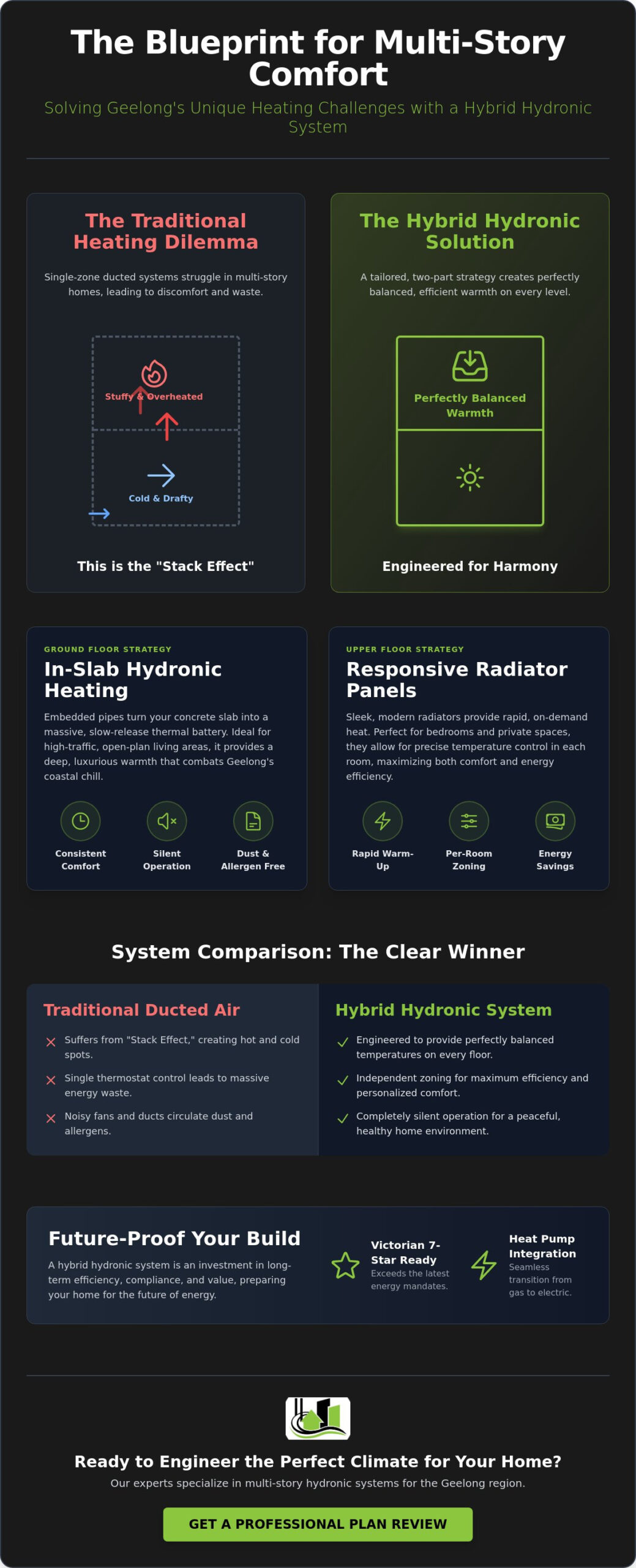
Traditional ducted systems often struggle with multi-level layouts because they rely on a single thermostat that can’t account for the different needs of each floor. If the thermostat is downstairs, the upstairs becomes uncomfortably hot; if it’s upstairs, the ground floor stays freezing. This imbalance is worsened by the “Stack Effect.” The Stack Effect is a physical phenomenon where buoyant warm air rises through stairwells and voids, creating a high-pressure zone at the top of the house that forces cold, drafty air to be sucked in through ground-floor windows and doors.
Heating an entire house just to reach a comfortable temperature in one room is an immense waste of energy. By using hydronic radiator panels upstairs, you gain the ability to shut off heat in guest rooms or unoccupied spaces. This level of control is essential for modern living, offering several key advantages:
- Precision Control: Each room can have its own thermostat or manual valve for tailored comfort.
- Energy Efficiency: You don’t pay to heat empty rooms or unoccupied levels.
- Silent Operation: No noisy fans or rattling ducts to disturb your sleep on the upper floors.
- Consistent Warmth: Radiant heat stays low where you need it, rather than gathering at the ceiling.
By moving away from forced air and toward a specialized hydronic layout, you solve the structural heating challenges inherent in Geelong’s multi-story designs. It’s about engineering a system that works with the physics of your home, not against it.
The Hybrid Strategy: Slab Heating Downstairs and Radiators Above
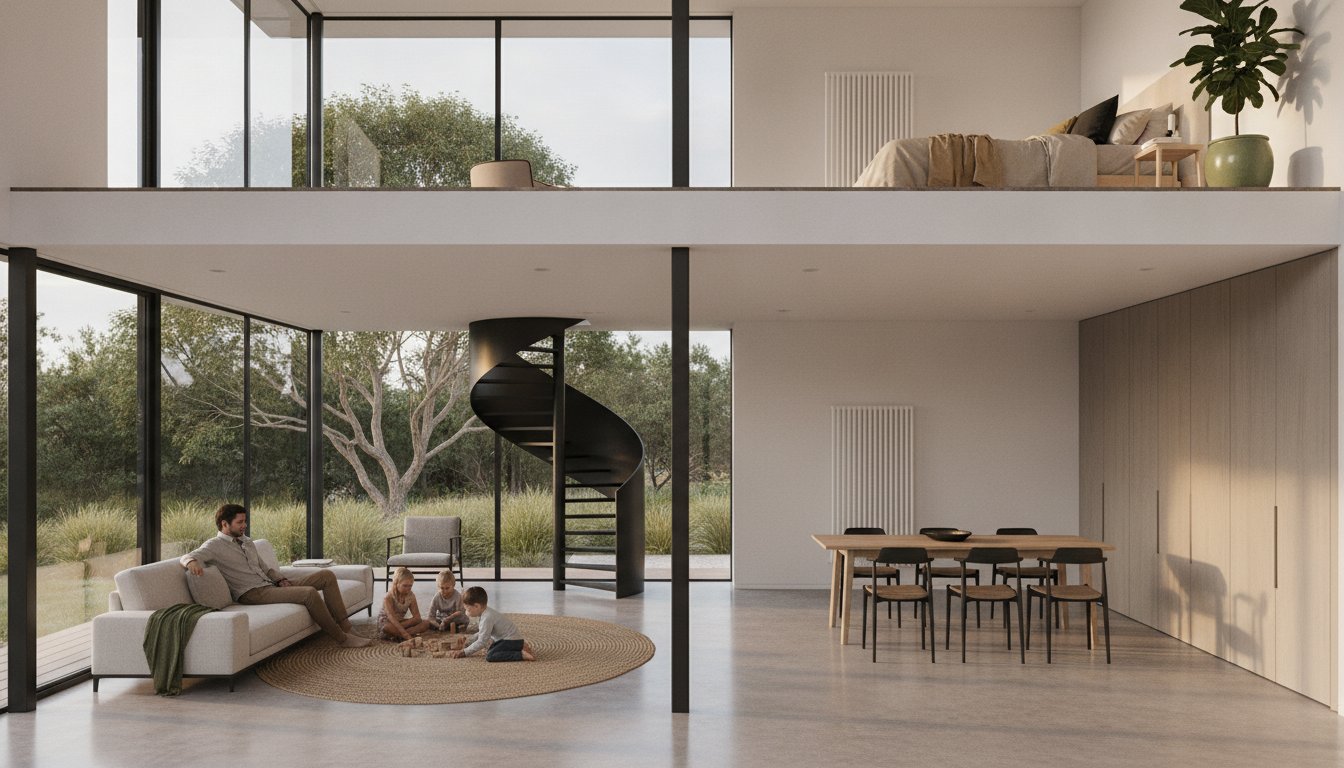
The most effective way to manage hydronic heating for multi-story homes Geelong is to stop treating the entire house as a single unit. Because your ground floor and upper levels serve different purposes, they require different heating technologies. A hybrid strategy is the gold standard for modern Victorian architecture. It combines the slow-release, high-mass warmth of the ground floor with the fast-acting, agile response of upper-level bedrooms. This approach ensures you aren’t waiting hours for a bedroom to warm up, nor are you wasting energy heating an entire slab when you only need a quick boost of comfort before sleep.
Ground Floor: In-Slab Comfort for High-Traffic Areas
The ground floor is the heart of the home, usually featuring open-plan kitchens and living zones. By installing underfloor heating directly into the concrete slab, you turn your foundation into a massive thermal battery. This system is ideal for high-traffic areas. It creates a consistent, gentle heat that makes polished concrete or large-format tiles feel incredibly luxurious underfoot. Since the pipework is safely embedded within the structure, there are no visible fixtures to interfere with your interior design. It’s a low-maintenance, “set and forget” solution that provides a stable base temperature for the entire residence.
First & Second Floors: The Agility of Radiator Panels
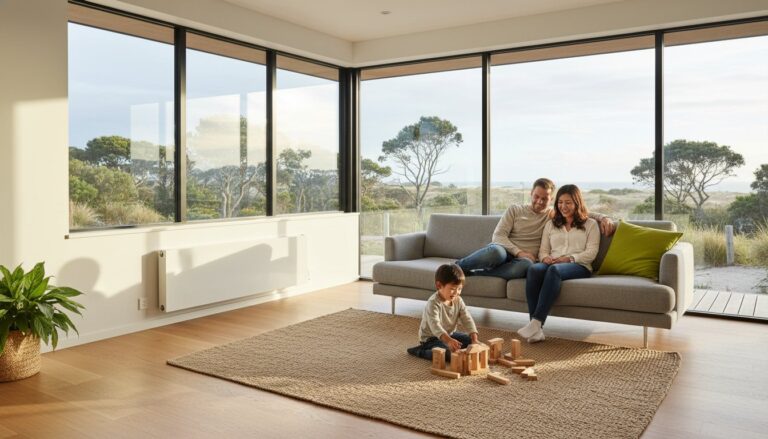
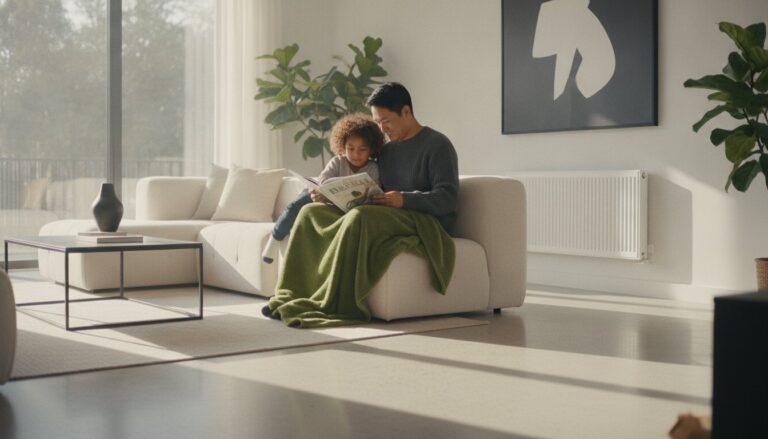
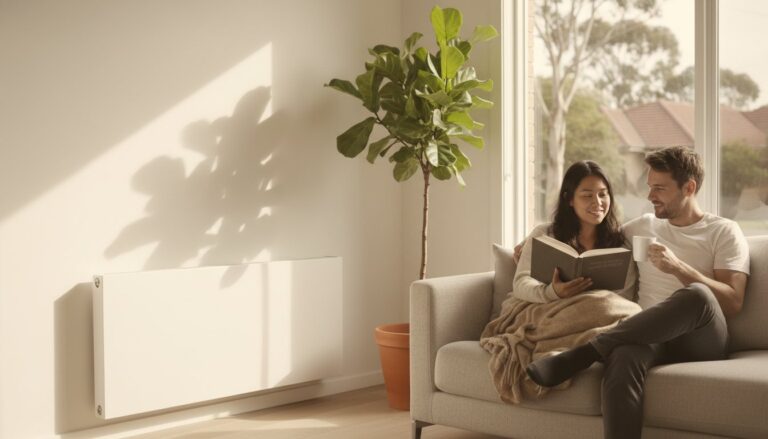
Upper levels are typically reserved for bedrooms and studies where heating needs are more sporadic. While a slab takes time to reach temperature, hydronic radiator panels offer the rapid response required for these zones. You can switch them on 20 minutes before bed and enjoy immediate radiant warmth. Each panel is equipped with individual thermostatic radiator valves (TRVs), allowing for precise temperature control in every room. This level of zoning is a critical part of meeting Australian standards for hydronic system design; it ensures you aren’t paying to heat empty guest rooms or unoccupied hallways.
Installation requirements also differ significantly between floors. Most Geelong multi-story builds use timber-joist construction for upper levels, which makes the lightweight installation of radiators far more practical than heavy screed underfloor systems. Modern designer radiators also offer a sleek, architectural aesthetic that complements contemporary Geelong homes. To complete the upstairs sanctuary, many homeowners integrate hydronic towel rails into ensuites. These rails serve a dual purpose: they provide dedicated warmth for your towels while acting as an efficient heat source for the bathroom. If you’re currently reviewing your architectural plans, it’s the ideal time to discuss a hybrid layout with a design specialist to ensure every level of your home is perfectly balanced.
Engineering the Vertical System: Manifolds, Pumps, and Zoning
Engineering hydronic heating for multi-story homes Geelong involves more than just connecting pipes; it requires balancing pressure across every vertical meter of the build. Moving water against gravity presents a unique set of hydraulic challenges that a single-story design never encounters. To ensure consistent performance, we install separate manifolds for every level of the residence. This prevents “flow starvation,” a common issue where the ground floor receives all the thermal energy while the upper stories struggle with lukewarm water. By giving each floor its own hub, we can precisely calibrate the flow rates to match the specific heat loss of that level.
Precision is the hallmark of a high-performance system. Secondary pumps play a vital role here, acting as boosters to ensure that hot water reaches the highest radiator panels without losing its thermal energy along the way. We also coordinate closely with builders during the framing stage. This allows us to run vertical “risers” through the most efficient paths before the first-floor joists are laid. Without this early-stage planning, you risk losing valuable floor space to bulky bulkheads or compromising the system’s efficiency with unnecessary pipe bends.
Smart Zoning for Multi-Level Control
Designing for “Day” and “Night” levels is the most effective way to maximize energy-efficient heating and cooling. Most Geelong families spend their daylight hours in ground-floor living areas and their evenings in upstairs bedrooms. Our zoning strategy reflects this lifestyle. Smart thermostats allow you to pre-heat the ground-floor hydronic underfloor heating via a mobile app before you even wake up. Simultaneously, you can keep the upstairs zones completely dormant during the day, significantly reducing your energy consumption. This independent control ensures that every room is only heated when it’s actually in use, providing a level of comfort and economy that traditional ducted systems simply can’t match.
Manifold Placement and Pipe Routing
The placement of your manifolds is a critical design decision that balances accessibility with aesthetics. We typically tuck these units into under-stair voids, linen cupboards, or even dedicated wall cavities. These locations keep the infrastructure out of sight while ensuring that our technicians can easily access the valves for future system servicing and maintenance.
Heat loss in transit is another factor we manage through careful routing. Pipes traveling through internal wall cavities are insulated to ensure that the warmth stays in the water until it reaches your hydronic radiator panels. A master controller acts as the brain of the operation, syncing the heat pump with the individual floor loops. It monitors the demand from every zone and adjusts the water temperature in real-time, ensuring the system operates with the surgical precision required for a modern multi-story home.
Future-Proofing for 2026: Heat Pumps and Energy Standards
2026 marks a decisive shift for the Victorian building industry. With the state’s 7-star NatHERS energy mandate now in full effect, architects and homeowners are moving away from traditional climate control. Choosing heat pump hydronic heating is no longer just a premium upgrade; it’s a strategic necessity for meeting these rigorous performance standards. In a multi-story residence, the total air volume is significantly higher than a single-level home, requiring a system that can deliver sustained warmth without draining your budget. Engineering hydronic heating for multi-story homes Geelong involves calculating these specific loads to ensure your heat pump is perfectly sized for the vertical scale of your property.
Pairing your system with a solar PV array allows you to run your heating for near-zero operational costs. Because heat pumps use electricity to move heat rather than gas to create it, they can be powered entirely by the energy collected on your roof. This synergy is a cornerstone of the Victorian Gas Substitution Roadmap, which encourages a transition toward cleaner alternatives. By going all-electric now, you avoid the complications of the 2027 mandate that will require electric replacements for failed gas hot water systems in existing homes. If you’re planning a new build and need to ensure compliance with the latest regulations, consult with our design team to find the right electric heat pump for your project.
Meeting the 7-Star NatHERS Requirement
Hydronics is often the most straightforward path to a 7-star rating in Victoria. Radiant systems don’t rely on forced air, which significantly reduces the “air change” heat loss that often penalizes energy scores in multi-story houses with large stairwells. In Geelong’s coastal climate, low-temperature heat pumps operate with incredible efficiency, extracting warmth from the air even on cold, foggy mornings to keep your floor loops at a steady, comfortable temperature. This method ensures your home remains airtight and energy-efficient without sacrificing the luxury of a warm floor.
Electric Heat Pumps vs. Condensing Boilers
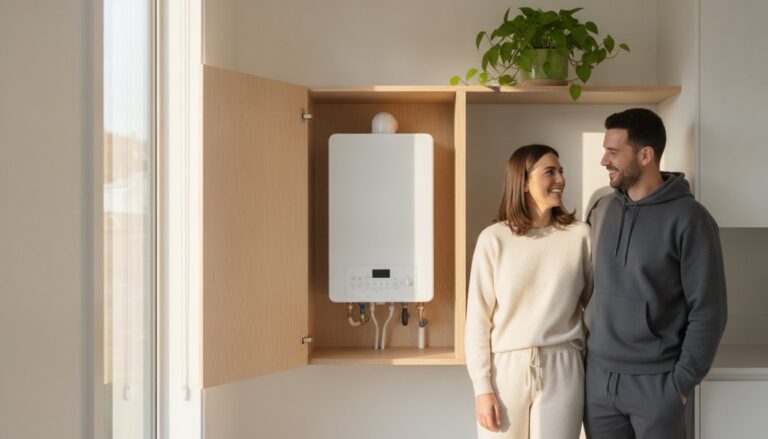
While an external heat pump unit requires a small outdoor footprint, a wall-mounted boiler is a compact alternative often used in retrofits for older Geelong homes where gas infrastructure is already present. However, the efficiency gap is widening as we move toward full electrification. High-efficiency gas is still a viable retrofit option, but it cannot match the long-term sustainability of an all-electric setup. The Coefficient of Performance (COP) for heat pumps in 2026 typically ranges from 3.5 to 4.0, meaning they deliver up to four times more energy than they consume.
The Melbourne Hydronic Heating Advantage: Geelong’s Multi-Story Experts
Engineering a multi-level heating system is a task that demands deep technical expertise and local knowledge. At Melbourne Hydronic Heating, we bring over 30 years of experience to every project, specializing in the complex vertical designs required for Geelong’s unique architectural landscape. We aren’t just installers; we are consultants who understand how the biting winds of the Surf Coast affect heat retention in a three-story home. Our lead technician’s 11-month tenure in the Antarctic is a testament to our commitment to reliability in the harshest conditions imaginable. This background ensures that your system is designed with a level of precision that guarantees comfort, even when the coastal weather is at its most volatile. Choosing hydronic heating for multi-story homes Geelong means trusting a team that treats your home’s comfort as a precise engineering challenge.
Our Design and Consultation Process
Our specialized process begins long before a single pipe is laid. We work directly with your architect during the initial planning stages to identify the best ways to hide pipework within wall cavities and optimize the placement of radiator panels. This architectural plan review is critical for hydronic heating for multi-story homes Geelong because it ensures the infrastructure doesn’t compromise your interior aesthetics or structural integrity. We perform a custom heat-load calculation for every single room on every floor, accounting for window sizes, ceiling heights, and room orientation. This meticulous approach allows us to coordinate seamlessly with your builder for a two-phase installation. We manage the rough-in during framing and return for final commissioning once the build is nearing completion, ensuring every valve and pump is tuned to perfection.
Ongoing Support and Maintenance
A high-performance vertical system requires professional care to maintain its efficiency over decades of use. We recommend an annual hydronic heating service to check vertical pump performance, test water quality, and ensure your manifolds remain perfectly balanced. These regular check-ups prevent the air locks and pressure drops that can sometimes plague poorly maintained multi-story systems. As a family-owned business, Melbourne Hydronic Heating is deeply committed to the Geelong and Surf Coast community, providing the stability and long-term support you need for such a significant investment. We don’t just finish a job and disappear; we remain your local partners in home comfort for the life of your system. We understand the local building regulations and the specific challenges of coastal construction, giving you peace of mind that your home is in expert hands. Request a custom hydronic design for your multi-story Geelong home today and experience the difference that specialized engineering and local dedication can make for your family’s well-being.
Secure the Future of Your Multi-Level Home Comfort
Achieving the perfect balance in a multi-story home requires more than just high-quality components. It demands a deep understanding of vertical hydraulics and local coastal conditions. By choosing a hybrid strategy that pairs ground-floor slab heating with responsive upstairs radiator panels, you solve the problem of uneven temperatures across different levels. This approach doesn’t just provide silent, dust-free warmth; it also ensures your project meets the 2026 Victorian 7-star energy standards. When you invest in hydronic heating for multi-story homes Geelong, you’re choosing a lifelong solution that grows more efficient as you integrate modern heat pump technology.
With over 30 years of industry experience, we specialize in these complex hybrid systems across the Surf Coast and Geelong regions. Our team is ready to help you navigate the transition toward a sustainable, all-electric future. Get a Professional Hydronic Design for Your Geelong Multi-Story Home and start building a healthier, more comfortable environment for your family today. Your dream home deserves a heating system that’s as well-engineered as its architecture.
Frequently Asked Questions
Is hydronic heating more expensive to install in a two-story home?
Installation costs are generally higher for multi-level properties due to the added complexity of vertical pipe routing and the requirement for additional manifolds. You are essentially commissioning a system that must overcome gravity to deliver heat across different elevations. While the initial investment is greater than a single-story setup, the long-term energy efficiency and superior comfort levels in a large home often provide a better return on investment.
Can I have floor heating on both levels of my Geelong home?
You can certainly install underfloor heating on every level, though the installation method changes depending on the floor structure. While the ground floor typically utilizes an in-slab system, upper levels with timber joists require specialized lightweight screed or “dry” plate systems. This allows for consistent hydronic heating for multi-story homes Geelong throughout the entire residence, although many families prefer the faster response times of radiators for upstairs bedrooms.
How do I hide the pipes for radiators on the upper floor?
We conceal all radiator pipework within internal wall cavities and floor joists during the initial framing stage of your build. By collaborating with your builder early in the process, we ensure that all plumbing is tucked away behind the plasterwork before it’s finished. This results in a clean, architectural look where only the sleek radiator panels are visible, maintaining the minimalist aesthetic of a modern Geelong home.
Will the water pressure be high enough to heat the third story?
We use dedicated secondary pumps and independent manifolds to ensure that water pressure remains consistent even on a third story. Gravity naturally resists the upward flow of water, so we engineer the system with sufficient head pressure to overcome this vertical resistance. This technical precision prevents cold spots and guarantees that your highest radiators perform with the same efficiency as those located on the ground floor.
Can I use a heat pump to power both slab heating and radiators?
Modern electric heat pumps are fully capable of managing multiple temperature zones, allowing them to service both high-mass slab heating and rapid-response radiators. We integrate mixing valves or buffer tanks to ensure each zone receives water at the optimal temperature for its specific purpose. This dual-capability is a major advantage for hydronic heating for multi-story homes Geelong, especially when aiming for 7-star energy compliance in 2026.
What happens if a pipe leaks between floors in a hydronic system?
The risk of a leak is extremely low because we use high-density cross-linked polyethylene (PEX) piping installed in continuous loops without any concealed joints. Without joins behind walls or under floors, the most common points of failure are eliminated. If the system ever detects a pressure drop, the master controller provides an immediate alert. This joint-free engineering makes the system one of the most secure and reliable heating methods available today.
How long does it take to install hydronics in a new multi-story build?
The installation is a two-phase process that typically spans about five to eight days of on-site work in total. The first phase occurs during the “rough-in” stage after framing, taking roughly three to five days to secure all pipework and manifolds. We return for the final two or three days once the house is nearing completion to mount the fixtures and commission the heat pump or boiler for operation.
Are hydronic radiators safe for children’s bedrooms upstairs?
Hydronic radiators are among the safest heating options for children’s rooms because they provide gentle warmth without any exposed flames or glowing elements. The surface temperature of a modern panel is warm enough to heat a room but won’t cause an instant burn if briefly touched. Because they don’t rely on fans to move air, they also don’t circulate dust or allergens, ensuring a healthier sleeping environment for your family.