Benefits of Cast Iron Radiators vs Steel: The 2026 Melbourne Guide
The radiator that takes the longest to warm up might actually be the smartest way to slash your Melbourne energy bills this winter. While modern thin-panel units are common, understanding the benefits of cast iron radiators vs steel is the key to solving uneven room temperatures and avoiding the cycle of constant system cycling. You want a home that feels consistently cozy, not a space that fluctuates between freezing and stuffy every time the heat source kicks in. It’s frustrating to invest in a premium system only to worry about corrosion or leaks appearing just a decade later.
We’ll help you choose between the rapid response of steel and the legendary thermal mass of cast iron to ensure your heating lasts for decades, not just years. This guide explores how these materials interact with modern air-to-water heat pumps, which typically operate with a high coefficient of performance between 3.5 and 4.0. You’ll discover the critical differences in heat retention, durability, and efficiency to help you create a comfortable, allergy-friendly home that aligns perfectly with your interior design. Whether you are retrofitting a period villa or building a contemporary masterpiece, the right material choice ensures your comfort is both sustainable and absolute.
Key Takeaways
- Learn how the high carbon content of cast iron provides superior heat storage compared to the lighter, more conductive nature of mild steel.
- Discover the benefits of cast iron radiators vs steel in terms of thermal mass, allowing you to maintain stable room temperatures even after the boiler cycles off.
- Compare the lifespans of both materials to choose between the 20-year cycle of steel panels or the 100-year heritage performance of cast iron.
- Find out why cast iron’s thermal properties make it an ideal partner for modern electric heat pumps operating at lower water temperatures.
- Match your radiator choice to your property type, from rapid-response steel for modern open-plan builds to steady cast iron for Melbourne’s period homes.
Understanding Metallurgy: The Core Differences Between Cast Iron and Steel
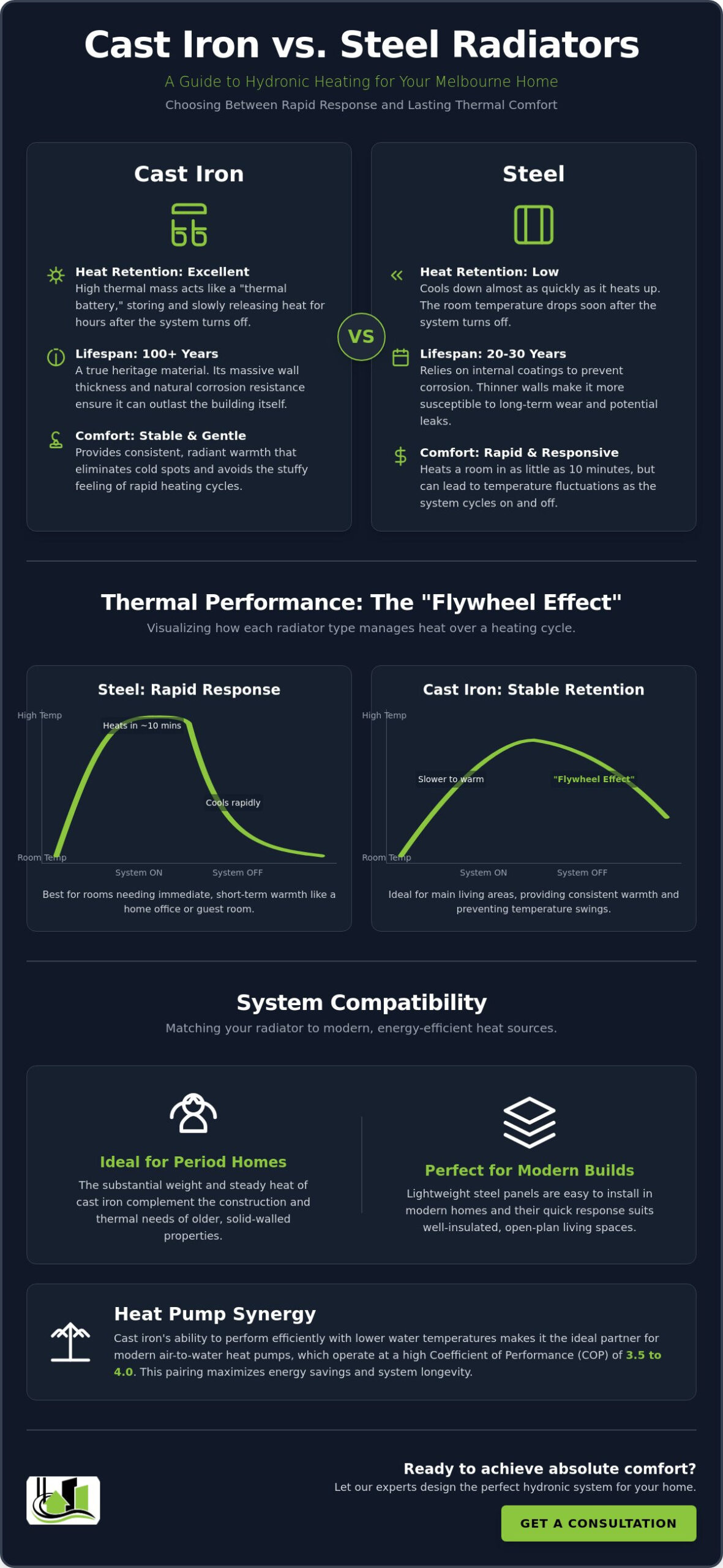
When comparing the benefits of cast iron radiators vs steel, you must understand the concept of “Thermal Mass.” This term describes a material’s ability to absorb, store, and slowly release heat. Think of a heavy cast iron unit as a thermal battery. It takes longer to “charge” or warm up, but it stays warm for hours. Steel is more like a high-performance sprinter; it’s agile and reacts instantly to your thermostat, but it cools down just as quickly. This primary trade-off pits weight and density against speed and agility.
The Density Factor: Why Weight Matters
The thickness of the metal walls determines how the radiator behaves during the heating cycle. You’ve likely heard a steel radiator make “pinging” or clicking sounds as the metal expands and contracts. Cast iron’s thick, sand-cast walls are too rigid for this, providing a silent heating experience. However, this density comes with a physical cost. A standard cast iron unit can weigh significantly more than a steel equivalent. When we install these in Melbourne’s older period homes, we often need to assess the timber floor joists. You can’t simply hang a heavy cast iron unit on a standard plasterboard wall. These units usually require floor-mounting or reinforced structural support to ensure your home’s integrity remains intact.
Corrosion Resistance and Material Integrity
The history of cast iron radiators shows us that these units are incredibly resilient. Cast iron is naturally resistant to internal “sludge” and oxygen corrosion because its thick walls can withstand minor oxidation for decades without failing. Modern steel radiators are much thinner, so manufacturers apply specialized internal coatings to help them resist the same issues. Even with these advancements, there’s a clear winner in longevity. One of the long-term benefits of cast iron radiators vs steel is the sheer lifespan of the product. Because of its massive wall thickness and natural resistance to internal oxidation, a well-maintained cast iron radiator can easily outlast the building it inhabits, earning its reputation as a “100-year material.”
Thermal Performance: Heat Retention vs. Response Time
Understanding the thermal behavior of your heating system is vital for Melbourne homeowners. The “Warm-up Phase” is where steel truly shines. Because mild steel is thin and highly conductive, it can reach its operating temperature in as little as 10 minutes. This makes it the perfect choice for rooms used sporadically, such as a home office or a guest bedroom where you need immediate warmth. However, the real magic happens during the “Cool-down Phase” with cast iron. One of the primary benefits of cast iron radiators vs steel is the ability to keep a room warm long after the boiler or heat pump has shut off.
In Melbourne, we often experience rapid temperature drops in the late afternoon. This is where the “Flywheel Effect” of cast iron becomes a game changer. Like a heavy wheel that continues to spin after you stop pushing it, cast iron radiators continue to radiate gentle heat well into the evening. This creates a stable environment that resists the volatile shifts of Victorian weather. Some believe that a slow warm-up time indicates wasted energy, but that’s a misconception. The energy isn’t lost; it’s simply stored within the metal’s mass and released gradually over several hours.
Choosing between these materials depends entirely on your daily routine. If you spend most of your time in a central living area, the steady release of heat from cast iron ensures you aren’t constantly adjusting the thermostat. When weighing the thermal benefits of cast iron radiators vs steel, consider how you use each space in your home. A balanced system often uses a mix of both to maximize comfort and efficiency.
Steady State Comfort: Eliminating Cold Spots
Victorian-era homes with high ceilings often suffer from cold spots because heat rises too quickly. Cast iron provides a more consistent radiant heat profile than steel. While steel panels often lead to “On/Off” cycling, where the room temperature fluctuates noticeably, cast iron follows a “Steady Curve.” This ensures that the air at floor level remains comfortably warm, making it a superior choice for older, draftier properties where maintaining a baseline temperature is difficult.
Response Time: When Speed is the Priority
If your lifestyle requires speed, steel is the priority. In kitchens where cooking already generates heat, or in well-insulated modern builds, the 10-minute response time of steel is a major advantage. If you prefer the look of cast iron but worry about the 40-minute wait for heat, modern technology offers a solution. Integrating your system with smart thermostats allows you to schedule a pre-warm cycle, so your home is perfect the moment you walk through the door. Ensuring your system is optimized for these different materials is easy with professional hydronic heating support tailored to your local needs.
Durability, Lifespan, and Aesthetic Value
Investing in a heating system is a significant decision for any Melbourne homeowner. When we look at the long-term benefits of cast iron radiators vs steel, the conversation inevitably turns to longevity. A standard steel panel radiator is a reliable, high-quality product, but it typically has a service life of 15 to 25 years before internal oxidation or wear begins to take a toll. Cast iron, however, operates on a completely different timeline. These units are frequently referred to as “heritage assets” because they easily last 50 to 100 years, and many original units installed in Melbourne’s earliest mansions are still functioning perfectly today. This permanence transforms your heating from a depreciating utility into a tangible property investment.
Maintenance requirements also differ between the two materials. Because mild steel is thinner, it’s more susceptible to the build-up of internal magnetite sludge if the system water isn’t treated correctly. This often leads to a need for more frequent power flushing to maintain efficiency. Cast iron’s thick, robust walls are far more resilient to these internal conditions. While no system is entirely maintenance-free, the structural integrity of cast iron provides a level of security that steel simply cannot match over multiple decades.
Health and Hygiene: The Allergy Benefit
A major advantage that often goes unmentioned is the impact on indoor air quality. Steel panels primarily heat a room through convection, which involves drawing cool air in from the bottom and venting warm air out the top. This process creates air currents that can circulate dust, pet dander, and pollen throughout your home. In contrast, one of the hidden benefits of cast iron radiators vs steel is the high percentage of radiant heat they emit. Radiant heat warms objects and people directly, much like the sun, without the need for heavy air movement. For Melbourne families dealing with asthma or seasonal allergies, this makes hydronic heating with cast iron a superior lifestyle choice for a cleaner, healthier living environment.
Customisation: Finishes and Colours
Aesthetic flexibility is where you can truly express your home’s personality. Steel radiators are usually factory-finished with a high-quality powder coating. While sleek and modern, your colour choices are often limited to a set range. Cast iron offers a blank canvas. You can select ornate Victorian scrolls for a period restoration or minimalist “hospital style” columns for a contemporary industrial look. These units can be professionally painted, burnished, or even polished to a mirror finish. Unlike steel, which is difficult to refurbish once the factory coating fails, cast iron can be sandblasted and repainted decades later to suit a new interior design. While there are many excellent hydronic heating panels on the market, cast iron remains the only option that evolves with your home over a century.
System Compatibility: Boilers vs. Modern Heat Pumps
Victoria is currently leading the national shift toward all-electric homes. This transition means many Melbourne residents are swapping traditional gas boilers for high-efficiency electric heat pumps. These systems operate differently than the gas units of the past. While a gas boiler might push water through your pipes at 70°C, a heat pump is at its most efficient when water temperatures are kept between 35°C and 55°C. This lower temperature profile is where the technical benefits of cast iron radiators vs steel become most apparent.
Cast iron’s secret weapon is its massive surface area. Because these radiators are often composed of intricate columns or ornate scrolls, they have a larger physical area in contact with the air than a flat steel panel. This allows them to emit more radiant heat even when the water inside isn’t boiling hot. Additionally, cast iron systems hold a much larger volume of water. This volume acts as a natural thermal buffer, which helps a heat pump maintain a steady state and avoids the “short cycling” that can reduce the equipment’s lifespan. When your heat pump operates with a coefficient of performance (COP) between 3.5 and 4.0, every bit of thermal stability helps maximize those energy savings.
Optimising for Low-Temperature Flow
In the hydronic world, we talk about Delta T (ΔT), which is the difference between the water temperature in the radiator and the desired room temperature. When you switch to a heat pump, you generally need to “oversize” your radiators to compensate for the lower flow temperatures. Cast iron makes this transition smoother. Because it retains heat so effectively, it bridges the gap during a heat pump’s “defrost cycle.” In Melbourne’s frosty mid-winter mornings, a heat pump might briefly pause to clear ice from its external unit. A steel radiator will go cold almost instantly during this phase. Cast iron, however, continues to radiate heat, ensuring your indoor comfort never dips. Understanding these benefits of cast iron radiators vs steel is essential for anyone planning a future-proof home.
The Role of the Hydronic Boiler
If you aren’t ready to go fully electric, modern boilers still offer incredible performance. These units use advanced modulation to adjust their output based on the “mass” of the system. High-mass cast iron radiators require a different modulation curve than low-mass steel panels. System balancing is crucial here, especially if you have a mixed-material installation. It’s also worth noting that cast iron possesses superior thermal shock resistance. While rapid temperature changes can cause stress fractures in the thin welds of steel panels over time, the robust casting of iron handles these fluctuations with ease. If you’re planning a system upgrade, it’s vital to get expert advice on hydronic system design in Melbourne to ensure your radiator choice matches your energy source.
The Verdict: Choosing the Right Radiator for Your Melbourne Home
Choosing between these materials is ultimately a choice between immediate gratification and long-term thermal stability. When evaluating the benefits of cast iron radiators vs steel, your decision should align with how you actually live in your home. If you work from a home office or have guest rooms that stay empty most of the week, the rapid response of steel panels is hard to beat. You can turn the heat on and feel the results in minutes. However, for the heart of the home where family gathers, nothing matches the deep, consistent warmth of cast iron. It eliminates the “peaky” heat cycles that often make rooms feel alternately too hot or too cold.
Property type also dictates the best fit. Melbourne’s period homes, with their high ceilings and solid masonry, are natural partners for cast iron. These buildings have their own thermal mass that works in harmony with the radiator’s steady release of energy. In contrast, lightweight contemporary builds with extensive glazing often benefit from the agility of steel. If you can’t decide, consider a hybrid approach. We often design systems that use cast iron in main living areas for baseline comfort and steel panels in bedrooms for quick, on-demand heating. This zoning strategy allows you to enjoy the specific benefits of cast iron radiators vs steel exactly where they are needed most.
Summary Comparison Table
| Feature | Cast Iron Radiators | Steel Radiators |
|---|---|---|
| Heat Retention | Exceptional (High Mass) | Low (Rapid Cool-down) |
| Response Time | Slow (30-45 mins) | Fast (10-15 mins) |
| Weight | Heavy (Requires floor support) | Light (Wall-mountable) |
| Lifespan | 50–100+ Years | 15–25 Years |
| Relative Cost | Higher initial investment | Budget-friendly initial cost |
| Best For | Living areas & Period homes | Bedrooms & Home offices |
| Melbourne Suitability | Ideal for volatile cold snaps | Great for quick morning heat |
Next Steps: Design and Installation
Before you commit to a specific material, a professional heat load calculation is essential. This technical assessment considers your room volume, insulation levels, and window sizes to determine the exact wattage required. Guessing the size of a cast iron unit can lead to an underpowered system that never reaches a comfortable temperature, especially when paired with low-temperature heat pumps. Local expertise is vital here. Balancing a system with high-mass radiators requires a deep understanding of hydraulic flow and boiler modulation that generic installers might overlook. To ensure your home stays perfectly comfortable for decades to come, book a consultation with Melbourne Hydronic Heating to design your bespoke system.
Securing Your Home’s Thermal Legacy
Selecting the right material is about more than just a look; it’s about how your home breathes and holds warmth during those unpredictable Victorian winters. You now understand that the benefits of cast iron radiators vs steel lie in the balance between immediate response and long-term thermal stability. Whether you prioritize the agility of modern steel panels for a home office or the century-long durability of cast iron for a high-ceilinged living room, the right choice will transform your daily living experience. Both materials offer distinct advantages when paired with modern heat pumps, provided the system is designed with technical precision.
As a family-owned and operated local Victorian business, we’ve spent over 30 years perfecting hydronic installations across Melbourne. Our team specializes in both traditional cast iron and modern steel panel systems, ensuring your technical design matches your lifestyle and property type perfectly. We’re here to help you navigate the transition to electric heat pumps while maintaining the premium comfort and health benefits you deserve. Request a Professional Hydronic Heating Quote for Your Melbourne Home today and take the first step toward a more comfortable, energy-efficient future.
Frequently Asked Questions
Are cast iron radiators more efficient than steel?
Cast iron radiators aren’t inherently more efficient, but they offer superior energy stability. While steel transfers heat quickly, cast iron’s density allows it to store energy and release it over a longer period. This reduces the frequency of your boiler or heat pump cycling on and off. When considering the benefits of cast iron radiators vs steel, this thermal stability often leads to more consistent comfort in Melbourne’s draftier period homes.
Can I mix cast iron and steel radiators in the same hydronic system?
You can definitely mix both materials in a single hydronic system. This “hybrid” approach is common in Melbourne renovations, where we install ornate cast iron in high-ceiling living areas and sleek steel panels in bedrooms or hallways. To ensure the system works perfectly, our technicians use specialized balancing valves to manage the different flow rates and thermal weights of the two materials across your home’s various zones.
How much heavier are cast iron radiators compared to steel?
Cast iron radiators are significantly heavier, often weighing four to five times more than a steel panel of the same heat output. A medium-sized cast iron unit can easily exceed 100kg once filled with water. Because of this massive weight, they typically require floor-mounting feet or structural wall reinforcement. This is a critical consideration for Melbourne homeowners with older timber floors that may need joist assessment before installation.
Do cast iron radiators take longer to cool down?
Yes, cast iron radiators stay warm much longer than steel due to their high thermal mass. While a steel panel cools down within 15 to 20 minutes of the system shutting off, cast iron can continue to radiate gentle heat for over an hour. This slow release provides a more stable indoor climate and is one of the key benefits of cast iron radiators vs steel for maintaining overnight warmth without restarting the boiler.
Is it harder to install cast iron radiators in an existing Melbourne home?
Installation is more labor-intensive but completely achievable for existing Melbourne homes. Because of their weight, cast iron units require more manpower to position and often need specific floor supports to protect heritage timber joists. We specialize in retrofitting these systems, ensuring the pipework is correctly sized to handle the higher water volume required by cast iron sections compared to modern thin-panel steel alternatives.
Do steel radiators rust faster than cast iron?
Steel radiators are more susceptible to internal corrosion because their walls are much thinner than cast iron. While modern steel panels have high-quality protective internal coatings, they typically have a service life of 15 to 25 years. Cast iron’s thick, sand-cast walls are naturally resilient to oxidation, allowing many units to function perfectly for over a century. This makes cast iron the superior choice for long-term material integrity.
Which radiator material is better for people with allergies?
Cast iron is generally better for allergy sufferers because it provides a higher percentage of radiant heat. Steel panels rely more on convection, which creates air currents that can circulate dust, pollen, and pet dander throughout a room. By warming objects and people directly rather than moving air around, cast iron helps maintain a cleaner, more hygienic environment for Melbourne families dealing with asthma or seasonal hay fever.
Are cast iron radiators compatible with modern smart thermostats?
Cast iron radiators are fully compatible with modern smart thermostats and sophisticated zoning controls. In fact, using smart technology helps mitigate their slower response time by scheduling the “pre-warm” cycle well before you arrive home. This combination of traditional thermal mass and modern digital control offers the ultimate balance of energy efficiency, premium home comfort, and precise temperature management for your local climate.