2026 Guide: Underfloor Heating for Melbourne Timber Floors
Is it actually possible to install underfloor heating for timber floors Melbourne homeowners love without the risk of wood warping or splitting? Most people in Victoria believe they have to choose between a warm house and the longevity of their expensive floorboards. It’s a valid concern. Timber is a living material that reacts to temperature changes, and the fear of damaging a significant investment keeps many families shivering through July. You deserve a solution that provides consistent warmth without the stress of structural damage.
We understand that you want a cozy, healthy home environment without compromising the integrity of your wood. This 2026 guide shows you how to achieve that ultimate comfort using precision-engineered hydronic systems that protect your floor while slashing energy bills. We’ll explore the critical 27°C safety limits, the high efficiency of modern electric heat pumps, and the specific installation methods that keep your home healthy and your floors pristine. By the end, you’ll know exactly how to integrate luxury heating into your Melbourne home with total confidence and technical peace of mind.
Key Takeaways
- Learn how the strict 27°C surface temperature rule prevents your timber floors from warping while maintaining a luxurious, consistent warmth.
- Discover why hydronic systems are considered the gold standard for underfloor heating for timber floors Melbourne homeowners choose for long-term floorboard integrity.
- Understand the health benefits of radiant heating, which provides a dust-free environment that is ideal for families managing asthma and allergies.
- Identify the most effective installation methods, from diffusion plates to in-screed solutions, tailored to Melbourne’s unique architectural styles.
- Find out how to future-proof your home by integrating energy-efficient electric heat pumps that align with Victoria’s 2026 sustainability standards and rebates.
Why Underfloor Heating for Timber Floors is Melbourne’s Healthiest Choice
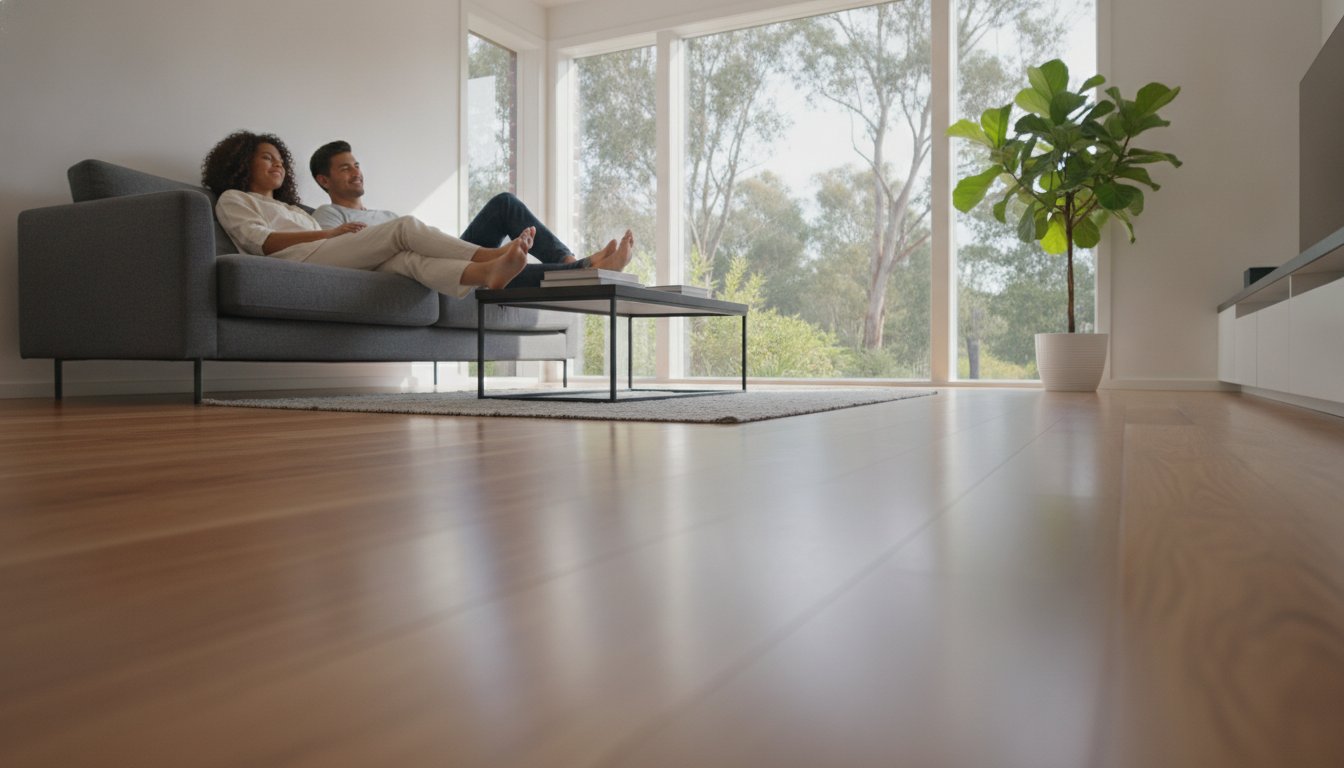
Melbourne’s winters are notorious for their damp chill and unpredictable temperature swings. For those living in classic Victorian or Edwardian weatherboard homes, this usually means drafty corridors and ice-cold floorboards that make winter mornings a challenge. Installing Underfloor heating systems specifically designed for timber applications changes this dynamic entirely. Hydronic underfloor heating uses a network of insulated pipes to circulate warm water beneath your floorboards, transforming the timber itself into a source of radiant warmth. There’s a profound psychological benefit to walking barefoot on warm natural wood on a July morning. It creates a sense of sanctuary that traditional convection heaters simply cannot replicate.
The Asthma and Allergy Advantage
Many Melbourne families struggle with respiratory issues, and traditional forced-air or ducted heating is often a major culprit. These systems force air through dusty vents, circulating allergens, pet dander, and dust mites throughout the living space. By contrast, radiant heat is “still air” heating. It doesn’t blow particles around or dry out the air excessively, which is vital for maintaining a healthy indoor environment. When you choose underfloor heating for timber floors Melbourne homes become significantly more hypoallergenic. Timber is naturally easier to keep clean than carpet, and because the heating system keeps the floor surface dry and warm, it actively discourages the growth of mould. It’s a cleaner, more sterile way to live that offers genuine peace of mind for parents of children with asthma.
Efficiency in the Victorian Climate
Our local weather changes fast; a sunny afternoon in Melbourne can turn into a freezing evening in minutes. Split systems often cycle on and off rapidly, creating uncomfortable “hot spots” while the floor remains cold. Hydronic underfloor heating provides a much more stable heat profile by utilizing the floor’s thermal mass. By maintaining a lower, more consistent water temperature, these systems use less energy to keep your home at a comfortable level. They work with the natural insulating properties of the wood, ensuring the heat is distributed evenly across the entire surface area. This efficiency is vital for homeowners looking to reduce their carbon footprint while managing the rising costs of energy. You get a system that works in harmony with the Victorian climate rather than constantly fighting against it.
The result is a home that feels fundamentally different. You aren’t just avoiding cold feet; you’re investing in a system that supports your family’s long-term health and the structural integrity of your property. It is about creating a premium lifestyle that values technical precision as much as it values daily comfort.
Hydronic vs. Electric: Choosing the Right System for Wood
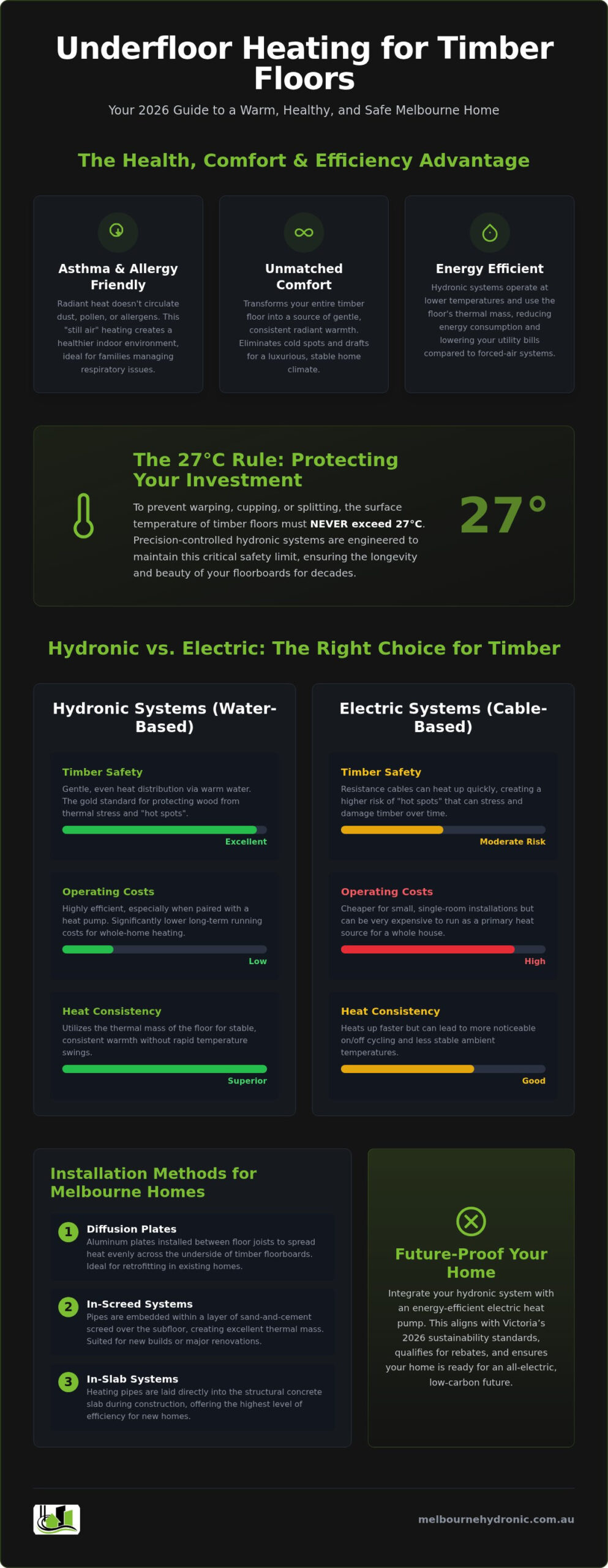
Comparing water-based systems to electric cables is essential when planning your renovation or new build. While both technologies provide warmth, the method of heat delivery is fundamentally different. Electric systems use resistance cables that can reach high temperatures quickly. Hydronic systems use a network of insulated PEX piping to circulate warm water. For those installing underfloor heating for timber floors Melbourne experts generally recommend hydronic as the superior choice for preserving the wood’s structural integrity over many decades.
Timber is a natural, reactive material. It expands and contracts based on moisture levels and temperature changes. Electric mats can sometimes create “hot spots” where the cable touches the wood, leading to localized stress. Hydronic systems provide a much more consistent thermal mass. By using a manifold to blend water to a precise temperature, you ensure the heat stays within the manufacturer’s safe limits. This prevents the warping or cupping that can occur when timber is subjected to rapid or uneven temperature spikes. If you’re unsure which setup fits your specific subfloor, consulting with a specialist at Melbourne Hydronic Heating can help clarify the best technical path forward for your home.
Operating costs are another critical factor for Victorian families. While electric systems are often cheaper to install in small areas like a single bathroom, they can be expensive to run as a primary heat source during a long winter. Choosing energy-efficient heating systems like hydronic heating, especially when paired with a heat pump, offers significant long-term savings. It’s a professional-grade solution that pays for itself through lower utility bills and a longer-lasting floor finish.
The Hydronic Advantage for Timber
The secret to timber longevity lies in the manifold. This component allows us to limit the water temperature to a gentle 45°C or 55°C, ensuring the floor surface never exceeds the critical 27°C threshold. This steady, low-intensity heat mimics the natural environment wood prefers. It’s a reliable, low-maintenance approach that has been the standard in premium European homes for decades. Because the water carries the heat so effectively, there’s no need for the “bursts” of high temperature that can damage delicate floorboard finishes.
Thermal Conductivity of Different Woods
Not all wood reacts to heat in the same way. The density of the timber determines its thermal conductivity, or how fast heat moves from the pipes to your feet. Softwoods often have a higher “R-value” (thermal resistance), meaning they take longer to warm up but hold heat well. Harder Australian timbers like Spotted Gum or Blackbutt are denser and more conductive. We always balance the floor thickness with the system’s responsiveness to ensure you get the perfect level of comfort without overworking the boiler or heat pump.
Installation Methods: Diffusion Plates, Screed, and Slab
Every Melbourne home presents a unique structural challenge. Whether you’re restoring a double-fronted Victorian in Carlton or building a contemporary masterpiece in Brighton, the success of your system depends on matching the installation method to your specific subfloor. When designing underfloor heating for timber floors Melbourne residents often face a choice between integrating pipes into a new concrete slab or retrofitting them into an existing timber-framed floor. Each path requires technical precision to ensure the heat reaches your feet efficiently without being lost to the ground or the crawl space below.
High-quality insulation is the silent hero of any successful installation. Without a robust thermal barrier beneath the heating pipes, a significant portion of your energy will leak downwards. In a typical Melbourne weatherboard home, this means heating the damp air beneath the house rather than the living space. To address such issues, Subfloor Ventilation Sydney offers professional solutions to eliminate excess moisture and mould, ensuring the subfloor environment remains dry and stable. We utilize high-density polystyrene or specialized reflective backing to ensure every watt of energy is directed upwards through the timber boards.
Aluminium Diffusion Plates Explained
In homes with traditional joist construction, there is often a pocket of air between the heating pipes and the floorboards. Air is a poor conductor of heat, which can lead to “striping,” where only the wood directly above a pipe feels warm. Aluminium diffusion plates solve this by acting as a thermal bridge. These plates are shaped to cradle the PEX piping and then fixed across the joists. Because aluminium is an exceptional conductor, it pulls the heat from the water and spreads it across the entire underside of the timber. This method is the standard for upper-storey extensions and heritage renovations where a concrete pour isn’t feasible.
Floating Floors and In-Screed Systems
For many modern renovations, an in-screed system offers the perfect balance of responsiveness and stability. This involves laying the hydronic pipes over insulation and covering them with a thin layer of specialized floor-levelling screed, usually between 20mm and 30mm thick. This creates a flat, thermally conductive mass that is ideal for engineered timber or laminate options. To explore a range of compatible materials, including high-performance vinyl, you can check out DIY Floorboards for your project needs. The screed protects the pipes from damage during the final flooring installation and provides a smooth surface for adhesives. It’s a popular choice for Melbourne homeowners who want the luxury of hydronic heat without the height requirements of a full structural slab. We take extra care during this phase to ensure the screed is fully cured before the timber is laid, preventing any residual moisture from affecting your floorboards.
Choosing the right method is about more than just warmth. It’s about protecting the structural integrity of your home while maximizing energy efficiency. A well-installed system doesn’t just feel better; it operates quietly and reliably for decades, making it one of the most significant value-adds for any premium Melbourne property.
The 27°C Rule: Protecting Your Timber Floor from Damage
The 27°C rule is the most important technical standard for anyone installing underfloor heating for timber floors Melbourne. This specific temperature limit is the threshold where wood stays stable. If the surface gets hotter, the timber loses moisture too rapidly, which causes the cellular structure of the wood to shrink unevenly. This results in “cupping,” where the edges of the boards rise, or “gapping,” where wide spaces appear between planks. To manage this, we install sophisticated thermostats that prioritize floor probe data over simple air temperature. These sensors act as a safety cut-off, ensuring the water circulating in your pipes never pushes the timber beyond its physical limits.
Managing the environment around the floor is just as vital as the temperature of the floor itself. Relative humidity plays a massive role in how wood behaves. Melbourne’s climate can be erratic, and during a dry winter spell, the air inside a heated home can become quite parched. If the humidity drops too low, the timber will surrender its internal moisture, leading to structural stress. We always advise clients to monitor their indoor environment to ensure the wood remains supple and flat, preserving the premium look of their renovation for decades.
Solid vs. Engineered Timber
While most timbers can be heated, engineered timber is widely considered the gold standard for stability. Its layered construction is designed to counteract the natural movement of wood, making it far less likely to react to temperature changes than solid boards. If you prefer solid timber, the installation becomes more complex. You’ll need to choose denser species and use specialized elastic adhesives that can handle the thermal expansion. We also recommend using high-quality, thermally conductive underlays that help the heat pass through the floor without getting trapped, which could lead to localized overheating.
Commissioning Your Melbourne Heating System
The most dangerous time for a timber floor is the first two weeks of operation. You must follow a strict commissioning protocol to avoid shocking the material. It’s a patient process that ensures the longevity of your investment.
- The Settling Phase: Never turn the heating on immediately after the floor is installed. Wait at least 48 to 72 hours for all glues and coatings to stabilize.
- The Incremental Increase: Begin by setting the system to a very low temperature, usually around 18°C or 20°C. Increase the heat by no more than 1°C or 2°C every 24 hours. This slow transition allows the timber to reach a new moisture equilibrium without stress.
- Monitoring Humidity: During Melbourne’s driest winter months, external humidity can drop significantly. Keeping indoor relative humidity between 40% and 60% helps keep the wood supple and prevents shrinkage.
Ensuring your system is commissioned correctly is the difference between a lifetime of comfort and a costly floor repair. For professional guidance on setting up your system safely, contact our specialist design team today.
Future-Proofing with Electric Heat Pumps in 2026
The transition toward all-electric homes in Melbourne and Geelong has accelerated significantly. With Victorian government incentives and the phase-out of new gas connections, homeowners are looking for sustainable ways to keep their properties warm. High-efficiency electric heat pumps have emerged as the gold standard for powering modern hydronic systems. When you install underfloor heating for timber floors Melbourne, pairing it with a heat pump ensures your home is ready for the energy standards of 2026 and beyond.
These systems are incredibly efficient. Most air-source heat pumps operate with a Coefficient of Performance (COP) between 3.5 and 4.0. This means for every 1 kW of electricity consumed, the system delivers up to 4 kW of heating energy. If you have a solar PV system installed, you can effectively run your floor heating for free by timing the system to “charge” your floor’s thermal mass during the sunniest parts of the day. It’s a clever way to bank energy in your screed or slab for use throughout the cold Victorian night.
Low-Temperature Heating Synergy
Heat pumps and underfloor systems are a perfect technical match. Traditional radiator panels often require water temperatures above 60°C to be effective, which can force a heat pump to work harder and less efficiently. In contrast, underfloor pipes only need water temperatures between 35°C and 45°C to maintain a comfortable environment. This lower demand maximizes the heat pump’s efficiency and extends its lifespan. More importantly for your flooring, this consistent, low-intensity warmth is exactly what’s required to stay under the 27°C safety limit, ensuring your timber stays flat and beautiful.
Getting Your Quote from Melbourne Hydronic Heating
With over 30 years of local experience, we’ve seen Melbourne’s heating trends evolve from basic gas boilers to sophisticated, all-electric solutions. We specialize in hydronic heating in Melbourne, providing a full service from initial design to final commissioning. Our team doesn’t just install pipes; we analyze your specific timber species, subfloor construction, and insulation levels to create a bespoke system.
Whether you’re planning a heritage restoration in Geelong or a luxury new build in the eastern suburbs, we’re here to help. The next step is a detailed consultation where we can map out the technical requirements of your project. Book your design session with Melbourne Hydronic Heating today to secure a warm, healthy, and energy-efficient home for your family.
Secure Your Home’s Comfort and Floor’s Longevity Today
Achieving the perfect balance of luxury and technical safety is entirely possible with the right expertise. You can enjoy the healthy, dust-free environment of radiant heat while strictly adhering to the 27°C safety rule to protect your timber investment. Whether you’re choosing diffusion plates for a heritage renovation or an in-screed system for a modern extension, the key lies in precision engineering. By future-proofing your property with electric heat pump technology, you’re choosing a sustainable path that aligns with Victorian energy standards. This ensures your underfloor heating for timber floors Melbourne project delivers maximum efficiency for decades to come.
At Melbourne Hydronic Heating, we bring over 30 years of local experience to every project. As a Victorian family-owned and operated business, we’re specialists in integrating energy-efficient heat pumps into residential designs. We understand the unique challenges of the local climate and the specific needs of various timber species. Ready to transform your living space? Request a tailored Underfloor Heating Quote for your Melbourne home and take the first step toward a warmer, healthier lifestyle. We look forward to helping you create a sanctuary that stays cozy for generations.
Frequently Asked Questions
Can I use underfloor heating with solid hardwood floors?
Yes, you can use underfloor heating with solid hardwood, provided you choose stable species and follow a strict commissioning process. Denser timbers like Spotted Gum or Ironbark are typically more resilient to thermal changes than softer woods. It’s essential to use high-quality elastic adhesives that allow for the natural expansion and contraction of the wood. We recommend consulting with a specialist to ensure your specific timber choice is compatible with the system’s heat output.
Will underfloor heating make my timber floors gap or warp?
Your floors won’t gap or warp if the system maintains a consistent, low-intensity heat. Damage usually occurs when the surface temperature exceeds the industry-standard 27°C limit or if the system is turned on too quickly after installation. By using sophisticated sensors and a gradual commissioning phase, we ensure the timber stays stable. Properly installed underfloor heating for timber floors Melbourne homes rely on keeps the wood within its safe moisture equilibrium throughout the year.
How long does it take for timber floors to warm up with hydronic heating?
Hydronic systems are designed for constant, steady warmth rather than rapid, on-demand heating. Depending on whether you have an in-slab or in-screed installation, it usually takes between 12 and 24 hours to reach full operating temperature. Once the thermal mass is heated, the system is incredibly efficient at maintaining that warmth. This slow response time is actually a benefit for timber, as it prevents the thermal shock that causes structural damage.
Is engineered timber better than solid wood for underfloor heating?
Engineered timber is the recommended choice for underfloor heating because its cross-layered structure provides exceptional dimensional stability. This construction minimizes the wood’s natural tendency to expand or contract when temperatures change. While solid wood is possible, engineered boards offer a much lower risk of gapping or crowning. This makes them a safer and often more durable option for premium Melbourne renovations where long-term floor integrity and aesthetic consistency are priorities.
What is the maximum temperature for underfloor heating under timber?
The industry-standard maximum surface temperature for any timber floor is 27°C. Exceeding this threshold can lead to moisture loss, causing the wood to shrink, crack, or warp. Modern hydronic systems use floor probes and manifolds to precisely control the water temperature, ensuring the surface never gets too hot. Most regulations for 2026 also cap the maximum water flow temperature at 55°C to improve efficiency and protect delicate floor finishes from heat stress.
Do I need a special underlay for timber floors with underfloor heating?
You must use a specialized underlay designed for high thermal conductivity. Standard foam underlays often act as insulators, trapping the heat beneath the floorboards and reducing the system’s efficiency. A high-density underlay allows the heat to pass through the timber quickly and evenly. It also provides the necessary moisture barrier and acoustic properties while ensuring the radiant heat reaches the living space without wasting energy or overheating the subfloor material.
How much does it cost to run underfloor heating for timber floors in Melbourne?
Running costs depend on your home’s insulation and the energy source used. In Victoria, switching from an aging gas boiler to an efficient electric heat pump can save households approximately $400 annually on energy bills. Most modern air-source heat pumps deliver 3.5 to 4 kW of heat for every 1 kW of electricity used. This high efficiency makes underfloor heating for timber floors Melbourne a cost-effective choice, especially when integrated with a household solar system.
Can I install underfloor heating under existing timber floors?
You can install underfloor heating under existing floors, though it’s most common during a major renovation. For homes with accessible subfloors, we can install aluminium diffusion plates between the joists from below. If you’re replacing the floorboards, a thin in-screed system can be laid over the existing subfloor before the new timber is installed. Both methods provide the same luxury warmth and health benefits as a new-build installation without requiring a full concrete slab pour.