Fan Coils in Melbourne: The 2026 Guide to Hybrid Hydronic Comfort
Why settle for a heating system that leaves you sweltering during a 38 degree Melbourne February? Most homeowners love the gentle warmth of hydronic heat, yet they often feel limited by the slow response times of traditional panels when a sudden cold snap hits Geelong or the Mornington Peninsula. You already know that hydronic systems are the gold standard for healthy, dust free living, but the lack of integrated cooling remains a common frustration for many Victorian families who want year round comfort without the allergens of traditional ducted air.
In this 2026 guide, you will discover how modern fan coils provide the ultimate hybrid solution, delivering rapid heating and high efficiency cooling through a single, discreet system. By combining European engineering with our local expertise, these units offer the fast acting temperature control that Melbourne’s unpredictable weather demands. We will break down exactly how fan coils integrate with your heat pump or boiler to create a whisper silent, energy efficient home that stays perfectly comfortable regardless of the season outside.
Key Takeaways
- Discover how fan coils provide the ultimate hybrid solution for rapid heating and optional cooling, tailored specifically for the 2026 Melbourne climate.
- Learn how to integrate low-temperature heat pumps to replace aging gas boilers, ensuring a sustainable and energy-efficient future for your Victorian home.
- Compare the aesthetic and space-saving advantages of recessed ceiling units versus traditional wall-mounted panels to achieve a minimalist, modern finish.
- Gain professional insights into the “bigger is not always better” rule for sizing units to maximize hydronic efficiency and long-term performance.
- Understand why expert installation and precise circuit balancing are essential for achieving a whisper-quiet, allergen-friendly home environment.
Understanding Fan Coils in the Melbourne Hydronic Context
Melbourne’s weather is notoriously fickle. Homeowners planning 2026 renovations in suburbs from Brighton to Geelong are increasingly moving away from single-source heating. They’re looking for systems that offer both the gentle luxury of water-based warmth and the immediate response of forced air. This is where fan coils enter the frame. These units represent a sophisticated evolution in home climate control, bridging the gap between traditional radiant systems and modern air conditioning. A fan coil is a heat exchanger that uses water rather than refrigerant. By integrating these units into a hydronic circuit, you gain a “Hybrid Advantage” that combines the silent efficiency of a boiler or heat pump with the agility of a fan-driven system.
The Core Components: How the Fan and Coil Work Together
The operation of a Fan coil unit is elegantly simple but relies on precision engineering. Inside the chassis, a series of high-grade copper or aluminum coils carry heated or chilled water. A quiet, multi-speed fan draws air from the room, pushes it across these coils, and recirculates the conditioned air back into the living space. High-quality coils are essential for maximizing heat transfer, ensuring that every watt of energy generated by your primary heat source is utilized. Unlike standard split systems, there are no harsh refrigerants flowing through your walls, only treated water. This makes the system safer for the environment and easier to maintain over a 20-year lifespan.
Why Melbourne Homes Need Responsive Heating
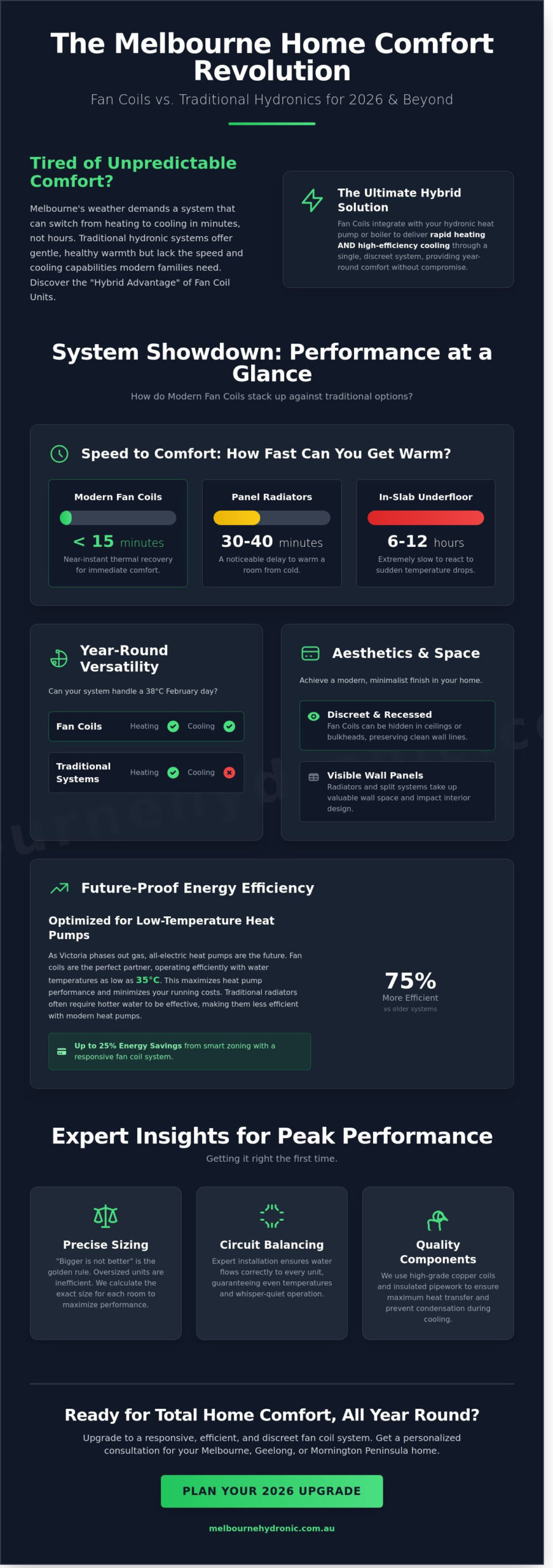
Victoria’s climate demands flexibility. While traditional hydronic heating methods like in-slab underfloor pipes are wonderful for maintaining a steady baseline temperature, they suffer from a “slow start” problem. An underfloor system can take 6 to 12 hours to react to a sudden cold snap. In contrast, fan coils provide nearly instant thermal recovery. They act as a “boost” for your home, reaching target temperatures in less than 15 minutes. When compared to cast iron or steel radiator panels, which typically require 30 to 40 minutes to warm a room, these units offer the fastest response time in the hydronic market. This responsiveness is vital for Melbourne families who return home to a cold house and need comfort immediately. It allows for precise zoning, meaning you only heat the rooms you’re using, which can reduce energy bills by up to 20% in large multi-story residences.
The Mechanics of Comfort: Integrating Fan Coils with Heat Pumps
Melbourne’s shift toward sustainable living has accelerated the adoption of all-electric solutions. As gas connections for new homes phase out across Victoria, heat pump hydronic heating has emerged as the primary choice for homeowners seeking long-term efficiency. While traditional radiators excel at steady warmth, fan coils act as the high-performance terminal for modern low-temperature systems. They operate effectively with water temperatures as low as 35°C, making them the perfect partner for air-to-water heat pumps. Hydronic radiant heating principles ensure that the heat distribution is even, but fan coils add the responsiveness needed for Melbourne’s unpredictable weather changes.
Choosing between a 2-pipe and 4-pipe configuration depends on your specific lifestyle and home layout. A 2-pipe system is a cost-effective choice, allowing the entire home to be either in heating or cooling mode. A 4-pipe setup offers the ultimate luxury, providing the ability to heat one room while cooling another simultaneously. This flexibility, combined with smart zoning, allows families to deactivate unused zones in multi-storey homes, often reducing seasonal energy bills by 25% or more.
Heating and Cooling from a Single System
One of the most significant advantages of this technology is the ability to provide active cooling through the same pipework used for heating. When paired with a reversible heat pump, fan coils circulate chilled water to lower indoor temperatures rapidly. This eliminates the need for bulky, separate split systems that clutter your walls and exterior. To ensure peak performance during a humid Melbourne summer, we use high-grade insulated pipework. This prevents condensation from forming on the pipes, protecting your ceiling and wall cavities from moisture. It’s a streamlined, “invisible” comfort solution that maintains a healthy, allergen-friendly environment without the dust circulation associated with traditional ducted air.
Energy Efficiency and Variable Speed Motors
Modern systems have moved away from the clunky, noisy fans of the past. We now utilize EC (Electronically Commutated) motors which offer precise control over airflow. Unlike traditional AC motors that run at full speed or not at all, EC motors adjust their output based on the immediate demand of the room. This variable speed capability ensures a constant temperature is maintained, removing the “on-off” cycling that often leads to cold draughts. EC motors can reduce fan energy usage by up to 70% compared to standard AC motors. If you’re planning a renovation, it’s a great time to consult with a local specialist about integrating these efficient motors into your home design.
Fan Coils vs. Traditional Radiators: Which is Right for You?
Choosing between these two technologies often depends on your home’s architectural DNA. Traditional hydronic panels are visible wall fixtures. While modern European designs are sleek, they still occupy valuable wall real estate. In contrast, recessed units disappear into ceiling cavities or bulkheads. This makes them the preferred choice for minimalist Melbourne apartments where every square metre counts and clean sightlines are a priority.
The heating experience differs significantly between the two. Radiators provide radiant heat, warming objects and people directly like the sun. The convective heat of fan coils uses an internal fan to circulate warm air, which allows for a much faster response time when you arrive home on a 5-degree July evening. If you’re integrating with heat pumps, fan coils offer a versatile way to distribute that energy efficiently while providing the added benefit of summer cooling.
Many homeowners worry about noise in quiet bedrooms. Modern units operate at sound levels as low as 23 decibels; that’s quieter than a library whisper. You won’t hear them over the ambient sounds of a Melbourne suburb at night, making them perfectly suitable for master suites and nurseries alike.
Health and Hygiene: The Asthma and Allergy Factor
Unlike traditional ducted heating, which can blast dust and allergens through floor vents, hydronic systems are a closed-loop solution. They don’t pull air from dusty subfloors or roof cavities. Each unit features integrated, washable filters that trap airborne particulates before they circulate. Melbourne Hydronic Heating recommends these systems for families managing asthma, as they provide the air movement of a forced-air system without the hygiene compromises of gas-ducted alternatives.
Installation Complexity and Retrofitting
You can often add these units to an existing radiator network, but it requires careful hydraulic balancing. They typically require larger flow rates than standard panels to achieve their rated output. While a radiator might run on 16mm piping, a high-capacity unit often needs 20mm or 25mm lines to move enough water. In Victorian-era homes, ceiling-mounted installations require a structural assessment. We ensure the heritage lath-and-plaster ceilings can support the chassis weight, which often ranges from 15kg to 30kg depending on the specific model selected for the room.
Selecting and Positioning Fan Coils for Optimal Performance
Achieving the perfect balance of warmth and silence in a Melbourne home requires more than just picking a brand; it requires engineering foresight. Selecting the right fan coils involves a careful analysis of your room’s volume and insulation levels. Many homeowners assume a larger unit provides faster heating, but this is a common misconception. An oversized unit cycles on and off too frequently, which creates annoying temperature swings and increases wear on the motor. We calculate the specific heat load of your space to ensure the unit runs at a steady, efficient pace, maintaining a consistent 21°C environment during those brisk Victorian winters.
Strategic placement is equally vital for your comfort. We avoid placing units where they blow air directly onto sofas or beds, as even warm air can feel like a draught if the velocity is too high. Instead, we focus on perimeter placement to neutralize cold spots. Integrating your system with a modern thermostat allows for sophisticated automation. You can program your system to pre-warm the living area 30 minutes before you arrive home, ensuring you never walk into a cold house.
Wall-Mounted vs. Concealed Units
High-wall fan coils offer a practical path for retrofitting older Melbourne homes. They mirror the footprint of traditional split systems, making installation straightforward without major structural changes. For premium architectural builds, concealed bulkhead units are the preferred choice. These “invisible” systems hide within the ceiling or custom cabinetry, leaving only a sleek linear grille visible. It’s essential to plan for a discreet access panel during the design phase so our technicians can perform routine filter cleaning and drainage checks without disturbing your plasterwork.
Fan Coils vs. Trench Heating
Deciding between different delivery methods depends on your home’s architecture. While hydronic trench heating is the premier choice for floor-to-ceiling glass to prevent condensation, fan coils provide more “punch” for large, open-plan zones. Trench systems rely on natural convection, whereas fan coils use active airflow to push heat deeper into a room. In many high-end Melbourne renovations, we combine both. The trench heating manages the glass perimeter, while fan coils handle the central living volume for a comprehensive climate solution.
Ready to design a system tailored to your home’s unique layout? Contact our Melbourne specialists today for a professional heat load assessment.
Expert Installation and Maintenance in Melbourne & Geelong
Thirty years of hands-on experience in the Victorian heating industry isn’t just a milestone; it’s the technical foundation required to master complex hydronic circuits. At Melbourne Hydronic Heating, our process moves beyond simple placement. We begin with a custom thermal design that accounts for your home’s specific orientation and insulation levels. This leads into a professional commissioning phase where we fine-tune every component to ensure your system operates at peak efficiency from day one. We don’t just install equipment; we engineer a silent, dust-free environment tailored to the local climate.
The Importance of System Balancing
Precision is vital when integrating fan coils into a wider hydronic network. Without expert balancing, water naturally follows the path of least resistance, which often “starves” more distant radiators or floor coils of the heat they need. To prevent this, we utilize high-grade balancing valves and modern smart pumps in all our Victorian installations. These components allow us to regulate flow rates with mathematical accuracy, ensuring every room reaches its target temperature simultaneously. An unbalanced system can lead to uneven heating and increased energy costs, often adding 15% to your seasonal utility bills due to pump strain and heat loss.
Ongoing Servicing for Longevity
To keep your system running at maximum performance, regular professional attention is essential. Our maintenance protocols are designed to handle the specific demands of Melbourne’s fluctuating weather. We focus on several critical areas:
- Annual Air-Lock Checks: We remove trapped air that causes noise and reduces heat transfer efficiency.
- Pump Performance Monitoring: Ensuring the heart of your system isn’t working harder than necessary.
- Power Flushing: This process clears the internal heat exchangers of debris and magnetite, preventing the sludge buildup that can lead to costly repairs.
- Condensate Drain Management: Crucial for fan coils, we clear these lines to prevent water damage and ensure proper humidity control.
- Filter Hygiene: We clean or replace filters to maintain the allergen-friendly, dust-free air quality our clients expect.
Choosing a Melbourne-based specialist ensures you have immediate access to local support and genuine spare parts. We understand the urgency of a July cold snap, and our proximity means we can keep your home warm without the long wait times associated with generalist contractors. Our technicians are familiar with the specific water chemistry and environmental factors unique to the Port Phillip Bay area, which allows us to provide advice that’s both practical and technically sound.
Whether you’re retrofitting a period home or designing a modern masterpiece across Melbourne, the right installation partner makes the difference between a basic heater and a luxury climate system. To start your journey toward a healthier, more efficient home, you can request a tailored hydronic heating quote in Melbourne and speak with our expert team about your specific requirements.
Elevate Your Living Standards with 2026 Hybrid Technology
Investing in your home’s climate shouldn’t be a compromise between efficiency and comfort. Integrating fan coils with a high-efficiency heat pump allows you to enjoy silent, allergen-friendly heating in winter and crisp cooling throughout the Melbourne summer. This dual-purpose technology eliminates the need for separate, bulky systems. It reduces your energy footprint while maintaining a dust-free environment for your family.
Melbourne Hydronic Heating brings over 30 years of local expertise to every installation. We’re a family-owned Victorian business dedicated to precision engineering and your long-term well-being. Our specialists understand the unique climate challenges of Melbourne and Geelong. We ensure your system performs optimally through every sudden temperature shift. Whether you’re upgrading an existing property or building a new architectural masterpiece, our team provides the technical mastery required for a seamless transition to modern hydronic luxury.
Request a custom fan coil design and quote for your Melbourne home and secure a healthier, more comfortable future today.
Frequently Asked Questions
Are fan coils noisy compared to standard hydronic radiators?
Modern fan coils operate at noise levels as low as 20 to 25 decibels on their lowest settings. While standard radiators are completely silent because they have no moving parts, fan coils use advanced DC motors to minimize sound. They’re much quieter than traditional ducted air conditioning systems. You’ll barely notice them running in a quiet Melbourne bedroom during the night.
Can I use fan coils for both heating and cooling in Melbourne?
Yes, you can use fan coils for both heating and cooling when they’re paired with a reverse-cycle heat pump. This setup provides a year-round climate solution through a single hydronic circuit. It’s an ideal choice for Melbourne homeowners who want the gentle warmth of hydronic heat in July and refrigerated cooling during a 40 degree January heatwave.
How much does it cost to install fan coils in a typical Melbourne home?
Installing a single fan coil unit in a Melbourne home typically costs between A$2,800 and A$4,200 including professional labor. Total project costs vary based on the number of zones and the complexity of the pipework. These figures align with 2024 Australian industry averages for premium hydronic components. A full system for a three-bedroom house often starts around A$15,000 depending on the heat pump capacity.
Do fan coils require a specific type of boiler or heat pump?
Fan coils require an air-to-water heat pump if you intend to use them for both heating and cooling. Traditional gas boilers only produce hot water, which limits the fan coil to heating functions only. If you want a dual-purpose system, the heat pump must be capable of chilling water to roughly 6 or 7 degrees Celsius for effective summer cooling.
How often do the filters in a fan coil unit need to be cleaned?
You should clean or inspect the filters in your fan coil unit every 3 to 6 months to maintain peak performance. Regular maintenance ensures the system remains allergen-friendly and maintains optimal airflow throughout your home. In Melbourne properties with pets or high dust levels, a 90 day cleaning cycle is the best way to ensure healthy air quality.
Can fan coils be retrofitted into an older Victorian home with existing hydronics?
Retrofitting fan coils into Victorian homes is definitely possible, but it requires planning for condensate drainage. Unlike standard radiators, these units produce moisture during the cooling process that must be piped away. We often integrate these units into heritage renovations by using subfloor spaces or ceiling voids to hide the necessary 20mm drainage lines and insulated pipework.
What is the difference between a 2-pipe and a 4-pipe fan coil system?
A 2-pipe system uses one supply and one return pipe, meaning the entire home must be in either heating or cooling mode at once. A 4-pipe system features dedicated lines for both hot and cold water. This allows for 100 percent flexibility where one room can be cooled while another is heated simultaneously. Most Melbourne residential installs utilize the 2-pipe configuration to keep installation costs lower.
Are fan coils more energy-efficient than standard split system air conditioners?
Fan coils are exceptionally efficient, often achieving a Co-efficient of Performance (COP) above 4.0 when paired with modern heat pumps. This means they deliver 4 units of thermal energy for every 1 unit of electricity used. While split systems are also efficient, hydronic fan coils provide a more consistent temperature without the dry, recycled air feel. They’re a premium choice for those prioritizing both health and energy savings.