Hydronic Heating Cost Per Square Metre Melbourne 2026: The Complete Price Guide
Could the A$12,000 you invest in a standard ducted system today actually cost you triple in health expenses and energy spikes by the time 2030 arrives? Most Melbourne homeowners agree that the upfront investment for a premium, dust free system feels daunting, especially when trying to pinpoint the hydronic heating cost per square metre 2026 for a specific floor plan. It’s natural to worry about hidden installation fees in a 1950s weatherboard or wonder if the shift toward electric heat pumps justifies the higher entry price. You want a home that’s warm, quiet, and healthy, but you need the numbers to make sense before you commit.
We are here to provide clarity with the exact market rates for radiator and floor systems across Victoria. You’ll discover why slab heating typically sits between A$65 and A$85 per square metre, while radiator panel systems for existing homes range up to A$115. This guide provides a clear budget framework, compares the long term ROI of electric systems, and highlights how to avoid financial surprises during your installation. We will break down every technical detail so you can choose the best system for your family’s comfort and health with total confidence.
Key Takeaways
- Understand the 2026 market landscape across Greater Melbourne and the Mornington Peninsula to establish a realistic baseline for your premium home heating project.
- Learn how to accurately calculate the hydronic heating cost per square metre 2026 by factoring in the “scale effect,” where larger Bayside properties often benefit from improved investment efficiency.
- Navigate the transition toward high-efficiency electric heat pumps over traditional gas boilers to ensure your system remains future-proof and compliant with Victorian energy regulations.
- Identify the critical price differences between seamless new-build installations and complex retrofits, helping you avoid the hidden costs often associated with Melbourne renovations.
- Discover how precision design maximizes your long-term ROI by significantly reducing running costs and creating a healthier, dust-free environment for your family.
Current Market Rates: Hydronic Heating Cost Per Square Metre in Melbourne 2026
As we move through 2026, the hydronic heating cost per square metre 2026 in Greater Melbourne reflects a market shaped by high demand for energy-efficient, dust-free living. Homeowners from the Mornington Peninsula to the northern suburbs are moving away from traditional forced-air systems in favor of the silent, allergen-friendly warmth that only water-based systems provide. While material costs for European-sourced polymers and copper have seen a 4.2% increase since early 2025, installation efficiencies in the Victorian sector have helped keep baseline rates competitive for new builds and major renovations.
You should view a per-metre rate as a professional baseline rather than a final fixed quote. Every Melbourne home possesses a unique thermal profile. A glass-heavy architectural build in Brighton requires a different heat load calculation than a sheltered, double-brick cottage in Cheltenham. These variables dictate the density of the pipework and the capacity of the heat source, which ultimately influences your final investment. We focus on delivering a system that doesn’t just fit your floor plan but masters your home’s specific climate challenges.
Average Price Ranges for Melbourne Homes
In the current 2026 landscape, the following figures represent the standard investment levels for professionally installed systems across Victoria:
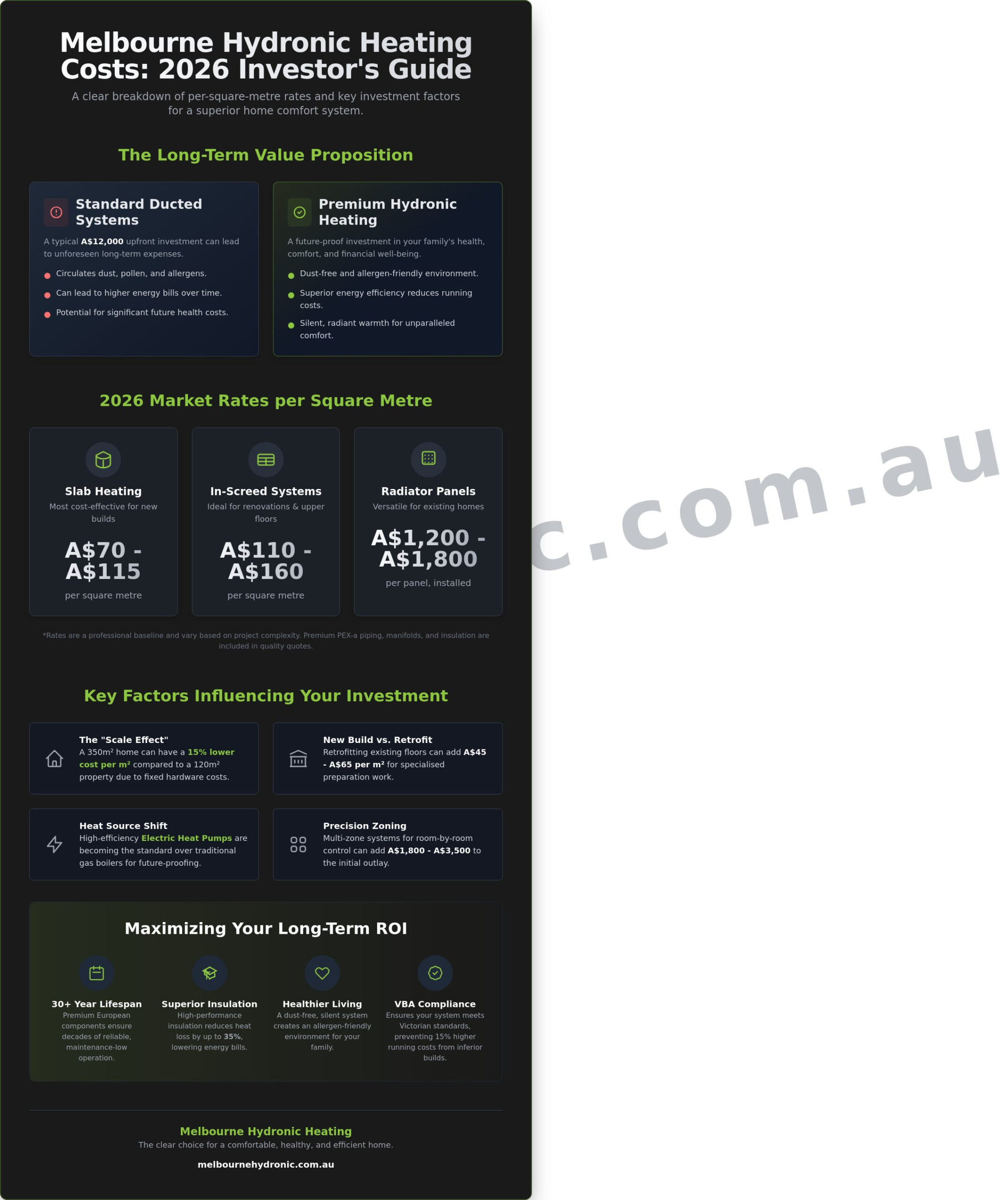
- Standard Hydronic Slab Heating: A$70 to A$115 per sqm. This is the most cost-effective method for new builds where pipes are tied directly to the structural reinforcement.
- In-Screed (Thin-Bed) Systems: A$110 to A$160 per sqm. Popular in renovations or upper-floor additions, these systems sit within a thinner layer of concrete on top of the existing floor.
- Radiator Panel Systems: A$1,200 to A$1,800 per panel, fully installed. This average includes the cost of the designer panel, thermostatic valves, and the labor to pipe the unit back to the central manifold.
What’s Included in the Square Metre Rate?
A transparent hydronic heating cost per square metre 2026 includes more than just the visible components. A premium installation covers high-grade PEX-a piping with oxygen barriers, which prevents internal corrosion and extends the system’s life to 30 years or more. It also accounts for the manifold assembly, which acts as the “brain” of your floor heating, and high-density R-rated edge insulation to prevent heat from escaping into the external footings.
Quality remains the primary driver of value in the Melbourne market. We utilize premium European components from brands like Rehau or Giacomini because they offer superior reliability compared to cheaper, non-certified alternatives. Be cautious of quotes that seem unusually low; they often omit essential Victorian Building Authority (VBA) compliance certifications or use inferior insulation that results in 15% higher running costs over the life of the system. Investing in a compliant, high-spec system ensures your home remains a healthy, silent sanctuary for decades.
Key Factors That Influence Your Per-Square-Metre Investment
Calculating the hydronic heating cost per square metre 2026 isn’t just about the size of your floor plan. In Bayside, we see the “Scale Effect” frequently. A 350-square-metre home often enjoys a 15% lower cost per unit of area compared to a 120-square-metre unit. This happens because the primary investment, like a premium European condensing boiler or a high-efficiency heat pump, remains a relatively fixed expense regardless of whether it’s heating six radiators or twelve. The more area you cover, the more you spread those fixed hardware costs across your project.
Don’t ignore floor preparation. If you’re building a new slab in Geelong, laying coils directly into the concrete is the most efficient path. Retrofitting over existing timber floors in a Victorian-era cottage requires specialized structural work or screed layers. This typically adds A$45 to A$65 per square metre to the base installation price. Adding high-performance R2.5 underfloor insulation protects your investment. It reduces heat loss by roughly 35%, ensuring the radiant warmth stays inside your living space rather than escaping into the Melbourne dampness.
Zoning adds another layer of precision. You can choose to heat the whole home as one zone or install individual room controls. While multi-zone systems increase the initial outlay by approximately A$1,800 to A$3,500, they offer significant long-term savings. This setup provides a dust-free, allergen-friendly environment; it’s a massive relief for the 11% of Australians living with asthma who need targeted climate control without moving air.
System Type: Floor Heating vs Radiator Panels
Radiator panels are the gold standard for Melbourne retrofits. They require significantly less labor than lifting floors. We can often complete a full installation in a 3-bedroom home within 3 to 4 days. If you have floor-to-ceiling glass in a modern Geelong extension, trench heating is the solution. It sits flush with the floor, creating a curtain of heat that blocks cold drafts. Trench systems generally cost 25% more than standard wall-mounted panels because of the specialized cabinetry and floor cutting required.
Property Layout and Accessibility
Single-storey homes are straightforward. Double-storey properties in suburbs like Camberwell present challenges. Running pipework between levels can add A$2,200 to the labor total. For older Victorian homes, we need at least 450mm of crawl space to safely install under-floor pipework. If your boiler is located more than 20 metres from the furthest radiator, we use larger diameter pipes to maintain pressure; this slightly nudges the materials budget upward. You can request a detailed site assessment to see how your specific layout impacts the hydronic heating cost per square metre 2026 for your renovation or build.
The 2026 Shift: Gas Boiler vs Electric Heat Pump Costs
The Victorian Government’s Gas Substitution Roadmap, originally launched in 2022 and updated in 2024, has fundamentally altered the financial landscape for Melbourne homeowners. By 2026, the push toward full electrification is no longer a trend; it’s a regulatory reality. New builds in Geelong and Melbourne are already restricted from gas connections, and the “future-proofing tax” on gas is becoming evident. Choosing a gas boiler in 2026 might save money today, but rising gas tariffs and potential carbon offsets mean you’ll likely pay more over the system’s 15 year lifespan.
When analyzing the hydronic heating cost per square metre 2026, the heat source is your most significant variable. While traditional gas boilers remain efficient, modern electric heat pumps offer a coefficient of performance (COP) of 3.0 to 5.0. This means for every 1kW of electricity consumed, you get 3kW to 5kW of heat. In contrast, even a high-efficiency condensing gas boiler tops out at around 95% efficiency. This gap is why the ROI for electric systems has shortened to approximately 6 to 8 years for most Bayside and Mornington Peninsula homes.
Electric Heat Pump Investment
Investing in an air-to-water heat pump typically adds A$6,000 to A$10,000 to your initial system cost compared to a gas boiler. You’re paying for sophisticated compressor technology that extracts heat from the Melbourne air, even when it’s 2°C outside. To maximize this investment, many clients integrate a 6.6kW or 10kW solar PV system. By running the heat pump during daylight hours to “pre-heat” the thermal mass of your floor or radiators, you can achieve nearly zero daily running costs. On narrow Bayside blocks, we factor in A$1,500 to A$3,000 for specialized placement or acoustic enclosures to meet local council noise regulations, as outdoor units must operate quietly to maintain neighborhood comfort.
Gas Boiler Replacement and Retrofit
If you’re replacing an aging boiler in an existing hydronic system, a straight swap costs between A$5,500 and A$9,000. However, transitioning from gas to electric requires infrastructure changes. You’ll need a dedicated 20A or 32A electrical circuit and potentially larger pipework to handle the lower flow temperatures of heat pumps. While the hydronic heating cost per square metre 2026 for a gas retrofit is lower upfront, the health benefits of our dust-free, allergen-friendly systems remain identical. We recommend electric for any homeowner planning to stay in their property past 2030 to avoid the inevitable costs of decommissioning gas lines later.
The shift to electric also supports a healthier home environment. By removing combustion from the premises, you eliminate the risk of carbon monoxide and contribute to a lower-carbon Melbourne. Whether you choose the lower entry price of gas or the long-term efficiency of a heat pump, our team ensures the installation provides that signature silent, luxurious warmth your family deserves.
Installation Complexity: New Build vs Melbourne Retrofit
The final invoice for your system depends heavily on your home’s phase of life. In 2026, the hydronic heating cost per square metre 2026 for a new build remains the most budget-friendly option because labor efficiency is at its peak. When we work on a clean slate, there is no heritage plaster to protect or century-old floorboards to delicately pry up. The architecture of the installation is straightforward, allowing for a faster, more clinical execution of the design.
Labor rates for specialized, VBA-licensed hydronic technicians in the Greater Melbourne area currently range between A$125 and A$165 per hour. These rates reflect the high level of precision required for Victorian Building Authority (VBA) compliance. Every installation requires a compliance certificate, which generally costs between A$250 and A$550 depending on the project’s scale. This documentation isn’t just a legal hurdle; it’s your guarantee that the system meets the strict 2026 energy safety standards.
New Build Economics
In new Melbourne housing estates, standardized floor plans allow for predictable, “clean” pricing. We coordinate directly with your concreters to lay PEX piping into the slab before the pour. This method reduces labor hours by approximately 28% compared to post-construction installs. Because pipe routing happens before walls are finished, we avoid the expensive detours required in finished homes. This efficiency keeps the hydronic heating cost per square metre 2026 toward the lower end of the A$68 to A$95 spectrum for slab-based systems.
The Retrofit Challenge
Renovating a period home in Bayside or the Mornington Peninsula introduces the “Retrofit Reality.” Here, hidden costs often emerge behind the walls. Around 82% of retrofits in these established suburbs require an electrical switchboard upgrade to accommodate modern, 2026-spec high-efficiency heat pumps. These electrical works can add A$1,800 to A$3,200 to your initial estimate.
Lifting original Baltic pine floorboards or chasing pipes into double-brick masonry requires a surgeon’s touch. A professional hydronic heating service melbourne uses specialized thermal imaging to map existing infrastructure, preventing accidental damage to your home’s character. DIY attempts in these environments usually end in disaster, often doubling the eventual repair bill. Choosing a specialist ensures the system integrates silently into your home without compromising its structural integrity or aesthetic value.
Ready to see how these factors influence your specific project? Get a detailed, site-specific quote for your Melbourne home today.
Maximizing ROI: Why Melbourne Hydronic is the Best Long-Term Choice
While the initial hydronic heating cost per square metre 2026 might appear higher than standard split systems, the long-term return on investment is unmatched. Many homeowners fall into the “Cheap Quote Trap,” where a low initial price masks poor system design. A sub-optimal layout can increase your monthly running costs by 30% because the boiler must work harder to circulate water through inefficient pipe runs. With our 30 years of local experience in the Victorian climate, we focus on engineering systems that pay for themselves through reduced energy consumption.
Property buyers in Melbourne and Geelong view hydronic heating as a premium luxury feature. Real estate data suggests that a high-quality installation can boost a home’s resale value by approximately 4% to 6%. Beyond the financial gains, the health ROI is significant. Because these systems don’t use fans to move air, they don’t circulate dust, pet dander, or allergens. It’s the gold standard for families managing asthma or allergies, providing a silent and healthy warmth that air-based systems can’t replicate.
Precision Design and Supply
Our engineering team focuses on technical precision to eliminate energy waste. We optimize pipe spacing to ensure every A$ spent on gas or electricity translates into consistent radiant heat. We also include a comprehensive power flush with our installations to remove internal sludge and debris. This process protects your heat exchanger and ensures the system maintains peak efficiency for its 25-year lifespan. For those looking to blend performance with interior design, check our Hydronic Radiator Panels Melbourne Guide for style options.
Get a Professional Quote
We provide transparent, project-based installation fees that reflect the actual requirements of your home. As a local specialist based near Cheltenham, we’ve spent decades servicing the Bayside area and understand the specific insulation and architectural needs of local properties. We don’t use generic estimates; we provide a fixed-price quote so you can plan your budget with confidence. Your hydronic heating cost per square metre 2026 will be clearly outlined from the start. Request your custom Melbourne Hydronic Heating quote today and invest in a lifetime of silent, dust-free comfort.
Secure Your Melbourne Home’s Comfort for 2026
Investing in a hydronic system is a 25 year commitment to your family’s health and your property’s value. The hydronic heating cost per square metre 2026 highlights a clear market shift toward high-efficiency electric heat pumps that integrate perfectly with solar arrays. Whether you’re planning a new slab pour for underfloor heating or retrofitting elegant radiator panels into a classic Victorian terrace, the silent and dust-free benefits remain unmatched. We’ve spent 30+ years perfecting these systems across Melbourne and regional Victoria, ensuring every installation meets rigorous engineering standards.
Our VBA licensed and insured technicians handle the entire process from custom design to final commissioning. You’ll gain a system that doesn’t just heat your rooms but transforms the way you live during those biting Melbourne winters. It’s time to move away from inefficient forced-air units and embrace the gold standard of European heating technology. We combine local expertise with premium components to ensure your investment pays dividends in both comfort and energy savings for decades.
Get a Fixed-Price Hydronic Heating Quote for Your Melbourne Home
We look forward to helping you create a warmer, healthier, and more sustainable home for the future.
Frequently Asked Questions
Is hydronic heating more expensive than ducted heating in Melbourne?
Yes, hydronic heating typically requires a 40% to 60% higher initial investment compared to standard gas ducted systems. While a premium ducted system for a standard Melbourne home might cost A$9,000, a full hydronic radiator setup often starts at A$16,000. You’re paying for a dust-free, allergen-friendly environment and a system that uses silent convection rather than noisy fans. Most homeowners find the 25% reduction in monthly energy bills justifies the higher entry price over time.
How much does it cost to run hydronic heating per year in 2026?
A typical 200 square metre home in Melbourne costs between A$1,200 and A$1,800 per year to run using a high-efficiency electric heat pump. If you’re still using a natural gas condensing boiler, expect annual costs to sit closer to A$2,200 due to rising gas tariffs in Victoria. Your hydronic heating cost per square metre 2026 averages out to roughly A$6.00 to A$9.00 annually. These figures assume a standard 20 degree Celsius thermostat setting throughout the Victorian winter.
Can I install hydronic heating in an existing Melbourne home?
You can certainly retrofit hydronic heating into existing Melbourne properties using wall-mounted radiator panels. While underfloor piping is difficult to install in established slabs, we can run pipework through ceiling cavities or under floorboards to reach every room. This process usually takes 3 to 5 days for a standard three-bedroom home. Retrofitting adds approximately 15% to the installation labour cost compared to a new build, but it remains the most effective way to eliminate cold spots in older Victorian-era houses.
Does hydronic heating add value to my Melbourne property?
High-end heating systems like hydronic often increase a property’s resale value by 2% to 5% in the Melbourne and Geelong markets. Real estate data from 2025 shows that buyers prioritise energy-efficient features and healthy living environments. Because hydronic systems are seen as a premium, “invisible” luxury, they help homes stand out during winter inspections. You aren’t just installing a heater; you’re adding a permanent architectural asset that lasts twice as long as standard air-based systems.
How long does a hydronic heating system last before needing a boiler replacement?
A quality European-manufactured boiler typically lasts 15 to 20 years, while the radiator panels and copper pipework can easily exceed 30 or 40 years. Modern electric heat pumps have a projected lifespan of 15 years before major components require significant attention. This longevity is nearly double that of reverse-cycle air conditioning units, which often fail after 10 years of heavy use. Choosing premium brands like Baxi or Immergas ensures you’ll have access to spare parts well into the 2040s.
What is the cheapest way to install hydronic heating in a new build?
The most cost-effective installation method is an “in-slab” system laid before the concrete foundation is poured. This reduces labour costs by 20% because technicians don’t need to navigate wall cavities or finished flooring. To further optimise your hydronic heating cost per square metre 2026, consider a single-zone layout for the main living areas. This targeted approach brings the initial investment down to roughly A$105 per square metre while still providing the core benefits of radiant warmth where you spend 80% of your time.
Are there Victorian government rebates for electric hydronic heat pumps in 2026?
Yes, the Victorian Energy Upgrades (VEU) program continues to offer incentives for homeowners switching from gas to electric heat pump technology. In 2026, eligible Melbourne residents can receive rebates ranging from A$1,500 to A$3,200 depending on the efficiency rating of the chosen unit. These subsidies help Victoria reach its net-zero targets. We recommend checking the current Solar Victoria portal, as these rebates often fluctuate based on quarterly budget allocations and new energy efficiency standards.
How often should I service my hydronic system to keep costs down?
You should schedule a professional service every 2 years to maintain peak efficiency and prevent internal corrosion. A standard service costs between A$250 and A$400 but can prevent a 15% increase in running costs caused by air pockets or sludge buildup in the pipes. Our technicians check the system pressure, test the water pH levels, and flush out any debris. Regular maintenance ensures your warranty remains valid and keeps the system running silently and safely for decades.