
Hydronic Underfloor Heating Running Costs in Melbourne: 2026 Guide
What if you could maintain a perfectly consistent temperature throughout your home all winter without ever worrying about the next gas bill? For many Victorians, the rising cost of natural gas, which recently traded at averages around $10.82 per gigajoule, has turned home comfort into a source of financial stress. You might be wondering if hydronic underfloor heating running costs in Melbourne are still manageable in 2026, or if switching to an electric heat pump is truly the efficient solution it’s claimed to be.
We understand that navigating energy price fluctuations and technical efficiency ratings can feel overwhelming. That’s why we’ve created this guide to provide a clear, research-backed breakdown of what it really costs to run these systems today. You’ll learn how to achieve a predictable monthly energy budget while moving away from fossil fuels entirely. We’ll show you how to maximise your rooftop solar ROI to potentially heat your floors for free. From the impact of the latest Victorian Default Offer to the importance of precision design, this guide covers everything you need to know to ensure your home remains a warm, healthy sanctuary for your family.
Key Takeaways
- Learn how Melbourne’s unique “four seasons in one day” climate impacts system cycling and why high-performance insulation is your most effective tool for lowering energy consumption.
- Discover how modern electric heat pumps and their high Coefficient of Performance (CoP) can significantly reduce hydronic underfloor heating running costs melbourne compared to traditional gas boilers.
- Understand the “Solar Synergy” strategy, where aligning your heating schedule with peak solar production hours can lead to near-zero daytime running costs.
- Master practical efficiency through smart zoning and weather-compensation sensors that prevent energy waste by only heating the spaces you actually use.
- See why a bespoke, professionally designed system from a local specialist is essential for avoiding the hidden costs and poor performance typical of off-the-shelf solutions.
Factors Influencing Underfloor Heating Running Costs in Melbourne
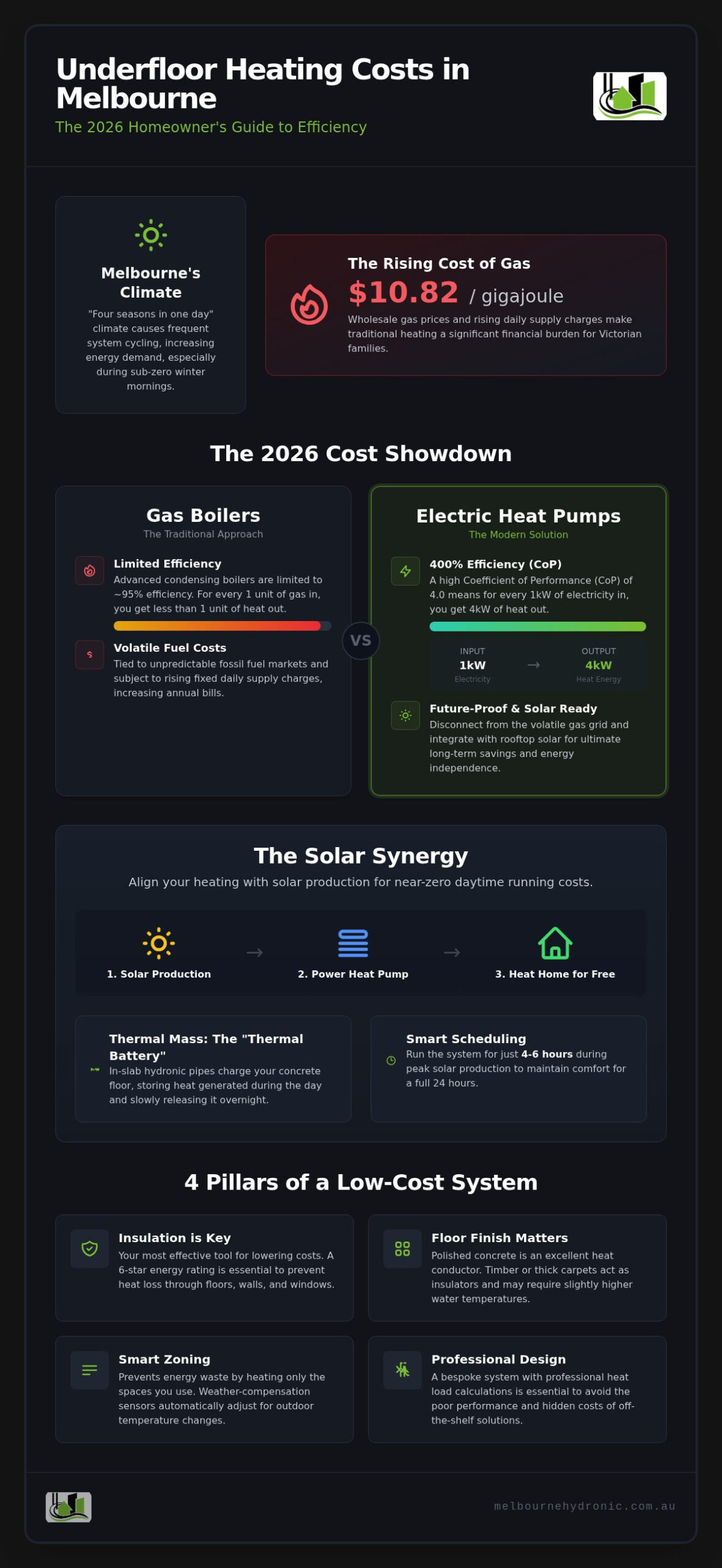
Melbourne’s “four seasons in one day” is more than a local cliché; it’s a significant technical factor in your home’s energy profile. Rapid temperature shifts cause heating systems to cycle on and off frequently. Since the 2024 Victorian gas ban for new builds, the focus has shifted toward electric heat pump efficiency. This means hydronic underfloor heating running costs melbourne homeowners experience are now dictated by how well a system interacts with the building’s shell rather than just the price of fuel.
Your choice of floor finish also plays a critical role. Polished concrete acts as an excellent conductor, transferring heat into the room with minimal resistance. Engineered timber or thick carpets act as insulators, requiring slightly higher water temperatures to achieve the same ambient warmth. Additionally, the physical system type matters. In-slab systems turn your entire floor into a “thermal battery,” while ultra-slim screed systems offer a faster response time but hold less residual heat. To keep costs low, a 6-star energy rating or higher is essential, as even the most efficient heat pump can’t compensate for a home that leaks heat through uninsulated floors or single-glazed windows.
Melbourne’s Climate and Heat Load
Sub-zero winter mornings in Melbourne create a high “peak load” demand. If a system isn’t designed for these specific spikes, it will struggle to reach your desired temperature, leading to longer run times and higher bills. In Geelong, coastal winds add a significant “chill factor” that increases heat loss through the building’s envelope. We use professional heat load calculations to ensure your system is perfectly sized. This prevents the inefficiency of an oversized unit that “short-cycles” or an undersized unit that never stops running.
Thermal Mass: Your Secret Cost-Saving Weapon
Thermal mass is the ability of a material, like concrete, to store heat energy. By using in-slab hydronic pipes, you’re essentially charging a giant battery under your feet. This allows you to bridge the gap between sunset and sunrise without constantly drawing power. In a well-insulated Melbourne home, it’s common to run the heating for only 4-6 hours during the day. This keeps the home comfortable throughout the night, effectively lowering hydronic underfloor heating running costs melbourne residents face by avoiding expensive peak-hour electricity rates.
Heat Pumps vs. Gas Boilers: The 2026 Cost Showdown
For decades, Melburnians believed gas was the only economical way to heat a home. In 2026, that’s no longer the case. With wholesale gas prices trading near $10.82 per gigajoule in August 2026, the financial argument for traditional combustion has weakened. When evaluating hydronic underfloor heating running costs melbourne families must look beyond the initial purchase price and focus on operational efficiency. The shift toward electrification isn’t just about the environment; it’s a calculated move to escape the volatility of fossil fuel markets.
The CoP Advantage Explained
Modern electric heat pumps operate on a completely different physical principle than traditional burners. While even the most advanced condensing gas systems are limited to roughly 95% efficiency, heat pumps use a Coefficient of Performance (CoP) to multiply energy. In Melbourne’s climate, a high-quality heat pump typically achieves a CoP of 3.5 to 4.0. This means for every 1kW of electricity consumed, the system delivers up to 4kW of heat into your floors. This 400% efficiency is the primary reason why disconnecting from the gas grid has become the gold standard for long-term savings.
The Reality of Gas in Victoria 2026
The Victorian gas ban for new residential builds has fundamentally shifted the property market. Beyond the environmental impact, the total “running cost” of a gas-fired boiler now includes rising daily supply charges that can add hundreds of dollars to your annual expenses before you’ve even turned the heat on. For many homeowners, these fixed costs make gas an expensive secondary utility that’s hard to justify.
Annual maintenance also factors into the “showdown.” Gas systems require stringent biennial safety checks to prevent carbon monoxide risks. Conversely, heat pump servicing focuses on mechanical longevity and refrigerant levels, similar to a standard air conditioning service. If you’re planning a renovation, our team can help you assess a gas-to-electric conversion to future-proof your property value while slashing monthly overheads. By removing the gas meter entirely, you eliminate a whole category of utility bills, making your energy budget far more predictable and manageable.
The Solar Synergy: Heating Your Melbourne Home for Free
Pairing a high-efficiency heat pump with a rooftop solar PV system is the most effective strategy to drive down hydronic underfloor heating running costs melbourne homeowners face. In 2026, the financial logic has shifted. Exporting excess solar energy to the grid in Victoria now offers diminishing returns, with feed-in tariffs often as low as 0.8¢ to 8¢ per kilowatt-hour. It’s far more profitable to “self-consume” that energy by powering your heating system. By aligning your system’s primary run-time with peak solar production hours, typically between 10 am and 3 pm, you can effectively zero out your daytime heating expenses.
While radiator panels are excellent for quick bursts of warmth, underfloor heating is uniquely suited to solar integration. This is due to the inherent thermal mass of the floor. Smart controllers and weather-compensation sensors can now automate this process, ensuring your heat pump activates exactly when your solar panels are generating a surplus. This automation removes the guesswork, allowing your home to harvest energy when it’s cheapest and most abundant.
Maximising Solar PV ROI
To effectively offset a hydronic load, most Melbourne homes benefit from a solar system sized between 6.6kW and 10kW. Even on a typical overcast Melbourne winter day, a well-designed solar array can generate enough power to significantly supplement a heat pump’s requirements. Instead of paying retail electricity rates, you’re using a free, renewable resource generated right on your roof. This strategy doesn’t just lower your bills; it maximises the return on investment for your solar hardware by shortening the payback period through increased self-consumption.
The Slab as a Thermal Battery
The concept of the “thermal battery” is what sets underfloor systems apart from traditional “on-demand” gas heating. A concrete slab can retain heat for several hours after the heat pump has turned off. By “charging” the slab during the sunniest part of the day, you’re storing energy in the very structure of your home. This stored warmth then slowly radiates throughout the evening and night. Maintaining a consistent “base” temperature in the slab prevents the system from having to work at maximum capacity during the freezing pre-dawn hours. This methodical approach ensures your home remains comfortable 24/7 while avoiding the expensive peak-hour electricity rates that often occur just after sunset.
Practical Strategies to Minimise Monthly Bills
Managing your system effectively is just as important as the hardware itself. While the thermal mass of a slab provides incredible stability, heating unused spaces like guest bedrooms or laundries is a direct drain on your finances. Smart management habits keep hydronic underfloor heating running costs melbourne within a predictable monthly budget, ensuring you only pay for the comfort you actually use.
One of the most common misconceptions is that you should turn the system off completely when leaving the house for the day. In Melbourne’s erratic climate, this often forces the heat pump to work at maximum capacity for several hours to regain lost ground. Instead, we recommend using “setback” temperatures. Lowering the thermostat by just 2-3 degrees during the day maintains a core level of warmth in the slab. This ensures the system only needs a small amount of energy to return to your preferred comfort level when you arrive home.
Smart Zoning and Automation
Modern systems allow you to divide your home into distinct zones, such as living areas, sleeping quarters, and wet areas. You can program the living areas to be warm during the day while keeping the bedrooms at a lower temperature until just before sleep. Weather-compensation sensors are another vital tool; they detect outdoor temperature drops before they affect your indoor environment. This proactive adjustment prevents the system from “overshooting” and wasting energy. Similar precision in temperature management is available for those on the move through Rixen’s Enterprises, Inc., which specializes in advanced hydronic systems and control solutions for mobile and marine environments. Integrated phone apps now make it simple to override schedules if your plans change, ensuring you don’t pay to heat an empty house while you’re stuck at work or out in the city.
Regular hydronic heating service is the final piece of the efficiency puzzle. Over time, magnetite and sludge can build up within the pipes, acting as an unintended insulator that prevents heat from reaching your floors. This forces your heat pump to run longer and consume more electricity to achieve the same result, directly increasing hydronic underfloor heating running costs melbourne residents experience.
Power flushing is a specialised process that cleanses the system, restoring it to its original design performance. Trapped air in the lines can also cause uneven heating and increased wear on the circulating pumps. A quick annual check ensures your system remains at peak efficiency throughout the winter months. If your bills have unexpectedly crept up, it’s often a sign that your system is overdue for professional attention. You can book a comprehensive system health check to ensure your installation continues to deliver premium comfort at the lowest possible cost.
Designing for Efficiency with Melbourne Hydronic Heating
A system is only as efficient as the engineering behind it. Many homeowners focus on the hardware but overlook the fact that poor layout and incorrect pipe spacing can lead to significantly higher hydronic underfloor heating running costs melbourne families have to pay. At Melbourne Hydronic Heating, we’ve spent 30 years refining a bespoke design process that treats every home as a unique thermal environment. Unlike off-the-shelf solutions that use generic calculations, our designs account for specific heat loss variables, ensuring your heat pump operates at its most efficient CoP.
The Melbourne Hydronic Heating consultation process begins with a precision audit of your floor plan and insulation levels. This engineering-led approach prevents the energy waste associated with over-specifying or under-sizing equipment. By getting the design right from the start, we ensure your investment delivers the premium comfort and low overheads you expect. We don’t just install pipes; we design a long-term energy strategy for your property.
The Value of Local Expertise
Operating as a family-owned business in Victoria gives us a deep understanding of local building standards and the specific climate challenges of the Port Phillip region. We’ve managed countless gas-to-electric conversions in suburban Melbourne, helping families transition away from fossil fuels while maintaining a warm, healthy home. Our experience shows that a well-designed electric system, integrated with solar, isn’t just a technical upgrade; it’s a lifestyle choice that prioritises long-term wellness and financial stability. We understand how Geelong’s coastal winds or the Dandenongs’ damp winters affect system performance, and we build that knowledge into every project.
Get Your Custom Efficiency Quote
Every project is different. We calculate the projected ROI for your specific project, showing you how smart technology and solar integration will lower your hydronic underfloor heating running costs melbourne. For some homes, the ultimate solution is a hybrid design. This might involve integrating hydronic heating panels in bedrooms for quick response times, combined with underfloor heating in main living areas for sustained thermal mass. This hybrid approach offers the best of both worlds: rapid warmth when you need it and deep, consistent heat when you’re relaxing. Contact our Melbourne specialists today for an energy-efficient design quote and take the first step toward a home that’s warm, healthy, and entirely independent of rising gas prices.
Future-Proof Your Home’s Comfort and Energy Budget
Managing hydronic underfloor heating running costs melbourne families encounter doesn’t have to be a guessing game. By combining high-efficiency heat pump technology with the thermal battery of your concrete slab, you’re investing in a system that works with Melbourne’s climate rather than against it. The 2026 energy landscape rewards those who integrate solar PV and smart zoning to eliminate reliance on volatile fossil fuel markets. It’s a strategic shift that prioritises both your wallet and your well-being.
Our team brings over 30 years of experience as a family-owned Victorian business. We specialise in solar and heat pump integration, ensuring your bespoke design delivers maximum ROI and a healthier, allergy-friendly living environment. Stop worrying about rising gas prices and start enjoying the premium comfort of a professionally engineered system. You can Get a Professional Quote for Energy-Efficient Underfloor Heating today to see how we can transform your home’s efficiency. We look forward to helping you create a sanctuary that remains perfectly warm all winter long.
Frequently Asked Questions
Is electric hydronic underfloor heating more expensive to run than gas in 2026?
Electric heat pumps are generally more cost-effective than gas boilers in 2026. While wholesale gas prices in Victoria have traded around $10.82 per gigajoule, modern heat pumps achieve a Coefficient of Performance of 3.5 to 4.0. This means they deliver four times the heat for every unit of electricity used. When paired with solar, the gap widens further, making heat pumps the superior choice for managing hydronic underfloor heating running costs melbourne homeowners face.
Can I run my underfloor heating entirely off my solar panels?
You can effectively zero out your daytime heating costs by aligning your system’s run-time with peak solar production hours, usually between 10 am and 3 pm. A 6.6kW or 10kW solar system can often cover the entire load of a modern hydronic heat pump during these hours. By using the concrete slab as a thermal battery, you store that free energy to keep the home warm throughout the evening without drawing from the grid.
Does underfloor heating need to be left on 24/7 to be efficient?
It’s more efficient to use setback temperatures rather than leaving the system on full power 24/7 or turning it off completely. Dropping the thermostat by 2-3 degrees when you’re away or asleep prevents the slab from losing too much core heat. This strategy ensures the heat pump doesn’t have to work at maximum capacity to recover, which is a key factor in keeping hydronic underfloor heating running costs melbourne manageable and predictable.
What is the most energy-efficient floor covering for hydronic heating?
Polished concrete and natural stone are the most efficient floor coverings because they have high thermal conductivity and excellent heat retention. These materials allow heat to transfer quickly from the pipes to the room’s surface. While engineered timber and carpets can be used, they act as insulators and require the system to run at slightly higher water temperatures to achieve the same level of comfort, which can marginally increase your overall energy consumption.
How much does the Victorian gas ban affect my heating choices?
The Victorian gas ban applies to new residential builds requiring a planning permit, making electric heat pumps the mandatory standard for hydronic systems in those projects. For existing homes, it has accelerated the trend toward gas-to-electric conversions. Choosing an electric system now future-proofs your property value and allows you to disconnect from the gas grid entirely, eliminating rising daily supply charges that contribute to higher annual utility bills for Melbourne families.
Does a heat pump make much noise in a suburban Melbourne backyard?
Modern hydronic heat pumps are designed for suburban density and operate at very low decibel levels, often comparable to a quiet conversation. When professionally installed on anti-vibration mounts, they are barely audible from a few metres away. It’s important to consider placement during the design phase to ensure the unit is away from bedroom windows and neighbouring properties, maintaining the tranquil environment of your Melbourne or Geelong backyard while the system runs.
How often should I service my hydronic underfloor system to keep costs low?
We recommend a professional service every 12 to 24 months to maintain peak efficiency. Over time, air bubbles or magnetite sludge can build up in the pipes, forcing the pump to work harder and increasing energy use. A standard service includes checking water chemistry, cleaning filters, and ensuring the heat pump’s refrigerant levels are optimal. Regular maintenance prevents small inefficiencies from turning into high running costs or expensive mechanical repairs later on.
Is underfloor heating better for asthma and allergies than split systems?
Hydronic underfloor heating is significantly better for asthma and allergy sufferers because it uses radiant heat instead of forced air. Standard split systems or ducted heaters circulate dust, pollen, and pet dander throughout the home. Because hydronic systems don’t rely on fans or vents, they create a much cleaner and more hygienic environment. This health-focused benefit adds immense value to the home beyond just the technical efficiency and lower running costs of the system.