
The Homeowner’s Guide to Thermostats: Mastering Melbourne Comfort in 2026
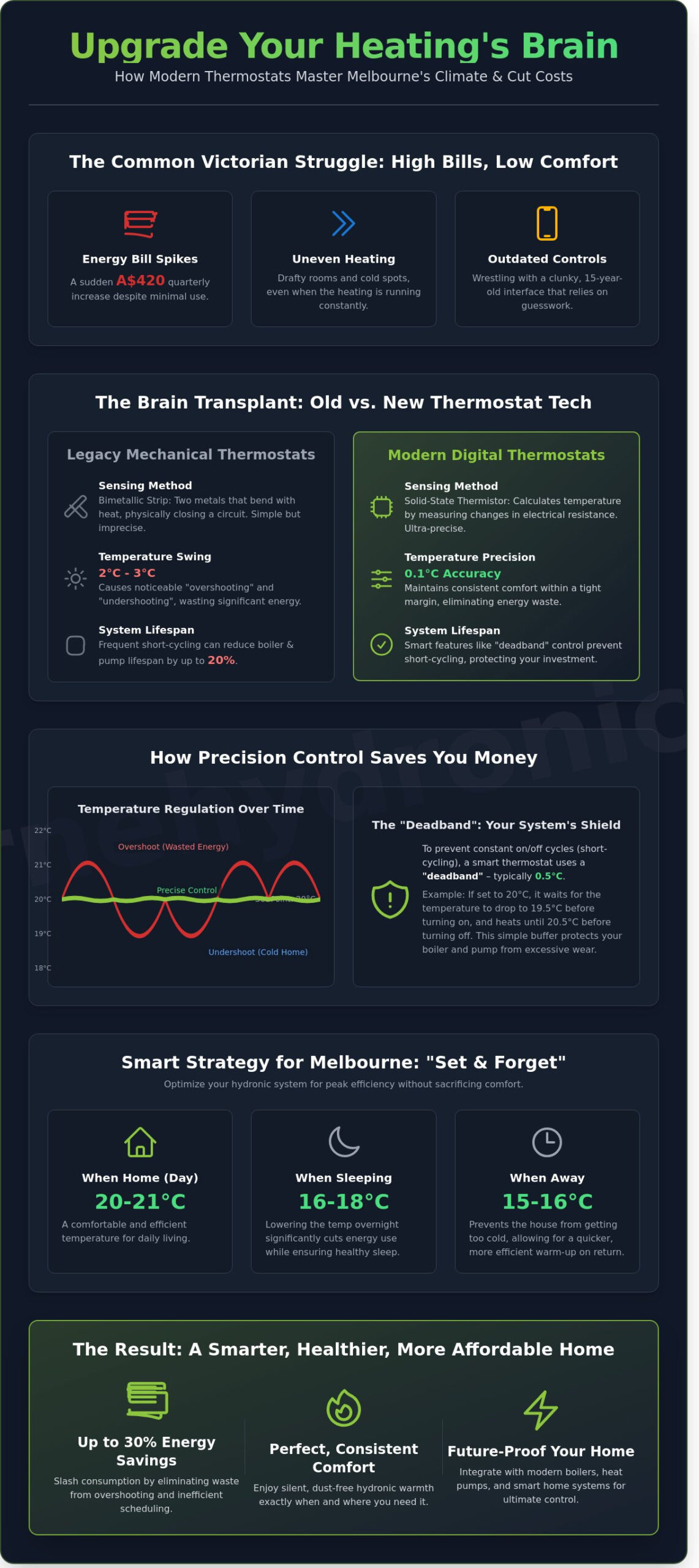
Last Tuesday, while Melbourne shivered through a 4°C morning, Sarah noticed a A$420 spike in her quarterly energy statement despite her living room still feeling drafty and uneven. It’s a common Victorian struggle where a legacy thermostat acts more like a guessing tool than a precision instrument. We agree that wrestling with a clunky, 15 year old interface is the last thing you want to do during a freezing July night. You deserve a home that feels like a sanctuary, offering the dust-free, silent warmth that premium hydronic systems are famous for without the financial stress of rising utility costs.
This guide reveals how upgrading to a modern “brain” for your heating can slash your energy consumption by up to 30% while maintaining perfect, consistent comfort. You’ll learn how to master Melbourne’s volatile climate using the latest 2026 smart features. We’ll explore everything from smartphone remote control to automated scheduling that ensures your home is always at the ideal temperature before you even step through the front door.
Key Takeaways
- Understand why your thermostat acts as the essential “brain” of your home, moving beyond simple temperature sensing to provide intelligent, precise climate control.
- Learn the “Set and Forget” strategy and specific temperature set-points tailored for Melbourne’s climate to slash energy bills without sacrificing warmth.
- Discover how to choose between manual and programmable controllers to find the ideal balance of tactile ease and automated scheduling for your Victoria property.
- Uncover the science of the “deadband” to prevent system short-cycling, ensuring the long-term reliability and efficiency of your hydronic heating investment.
- Gain insights into why professional calibration is vital for integrating European boilers and heat pumps to maintain a quiet, allergen-free home environment.
What is a Thermostat? Understanding the Brain of Your Home
Your home’s comfort depends on a single, often overlooked device. A thermostat is a regulatory component that senses the temperature of a physical system and performs actions to maintain that system near a desired set point. It’s vital to distinguish this from a simple thermometer. While a thermometer only observes and displays the current temperature, a thermostat commands. It acts as the primary intelligence center for your HVAC setup, constantly comparing the actual room climate against your preferred settings.
This active control makes the device the most critical component for achieving energy efficient heating in modern Victorian residences. Without a precise thermostat, your heating system would operate blindly. It would either run indefinitely or fail to activate when needed. High-quality sensors now maintain temperatures within a narrow 0.5°C margin, which is essential for both comfort and cost management. By accurately reading the environment, these devices prevent two common problems:
- Overshooting: This occurs when a system doesn’t shut off in time, pushing the room temperature 2 or 3 degrees past your target and wasting expensive energy.
- Undershooting: This happens when a system is too slow to react, allowing the home to become uncomfortably chilly before the heat finally kicks back in.
The Role of Thermostats in Hydronic Systems
Hydronic heating operates differently than standard forced-air AC units. It relies on the steady movement of hot water through radiator panels or floor coils. The thermostat in these systems doesn’t just flip a switch; it manages the intricate flow of water via zone valves and actuators. It communicates directly with the boiler or air-to-water heat pump to modulate the heat output. Because water retains thermal energy much longer than air, hydronic controllers require higher precision to account for thermal lag. This ensures your slab or radiators reach the perfect temperature without a spike in your gas or electricity bills.
Thermostat vs. Humidistat: What’s the Difference?
Temperature is only one part of the comfort equation during a damp Melbourne winter. While a thermostat monitors heat, a humidistat measures and controls moisture levels in the air. By the year 2026, integrated dual-purpose sensors will become the expected standard for Victorian home builds. These units are particularly important for Bayside properties, where high coastal humidity can make a room feel significantly colder than the display suggests. Managing both variables ensures a crisp, healthy, and dust-free environment that protects your home from condensation and mould while keeping your family warm.
How Thermostats Work: The Science of Temperature Control
A thermostat acts as the command center for your home heating. It is essentially a sophisticated switch that bridges the gap between your desired comfort and the boiler output. To prevent your heater from clicking on and off every 30 seconds, engineers use a concept called the “deadband” or differential. This is a narrow temperature range, often set at 0.5 degrees, that prevents short cycling. Without this buffer, your system would suffer unnecessary wear and tear; this could reduce the lifespan of your pump and boiler by up to 20% over a decade.
Mechanical vs. Electronic Sensing
Old school thermostats relied on bimetallic strips. These strips consist of two different metals bonded together that expand at different rates when heated, physically bending to break an electrical circuit. While reliable for decades, they lack the precision required for modern energy efficiency. By 2026, the Australian market is projected to shift almost entirely toward solid state digital sensors. These modern thermistors offer 0.1 degree accuracy, a necessity for the high end Melbourne renovations where every watt of energy counts. Digital sensors do not just feel the air; they calculate resistance changes to provide a stable, flicker free environment.
The Communication Loop
In Australia, most residential systems utilize low voltage (24V) wiring, though some older homes still feature 240V line voltage setups. The way your thermostat talks to your boiler is changing rapidly. While traditional wall cables remain the gold standard for reliability, wireless protocols like Zigbee, Z-Wave, and Thread are becoming the preferred choice for retrofitting Victorian era homes where running new wires is difficult. For those seeking maximum efficiency, we recommend systems using OpenTherm communication. Unlike a simple on/off switch, OpenTherm allows the controller to tell the boiler exactly how much heat is needed, modulating the flame for a smoother warmth.
Hydronic heating operates differently than split systems. It relies on radiant heat, which warms objects rather than just blowing hot air. This creates a phenomenon known as thermal lag. Because water and concrete slabs take time to heat up and cool down, a smart thermostat must predict when to shut off the boiler before the room actually reaches the target temperature. If the system stops exactly at 21 degrees, the residual heat in the pipes might push the room to 23 degrees. Advanced controllers use algorithms to account for this, ensuring your expertly installed hydronic system maintains a perfect, steady climate without overshooting.
- Radiant vs. Air: Sensors in hydronic setups often prioritize floor or surface temperature to ensure a consistent heat profile.
- Predictive Logic: Modern units learn your home’s heat loss rate over 48 hours to refine their firing schedules.
- System Protection: Integrated software prevents the water in your pipes from reaching freezing temperatures during a Melbourne cold snap.
Comparing Thermostat Types for Melbourne Properties
Choosing the right controller for your hydronic system is about more than just turning a dial. In Melbourne, where the temperature can drop 10 degrees in an hour, your thermostat acts as the brain of your home’s comfort. The hardware you choose determines how efficiently your boiler operates and how much you’ll spend on monthly energy bills.
- Manual Thermostats: These models use a simple dial or slider. They’re reliable and don’t require an internet connection, making them a favorite for those who prefer tactile, straightforward operation without navigating digital menus.
- Programmable Thermostats: These allow for pre-set schedules. Most Melbourne homeowners save approximately 15% on winter energy bills by setting specific “Sleep” and “Away” modes that lower the temperature while the house is empty.
- Smart Thermostats: These are the gold standard for 2026. They use learning algorithms to understand your habits and adjust settings automatically.
For specialized installations like hydronic trench heating, a smart or high-precision digital thermostat is essential. Trench systems rely on steady convection to create a curtain of warmth in front of glass facades. Maintaining a consistent floor-level temperature prevents the system from overworking, ensuring the “invisible comfort” these systems are known for remains efficient.
The Rise of Smart Thermostats in 2026
Geofencing tech ensures your heater knows when you’re 5km away from home after a long day in the CBD. It starts the warm-up process so you walk into a 21°C environment. Modern units also use weather compensation. If the Mornington Peninsula forecast predicts a sudden cold snap, your system adjusts the water temperature in your boiler before the house feels the chill. You can manage everything through Google Home, Alexa, or Apple HomeKit with simple voice commands.
Multi-Zone Control Systems
A single control point often struggles in two-storey Melbourne properties because heat naturally rises. This leaves the ground floor cold while upstairs bedrooms become stuffy. Multi-zone systems solve this by using Smart Radiator Valves (TRVs) on individual units. You can keep your home office at 20°C while leaving guest rooms unheated. This targeted approach reduces energy consumption by up to 25% compared to heating the entire house simultaneously. It’s a cleaner, more efficient way to maintain a dust-free, healthy atmosphere in every room. For homeowners who also need rapid cooling during Melbourne’s hot summers, fan coils integrated into a hybrid hydronic system offer precise multi-zone temperature management for both heating and cooling through a single setup.
Maximising Efficiency: Thermostat Strategies for Victoria’s Climate
Melbourne’s weather is notoriously volatile, often swinging 15 degrees in a single afternoon. Managing your home’s climate requires a strategy beyond just turning a dial. The “Set and Forget” rule is the gold standard for efficiency. Every time you adjust your thermostat by just one or two degrees, you force your system to work harder. This reactive cycling can increase energy bills by up to 10 percent annually. Instead of constant manual changes, aim for consistency to allow your boiler or heat pump to operate in its most efficient condensing range.
For most Melbourne homes, we recommend a living room set-point of 21°C. This provides a premium, dust-free warmth that feels natural and healthy. For bedrooms, 18°C is the ideal balance for sleep quality and energy savings. If you use hydronic underfloor heating, you must account for thermal mass. Concrete slabs act as a thermal battery and require a 120-minute head start to reach your desired temperature. Program your system to activate at 5:00 AM if you want a warm floor by 7:00 AM.
Placement Matters: Where to Install Your Sensor
Your thermostat needs to read the average air temperature, not a localised hot spot. Mounting the unit exactly 1.5 metres above the floor ensures it measures the air you actually breathe. Keep sensors away from direct sunlight, fireplaces, or drafty windows common in older Victorian terrace houses. For large, open-plan extensions in Bayside or Toorak homes, we often install remote sensors to average out the temperature. This prevents cold spots in the kitchen while the lounge stays warm.
Seasonal Programming Tips
Victoria’s seasons demand specific settings to protect your investment. During Autumn, ensure your system’s “Frost Protection” mode is active. This triggers the pump if external temperatures drop below 5°C, preventing internal pipes from freezing. In Winter, if you’ve transitioned to an electric heat pump, program the bulk of your heating for off-peak windows to lower costs. When Spring brings those sudden 25°C days, switch to manual override to keep the system dormant until the evening chill returns. Homeowners seeking year-round comfort without a separate cooling system may also benefit from exploring how fan coils deliver hybrid hydronic heating and cooling through the same pipework infrastructure.
Optimising your controls ensures your hydronic system delivers the quiet, allergen-friendly comfort it was designed for. If your current controls feel outdated or unresponsive, a modern upgrade can significantly reduce your carbon footprint while enhancing your home’s luxury feel.
Consult our expert team for a tailored heating solution
Expert Installation and Integration in Melbourne
Professional calibration is the secret to a hydronic system that lasts 25 years instead of 15. When a thermostat isn’t synced correctly with a high-end European boiler or a modern electric heat pump, the system often suffers from short-cycling. This repetitive starting and stopping increases wear on internal pumps and burners by roughly 30%. Our technicians ensure your controller understands the thermal mass of your home, allowing for long, efficient heating cycles that protect your investment.
Melbourne Hydronic Heating brings a 30-year local perspective to every installation. We’ve seen how Victorian winters stress local grids and fuel bills. By integrating smart home technology with precision engineering, we create a felling of luxury that’s also allergen-friendly. Because hydronic systems don’t rely on fans, they don’t circulate dust. A perfectly tuned controller maintains this “still” heat, ensuring your environment remains healthy and silent.
Upgrading Your Existing System
You don’t need a brand-new house to enjoy modern control. It’s a common myth that you can’t put a smart thermostat on a 20-year-old gas boiler. Most legacy units are compatible, though they often require updated wiring. Modern WiFi-enabled controllers usually need a “C-wire” to provide constant 24V power. If your older Melbourne home lacks this, we use power-add-on kits or pull new cabling to ensure a stable connection.
The financial logic for an upgrade is clear. While a premium smart controller might cost A$400, the return on investment is rapid. Based on current Victorian energy tariffs, the average household saves A$1,035 over 36 months through better scheduling and geofencing. These units learn your habits, automatically lowering the temperature when you head to work and warming the floors before you return. If you’re considering a complete system overhaul, getting a hydronic heating quote Melbourne will help you understand the full scope of modern efficiency improvements available for your property.
The Melbourne Hydronic Advantage
Our approach goes beyond simply mounting a box on a wall. We specialize in system design where the controller communicates directly with the manifold. This level of integration allows for true multi-zone control, meaning you aren’t wasting energy heating a guest bedroom that’s rarely used. We provide localized support across several key areas:
- Cheltenham and Bayside: Expert retrofitting for coastal properties facing high humidity.
- Mornington Peninsula: Specialized heat pump integrations for larger, exposed acreage homes.
- Greater Melbourne: Comprehensive system audits to identify efficiency leaks in older pipework.
Don’t let an outdated dial dictate your comfort or your energy bills. Contact us today for a professional system audit and a thermostat upgrade that brings your home into the digital age. Our team is ready to ensure your hydronic system delivers the dust-free, silent, and cost-effective warmth your family deserves.
Take Command of Your Melbourne Home Comfort Today
Melbourne’s weather is notoriously unpredictable, but your indoor environment shouldn’t be. By 2026, homeowners who prioritize smart climate management will see significant gains in both daily comfort and long-term cost savings. Selecting a high-performance thermostat serves as the vital link between your heating hardware and a perfectly tempered living space. It ensures your system operates with the technical precision required to handle Victoria’s unique temperature swings without wasting energy or compromising on air quality.
Melbourne Hydronic Heating has spent 30+ years mastering the art of Victorian home warmth. We’re specialists in European hydronic technology, providing silent, dust-free heating solutions that improve your family’s health and lifestyle. As a family-owned and operated business based in Cheltenham, we pride ourselves on delivering premium engineering with a local, friendly touch. You don’t have to settle for inefficient systems that struggle when the mercury drops. Unlike traditional ducted heating in Melbourne that circulates dust and allergens throughout your home, our hydronic solutions paired with precision thermostat control deliver the silent, healthy warmth your family deserves. Upgrade your Melbourne home comfort with a professional thermostat consultation and experience the difference that three decades of local expertise makes. Your journey to a healthier, more luxurious home starts with a single, expert adjustment.
Frequently Asked Questions
Where is the best place to put a thermostat in a Melbourne home?
Place your thermostat on an interior wall about 1.5 meters above the floor in a frequently used room like the living area. Avoid spots near windows, direct sunlight, or drafty hallways. These factors cause ghost readings that trigger your boiler unnecessarily. Proper placement ensures your hydronic system maintains a consistent, dust-free warmth across your home without wasting energy on false temperature drops.
Can I install a smart thermostat myself or do I need an electrician?
You should hire a licensed A-Grade electrician or a specialized hydronic technician for the installation. While some low-voltage battery units seem simple, most Melbourne systems involve 240V wiring that must comply with AS/NZS 3000 safety standards. Professional installation ensures your smart thermostat integrates perfectly with your European boiler and doesn’t void your manufacturer warranty, which can save you A$400 in potential repair costs later.
Does a thermostat work with hydronic underfloor heating?
Yes, specialized thermostats are essential for managing the thermal mass of hydronic underfloor heating. These devices often include a floor probe to monitor slab temperature directly, preventing the system from overshooting your desired 21°C setting. Because floor heating has a slower response time, these smart controllers use predictive logic to start warming your home 60 minutes before you arrive, ensuring a healthy, silent heat.
How much can I save on my Melbourne energy bills with a programmable thermostat?
Melbourne homeowners typically save between 10% and 15% on annual heating costs by switching to a programmable model. For a standard three-bedroom home, this equates to roughly A$180 to A$320 in savings every year. By reducing the temperature by just 2°C while you sleep or work, you lower the workload on your condensing boiler without sacrificing the luxury of a warm morning wake-up.
What is the difference between a wired and wireless thermostat?
A wired unit uses physical electrical cables to communicate with your boiler, while a wireless version uses radio frequencies or Wi-Fi. Wired connections offer 100% reliability and never suffer from signal interference. Wireless options provide flexibility for heritage Melbourne homes where running new cables through double-brick walls is difficult. Around 70% of our retrofit projects now utilize wireless technology to preserve the home’s aesthetic integrity.
Why is my thermostat reading a different temperature than my phone app?
This discrepancy usually happens because of sensor calibration or a delay in data syncing between your local network and the cloud. Most apps refresh every 30 to 60 seconds, so they might lag behind the physical display. If the difference is more than 2°C, your wall unit might be affected by wall heat from the internal cavity. We recommend calibrating the sensor through the settings menu to ensure precision.
What happens to my thermostat if the power goes out in Melbourne?
Your settings will remain safe because 95% of modern thermostats use non-volatile flash memory or a backup battery like a CR2032 cell. While the display might stay on, your hydronic pumps and boiler require electricity to function and will stop running. Once the Victorian power grid restores service, the system will automatically resume its programmed schedule, meaning you won’t need to spend 20 minutes reconfiguring the clock.
Should I turn my thermostat off completely when I go to work?
You shouldn’t turn the system off completely because reheating a cold house consumes 20% more energy than maintaining a steady setback temperature. Instead, lower the target to 16°C while you’re at work. This prevents the thermal mass of your home from dropping too low. It’s a more efficient way to manage a hydronic system, ensuring your living spaces return to a comfortable 20°C quickly and cost-effectively.