
2026 Melbourne Guide: Upgrading Hydronic Thermostats
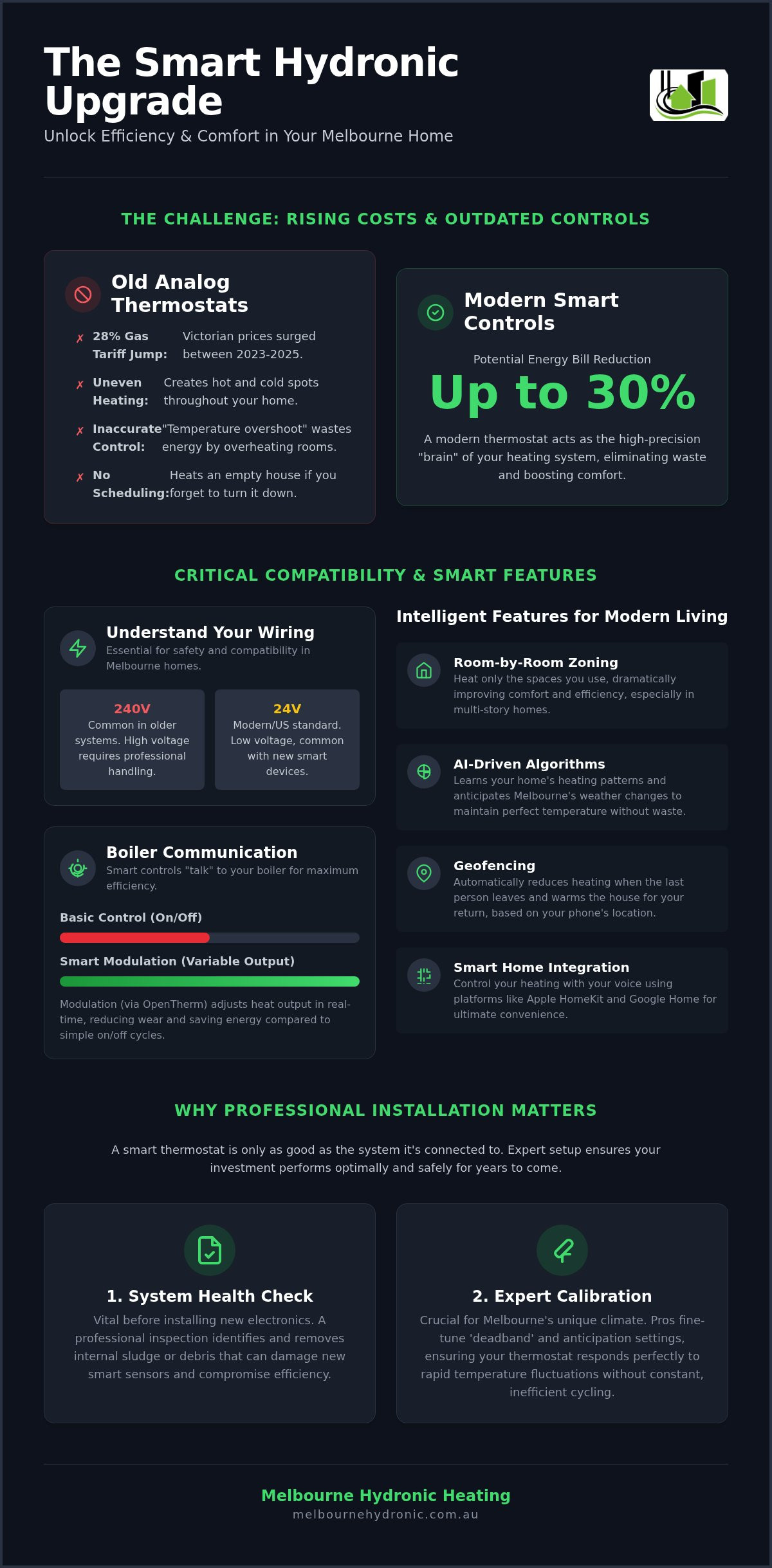
With Victorian gas tariffs jumping by 28% between 2023 and 2025, your old manual dial thermostat isn’t just a relic; it’s a hole in your household budget. Many Melbourne homeowners still struggle with uneven heating, where the lounge room feels like a sauna while the bedrooms remain chilly. You’ve likely noticed that upgrading thermostat for hydronic system components often feels complicated due to the gap between European hardware and Australian electrical standards. It’s frustrating to want a modern home but feel held back by confusing wiring or outdated controls.
We understand that you want a heating system that’s as intelligent as it is comfortable. This guide will show you how a modern control upgrade can slash your energy bills by up to 30% while transforming your living space. You’ll discover how to integrate your radiators with Apple HomeKit or Google Home and finally achieve precise, room-by-room zoning. We’ll walk through the latest 2026 local regulations and the most compatible smart technology to ensure your Melbourne home stays warm, efficient, and future-proof.
Key Takeaways
- Modernizing your controls can reduce Victorian energy bills by up to 30% by acting as the high-precision “brain” of your entire heating system.
- Understanding the technical difference between 24V and 240V wiring is essential when upgrading thermostat for hydronic system components to ensure compliance with Australian standards.
- Implementing room-by-room zoning allows you to heat only the spaces you use, significantly improving comfort and efficiency in multi-story Melbourne homes.
- A professional system health check is vital before installing new electronics to ensure that internal sludge or debris doesn’t compromise your new smart sensors.
- Expert calibration of ‘deadband’ and anticipation settings ensures your thermostat responds accurately to Melbourne’s unique daily temperature fluctuations.
Why Upgrading Your Hydronic Thermostat is the Best Investment in 2026
Think of your thermostat as the command center of your home. It’s the “hydronic brain” that dictates exactly when your pump runs and how hard your heater works. Upgrading thermostat for hydronic system efficiency is the single most impactful change a Melbourne homeowner can make in 2026. With Victorian gas tariffs having risen by 28% between 2023 and 2025, every minute of unnecessary boiler operation directly impacts your bank account. Modern Smart thermostats use predictive algorithms to manage these costs. They don’t just react to the cold; they anticipate it. Melbourne’s weather is notoriously fickle. One hour it’s 18 degrees, the next it’s 8. AI-driven controls process these shifts in real-time, ensuring your home remains a sanctuary without wasting energy on outdated heating cycles.
The Limitations of Traditional Analog Controls
Older systems often rely on mechanical bimetallic strips. These strips physically bend to complete a circuit, but they lose their tension and accuracy after 10 or 15 years of use. This leads to “temperature overshoot,” where your system stays on longer than necessary and heats the room to 23 degrees when you only asked for 21. That two-degree difference represents a significant waste of gas or electricity. Traditional dials also lack scheduling capabilities. If you leave for work and forget to turn the dial down, you’re essentially burning money to heat an empty house. Without digital precision, your premium hydronic system is effectively flying blind.
Immediate ROI: Comfort and Cost Savings
The real magic happens when your control system can “talk” to your heat source. Modern smart thermostats often use OpenTherm protocols to enable modulation. Instead of just turning your boiler on and off at full blast, the system adjusts the flame height or water temperature to match the actual heat loss of the building. This reduces “cycling,” which prevents premature wear on internal components and extends the life of your equipment. Geofencing is a specialized tool that automatically lowers the heat when the last person leaves the house using smartphone GPS. When you consider upgrading thermostat for hydronic system hardware, the return on investment comes through both lower utility bills and a significantly longer system lifespan. By aligning your heating with your actual lifestyle, you stop paying for comfort you aren’t there to enjoy.
Compatibility Guide: Wiring, Boilers, and Heat Pumps
Before selecting a new device, you must understand the technical “voltage gap” that exists in the Australian market. Many popular smart thermostats are designed for the North American 24V standard. However, many older Melbourne hydronic systems operate on 240V mains power. Attempting a DIY install without verifying this can lead to catastrophic failure of your new device or your boiler’s control board. When upgrading thermostat for hydronic system performance, identifying whether you have “dry contact” switching or a high-voltage loop is the first step toward a safe installation. This is particularly vital for homeowners in established suburbs like Camberwell or Malvern, where wiring standards have evolved over several decades.
The shift toward electrification has also changed the compatibility landscape. With the Victorian government’s 2024 ban on gas connections for new homes, more residents are transitioning to heat pump hydronic heating. These electric systems require sophisticated controls that can manage the specific modulation of a heat pump. Unlike a gas boiler that provides rapid, high-intensity heat, a heat pump operates most efficiently when the thermostat can communicate digitally with the unit’s inverter. This ensures the system maintains a steady “cruise” speed rather than constantly stopping and starting.
Is Your Current System Upgradeable?
Most modern condensing boilers and heat pumps use digital bus protocols to exchange data. If your existing thermostat is a simple plastic dial, it likely uses a basic relay to tell the boiler to turn on or off. You can often check your compatibility by carefully removing the thermostat faceplate to inspect the wiring. If you see only two wires, you have a simple switch loop. Choosing ENERGY STAR certified smart thermostats ensures you’re using hardware built for efficiency, but these often require a relay box to bridge the gap between the smart interface and your specific boiler model.
The Role of the Common Wire (C-Wire)
Smart thermostats require constant power to maintain their Wi-Fi connection and run their vibrant touchscreens. This power is usually delivered via a “C-wire” or Common wire. Many heritage Melbourne renovations only have two-wire setups, which don’t provide this dedicated power. In these cases, you don’t necessarily need to tear open your walls to run new cables. Power Extender Kits (PEK) can often be installed at the boiler end to provide the necessary current over your existing wires. If you’re unsure about your home’s current wiring configuration, a professional wiring audit can prevent costly mistakes and ensure your new controls work seamlessly from day one.
Comparing the Top Smart Controls for Melbourne Homes
Selecting the right hardware is the most visible part of upgrading thermostat for hydronic system setups. While aesthetics matter in a modern Melbourne renovation, the internal logic of the device determines how well it interacts with your water-based system. Most global brands focus on air-based HVAC, so choosing a model with specific hydronic features is vital for maintaining a consistent ambient temperature. A smart interface should simplify your life, not add technical friction to your daily routine.
Google Nest vs. Ecobee for Hydronic Systems
Google Nest remains a popular choice for its sleek stainless steel finish and intuitive interface. Its standout feature for Victorian homeowners is “True Radiant,” a learning algorithm designed specifically for the thermal lag of hydronic systems. It learns exactly how long your radiators take to warm up and shuts off the heat before the room gets too hot. Ecobee SmartPremium takes a different approach by focusing on multi-room sensing. It uses remote sensors to monitor temperatures in different parts of the house. This is a game-changer for long Melbourne terrace houses in suburbs like Fitzroy or Carlton, where the front bedroom might be freezing while the back kitchen stays warm. Both systems integrate seamlessly with Apple HomeKit, Google Home, and Amazon Alexa, allowing for effortless voice control.
Specialist Controls for Underfloor and Multi-Zone Systems
Standard smart thermostats often struggle with the unique demands of underfloor heating. Because a concrete slab holds heat for hours, you need a controller that doesn’t just react to air temperature but understands the energy stored in the floor. Brands like Ivar and Siemens offer specialized hydronic logic that manages this thermal mass more effectively than generic alternatives. The Ivar Cubodomo system is particularly effective for minimalists who want discrete, zone-specific control without a bulky unit on every wall. When you’re committed to upgrading thermostat for hydronic system components in a large property, these specialized brands offer the robust relay support and manifold integration that consumer-grade gadgets sometimes lack.
Always ensure your chosen hardware supports Australian app stores and local time zones. Some grey-market imports might struggle with local server connectivity or daylight savings transitions. A locally supported device ensures you receive the latest firmware updates to keep your system secure and functional within the variable Melbourne climate. Choosing a supported brand means your smart home ecosystem remains stable and responsive year-round.
Retrofitting and Zoning: How to Upgrade an Existing System
Upgrading the control interface of your home is a technical process that requires a holistic view of your plumbing. When you begin the journey of upgrading thermostat for hydronic system performance, you aren’t just swapping a plastic box on the wall. You’re recalibrating how water moves through your home. This transition involves four critical steps: a system health check, strategic zoning, hardware integration, and final balancing. Each phase ensures your new digital sensors aren’t being undermined by legacy mechanical issues that often plague older Victorian properties.
The Power Flush Connection: Accuracy Matters
Sludge is the silent enemy of smart technology. Over time, internal corrosion creates a thick magnetite debris that settles in your pipes and radiators. This creates “cold spots” where a radiator panel doesn’t reach its target temperature. If your new thermostat is located near a partially blocked unit, it will continuously call for more heat. This forces your boiler to work overtime to warm a room that the thermostat perceives as cold, even if the rest of the house is overheating. A comprehensive hydronic heating service melbourne is the essential prerequisite for any control upgrade. Industry professionals report that a clean, debris-free system can respond up to 20% faster to thermostat commands. This responsiveness allows your smart sensors to maintain a tighter temperature range, preventing the energy-wasting swings common in neglected systems.
Zoning Radiator Panels with Smart TRVs
Zoning is where the most significant energy savings are found. In a traditional Melbourne setup, the whole house is usually either on or off. By installing Smart Thermostatic Radiator Valves (TRVs) on each hydronic heating panel, you turn every room into an independent climate zone. These valves act as “slaves” to the master thermostat, opening and closing based on the specific needs of that individual space. For underfloor systems, this process involves installing thermal actuators on the manifold. These actuators are the physical “gates” that your thermostat opens when a specific zone needs warmth. Once these components are in place, your technician must balance the system flow. This ensures that when only one small zone is active, the pump pressure remains stable and silent. If you’re ready to modernize your home’s comfort, schedule a professional system audit to see how digital zoning can transform your energy efficiency.
Professional Integration: Why Expert Setup Matters in Melbourne
While the sleek screens and mobile apps of modern controls are enticing, the physical integration of these devices is a high-stakes task. Upgrading thermostat for hydronic system hardware in Victoria often involves navigating 240V mains power, which is significantly more dangerous than the low-voltage systems found overseas. A mistake during a weekend DIY project doesn’t just risk a blown fuse; it can permanently damage your boiler’s motherboard or even violate your home insurance policy. Professional installation ensures that every connection is secure and compliant with local electrical standards, providing the peace of mind that comes from certified expertise.
Expert setup goes beyond simple wiring; it’s about the fine-tuning that happens after the device is powered on. Our technicians calibrate specific parameters like “deadband” and “anticipation” to suit the variable Melbourne climate. The deadband is the small temperature range around your setpoint that prevents your system from constantly clicking on and off. If this isn’t set correctly, your pump and boiler will suffer from excessive wear and tear. Anticipation settings allow the system to learn the unique thermal inertia of your home, whether you live in a drafty Geelong heritage house or a high-performance modern build. This level of precision is how Melbourne Hydronic Heating has helped local families maintain comfort for over 30 years.
Local Expertise for Melbourne & Geelong
Navigating Victorian plumbing and electrical codes requires a deep understanding of local retrofitting requirements. Every house layout is different, and a one-size-fits-all approach to control logic leads to wasted energy. As a local, family-owned business, we understand the architectural quirks of Melbourne and Geelong. We design control solutions that respect the integrity of your property while providing the premium life quality you deserve. Our team doesn’t just install a box; we tailor the entire “hydronic brain” to work in harmony with your specific insulation levels and room usage patterns.
Next Steps: Your Path to a Smarter Home
The shift toward an all-electric, smart-controlled future is already happening across Victoria. Transitioning from a gas boiler to a high-efficiency heat pump is a significant step, and having the right thermostat in place is the foundation of that journey. We provide ongoing support through remote diagnostics and annual maintenance to ensure your system remains as efficient in year ten as it was on day one. Modernizing your controls is the first step toward a healthier, more sustainable home environment.
Ready to modernize? Get a professional thermostat upgrade quote today.
Future-Proof Your Melbourne Home with Smart Hydronic Controls
Modernizing your home’s heating logic is more than a convenience; it’s a strategic response to rising Victorian energy costs. By upgrading thermostat for hydronic system efficiency, you gain the ability to manage your comfort with room-by-room precision while reducing unnecessary boiler operation. Whether you’re navigating complex 240V wiring or preparing for a full transition to an electric heat pump, the right control system acts as the essential brain of your environment. It ensures your investment in comfort translates into measurable utility savings.
With over 30 years of experience across Melbourne and Geelong, our team specializes in bridging the gap between advanced international technology and local architectural requirements. We combine professional maintenance, including expert power flushing, with precision calibration to ensure your system operates at peak performance. Don’t let outdated controls drain your budget or compromise your home’s well-being. Upgrade your Melbourne hydronic system with expert thermostat integration today and enjoy a more sustainable, comfortable lifestyle. Your path to a smarter, more efficient home is just a consultation away.
Frequently Asked Questions
Can I use a Nest thermostat with my hydronic radiator system?
Yes, you can use a Nest thermostat with your hydronic radiator system, provided it’s installed with a compatible relay or Heat Link. Most Nest units are designed for 24V North American systems, while many Melbourne homes use 240V switching. A professional installer ensures the voltage is stepped down correctly. Once connected, Nest’s True Radiant software learns your home’s thermal mass to prevent overheating and maximize comfort.
Do I need a C-wire to upgrade to a smart thermostat in an old Melbourne house?
Most modern smart thermostats require a C-wire to provide constant power for Wi-Fi and touchscreens. Many heritage homes in suburbs across Melbourne and Geelong often only have two-wire setups. You don’t necessarily need to rewire your entire house. We often use Power Extender Kits or external power adapters to bridge this gap without damaging your walls or compromising the system’s clean aesthetic.
How much can I actually save on my Melbourne energy bills with a smart thermostat?
Upgrading thermostat for hydronic system efficiency can reduce your annual energy bills by up to 30%. These savings come from eliminating temperature overshoot and using geofencing to lower heat when you’re away. Since Victorian gas prices rose significantly between 2023 and 2025, even a small reduction in boiler runtime translates into substantial dollar savings. The exact amount depends on your home’s insulation and your specific heating habits.
Is it possible to have different temperatures in every room with hydronic heating?
Yes, achieving room-by-room control is entirely possible by installing Smart Thermostatic Radiator Valves on your radiator panels. This allows you to set a cozy 21 degrees in the lounge while keeping unused guest rooms at 16 degrees. For underfloor systems, we use thermal actuators on the manifold to achieve similar results. This level of zoning ensures you’re only paying to heat the spaces you’re actively using.
Does a smart thermostat work with an electric heat pump as well as a gas boiler?
Smart thermostats are compatible with both gas boilers and modern electric heat pumps. However, heat pumps benefit from specific digital protocols that allow the thermostat to communicate with the unit’s inverter. This prevents the heat pump from short cycling, which is vital for maintaining the high efficiency levels these systems are known for. It’s a key step for Melbourne homeowners transitioning away from gas toward a fully electric future.
What happens to my hydronic heating if the Wi-Fi goes down?
Your heating will continue to function even if your Wi-Fi connection drops out. Most smart thermostats are designed to maintain their last programmed schedule or allow for manual temperature adjustments directly on the wall unit. While you’ll temporarily lose remote app control and geofencing features, your home will remain warm. Once your internet service is restored, the system will automatically reconnect and sync your data without manual intervention.
Will upgrading my thermostat fix my radiators if they aren’t getting hot?
A new thermostat won’t fix physical blockages or air pockets within your radiators. If certain panels remain cold while the system is running, the issue is likely internal corrosion or sludge. We recommend a professional power flush and system service before upgrading thermostat for hydronic system controls. This ensures your new digital sensors are reading accurate temperatures and that the water can actually circulate effectively through every room.
Can I install a smart thermostat myself or do I need a licensed professional?
In Victoria, any work involving 240V wiring or system modifications valued over $750 legally requires a licensed professional and a VBA Compliance Certificate. Hydronic systems are complex pressurized environments. A licensed technician ensures your warranty remains valid and that the control logic is calibrated correctly for Melbourne’s climate. Attempting a DIY install on a high-voltage system poses significant safety risks and could lead to expensive component failures.