Best Heating for Double Brick Homes in Melbourne: 2026
Why does your living room still feel like a walk-in freezer even when the heater is cranked to the max? If you’re living in one of Melbourne’s iconic Victorian or Edwardian houses, you’ve likely realized that standard air conditioners often lose the battle against solid masonry. These beautiful properties were built to last, but their thick walls act as a massive heat sink, absorbing warmth and leaving you with a persistent, bone-deep chill. Finding the best heating for double brick homes Melbourne owners can rely on requires a shift from heating the air to heating the structure itself.
We understand the frustration of high energy bills that don’t deliver actual comfort. This guide explains how radiant hydronic systems master the thermal mass of your home, turning cold brickwork into a source of steady, gentle warmth. You’ll discover why hydronic radiator panels are the superior choice for 2026, especially when paired with modern electric heat pumps. We’ll show you how to achieve a healthier, dust-free environment while significantly lowering your seasonal running costs and mastering the unique thermal lag of your period home.
Key Takeaways
- Learn how to master your home’s thermal mass by turning cold brick walls into a “thermal battery” that radiates steady warmth.
- Understand why radiant hydronic panels are the best heating for double brick homes Melbourne residents can choose for draft-free comfort.
- Explore the health advantages of fan-free heating that doesn’t circulate dust or allergens throughout your living spaces.
- Compare the long-term efficiency of modern electric heat pumps against traditional gas boilers under Victoria’s latest energy standards.
- Discover how subfloor retrofitting allows you to install premium heating without disturbing the heritage features of your period home.
The Double Brick Challenge: Why Melbourne Homes Stay Cold
Melbourne’s heritage charm often comes with a hidden cost: a persistent winter chill. Double brick construction is a hallmark of local architecture, yet it presents a unique thermodynamic hurdle. Unlike modern timber frames that rely on lightweight insulation, solid brick acts as a massive thermal battery. In winter, these walls soak up the cold from the outside, creating a cold-sink effect where your heater is forced to fight the freezing masonry before it can even begin to warm the room. Without addressing the structure itself, even the most expensive air-based systems will leave you reaching for a jumper.
The Science of Thermal Mass
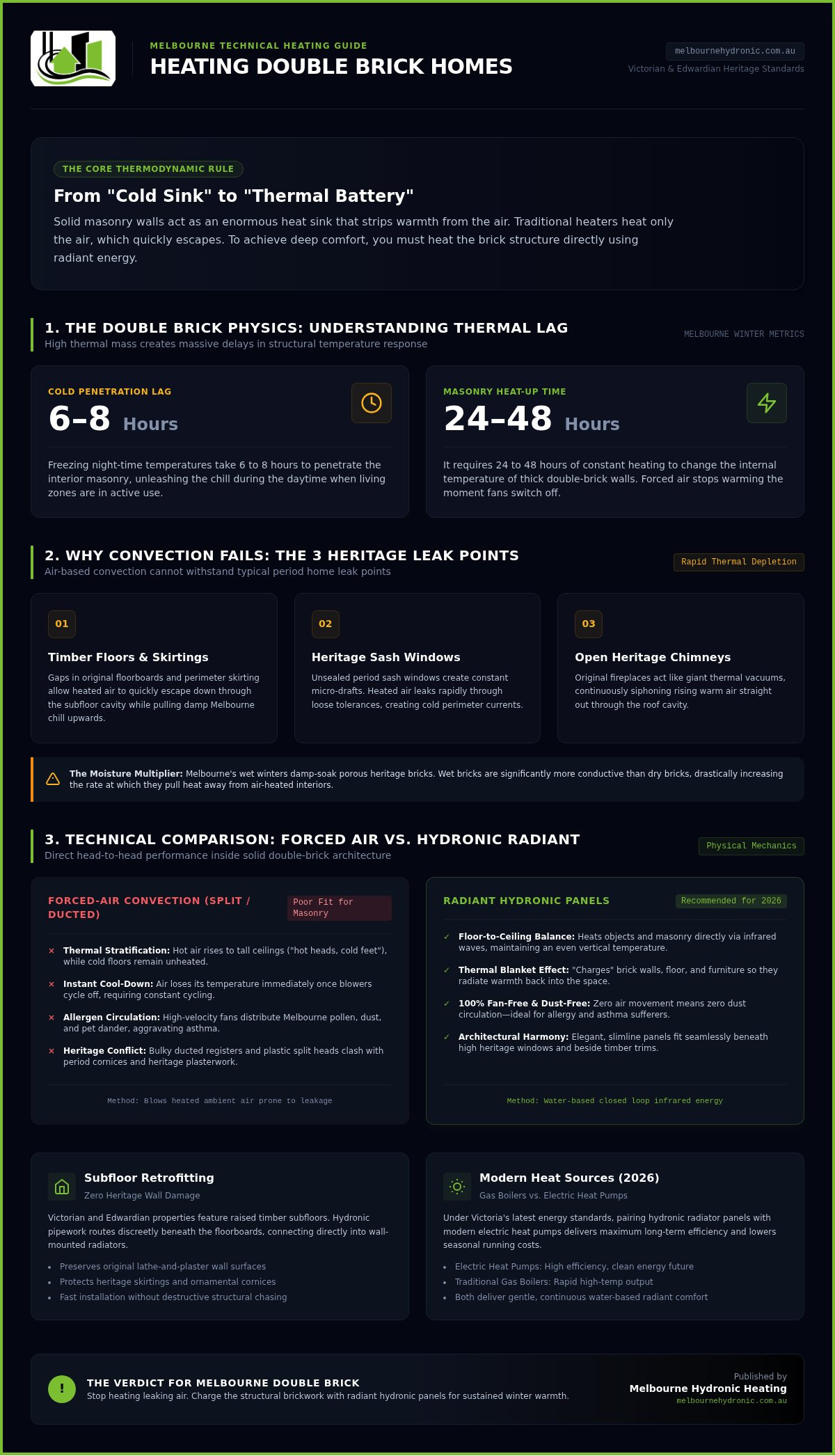
Double brick walls possess high thermal mass, which leads to a phenomenon known as thermal lag. In a typical Melbourne winter, this lag lasts roughly 6 to 8 hours. This means the freezing temperatures from a frosty night don’t fully penetrate the interior until the following day. Conversely, it can take 24 to 48 hours of constant heating to actually change the internal temperature of the masonry. This is why the principles of radiant heating are so vital for these properties. Radiant systems transfer energy directly into the building’s envelope rather than just warming the air. To find the best heating for double brick homes Melbourne owners must look for solutions that “charge” the walls with warmth, turning the cold-sink into a source of steady heat.
Heat Loss in Period Properties
Traditional insulation methods usually fail in heritage structures because the narrow cavities between brick layers are either inaccessible or prone to moisture bridges. Melbourne’s high winter humidity also introduces dampness into the porous brickwork. Wet bricks are far more conductive than dry ones, meaning they pull heat out of your home at an accelerated rate. Standard convection heating is particularly ineffective in this environment. Because air is a poor conductor, the warmth it carries is instantly lost through several common leak points:
- Gaps in original timber floorboards and skirting.
- Unsealed heritage sash windows.
- Open chimneys that act like vacuums for warm air.
When you rely on air-based heating, the cold masonry surfaces simply strip the warmth from the air as it circulates. This creates a cycle where you’re constantly paying to heat air that escapes or cools down immediately. Mastering the best heating for double brick homes Melbourne requires a shift away from air-based convection toward systems that provide a consistent, radiant floor-to-ceiling temperature.
Convection vs. Radiant Heat: The Battle for Brick Homes
Choosing the best heating for double brick homes Melbourne owners often find themselves deciding between air-based convection and water-based radiant systems. Most people are familiar with forced-air heating, such as ducted systems or split systems, which work by blowing hot air into a room. While these might seem fast, they struggle in the dense, high-mass environment of a double brick house. Because air is a poor conductor of heat, it does very little to warm the actual structure of your home. Instead, the warmth is quickly absorbed by the cold masonry, leading to a cycle of constant operation and high energy consumption.
The Failure of Forced Air
Convection heating creates a significant comfort issue known as stratification. In many of Melbourne’s period homes, high ceilings cause the warm air to rise immediately, leaving your feet cold while the space near the ceiling stays hot. This “hot heads and cold feet” problem is exacerbated by the fact that air cools down the moment the fan stops. For families dealing with Melbourne’s high pollen counts, these systems also present a health challenge. Forced air circulates dust, pet dander, and allergens throughout every room, which can be a major trigger for asthma sufferers. Beyond the health impact, the aesthetic of bulky units often clashes with heritage plasterwork and ornate cornices.
The Radiant Advantage
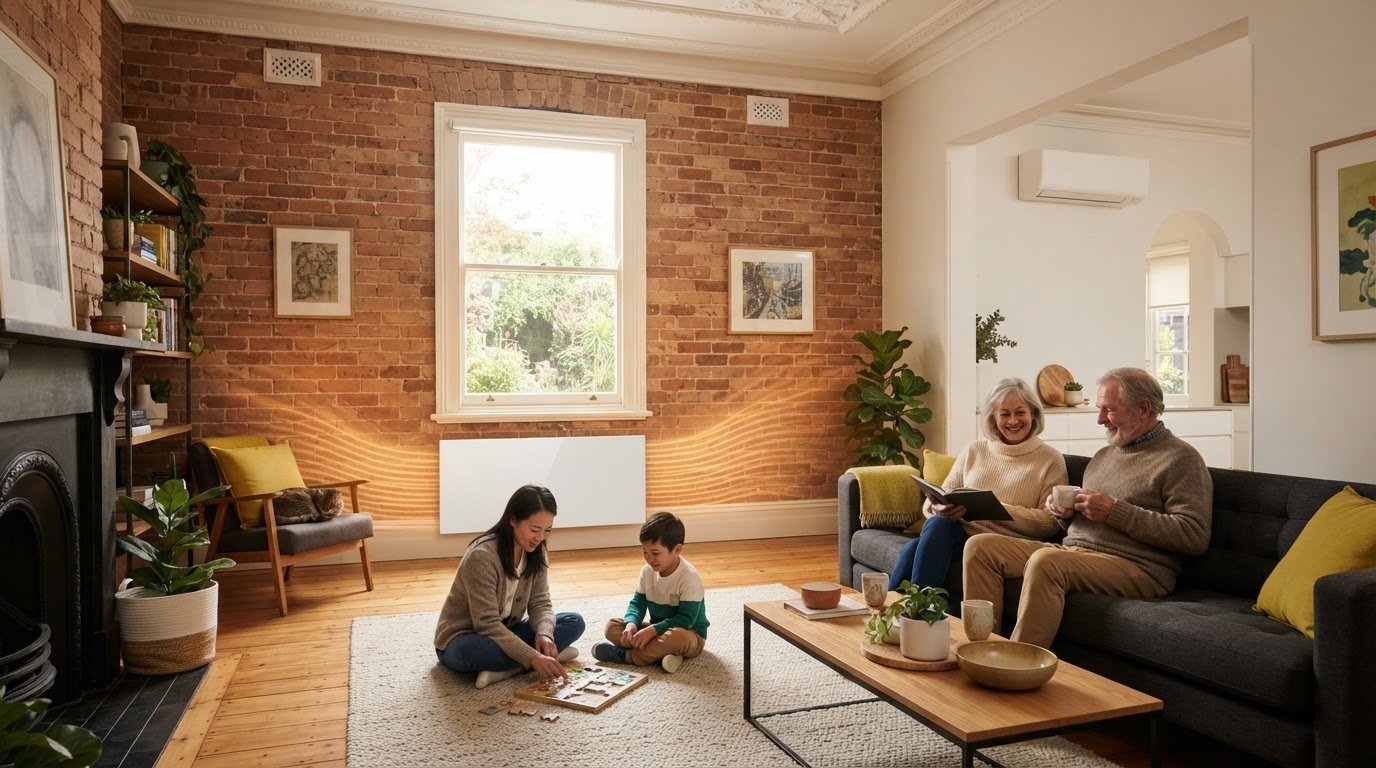
Radiant heat operates on a completely different physical principle. Rather than heating the air, it warms objects and people directly through infrared waves, much like the sun. This is the core reason why hydronic heating is considered the gold standard for solid masonry buildings. When you use radiant panels, the energy is absorbed by the brickwork, furniture, and floor. This creates a “thermal blanket” effect where the entire room maintains a consistent, even temperature from floor to ceiling.
According to the Your Home guide to thermal mass, managing the temperature of high-density materials like brick is essential for year-round comfort. Radiant systems are silent, movement-free, and don’t rely on fans, making them the most hygienic choice for modern living. They work with the physics of your home rather than against it. If you’re looking for a system that delivers premium comfort without the noise or dust, you can explore how these specialised hydronic solutions transform the living experience in older Melbourne properties.
Best Hydronic Solutions for Double Brick: Radiators vs. Underfloor
Double brick homes require a strategic choice between radiator panels and underfloor systems. Each delivery method interacts differently with the high thermal mass of masonry. Whether you’re retrofitting a heritage cottage in Geelong or extending a Victorian terrace in Carlton, the delivery method you choose will dictate your daily comfort and long-term running costs. While both systems provide the superior radiant warmth discussed earlier, their application depends heavily on your home’s layout and flooring structure.
Hydronic Radiator Panels
Radiator panels are often the best heating for double brick homes Melbourne owners can choose for a retrofit. Their primary advantage is response time. Unlike slab heating, which can take several hours to reach a comfortable temperature, hydronic heating panels provide warmth much faster. This flexibility is essential for Melbourne’s volatile weather, where a sunny morning can turn into a freezing afternoon in minutes. By placing panels on internal brick walls or beneath windows, you effectively “charge” the masonry to block drafts. Modern panels are no longer just bulky white boxes; they serve as design features, with vertical slimline models and period-correct cast iron styles that enhance heritage interiors.
Hydronic Underfloor Heating
For those seeking the ultimate luxury of warm feet on a cold Melbourne morning, underfloor heating is unmatched. In existing double brick properties, installing this in heritage rooms can be challenging due to floor heights and skirting boards. It’s most effective in new extensions where pipes can be laid directly into a concrete slab. This turns the entire floor into a massive, low-temperature radiator. According to Sustainability Victoria’s heating systems guide, matching your heat emitter to your specific floor type is vital for maximizing energy efficiency. If you have large floor-to-ceiling glass doors, hydronic trench heating provides a discreet solution, creating a curtain of warmth without occupying wall space.
We often find that a hybrid approach works best for Melbourne’s double brick homes. You might choose underfloor heating for a new open-plan living area while retaining the fast-acting control of radiator panels in the original bedrooms. This allows for precise zoning, ensuring you aren’t wasting energy heating unused spaces. By combining these technologies, you can master the thermal lag of your home and enjoy a consistent, premium living environment year-round.
Efficient Heat Sources: Gas Boilers vs. Electric Heat Pumps
The energy landscape in Victoria is undergoing a significant transformation. As we move through 2026, the shift toward all-electric living is no longer just a trend; it’s a regulatory reality for many. For owners seeking the best heating for double brick homes Melbourne offers, the choice of heat source is the most critical decision for long-term sustainability. While the delivery method-radiators or underfloor pipes-determines how you feel the heat, the boiler or heat pump determines how much you pay for it. Both options have distinct technical advantages depending on your home’s existing infrastructure and your environmental goals.
Electric Heat Pumps
Modern air-to-water heat pumps represent the pinnacle of efficiency for hydronic systems. These units don’t create heat through combustion; instead, they extract thermal energy from the outside air and transfer it into your home’s water circuit. Even on a 2°C Melbourne morning, these systems operate with remarkable effectiveness. An electric heat pump typically achieves a Seasonal Coefficient of Performance (SCOP) between 3.0 and 4.5. This means for every 1kW of electricity used, you receive 3kW to 4.5kW of heat energy.
Choosing heat pump hydronic heating is particularly strategic if you have a rooftop solar PV system. You can program the pump to “charge” your home’s thermal mass during daylight hours, essentially using your brick walls as a battery for free energy. This integration can reduce annual running costs to between $900 and $1,350, a stark contrast to the $1,600 to $4,100+ often seen with standard gas tariffs in 2026.
Modern Gas Boilers
Despite the push for electrification, high-efficiency gas boilers remain a reliable solution for many heritage retrofits. Traditional radiator panels in older double brick homes were often sized to run at high water temperatures, usually around 65°C to 75°C. While heat pumps are becoming better at reaching these temperatures, a gas boiler replacement can sometimes be the more straightforward path for existing systems. Modern condensing boilers are significantly more advanced than the units installed twenty years ago, capturing waste heat from exhaust gases to improve efficiency to over 90%.
For smaller inner-city terraces where outdoor space is at a premium, compact “combi” boilers provide both space heating and domestic hot water from a single wall-mounted unit. However, with the Victorian government’s 2027 milestones approaching-including bans on replacing gas hot water systems in rental properties-switching to electric is often the smarter long-term investment. If you are unsure which technology fits your property’s specific masonry layout, you can request a professional system assessment to compare your options.
Retrofitting Hydronic Heating in Melbourne Brick Homes
Many homeowners worry that installing a new system into an existing double brick structure will be invasive or messy. However, with over 30 years of experience in Melbourne and Geelong, we’ve refined techniques that preserve your home’s heritage while delivering modern comfort. Retrofitting is often the only way to achieve the best heating for double brick homes Melbourne families need to combat the persistent “cold-sink” effect of masonry. By working with the building’s existing layout, we can install a premium system with surprisingly little disruption to your daily life.
The Installation Process
The journey begins with a detailed thermal assessment. We calculate the specific heat-load requirements of each room, taking into account the thickness of your brickwork and the height of your ceilings. This engineering precision ensures your boiler or heat pump isn’t oversized or struggling to keep up. It’s the foundation of a system that runs efficiently for decades.
To hide the pipework, we typically utilize the sub-floor crawl spaces found in many of Melbourne’s Victorian and Edwardian homes. Insulated piping is routed beneath the floor joists and brought up directly into the radiator panels through small, discreet penetrations. If your home is on a concrete slab, we look toward attic cavities or slimline wall-mounted trunking. Once the hardware is in place, we perform system balancing. This process fine-tunes the water flow to every radiator, ensuring that the furthest bedroom reaches the target temperature just as quickly as the living room.
Maintaining Your System
A high-quality hydronic installation is a significant long-term investment in your property’s value and your family’s well-being. To ensure it continues to operate at peak efficiency, an annual hydronic heating service is essential. During this check, we inspect the heat pump or boiler components, verify system pressure, and ensure all thermostatic valves are responsive.
Over time, the water inside any closed-loop system can develop a build-up of magnetite, often referred to as “sludge.” This is why we recommend professional power flushing every 5 to 7 years. This process cleans the entire circuit, restoring flow and preventing unnecessary wear on the pump. With this level of professional care, hydronic systems easily last 25 years or more. By choosing a specialist who understands the unique challenges of local architecture, you’re securing the best heating for double brick homes Melbourne can offer, backed by decades of technical expertise.
Achieve Year-Round Comfort in Your Heritage Home
Living in a double brick property shouldn’t mean enduring a bone-deep chill every winter. By mastering the thermal mass of your walls with radiant hydronic technology, you can turn a cold-sink into a source of consistent, healthy warmth. Whether you opt for the rapid response of radiator panels or the luxury of underfloor heating, the key is choosing a system that works with the physics of your home. As Victoria moves toward an all-electric future, integrating a modern heat pump is the smartest way to secure the best heating for double brick homes Melbourne has to offer while keeping running costs low.
At Melbourne Hydronic Heating, we bring 30+ years of local experience to every project. As a family owned and operated business, we are specialists in heritage retrofits, ensuring your home’s character is preserved while its comfort is transformed. You don’t have to settle for drafts and high energy bills. Get a Custom Hydronic Quote for Your Melbourne Home today and start enjoying a premium, dust-free living environment that lasts for generations.
Frequently Asked Questions
Is hydronic heating really the best for double brick homes in Melbourne?
Yes, hydronic is widely considered the best heating for double brick homes Melbourne owners can install. Unlike split systems that only warm the air, hydronic panels emit radiant heat that is absorbed by your thick masonry walls. This process eliminates the cold-sink effect common in Victorian and Edwardian properties. Once the thermal mass of the brickwork is charged, it maintains a steady temperature, providing a level of comfort that air-based systems cannot match.
How much does it cost to install hydronic heating in a 3-bedroom brick house?
Installation costs for a three-bedroom home vary based on the number of radiator panels required and the choice of heat source. Factors such as whether you select an electric heat pump or a gas boiler, along with the accessibility of your sub-floor or attic, will influence the total investment. Every project requires a custom design to ensure the system is perfectly sized for your home’s specific heat-load requirements and architectural layout.
Can I install hydronic radiators without tearing down my heritage walls?
You can absolutely install hydronic radiators without damaging your heritage plasterwork or tearing down walls. We specialize in non-invasive retrofits for period homes across Melbourne and Geelong. By utilizing sub-floor crawl spaces or ceiling cavities, we route insulated pipework discreetly to each room. The only visible components are the stylish radiator panels themselves, which often enhance the aesthetic of traditional rooms while providing modern, efficient warmth.
Will an electric heat pump work in Melbourne’s coldest winter nights?
Modern electric heat pumps are engineered to operate efficiently even when Melbourne’s temperature drops toward freezing. These systems extract ambient heat from the outside air at temperatures as low as -10°C, which is well below a typical local winter night. For maximum efficiency during peak cold snaps, we ensure your heat pump is correctly integrated with your radiator circuit, providing reliable warmth without the need for traditional gas combustion.
Does hydronic heating help with condensation and mould in brick homes?
Radiant heating is highly effective at reducing condensation and mould issues in solid brick structures. By warming the internal leaf of the brickwork directly, hydronic systems prevent the dew point from forming on cold wall surfaces. This consistent, gentle warmth helps to dry out damp masonry and maintain a stable indoor humidity level. It’s a proactive way to protect both your family’s health and the structural integrity of your heritage property.
How long does a hydronic heating installation take in an existing home?
A typical retrofit in an existing Melbourne home usually takes between three and seven business days to complete. The duration depends on the complexity of the pipe routing and the number of zones being installed. Our team focuses on minimizing disruption, often working beneath the floorboards so your daily routine remains largely unaffected. We provide a clear timeline during the initial consultation so you know exactly what to expect during the installation phase.
Is hydronic heating better for people with asthma or allergies?
Hydronic systems are the gold standard for residents dealing with asthma or seasonal allergies. Standard air conditioners and ducted heaters rely on fans that constantly circulate dust, pollen, and pet dander throughout your living spaces. Because hydronic panels use natural convection and radiation without any moving air, they keep your indoor air quality clean and still. This makes them a superior lifestyle choice for health-conscious families in the Melbourne region.
Can I use my existing gas connection for a new hydronic system?
You can certainly use your existing gas connection if you choose a modern gas boiler for your hydronic system. High-efficiency condensing boilers are a proven technology for heritage homes, especially where electrical upgrades might be difficult. However, many homeowners are now opting to decommission their gas lines in favor of electric heat pumps. This shift avoids future gas network fees and aligns with Victoria’s long-term move toward all-electric residential energy standards.