Hydronic Underfloor Heating Running Costs: A 2026 Melbourne Guide
Your hydronic underfloor heating running costs don’t have to be a winter mystery. For too long, Melbourne homeowners have opened their energy bills in July with a sinking feeling, unsure whether their system is working efficiently or quietly draining their budget. With Victorian gas prices continuing to shift and heat pump technology advancing rapidly, that uncertainty is no longer something you have to accept.
You already know that hydronic underfloor heating delivers a quality of warmth that ducted systems simply can’t match. The radiant heat, the silence, the even temperature from floor to ceiling. What you want to know is whether it’s actually cheaper to run than the alternatives, and what you can do right now to bring those costs down.
This guide gives you exactly that. Drawing on 30 years of local experience across Melbourne’s famously unpredictable climate, we break down realistic annual running cost estimates, compare gas boiler and electric heat pump performance side by side, and show you how integrating solar PV can turn your hydronic system into one of the most cost-effective heating solutions available in Victoria today.
Key Takeaways
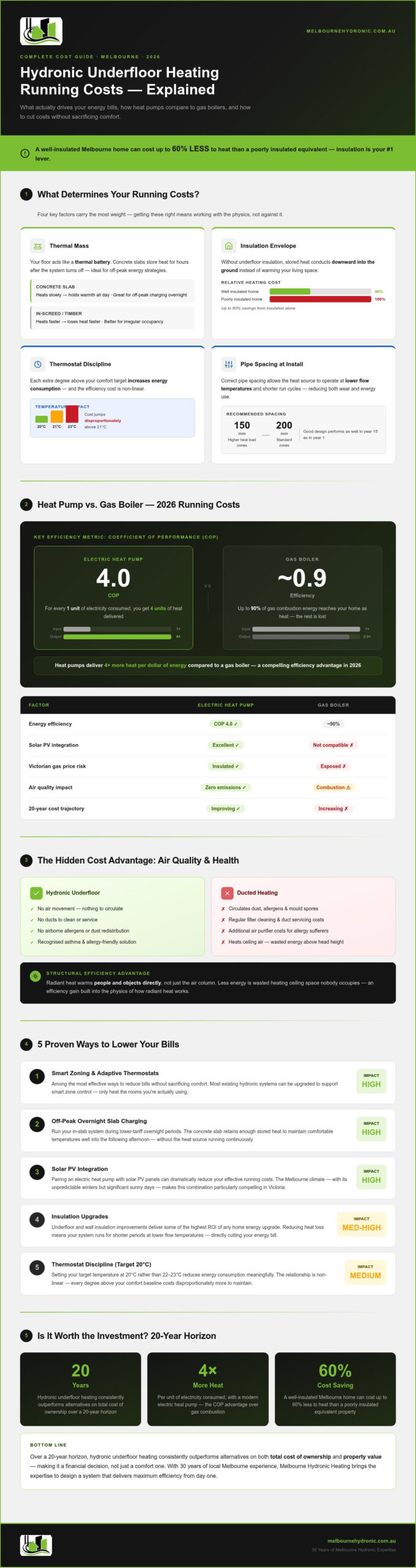
- Hydronic underfloor heating running costs vary significantly based on your floor construction and insulation rating — a well-insulated Melbourne home can cost up to 60% less to heat than a poorly insulated one.
- Electric heat pumps now deliver a COP of 4.0, meaning you get four units of heat for every unit of electricity consumed — a compelling efficiency advantage over traditional gas boilers in 2026.
- Melbourne’s unpredictable climate affects how your system responds and what you pay — understanding the local heating load is the key to accurate budgeting and smarter system design.
- Smart zoning and adaptive thermostat strategies are among the most effective ways to reduce your bills without sacrificing comfort — and most existing hydronic systems can be upgraded to support them.
- Over a 20-year horizon, hydronic underfloor heating consistently outperforms alternatives on both total cost of ownership and property value — making it a financial decision, not just a comfort one.
What Determines Hydronic Underfloor Heating Running Costs?
Most cost calculators you’ll find online reduce hydronic underfloor heating running costs to a single variable: floor area in square metres. That’s a starting point, not an answer. The real determinants are far more nuanced, and understanding them is what separates a system that runs efficiently for decades from one that quietly inflates your energy bills every winter.
Four factors carry the most weight: the thermal mass of your floor construction, the quality of your home’s insulation envelope, how you set and manage your thermostat, and whether your system was designed with correct pipe spacing from the outset. Get these right, and you’re working with the physics rather than against it.
Thermal Mass: Your Floor as a Battery
Concrete slabs behave fundamentally differently from timber floors, and that difference has a direct impact on what you pay to heat your home. A concrete slab in an in-slab hydronic system absorbs heat slowly over several hours, then releases it gradually and evenly long after the heat source has cycled off. Think of it as a thermal battery that charges during low-demand periods and discharges warmth throughout the day.
This characteristic makes concrete slab systems particularly well-suited to off-peak heating strategies. By running the system during lower-tariff periods overnight, the slab retains enough stored heat to maintain comfortable temperatures well into the following afternoon, without the heat source running continuously. In-screed systems, which sit above an existing substrate, have less thermal mass and respond more quickly to temperature changes. They heat up faster but also lose heat faster, which suits homes where occupancy patterns are irregular but generally means less opportunity to exploit off-peak energy pricing.
Insulation beneath the slab is equally critical. Without adequate underfloor insulation, a significant portion of that stored heat conducts downward into the ground rather than upward into your living space. A well-insulated home with a strong energy star rating can cost substantially less to heat than a comparable but poorly insulated property, because less energy is lost before it reaches you.
Thermostat discipline matters more than most homeowners realise. Each degree you add above your target comfort temperature increases energy consumption noticeably, because the system must maintain a higher water flow temperature to compensate. The relationship isn’t linear; the efficiency cost of pushing from 20°C to 23°C is proportionally greater than the initial degrees of heating.
The Health Dividend: A Cost Benefit Competitors Don’t Mention
Running cost comparisons almost never account for what ducted systems cost you beyond the energy bill. Ducted heating circulates air through ductwork that accumulates dust, allergens, and mould spores, requiring regular filter cleaning and professional servicing to maintain acceptable air quality. For households managing asthma or allergies, the ongoing cost of air purifiers, medical consultations, and lost productivity is real and measurable.
Hydronic underfloor heating produces no air movement. There’s nothing to circulate, no ducts to clean, and no airborne particulates being redistributed through your living spaces. That’s why it’s consistently recognised as an asthma and allergy-friendly heating solution, not just a comfort upgrade. Radiant heat also warms people and objects directly rather than heating the air column from floor to ceiling, which means less energy is wasted warming ceiling space that nobody occupies. The efficiency gain is structural, built into how radiant heat works rather than dependent on any particular setting or habit.
When you factor in correct pipe spacing at installation, typically between 150mm and 200mm centres depending on the heat load calculation for each zone, the system’s heat source operates at lower flow temperatures and shorter run cycles. That reduces wear on the boiler or heat pump and lowers your energy consumption simultaneously. Good design isn’t a luxury; it’s the foundation of a system that performs as efficiently in year fifteen as it did in year one.
Heat Pump vs. Gas Boiler: Comparing 2026 Running Costs
The choice between an electric heat pump and a gas boiler is no longer a straightforward one. Victorian energy policy is shifting, gas network costs are rising independently of commodity prices, and heat pump technology has reached a maturity point where the efficiency numbers genuinely change the financial case. For Melbourne homeowners assessing hydronic underfloor heating running costs, understanding this divide is now essential.
The Efficiency of Modern Electric Heat Pumps
COP, or Coefficient of Performance, is the single most important number in this comparison. A COP of 4.0 means the heat pump delivers four units of thermal energy for every one unit of electricity it consumes. No gas boiler, regardless of how efficient, can exceed a COP of 1.0, because combustion cannot produce more energy than the fuel contains. That gap is structural, not incremental.
In a Melbourne winter, ambient temperatures typically range between 5°C and 13°C overnight, which sits within the comfortable operating range of modern air-to-water heat pumps. Cold-climate models maintain strong performance down to around -10°C, meaning Melbourne’s winters rarely push these systems into their less efficient operating bands. The practical result is that electric hydronic heating performs reliably through the heating season without the efficiency penalties that affect heat pumps in genuinely sub-zero climates.
One variable worth understanding: heat pump COP does drop as outdoor temperatures fall. A unit rated at COP 4.0 at 7°C ambient may operate closer to COP 2.5 to 3.0 on Melbourne’s coldest nights. Even at that reduced performance, it still uses significantly less energy than gas combustion for the same heat output.
Gas Boilers: When Do They Still Make Sense?
Modern condensing gas boilers achieve efficiency ratings of up to 95%, which represents a genuine improvement over older systems. The lower upfront capital cost remains a real consideration, particularly for homeowners replacing an existing boiler rather than designing a new system. Gas infrastructure is already in place across most Melbourne suburbs, and the installation pathway is well understood.
The honest counterargument is trajectory. Victorian gas standing charges and usage rates have increased steadily, and policy direction is clearly favouring electrification over the medium term. A gas boiler installed today will still be operating in 2035, in a regulatory and pricing environment that’s difficult to predict with confidence. For homeowners weighing that uncertainty, choosing the best hydronic boiler for your situation requires weighing both current economics and longer-term exposure to gas network costs.
The ‘all-electric’ home transition is also reshaping the ROI calculation. Homeowners who pair a heat pump with solar PV effectively reduce their heating cost to near-zero during daylight hours, an offset that’s simply not available to gas systems. That combination is increasingly where the most compelling running cost reductions are found, and it’s a conversation worth having before committing to either heat source.
If you’re unsure which direction makes sense for your property and usage pattern, speaking with a specialist who understands both technologies in Melbourne’s specific climate context will give you a clearer picture than any general comparison can.
The Melbourne Factor: Climate and Solar Integration
Melbourne’s notorious “four seasons in one day” pattern isn’t just a local joke. It’s an engineering variable that directly shapes your hydronic underfloor heating running costs in ways that generic online calculators simply don’t account for. A system designed around Melbourne’s specific swing between a 7°C frost at dawn and a 17°C afternoon can be tuned to respond intelligently to that variability. One designed around a stable climate will fight it.
The practical consequence is this: Melbourne homes experience more frequent heating demand fluctuations than cities with steadier winter climates. A concrete slab system that’s been correctly designed for local conditions will absorb and retain heat through those mid-morning warm spells and release it through the cold snap that follows. A poorly matched system will cycle on and off inefficiently, chasing a moving target and consuming more energy in the process.
Optimising for Melbourne’s Winter Sun
Melbourne’s winter days are short but not sunless. Between roughly 10am and 3pm on a clear July day, a north-facing rooftop solar array can generate meaningful output, often enough to run a heat pump with minimal draw from the grid. Scheduling your system to run during this window is one of the most practical strategies available for reducing underfloor heating operating costs without any sacrifice in comfort.
The logic is straightforward. A concrete slab charged between 10am and 2pm retains that stored heat well into the evening, effectively acting as a thermal storage unit. You’re using solar energy to pre-load the slab, then drawing on that stored warmth through the peak evening hours when grid electricity rates are highest. This “solar sponge” approach doesn’t require a battery system; the slab itself is the battery.
Double glazing plays a critical supporting role here. Without it, heat absorbed by the slab during the day escapes through single-glazed windows as outdoor temperatures drop in the late afternoon. Homes with quality double glazing retain that radiant warmth significantly longer, extending the effective discharge window of the slab and reducing how often the heat source needs to cycle on after dark.
Regional Cost Variances in Victoria
Not all Victorian postcodes carry the same heating load. Ballarat and the Macedon Ranges sit at higher elevations with longer, colder winters and sustained overnight frosts that Melbourne’s bayside suburbs rarely experience. Homes in those regions typically require meaningfully more energy over a heating season than a comparable property in inner Melbourne.
Coastal Geelong presents a different challenge: wind exposure. Even when ambient temperatures are moderate, consistent onshore winds accelerate heat loss through the building envelope, increasing the effective demand on the heating system. The solution isn’t necessarily a larger system; it’s a correctly specified one, with accurate heat loss calculations for your specific site, orientation, and construction type.
That local precision is exactly where 30 years of Victorian experience makes a measurable difference. A system specified for Brighton’s relatively sheltered conditions won’t be the right answer for a windswept property in Ocean Grove, and vice versa. Getting that specification right at the design stage is what determines whether your system runs efficiently for decades or quietly overconsumes from day one.
5 Proven Ways to Lower Your Hydronic Floor Heating Bills
Reducing your hydronic underfloor heating running costs doesn’t require a system overhaul. Most of the meaningful gains come from smarter operation and consistent maintenance, changes you can implement this winter without replacing a single component.
Smart Controls and Zoning
Manifolds are the control centre of your hydronic system. Each circuit running from the manifold serves a specific zone, and modern actuator valves allow you to open or close individual circuits independently. The practical result: you’re only heating the rooms you’re actually occupying. A bedroom zone that sits unused from 8am to 10pm doesn’t need to run. Closing that circuit costs nothing and saves meaningfully over a full winter.
Where zoning controls the where, smart thermostats manage the when. The most effective models don’t just follow a fixed schedule; they learn your floor’s thermal lag, the delay between the heat source switching on and the slab reaching target temperature. Once calibrated, the system pre-heats to meet your comfort window rather than reacting after the fact. That shift from reactive to predictive operation is where the real efficiency gains appear. Booking a hydronic heating service Melbourne check can confirm whether your current controls are optimised for this kind of adaptive scheduling.
On the thermostat debate itself: “set and forget” works well for concrete slab systems with high thermal mass, where stable overnight temperatures make sense. Adaptive scheduling suits households with variable occupancy patterns. Neither approach is universally better; the right choice depends on your floor construction and how your household actually moves through the week.
Maintenance: The Secret to Low Running Costs
A neglected hydronic system works harder than it needs to. Annual servicing addresses three specific drag points that quietly inflate your bills:
- Component wear: Pump impellers, expansion vessels, and pressure relief valves all degrade gradually. A pump running outside its design parameters consumes more electricity for the same flow rate.
- Air in the system: Air pockets trapped in circuits force the pump to work against compressible voids rather than moving water efficiently. The result is uneven heating and measurably higher energy consumption.
- Sludge accumulation: Magnetite and corrosion deposits build up inside pipework over time, narrowing the internal bore and reducing heat transfer efficiency. A dirty system can cost noticeably more to run than a clean one.
Power flushing forces a high-velocity water and cleaning agent solution through the entire circuit, breaking down and removing accumulated sludge to restore heat transfer efficiency to near as-new levels. It’s one of the highest-return maintenance interventions available for an established system.
The straightforward truth is this: a well-maintained system runs at the efficiency it was designed to achieve. A neglected one doesn’t, and your energy bills reflect that gap every single month.
Book a system efficiency check with Melbourne Hydronic Heating
Is Hydronic Underfloor Heating Worth the Investment?
The upfront cost of hydronic underfloor heating is real, and there’s no point pretending otherwise. But framing it purely as an installation expense misses what the numbers actually show over time. When you account for system lifespan, replacement cycles, property value, and hydronic underfloor heating running costs across two decades, the financial picture shifts considerably.
Split systems typically require replacement every 10 to 12 years. Hydronic systems, when correctly installed and maintained, routinely last 20 years or more, with many components continuing well beyond that. That single fact means a homeowner choosing hydronic heating avoids at least one full system replacement cycle that a split system owner will face. The capital cost comparison isn’t installation versus installation; it’s one investment versus two.
There’s also a quality-of-living dimension that doesn’t appear on any energy bill. No fan noise cycling on and off through the night. No cold drafts from vents positioned at ceiling height. No uneven temperatures between rooms. Just consistent, silent warmth radiating upward from the floor. Melbourne buyers increasingly recognise this distinction, and it shows in property valuations. Homes with hydronic heating consistently attract buyer interest that comparable properties with ducted systems don’t, because the experience is simply different and buyers who’ve lived with hydronic heating don’t want to go back.
ROI and Long-Term Savings
The payback period on hydronic underfloor heating depends on your starting point, your heat source choice, and how well the system was specified. For most Melbourne homes transitioning from older ducted gas systems, the combination of lower running costs, eliminated replacement cycles, and reduced maintenance expense brings the effective payback window into the seven to ten year range. After that point, the system is generating net savings every winter it runs. Thirty years of local installation experience means Melbourne Hydronic Heating has seen these numbers play out across hundreds of Victorian homes, not in theory, but in practice.
Next Steps for Your Melbourne Home
The single most important step before any installation decision is a professional heat load calculation. This isn’t a square-metre estimate; it’s a detailed assessment of your home’s insulation, glazing, orientation, construction type, and local climate exposure. That calculation determines the correct system size, pipe spacing, and heat source specification. Getting it right at this stage is what separates a system that performs efficiently for decades from one that overconsumes from day one.
Choosing a specialist installer matters for the same reason. A general plumber can connect pipework, but specifying a hydronic system for Melbourne’s climate requires understanding thermal mass behaviour, zone design, heat pump performance curves, and how all of those variables interact across a Victorian winter. That expertise isn’t incidental; it’s what your long-term running costs depend on.
Contact Melbourne Hydronic Heating to book a consultation and find out exactly what a correctly specified system would cost to run in your home, backed by 30 years of local experience and a genuine understanding of what Melbourne winters actually demand.
Your Next Melbourne Winter Can Cost Less Than the Last
Hydronic underfloor heating running costs are ultimately a design and management question, not a fixed expense. The factors that matter most, your floor construction, insulation quality, heat source efficiency, and how intelligently your system is controlled, are all within your influence. A heat pump paired with north-facing solar delivers genuine running cost advantages that gas simply can’t replicate. And a well-maintained system holds that efficiency across decades, not just the first few winters.
What this guide can’t do is replace a calculation built around your specific home. Every Melbourne property has a different thermal profile, orientation, and occupancy pattern. Getting those variables right at the specification stage is what determines whether your system runs efficiently for 20 years or quietly overconsumes from day one.
Melbourne Hydronic Heating brings 30+ years of local experience and specialist knowledge in high-efficiency heat pump technology to every assessment. As a family-owned business, the advice you receive is grounded in real Victorian conditions, not generic estimates.
Get a custom hydronic underfloor heating quote for your Melbourne home and go into next winter knowing exactly what your system will cost to run.
Frequently Asked Questions About Hydronic Underfloor Heating Running Costs
How much does hydronic underfloor heating cost to run per year in Melbourne?
Annual running costs vary too much between properties to quote a reliable single figure, and any calculator that gives you one without knowing your floor construction, insulation rating, heat source, and occupancy pattern isn’t giving you useful information. What’s consistent is the pattern: well-insulated Melbourne homes with modern heat pumps run significantly cheaper per season than poorly insulated homes on gas, sometimes by more than half.
The only way to get an accurate number for your specific property is through a professional heat load calculation that accounts for your home’s actual thermal characteristics. That assessment is the foundation of any honest cost projection.
Is it cheaper to leave hydronic floor heating on all the time?
For concrete slab systems, maintaining a steady low temperature overnight is often more efficient than letting the slab cool completely and reheating it each morning. Reheating a cold slab requires a sustained high-energy input that continuous low-level operation avoids. The trade-off depends on your overnight tariff and how cold your home gets between heating cycles.
In-screed and suspended timber floor systems have less thermal mass and respond faster, so intermittent scheduling typically suits them better. There’s no universal answer; the right strategy depends on your floor type, your energy tariff structure, and your household’s actual routine.
Can I run hydronic underfloor heating with solar panels?
Yes, and it’s one of the most effective combinations available to Melbourne homeowners right now. A heat pump paired with north-facing solar PV can run at near-zero grid cost during Melbourne’s winter solar window, roughly 10am to 3pm on clear days. Scheduling the system to run during those hours pre-loads the slab with stored heat that carries through the evening peak.
The concrete slab acts as the thermal storage, so you don’t need a battery system to benefit. You’re using solar energy when it’s available and drawing on stored warmth when it’s not. For homeowners already considering solar, this pairing changes the long-term running cost calculation considerably.
Does a heat pump or a gas boiler have lower running costs for floor heating?
In most Melbourne scenarios, a modern heat pump delivers lower hydronic underfloor heating running costs than a gas boiler. The reason is structural: a heat pump with a COP of 4.0 produces four units of heat per unit of electricity consumed, while even a 95% efficient gas boiler can’t exceed one unit of heat per unit of fuel. That efficiency gap translates directly to lower energy bills across a full heating season.
The honest caveat is that electricity and gas tariffs both shift over time, and the comparison depends on current pricing in your area. Gas boilers carry a lower upfront cost and suit homes where gas infrastructure is already in place. For homeowners thinking beyond the next two or three winters, the trajectory of Victorian gas network costs is a factor worth weighing seriously.
How does insulation impact the running costs of my hydronic system?
Insulation is arguably the single biggest variable in your running costs, more influential than your thermostat setting or heat source choice in many cases. A poorly insulated home loses heat through walls, ceilings, and floors faster than the system can replace it, forcing the heat source to run longer and at higher output. Good insulation holds that heat inside, reducing how hard the system works to maintain your target temperature.
Underfloor insulation is particularly critical for in-slab systems. Without it, heat conducts downward into the ground rather than upward into your living space, which is essentially paying to heat soil. Addressing insulation deficiencies before or alongside a hydronic installation delivers compounding returns across every winter the system runs.
What is the most efficient temperature to set my underfloor heating thermostat?
Most Melbourne households find 19°C to 21°C delivers comfortable warmth without unnecessary energy consumption. Each degree above your actual comfort threshold adds to your running costs, because the system must maintain a higher water flow temperature to compensate. The relationship isn’t perfectly linear; pushing past your comfort point costs proportionally more than the initial degrees of heating.
Rather than chasing a specific number, focus on finding your household’s genuine comfort threshold and holding it consistently. Fluctuating between high and low settings, especially on slab systems, tends to be less efficient than stable operation at a moderate temperature. A well-calibrated smart thermostat that understands your floor’s thermal lag will manage this more precisely than manual adjustment.
How often does a hydronic system need servicing to maintain low running costs?
Annual servicing is the standard recommendation, and it’s not arbitrary. Over a heating season, air can accumulate in circuits, pump components wear gradually, and magnetite sludge builds up inside pipework. Each of these issues forces the system to work harder for the same heat output, which shows up directly in your energy bills. A system serviced every year holds its designed efficiency; one left for three or four years quietly degrades.
Power flushing, which isn’t required annually but is recommended when sludge accumulation is detected, restores internal pipework to near as-new condition and can recover meaningful efficiency that’s been lost to corrosion deposits. Treating servicing as optional is one of the most common reasons hydronic running costs drift upward over time.
Is hydronic underfloor heating more expensive than ducted gas heating to run?
Direct running cost comparisons depend heavily on system age, insulation quality, and how each system is operated. What the comparison consistently shows over longer timeframes is that hydronic systems don’t require the replacement cycles that ducted systems do, typically every 10 to 12 years, and they don’t carry the ongoing filter cleaning and duct maintenance costs that accumulate with forced-air systems.
Radiant heat also warms occupants and surfaces directly rather than heating the full air column from floor to ceiling, which means less energy is spent warming space that nobody actually occupies. For households where air quality matters, the absence of circulating air also eliminates the hidden costs associated with allergen management that ducted systems routinely generate.