
Finding Hydronic Leaks: A Guide for Melbourne Homeowners
You wake up on a chilly Melbourne morning, only to find your radiators stone-cold and your boiler flashing a “Low Pressure” error code. It’s a frustrating moment that often leads to a single, nagging fear: is there a hidden pipe leaking beneath your floorboards? While the thought of slab leaks and expensive demolition is enough to keep any homeowner up at night, the reality is often much simpler. Understanding how to find a leak in a hydronic system is about following a logical process of elimination rather than jumping to the worst-case scenario.
We understand that maintaining your home’s comfort shouldn’t feel like a guessing game involving your foundation. This guide will walk you through a professional, step-by-step approach to identifying the source of your pressure loss without unnecessary damage to your property. You’ll learn how to distinguish between a simple boiler component failure and a genuine pipe leak, discover the non-invasive technology used to pinpoint issues, and gain the clarity needed to decide if a fix is a DIY task or requires a specialist’s touch. From checking radiator valves to understanding thermal imaging, we’re here to help you restore your system’s integrity and your peace of mind.
Key Takeaways
- Recognise early warning signs such as a boiler pressure gauge dropping below 1.0 bar or unexplained warm spots on your flooring.
- Follow a systematic diagnostic process on how to find a leak in a hydronic system, starting with a 360-degree visual inspection of all exposed radiator panels and valves.
- Discover how non-invasive thermal imaging technology identifies hidden leaks beneath concrete slabs, saving you from unnecessary and destructive demolition.
- Understand the role of “black sludge” and internal corrosion in system failure and how regular power flushing can prevent future leaks.
- Evaluate professional repair strategies, from simple valve replacements to strategic slab bypasses, to restore your home’s heating efficiency and comfort.
Signs Your Hydronic System Has a Leak
Detecting a leak early is the most effective way to prevent structural damage to your Melbourne property. Because a hydronic system is a sealed loop, any loss of water eventually manifests as a loss of pressure. If you are wondering how to find a leak in a hydronic system, your first step isn’t grabbing a shovel; it is observing the subtle technical and physical cues your home is giving you. These signs range from digital error codes on your boiler to physical changes in your flooring materials.
Understanding the Pressure Gauge
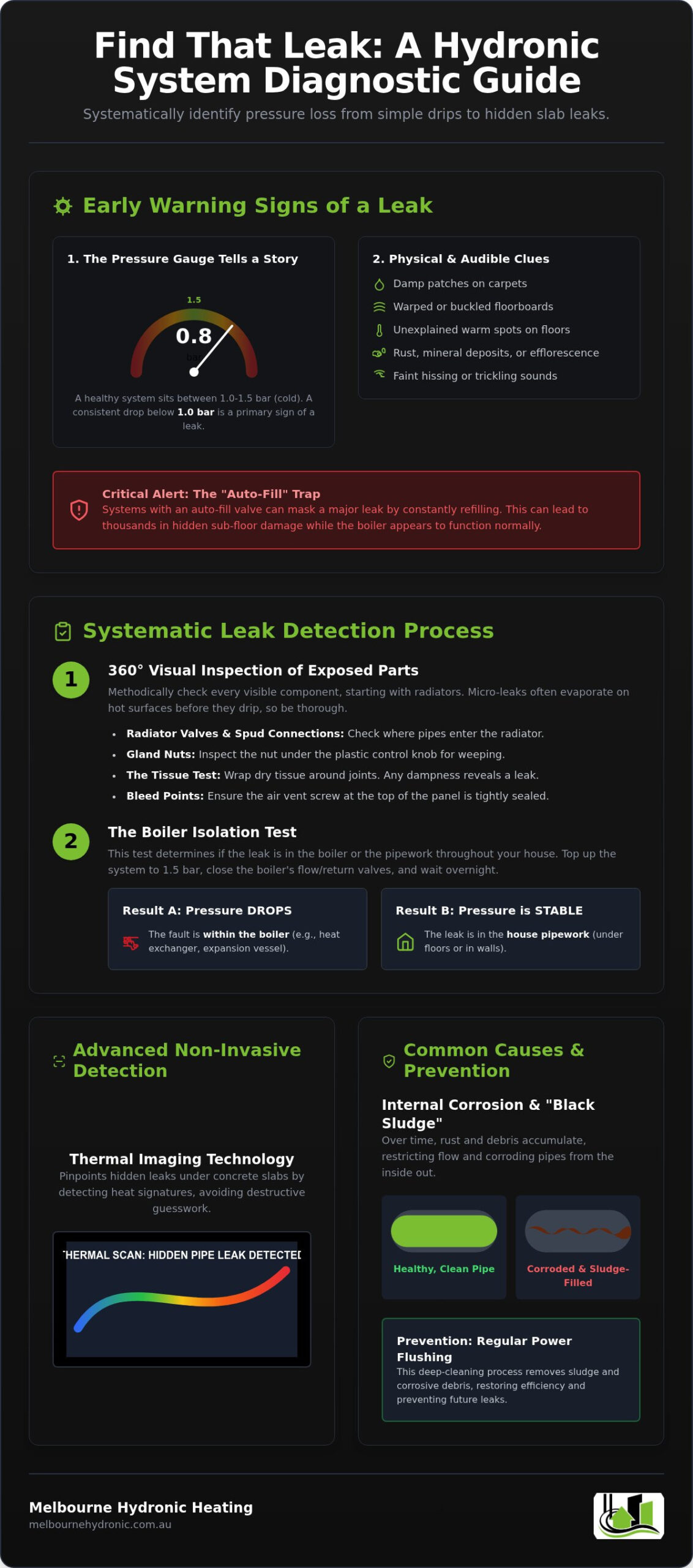
Your boiler’s pressure gauge should ideally sit between 1.0 and 1.5 bar when the system is cold. It’s normal for this needle to rise slightly as the water heats up and expands, but it should always return to its baseline once the system cools. A genuine leak is identified by a consistent, one-way trend downward. If the gauge hits zero, most modern boilers will enter a “lockout” mode to prevent the heat exchanger from melting. This safety feature protects your investment but leaves you without heating until the pressure is restored and the source of the loss is addressed.
Visual and Physical Evidence in Melbourne Homes
Physical symptoms often appear long before you see a puddle. You might notice damp patches on carpets, warped timber floorboards, or localized “warm spots” on a concrete slab that persist even when the heating is off. Check for rust tracking or mineral deposits around the base of your hydronic heating panels, as these indicate slow, weeping leaks at the valve connections. In many Melbourne suburbs, the reactive clay soils can cause slight house movements that stress pipe joints. This movement sometimes reveals a leak through “efflorescence,” which is a white, powdery salt residue that forms on slab edges or tile grout as leaking water evaporates.
Audible clues also play a role in your diagnostic process. You might hear a faint hissing sound near a radiator bleed valve or a rhythmic trickling noise behind a plaster wall. One of the most dangerous signs is the “Auto-Fill” trap. Some systems feature an automatic filling valve that tops up the water whenever pressure drops. If your system is constantly refilling itself, it is masking a major leak. This hidden water loss can lead to thousands of dollars in sub-floor damage while the boiler appears to be running normally. Recognizing these red flags is the essential starting point for anyone learning how to find a leak in a hydronic system before it becomes a costly emergency.
Step-by-Step: How to Find a Leak in a Hydronic System
Pinpointing a leak in a sealed heating loop requires a methodical process of elimination. You don’t need to be a technician to perform the initial checks, but you do need a keen eye and a logical sequence. Learning how to find a leak in a hydronic system starts with a 360-degree visual inspection of every exposed component, from the boiler cabinet in the garage to the furthest radiator in the bedroom. By following these steps, you can often identify simple fixes or at least provide your technician with the data they need to resolve the issue quickly.
The Radiator and Valve Checklist
Begin by inspecting every radiator panel. Focus your attention on the “spud” connection, which is the threaded joint where the valve enters the radiator body. You should also check the gland nut, located just under the plastic control knob. In many older Melbourne homes, these nuts can weep slightly as the internal packing dries out. Because these leaks are often “micro-leaks,” the water may evaporate off the hot metal before it ever drips onto the floor. To find these, wrap a piece of dry toilet tissue around the joint. If it comes away even slightly damp or discoloured, you’ve found a leak source. Don’t forget to check the bleed point at the top of the panel, as a loose air vent is a common culprit for slow pressure loss.
The Boiler Isolation Test
If your visual check yields no results, the next step is the boiler isolation test. This is a powerful diagnostic tool that separates the appliance from the rest of the house’s pipework. Start by topping up your system to 1.5 bar. Next, locate the flow and return isolation valves underneath your boiler and turn them to the “off” position. Leave the system overnight. If the pressure gauge on the boiler remains stable, the leak is located somewhere in your floor or walls. If the pressure drops while isolated, the fault lies within the boiler itself, such as a failing heat exchanger or an internal expansion vessel issue. A critical safety warning: never attempt to run the heating while these valves are closed, as this can cause the system to overheat and trigger a high-pressure discharge.
Finally, check the Pressure Relief Valve (PRV) discharge pipe. This is usually a small copper pipe that exits through an external wall. If you see water dripping from this pipe, or if the ground beneath it is damp, the valve is likely “passing” water. This often happens if debris gets stuck in the valve seat. Documenting these specific findings will significantly reduce the diagnostic time during your hydronic heating service melbourne. If these steps don’t reveal the source, it’s time to consider that the leak might be hidden within the building’s structure.
Advanced Leak Detection: When the Leak is Hidden
If your boiler isolation test confirms the leak is in the pipework but your carpets remain dry, you are likely dealing with a sub-floor issue. The old-school approach involved jackhammering concrete based on a guess, but modern diagnostics have turned this into a surgical process. Knowing how to find a leak in a hydronic system now relies on non-invasive sensors that protect your home’s structure. These tools allow us to see through solid surfaces, ensuring that repairs are localized and cost-effective.
How Thermal Imaging Works
For property owners in other regions, such as Central Florida, who require this level of precision for their own residential or commercial systems, you can learn more about Alberto Pro Plumbing to explore professional leak detection and repair options.
Thermal cameras detect infrared radiation, translating heat signatures into a visual map rather than seeing the water itself. When a pipe under a slab leaks, it creates a distinct “plume” of heat that spreads outward from the point of the break. By tracking the thermal energy, we can identify the exact path of the pipework and the specific spot where the heat signature is most intense. This technology is essential for Melbourne’s modern open-plan homes where polished concrete or large-format tiles are common. We can pinpoint the breach within a few centimetres, which eliminates the need for destructive “dig and hope” exploration.
Acoustic and Gas Detection Methods
Sometimes, thermal imaging alone isn’t enough, especially if the leak is very small or the slab is heavily insulated. In these scenarios, acoustic leak detection uses sensitive ground microphones to listen for the specific high-frequency hiss of water escaping under pressure. It is a precise way to hear what the eyes cannot see.
For the most challenging pinhole leaks, we utilize Tracer Gas testing. This is considered the gold standard for complex underfloor heating installations. The process involves draining the system and injecting a safe, non-toxic mixture of hydrogen and nitrogen. Because hydrogen molecules are incredibly small, they rise through the concrete slab at the leak site. Our technicians then use specialized “sniffer” probes to detect the gas as it escapes through the floor. This method ensures we only ever disturb the floor where it’s absolutely necessary, preserving your home’s aesthetic and structural integrity.
Common Causes of Leaks in Melbourne Hydronic Systems
Understanding the root cause of a pressure drop is just as vital as knowing how to find a leak in a hydronic system. In our 30 years of experience across Victoria, we’ve found that leaks are rarely the result of a single catastrophic event. Instead, they usually stem from long-term chemical processes or specific installation oversights that gradually compromise the system’s integrity. By identifying these causes early, you can move from reactive repairs to a proactive maintenance strategy that protects your home’s comfort.
The Danger of Corrosion and Sludge
Internal corrosion is the silent enemy of steel radiator panels. When oxygen enters a sealed system, it reacts with the iron to create magnetite, commonly known as “black sludge.” This abrasive substance settles in low-velocity areas, eating through the metal from the inside out until a pinhole leak forms. A common mistake homeowners make is constantly topping up a leaking system with fresh, oxygenated water. This creates a destructive feedback loop: the more fresh water you add, the more oxygen you introduce, which accelerates the corrosion. Maintaining proper water treatment and understanding hydronic heating chemistry is the best way to prevent these internal failures. If you notice dark, metallic-smelling water during a bleed, your system is already under internal attack.
Slab Leaks vs. Panel Leaks
The geography and construction style of your Melbourne home often dictate where a leak is likely to occur. Many 1990s-era builds in suburbs like Brighton or Camberwell used early generations of polybutylene pipe, which can become brittle over several decades. In newer developments, we often see issues with “waffle pod” slabs. Unlike traditional solid concrete slabs, waffle pods have hollow voids where leaking water can pool for months without ever showing a damp spot on the surface. This makes the diagnostic process even more critical.
- Electrolysis: This occurs when dissimilar metals, such as copper pipes and steel radiators, are joined without proper insulation, leading to rapid localized corrosion.
- Mechanical Damage: We frequently see “accidental nails” driven through floorboards during renovations, piercing the delicate pipework beneath.
- Copper and Concrete: Older installations where copper pipes were laid in direct contact with concrete are highly vulnerable. The lime in the concrete can chemically react with the copper, while the lack of expansion joints causes the pipe to rub against the abrasive slab as it heats and cools.
While replacing a single radiator panel is a straightforward task, repairing a slab-based loop is a more complex undertaking. If you suspect your sub-floor pipework is failing due to age or poor installation, you should consult a hydronic specialist to discuss non-invasive repair options before the damage spreads to your foundations.
Repairing and Preventing Future Hydronic Leaks
Once you’ve navigated the technical process of how to find a leak in a hydronic system, the focus shifts toward effective restoration and long-term protection. Identifying the breach is a significant milestone, but the quality of the repair determines whether your home’s comfort is permanently restored or merely patched. In Melbourne’s diverse housing stock, repair strategies vary from simple mechanical fixes to sophisticated engineering workarounds that preserve your interior finishes.
For minor issues like a weeping valve or a loose bleed point, a straightforward replacement is often sufficient. However, when a leak is confirmed deep within a concrete slab, we often recommend a slab bypass. This involves rerouting the affected loop through internal walls or ceiling cavities. This method is far less invasive than jackhammering polished concrete or removing expensive timber flooring. While some homeowners consider chemical “leak sealer” additives, we generally view these as temporary band-aids. These sealants can occasionally clog delicate internal components or reduce the efficiency of your heat exchanger, making a mechanical repair the superior choice for system longevity.
Professional Repair Strategies
Restoring a system requires more than just stopping the water; it requires ensuring the entire loop is balanced and chemically stable. When performing boiler repairs, we insist on using original equipment manufacturer (OEM) parts. These components are designed to handle the specific pressure and temperature profiles of your unit, reducing the risk of secondary failures. After any repair, we conduct a rigorous pressure test over several hours to ensure a 100% seal before the system is recommissioned. Under Victorian regulations, any repair work exceeding A$750 including labour and materials requires a VBA Compliance Certificate, which provides you with essential consumer protection and peace of mind.
Long-term Maintenance for Melbourne Homes
Prevention is always more cost-effective than emergency repair. The most robust defense against the “black sludge” and internal corrosion discussed earlier is a professional power flushing service, which is recommended every five years. This process removes accumulated debris and restores the system to its original factory-clean state. We also ensure that high-quality corrosion inhibitors, such as Fernox or Sentinel, are maintained at the correct concentrations to neutralize oxygen ingress.
Sometimes, what appears to be a leak is actually a failed expansion vessel. If the internal rubber diaphragm in this vessel loses its air charge, the system pressure will fluctuate wildly, often discharging water through the relief valve. A standard hydronic heating service includes checking this vessel to prevent “false” leak symptoms. To ensure your system remains efficient and leak-free, Book your 2026 system health check with Melbourne Hydronic Heating today and protect your home’s most vital comfort infrastructure.
Secure Your Home’s Heating Integrity
Identifying a pressure drop is the first step in maintaining a healthy heating loop. By moving from a simple visual inspection to a more technical boiler isolation test, you can effectively narrow down where the water is going. Understanding how to find a leak in a hydronic system doesn’t mean you have to face the challenge alone; it’s about making informed decisions that prevent long-term structural damage and restore the premium comfort your home deserves.
Whether you’re dealing with a weeping valve or a hidden sub-floor breach, precision is the key to a lasting fix. With 30+ years of local experience and specialist thermal imaging equipment, we provide the technical expertise needed to pinpoint issues without unnecessary demolition. Don’t let a minor pressure error turn into a major repair bill. You can Book a Specialist Hydronic Leak Detection Service with us today to access fixed-rate maintenance and professional troubleshooting. Let’s get your system back to its peak efficiency so you can enjoy a warm, worry-free winter.
Frequently Asked Questions
Is it normal for a hydronic system to lose pressure occasionally?
A hydronic system is a sealed loop, so it shouldn’t lose pressure under normal operating conditions. You might notice the gauge rise slightly when the water is hot and fall when it’s cold, but the baseline should remain steady. If you have to top up your system more than once a year, it’s a clear sign of a leak. Constant pressure loss indicates that water is escaping somewhere, even if you can’t see it yet.
Can I use a stop-leak liquid in my hydronic heating system?
Stop-leak liquids are generally a temporary band-aid and aren’t recommended as a permanent solution for Melbourne homes. These chemicals can settle in low-flow areas of your radiators or clog the delicate internal components of your boiler and heat exchanger. While they might slow a tiny pinhole leak, they don’t address the underlying cause, such as corrosion. A professional mechanical repair is always the safest way to ensure long-term system health and efficiency.
How much does professional hydronic leak detection cost in Melbourne?
Pricing for leak detection in Melbourne varies based on the complexity of the issue and the technology required. A standard inspection for straightforward cases might start around A$150. For hidden leaks requiring advanced tools like thermal imaging or tracer gas, costs can exceed A$600. It’s best to check with a specialist who offers fixed-rate troubleshooting to avoid unexpected expenses while you’re learning how to find a leak in a hydronic system.
What happens if I ignore a small leak in my hydronic floor heating?
Ignoring a small leak can lead to catastrophic structural damage and expensive restoration costs. Constant water ingress into a concrete slab can cause the soil to heave or subside, potentially cracking your foundation. Beyond structural risks, the moisture creates a breeding ground for mold under floorboards and carpets. Additionally, the constant introduction of fresh water accelerates internal corrosion, which will eventually destroy your radiators and boiler from the inside out.
Will my home insurance cover a hydronic system leak?
Most Australian home insurance policies cover resultant damage caused by a leak, such as ruined carpets or warped floorboards, but they rarely cover the cost of repairing the pipe itself. Every policy is different, so you should review your Product Disclosure Statement for specific exclusions. Insurers often look for evidence that the system was properly maintained, so keeping records of your annual servicing can be vital during a claim process.
How do I know if the leak is in the boiler or the pipes?
The most effective way to distinguish between a boiler fault and a pipe leak is to perform an isolation test. By closing the flow and return valves under the boiler, you trap pressure within the appliance itself. If the gauge continues to drop while isolated, the leak is internal to the boiler. If the pressure holds steady, the breach is located somewhere in your home’s pipework, radiators, or underfloor heating loops.
Can a hydronic leak cause structural damage to my slab?
Yes, a persistent leak can seriously compromise the structural integrity of a concrete slab. In Melbourne’s reactive clay soils, leaking water causes the ground to expand and contract unevenly. This movement puts immense stress on the slab, leading to cracks in the foundation or internal walls. Because the average insurance claim for water damage was over A$11,000 in 2025, addressing sub-floor leaks immediately is a critical financial and safety priority for homeowners.
Why does my boiler keep losing pressure even though I can’t see a leak?
Pressure loss without a visible puddle often points to micro-leaks at radiator valves where the water evaporates before hitting the floor. Alternatively, the leak might be hidden behind walls or beneath the slab. Another common culprit is a failed expansion vessel. If the vessel’s internal diaphragm loses its air charge, the system can’t handle water expansion, causing the relief valve to discharge water externally through a small copper pipe you might not notice.