
Smart Thermostat for Hydronic Heating Australia: The 2026 Efficiency Guide
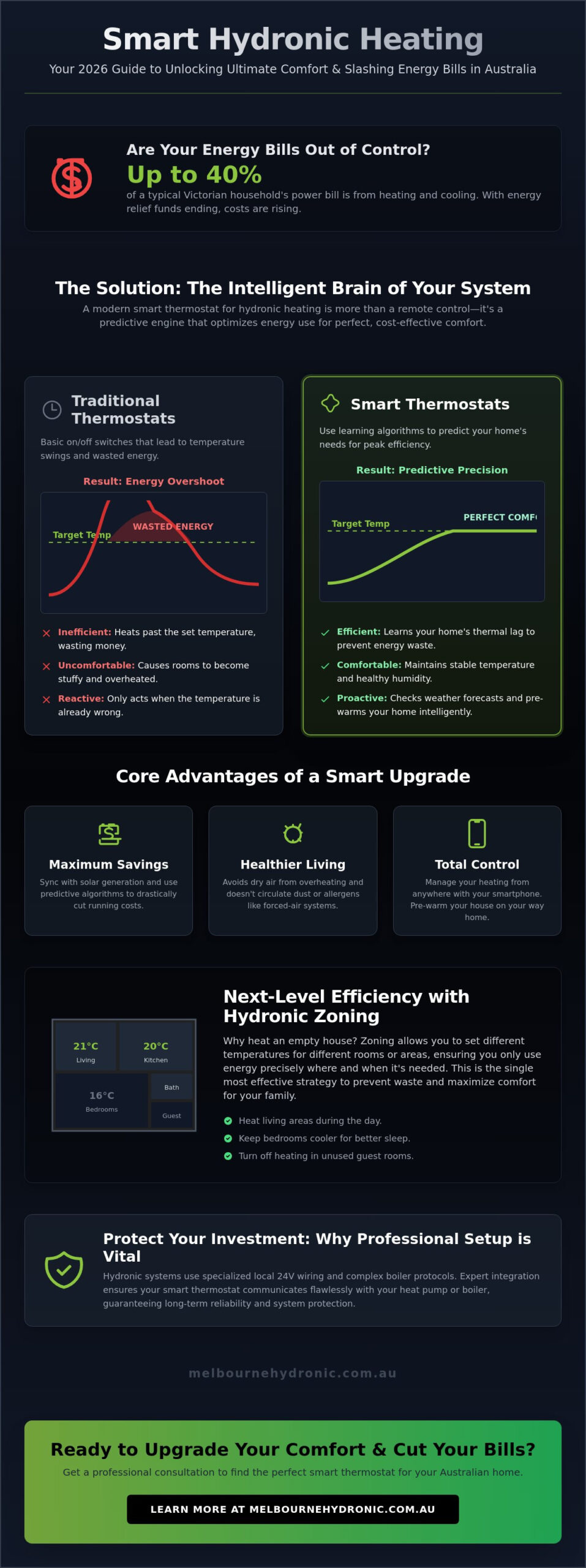
Did you know that heating and cooling can account for up to 40% of a typical Victorian household’s power bill? With the federal energy bill relief fund having ended in December 2025, many homeowners are feeling the pinch of rising costs even as they seek the premium comfort of hydronic radiator panels or underfloor systems. It’s frustrating to feel like you’re choosing between a warm home and a manageable bank balance, especially when conflicting information about European hardware makes choosing the right tech feel like a gamble.
We understand that you want a system that’s simple to use and actually works with local Australian wiring. Finding the right smart thermostat for hydronic heating Australia is the most effective way to bridge the gap between high energy prices and the luxury of a perfectly heated home. This guide explains how the latest 2026 technology can slash your energy bills while keeping your living space exactly how you like it. We’ll explore compatibility for gas boilers and electric heat pumps, clear up the confusion around voltage requirements, and show you how a system that learns your schedule can finally put you back in control of your utility costs.
Key Takeaways
- Learn how modern smart controls act as the intelligent brain of your system, ensuring radiator panels and underfloor heating operate only when and where they are needed.
- Discover how to select a compatible smart thermostat for hydronic heating Australia that integrates seamlessly with local 24V wiring and specialized boiler protocols.
- Understand the synergy between smart technology and electric heat pumps to achieve maximum seasonal efficiency while significantly reducing household running costs.
- Explore the benefits of hydronic zoning, which allows for precise room-by-room temperature control to prevent the common mistake of heating an empty house.
- Realize why professional integration is vital for complex hydronic wiring to protect your investment and ensure the long-term reliability of your heating system.
Understanding Smart Thermostats in the Australian Hydronic Landscape
A smart thermostat is much more than a sleek wall-mounted dial. In 2026, it serves as the essential intelligence layer for any high-efficiency home. While basic smart thermostat technology provides remote Wi-Fi access, the real value lies in how it manages the complex thermodynamics of water-based heating. Unlike a simple on/off switch, a smart thermostat for hydronic heating Australia uses predictive algorithms to understand your home’s unique heat retention patterns. This precision is especially beneficial for health-conscious families. Since hydronic systems don’t rely on forced air, they don’t circulate dust or allergens. Smart controls take this further by preventing the dry air caused by overheating, maintaining a stable, healthy humidity level that supports respiratory well-being and comfort.
The Core Difference: Traditional vs. Smart Controls
Manual thermostats often cause ‘energy overshoot’ in Victorian homes. When you set a traditional dial, it tells your boiler or heat pump to run until the room hits the target. However, hydronic radiator panels and concrete slabs have significant thermal mass. They continue to radiate heat long after the system clicks off. This often results in rooms becoming uncomfortably warm and wasting energy you’ve already paid for. Smart systems solve this by learning the ‘thermal lag’ of your floorplan. They calculate exactly when to power down the heat source so the residual warmth brings you to the perfect temperature without overshooting. Remote access also means you can pre-warm the house from your smartphone while commuting back from the city, ensuring you never walk into a cold home.
Why Australian Homeowners are Making the Switch Now
The shift toward smart control is accelerating due to the changing energy landscape. With the Victorian Essential Services Commission releasing the 2026-27 Victorian Default Offer, homeowners are looking for every possible way to mitigate costs. As we move toward the ‘all-electric’ mandate for new homes, many are replacing aging gas units with electric heat pumps. A smart thermostat for hydronic heating Australia is the best tool to manage these modern systems. These devices integrate perfectly with ecosystems like Google Home or Apple HomeKit, making climate management as simple as adjusting your lights. By upgrading now, you’re future-proofing your property and ensuring your heating system operates with the surgical precision required in a high-tariff environment.
Maximizing Efficiency: How Smart Controls Interact with Heat Pumps and Boilers
The efficiency of any hydronic system depends on how effectively the “brain” of the house communicates with the “heart” of the plant room. A smart thermostat for hydronic heating Australia acts as this vital bridge, ensuring that your radiator panels or underfloor pipes receive exactly the right amount of energy at the right time. Traditional thermostats operate on a binary basis: they’re either full-blast or completely off. Modern smart controls use modulation to adjust the heat output based on the real-time gap between the current and desired temperature. This is especially critical for in-slab heating. The huge thermal mass of a concrete floor requires hours to warm up and cool down. Without smart logic to predict these shifts, you waste energy by heating a floor that will remain warm long after you’ve gone to bed.
Smart Tech and the Modern Electric Heat Pump
Electric heat pumps are the gold standard for sustainable Victorian heating, but they function differently than gas burners. They are most efficient when they have long, steady runs rather than quick bursts of high heat. Smart thermostats manage this “slow start” nature by checking local weather forecasts and initiating the heating process earlier on exceptionally frosty mornings. You can also program the system to sync with peak solar generation hours if you have rooftop panels. This strategy protects your system’s COP (Coefficient of Performance) by ensuring the pump doesn’t have to work at maximum capacity during the least efficient, coldest hours of the night.
Extending the Life of Your Gas Boiler
For homes still utilizing gas boilers, the primary threat to equipment longevity is short-cycling. This occurs when a boiler turns on and off too frequently, causing rapid wear and tear on the heat exchanger and ignition components. A high-quality smart thermostat for hydronic heating Australia uses wider differential settings and intelligent delay logic to keep the boiler running for optimal, healthy durations. These devices are proven to provide certified energy savings by identifying when a system is struggling to reach its set point. This early detection allows you to schedule a proactive hydronic heating service before a minor efficiency drop turns into a total system failure. If your boiler seems to be clicking on and off every few minutes, it’s a clear sign that your control system needs a professional calibration to restore balance.
Comparing the Top Smart Thermostats for Australian Homes in 2026
Selecting a smart thermostat for hydronic heating Australia involves more than just picking a sleek screen. It requires a deep understanding of how your home’s infrastructure interacts with modern software. Because heating and cooling represent a massive portion of energy use in Australian homes, the interface you choose will directly dictate your monthly savings. You must decide if you prefer a consumer-friendly interface or a professional-grade control system capable of managing complex hybrid setups. The right choice balances technical compatibility with your daily lifestyle.
Google Nest (3rd Gen & Beyond): The All-Rounder
Google Nest remains a top contender due to its intuitive design and seamless integration with the Google Home ecosystem. Its “Home/Away Assist” feature is a significant benefit for Melbourne residents with unpredictable schedules. By using geofencing tech, the system detects when you’ve left the house and automatically lowers the temperature. It looks beautiful on the wall, with finishes like polished steel and copper that perfectly complement modern hydronic heating panels. Check with a technician to see if your specific boiler requires a 24V transformer for a successful installation.
Ecobee SmartPremium: Best for Multi-Room Sensing
The Ecobee SmartPremium is the superior choice for large, multi-story residences where a single central sensor is insufficient. It utilizes remote sensors to track occupancy and temperature in different rooms. This ensures the master bedroom stays comfortable even if the thermostat is located in a drafty hallway. Its built-in air quality monitor is a unique health-centric feature. It alerts you when VOC levels are high, which aligns with the clean, allergy-friendly nature of hydronic heat. It’s a proactive way to manage your home’s internal environment beyond just temperature.
Specialized Hydronic Controls: Ivar Cubodomo & Siemens
For homeowners seeking the highest level of technical precision, specialized systems like Ivar Cubodomo or Siemens offer unmatched control. These units are engineered specifically for the nuances of water-based heating. They handle multi-zone configurations, such as a mix of ground-floor slabs and upstairs radiators, with clinical accuracy. The Ivar Cubodomo system uses discrete, minimalist sensors that blend into high-end interior designs. While these systems may require professional programming, they offer the most robust way to manage a high-performance smart thermostat for hydronic heating Australia. They are built for technical reliability and often outperform standard consumer gadgets in complex electrical environments.
Zoning and Retrofitting: Upgrading Your Melbourne Hydronic System
Zoning is the practice of dividing your home into independent climate sectors. In many 1990s-era Melbourne residences, hydronic systems were installed as a single, house-wide loop. This ‘all or nothing’ approach is a major source of energy waste. By retrofitting a modern smart thermostat for hydronic heating Australia, you can finally stop heating guest rooms or corridors that stay empty for 22 hours a day. The hardware required for this transition goes beyond just the wall unit. You’ll typically need thermal actuators on your manifold and a central wiring center to coordinate the communication between your heat source and each individual zone.
Managing the different response times of your emitters is the key to true comfort. Hydronic radiator panels provide quick, convective warmth that responds rapidly to thermostat changes. In contrast, underfloor heating relies on the massive thermal storage of a concrete slab. A smart controller understands these nuances. It manages the ‘thermal lag’ so your bedroom stays cool for better sleep while the living area remains cozy until the very moment you head to bed. If you’re looking to modernize an older system, a professional system assessment is the best way to determine your retrofitting potential.
The 4-Step Process to Retrofitting Your System
- Step 1: System Audit – We check if your existing boiler or heat pump is smart-ready and identify the best locations for new sensors.
- Step 2: Wiring Assessment – Modern thermostats often require a ‘C-wire’ for constant power. We evaluate your current wiring to see if a 24V transformer or new cabling is needed.
- Step 3: Hardware Selection – We match specific thermostats to your zones, ensuring the interface meets your lifestyle needs.
- Step 4: Installation & Configuration – Professional setup is non-negotiable. We program the specific pump delays and modulation settings that DIY installs often miss.
The ROI of Zoning: How Much Can You Save?
Melbourne’s climate is famous for sharp overnight temperature drops and unpredictable winter sun. Zoning allows you to adapt to these changes without overworking your system. By setting lower temperatures in living areas at night while maintaining a comfortable 18 degrees in the bedrooms, you significantly reduce gas or electricity consumption. For a typical 4-bedroom Melbourne home, industry data suggests that eliminating heat from unused zones can reduce energy consumption by up to 20% during the peak winter months. This isn’t just about the money. It’s about reducing the mechanical load on your equipment to ensure it lasts for decades. Integrating a smart thermostat for hydronic heating Australia is the most effective way to bridge the gap between an aging 1990s system and 2026 efficiency standards.
Professional Integration: Why Expert Setup Matters
While the sleek packaging of a modern smart thermostat might suggest a simple weekend project, the reality of hydronic integration is far more complex. Standard split system air conditioning usually relies on straightforward low-voltage wiring, but Australian hydronic systems often feature a mix of high-voltage boiler interlocks and intricate manifold actuators. Attempting a DIY install can lead to ‘system hunting,’ where your boiler or heat pump cycles on and off rapidly because the software isn’t correctly calibrated to the thermal inertia of your home. At Melbourne Hydronic Heating, we bring 30 years of technical expertise to every project, ensuring that your new technology respects the traditional engineering of your system. We don’t just install a device; we ensure your home’s ‘brain’ and ‘heart’ are speaking the same language.
Expert calibration is the difference between a gadget and a solution. When we set up a smart thermostat for hydronic heating Australia, we adjust the specific cycle rates and pump delays that protect your equipment from premature wear. This professional touch ensures that the system operates with the quiet, effortless efficiency that hydronic heating is known for. Our technicians understand the local climate challenges in Victoria, allowing us to program your system to handle sudden temperature drops without wasting energy. This long-term perspective ensures your investment pays for itself through lower bills and a longer system lifespan.
Beyond the Box: The Importance of System Balancing
A smart thermostat is only as effective as the hydraulic balance of the pipes it controls. If the water flow isn’t balanced across your radiator panels, even the most advanced AI algorithm won’t fix a cold bedroom. During a professional installation, we look at the entire ecosystem. If your current unit is nearing the end of its life, we often find that boiler replacements provide the perfect opportunity to upgrade to smart controls. This combined approach ensures that the new boiler is programmed to communicate natively with the thermostat, maximizing the efficiency gains we have discussed throughout this guide. We verify that every valve opens correctly and that the pump speed matches the requirements of your specific floorplan.
Next Steps for Your Melbourne Home
Upgrading your home’s climate control shouldn’t be a source of stress or confusion. When you book a consultation, our local specialists visit your property to conduct a thorough audit. We assess your existing pipework, check the power supply for ‘C-wire’ compatibility, and recommend the hardware that best fits your lifestyle. This meticulous approach prevents the technical glitches that often plague DIY attempts. You’ll receive a system that’s ready to handle the unique challenges of the Victorian winter from day one. To start your journey toward a more efficient, comfortable home, Request a Smart Hydronic Consultation today and let our experts handle the technical precision for you.
Take Control of Your Home’s Climate Today
The transition to a high-efficiency home doesn’t have to be overwhelming. By integrating a smart thermostat for hydronic heating Australia, you’re investing in more than just a digital screen. You’re securing a system that learns your habits, protects your heat pump or boiler from unnecessary wear, and ensures your family enjoys a healthy, allergy-friendly environment. We’ve seen how smart zoning can transform an older Melbourne property into a modern, energy-saving sanctuary by eliminating heat in unused spaces while maintaining warmth where it matters most.
Achieving this level of technical precision requires a partner who understands the delicate balance of Victorian hydraulics. We are a family-owned and operated team with over 30 years of local experience, and we specialize in both heat pump and boiler integration. We ensure your hardware and software work in perfect harmony to deliver maximum comfort with minimum waste. Ready to modernize your living environment? Upgrade your comfort with a Smart Hydronic Consultation and discover how the latest technology can work for you. Let’s make your home the efficient, cozy sanctuary you deserve.
Frequently Asked Questions
Can I install a smart thermostat on an old hydronic system in Australia?
You can definitely retrofit a smart thermostat for hydronic heating Australia onto older systems. Most hydronic setups installed in the last few decades are compatible, though they often require a technical update to the wiring. Our team typically installs a 24V step-down transformer or a power extender to bridge the gap between vintage boilers and modern digital controls. This upgrade allows you to bring 2026 efficiency to a classic system without replacing the entire unit.
Do smart thermostats work with both gas boilers and electric heat pumps?
Smart thermostats are designed to communicate with both gas boilers and modern electric heat pumps. The key difference lies in the programming. For heat pumps, the thermostat manages a “slow start” to maintain a high Coefficient of Performance. For gas boilers, the software focuses on preventing short-cycling. This ensures that no matter your heat source, the delivery of warmth via your radiator panels remains consistent and cost-effective.
How much money can a smart thermostat really save me on Victorian energy bills?
While exact savings depend on your home’s insulation and usage habits, industry data suggests that smart zoning can reduce energy consumption by up to 20% during peak winter months. By eliminating heat in unused guest rooms and corridors, you stop paying for energy that doesn’t contribute to your comfort. In a state with rising tariffs, these small, automated adjustments add up to significant quarterly relief on your gas or electricity statements.
Do I need a special ‘C-wire’ for smart thermostat installation?
Most modern smart thermostats require a “C-wire” or common wire to provide continuous power for their Wi-Fi and displays. Many older Australian hydronic systems only have two wires at the thermostat location. If your home lacks this dedicated power line, we can install a power-addition kit or run new cabling. This ensures your thermostat never loses connection or runs out of battery during a cold Melbourne night.
Which smart thermostat is best for hydronic floor heating?
The best choice for underfloor heating is a thermostat that features predictive thermal mass logic, such as the Ecobee or specialized Ivar Cubodomo units. These devices understand that a concrete slab takes a long time to warm up and cool down. They prevent the floor from becoming uncomfortably hot by turning off the heat source before the target temperature is reached, using the slab’s residual warmth to finish the job.
Can I control individual radiators with a smart thermostat?
You can control individual radiators by installing smart Thermostatic Radiator Valves (TRVs) alongside your central thermostat. These digital valves allow you to set different temperatures for every room in your house. For example, you can keep your home office at 21 degrees while leaving the guest bedroom at a crisp 16 degrees. This level of granular control is the most effective way to maximize the efficiency of radiator panels.
Is professional installation required for smart hydronic controls in Melbourne?
Professional installation is highly recommended to ensure the safety and longevity of your system. Hydronic wiring is more complex than standard air conditioning and often involves high-voltage interlocks that can be dangerous for DIY attempts. An expert technician doesn’t just mount the device; they calibrate the pump delays and bypass settings. This technical precision ensures your system operates at peak efficiency from the moment it is turned on.
Will a smart thermostat help with system longevity?
A smart thermostat for hydronic heating Australia significantly improves system longevity by reducing mechanical stress. By preventing short-cycling and optimizing pump run times, the software ensures that your boiler or heat pump isn’t working harder than necessary. This proactive management reduces the frequency of repairs and helps you avoid the cost of premature boiler replacements. It’s an investment that protects your entire heating infrastructure for years to come.