The Quietest Central Heating System for Melbourne Homes: A 2026 Buyer’s Guide
Imagine it’s 3:00 AM on a freezing July night in a quiet street in Malvern or Geelong. The silence is suddenly shattered by the mechanical roar and metallic rattle of an old gas ducted heater kicking into gear. For many Melbourne families, this noise isn’t just a nuisance; it’s a nightly disruption that circulates dry air and dust through every room. You likely agree that a premium home should be a sanctuary of peace, not a source of constant background hum. This desire for tranquility is why more homeowners are switching to the quietest central heating system for homes: hydronic heating.
We’ll show you exactly why this silent, fan-free technology has become the gold standard for comfort in 2026. You’ll learn how to achieve a “set and forget” warmth that protects your family’s health by eliminating the dust movement that triggers asthma and allergies. This guide previews the latest European high-efficiency boilers and elegant panel radiators that provide whisper-quiet operation for your bedrooms. We’ll explore the technical precision and lifestyle benefits that make hydronic systems the most reliable investment for a peaceful, healthy Melbourne winter.
Key Takeaways
- Learn why 20-30dB is the essential acoustic target for Melbourne bedrooms and how to eliminate the disruptive “wind noise” and duct rattle common in traditional systems.
- Discover why hydronic underfloor and radiator panels are widely considered the quietest central heating system for homes, providing a “ghostly” warmth without moving air.
- Understand how modern 2026 heat pump technology and European-standard engineering keep external units whisper-quiet to ensure your neighbours are never disturbed.
- Explore professional design strategies, including acoustic pipe insulation and smart zoning, to prevent “water hammer” and maintain a silent sanctuary in every room.
- Gain expert insights from 30 years of local experience in delivering bespoke, dust-free, and silent heating solutions tailored for the unique climate of Victoria.
The Science of Silence: Why Most Central Heating Is Noisy
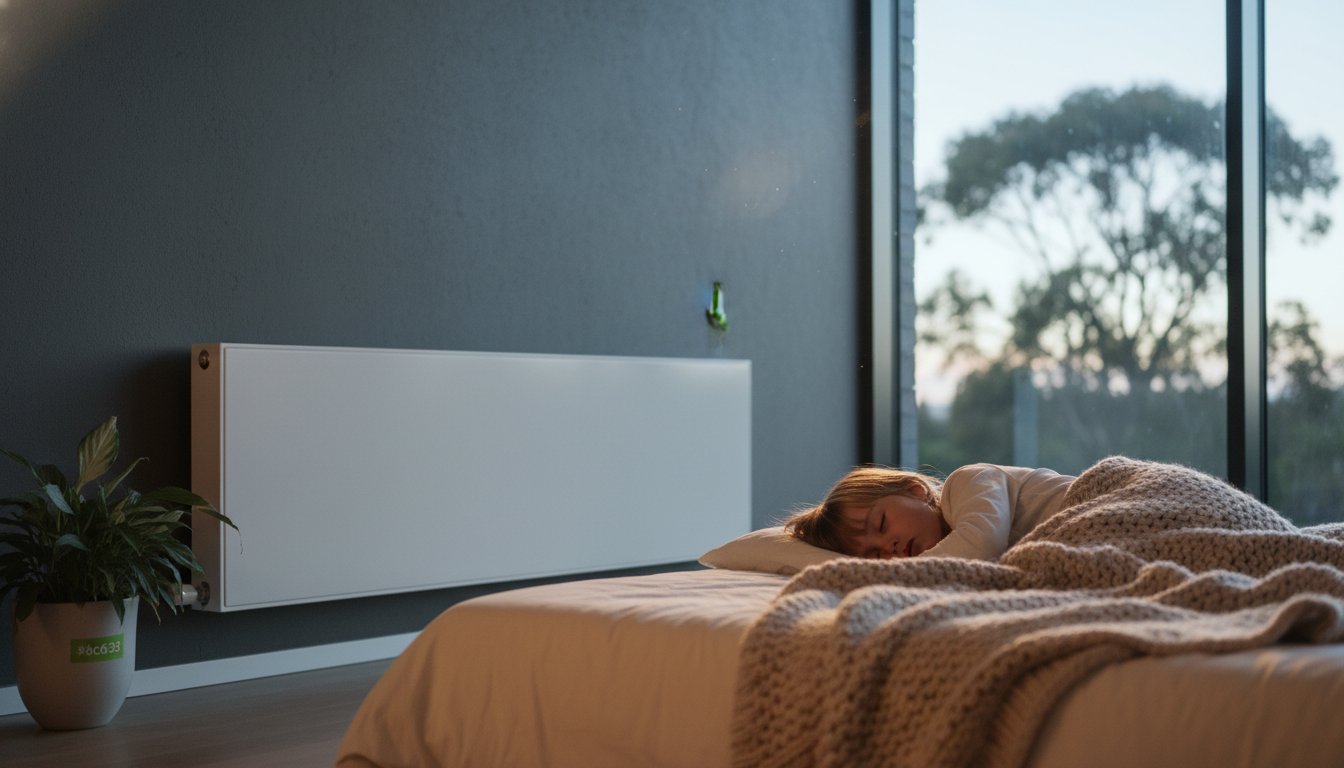
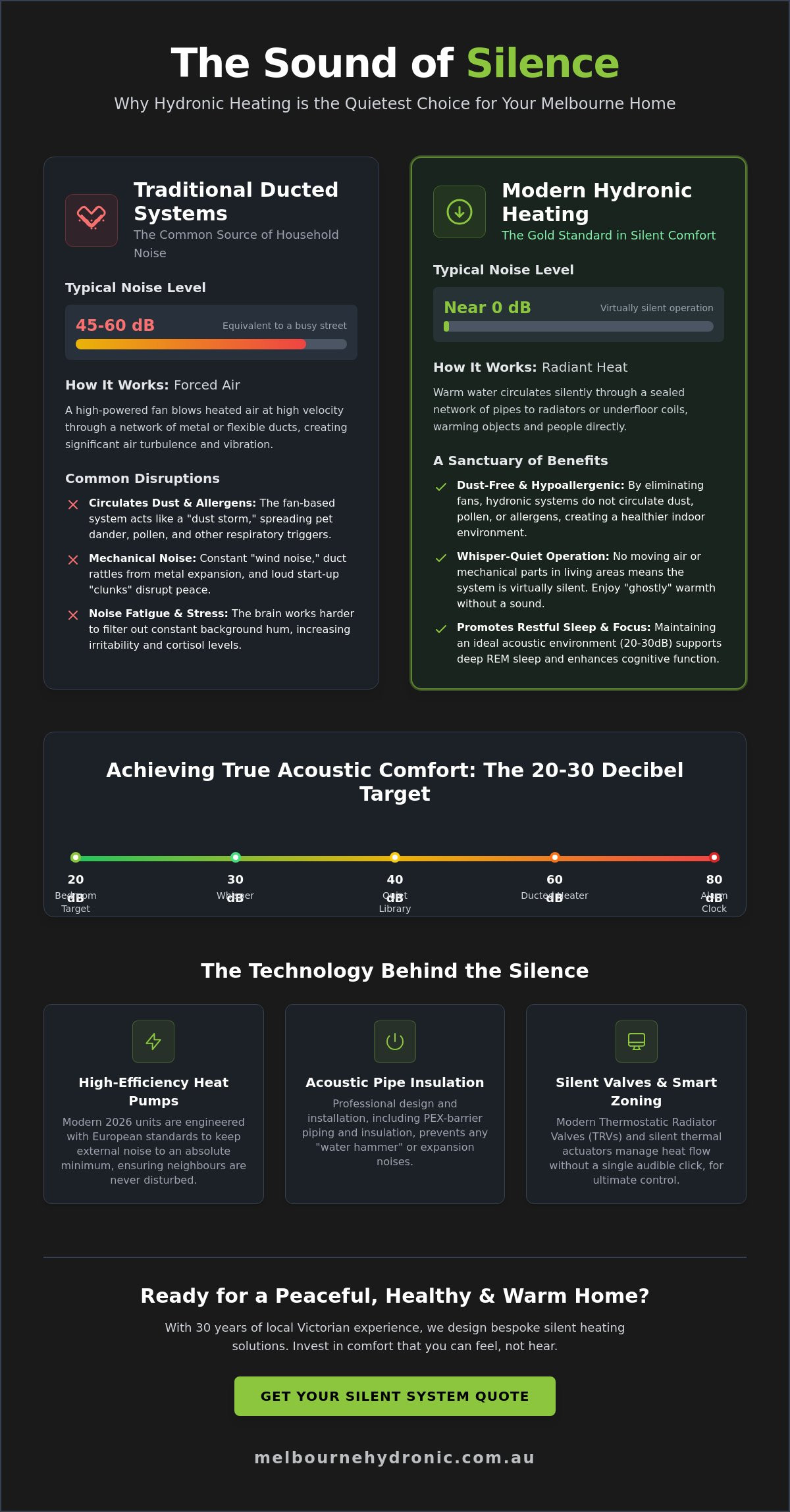
Melbourne homeowners often accept a background hum as a necessary trade-off for a warm house. However, true acoustic comfort for a bedroom or study rests between 20 and 30 decibels. For context, a soft whisper measures around 30dB. When a heating system exceeds this threshold, it disrupts deep REM sleep cycles and hinders cognitive focus. Most traditional systems fail this acoustic test because they rely on the rapid movement of air to distribute warmth.
The primary issue is air turbulence. In ducted gas systems, a high-powered fan pushes air through narrow metal or flexible channels at high velocities. This process creates wind noise and physical vibrations known as duct rattle. While some high-end installations might include a sound attenuator to dampen these vibrations, the physics of moving large volumes of air makes total silence impossible. Radiant heat systems bypass this problem by using water, which is a far more efficient and quieter medium for energy transfer. This fundamental difference in engineering makes hydronic technology the quietest central heating system for homes available in 2026.
The psychological impact of “white noise” from heating is often underestimated. Constant mechanical humming can lead to “noise fatigue,” where the brain spends extra energy filtering out the sound. This can result in increased irritability and reduced productivity during the day. Transitioning to a silent radiant system removes this invisible stressor from the home environment.
Decibel Comparisons: Ducted vs. Hydronic
A standard split system or ducted gas heater typically operates between 45 and 60 decibels during a peak heating cycle. In contrast, radiator panels emit virtually zero decibels. You won’t hear the startling “clunk” of gas solenoids or the metallic expansion of ducts every time the thermostat calls for heat. Modern hydronic systems use silent thermal actuators and modulating valves to manage flow without a single click. Hydronic silence is the absence of forced-air turbulence.
Health and Silence: The Por-Free Connection
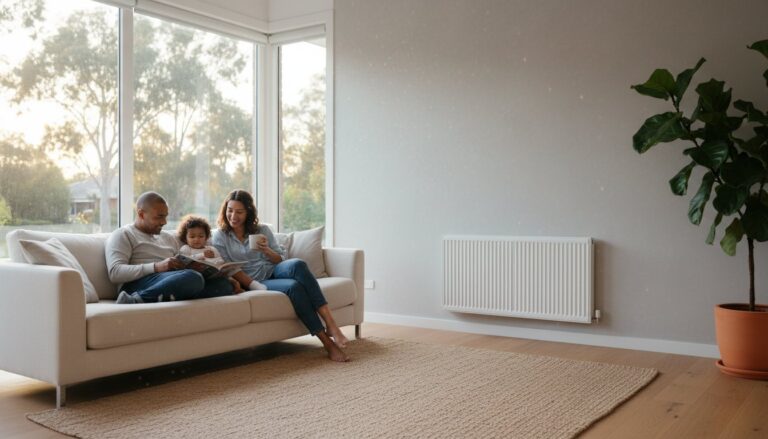
Acoustic comfort correlates directly with lower cortisol levels and improved heart rate variability. Beyond the ears, fan-based systems create a “dust-storm” effect, circulating pet dander and microscopic allergens through every room. Melbourne families managing asthma or hay fever are increasingly switching to fan-free radiant heat to stop this cycle. By removing the fan, you eliminate both the disruptive noise and the primary vehicle for respiratory triggers in the home. This creates a sanctuary that is both medically safer and whisper-quiet.
Hydronic Heating vs. Ducted: A Silent Comparison
Deciding on the quietest central heating system for homes requires looking beyond energy ratings to the actual physics of heat delivery. Gas ducted systems rely on high-velocity fans and metal ductwork that expands and contracts, creating a constant background hum and occasional rattling. In contrast, hydronic systems use water, which is a far more efficient and silent medium for energy transfer. While a standard furnace might register between 50 and 60 decibels, a well-installed hydronic system operates at near-zero decibels within the living space.
According to the U.S. Department of Energy, the delivery method significantly impacts both comfort and noise levels. For those still asking what is hydronic heating?, it’s a method where a boiler or heat pump warms water and circulates it through a sealed network of pipes. This eliminates the “whoosh” of air and the mechanical clatter associated with traditional Melbourne HVAC units.
Radiator Panels: Silent Convection
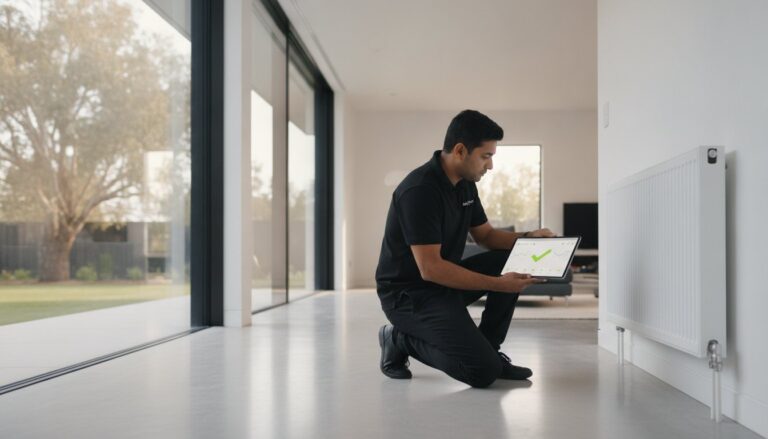
Modern hydronic heating panels have evolved significantly from the noisy steam radiators of the past. Older systems often suffered from “pinging” sounds caused by metal pipes expanding against floor joists. Today, we use pex-barrier piping and precision-engineered mounting brackets that allow for silent thermal expansion. Thermostatic radiator valves (TRVs) provide individual room control without the mechanical clicking of old-fashioned dampers. For Victorian-era renovations in suburbs like Carlton or Fitzroy, placing panels under windows creates a silent curtain of warmth that stops cold drafts without a sound.
Underfloor Heating: The Ultimate Invisible Solution
If silence is your absolute priority, underfloor heating in Melbourne is the gold standard for new builds and major extensions. It’s often described as “ghostly” warmth because there’s no visible or audible evidence of the system working. The pipes are encased in a concrete slab or screed, which acts as a massive thermal battery. This thermal mass holds heat for hours, maintaining a steady temperature with zero mechanical noise inside the room. It’s the quietest central heating system for homes because the only moving part, the circulation pump, is usually tucked away in a garage or an external cabinet.
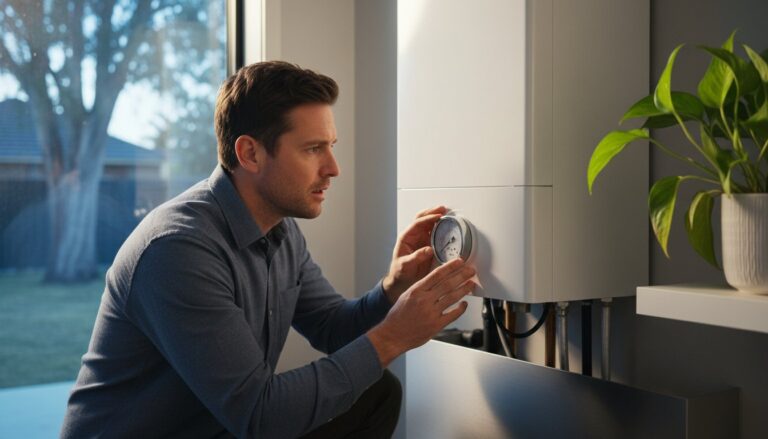
System noise isn’t always a design flaw; sometimes it’s a maintenance cry for help. Over time, internal corrosion can create magnetite sludge. This debris causes the boiler to “kettle” or groan as water struggles to circulate through the heat exchanger. A professional power flush, typically recommended every 5 to 8 years depending on water quality, removes this buildup and restores the whisper-quiet operation you expect. If your current system is starting to protest the cold with strange gurgles, you might want to speak with a Melbourne specialist to evaluate your system’s health and performance.
Managing External Noise: Heat Pumps and Boilers
The most frequent concern we hear from Melbourne homeowners involves the “neighbour factor.” Nobody wants to be the person whose heating system keeps the house next door awake at night. When searching for the quietest central heating system for homes, you must look beyond the radiators and consider the external footprint. In 2026, the technology has reached a point where the “hum” of a high-performance system is virtually indistinguishable from the ambient sounds of a quiet suburban street.
Modern heat pump hydronic heating units now operate at significantly lower decibel ranges than their predecessors. Leading models in 2026 typically produce between 45 and 52 dB(A) when measured from a distance of one metre. To put this in perspective, compare these figures to the typical decibel levels of household appliances, where a standard vacuum cleaner can reach 80 dB and an older air conditioning unit often fluctuates between 60 and 75 dB. By choosing a premium system, you’re opting for a sound profile that’s closer to a quiet conversation than industrial machinery.
Strategic placement is our primary tool for noise mitigation. We avoid installing units directly under bedroom windows or adjacent to a neighbour’s primary outdoor living area. By positioning the unit on a side wall away from boundary fences and using the building’s mass as a natural sound buffer, we ensure the system remains “seen but not heard.”
Acoustic Barriers and Installation Best Practices
Precision installation is what separates a silent system from an annoying one. We utilize heavy-duty vibration-dampening mounts for all outdoor heat pump units. These specialized rubber mounts decouple the unit from the concrete plinth or wall bracket, preventing “structure-borne” noise from vibrating through the home’s frame. It’s also vital to follow Melbourne council regulations, which generally adhere to EPA Victoria guidelines. These rules often dictate that noise levels at the residential boundary must not exceed 5 dB above the background noise level during night hours. Our professional design process includes a site-specific acoustic assessment to guarantee compliance and peace of mind.
Boiler Replacements for Quieter Operation
If your current system features an older gas boiler, you’re likely familiar with the “knocking” or “whirring” that occurs during startup. This is often caused by kettling or outdated pump technology. Upgrading to a modern condensing gas boiler eliminates these mechanical disruptions. In the 2026 Melbourne and Geelong market, brands like Baxi and Bosch have refined their internal insulation and fan speeds to achieve near-silent operation. A modern boiler is no louder than a standard refrigerator. This makes them ideal for installations in laundry rooms or kitchen cupboards where space is at a premium but silence is non-negotiable.
- Condensing Technology: Uses variable-speed fans that don’t need to run at full tilt 100% of the time.
- Internal Sound Deadening: High-density foam casing inside the boiler cabinet traps acoustic energy.
- Eliminating “Knock”: Modern systems use sophisticated air elimination valves to stop the air bubbles that cause pipe noise.
Selecting the quietest central heating system for homes requires this holistic view of both internal and external components. Whether you’re in a compact terrace in Richmond or a sprawling estate in Geelong, the right combination of 2026 technology and expert placement ensures your home remains a sanctuary of warmth and silence.
Designing Your Home for Acoustic Comfort
Creating the quietest central heating system for homes involves more than just selecting a premium boiler or heat pump. It requires a holistic approach to your home’s infrastructure. In Melbourne’s architectural landscape, where open-plan living and large glass surfaces are common, sound travels easily. We design systems that account for these acoustic challenges by focusing on smart zoning and high-quality installation materials.
Zoning for silence is a primary strategy. By dividing your home into independent heating circuits, you can keep living areas warm without circulating water through empty bedrooms. This reduces the overall workload on your system’s pump, leading to a significant decrease in ambient noise levels. Beyond zoning, we focus on the following technical details:
- Pipe Insulation and Lagging: Thermal expansion in copper pipes often causes clicking or “ticking” sounds as they rub against timber joists. We use high-density foam lagging and rubber-lined clips to absorb these vibrations, effectively preventing water hammer and expansion noise.
- Retrofitting Weatherboard Homes: Melbourne’s classic weatherboard cottages often lack the thermal mass of brick. We solve acoustic issues here by using vibration-dampening mounts for external units and ensuring all pipework is secured with acoustic-rated brackets to prevent the timber frame from acting like a soundboard.
- Luxury Integration: For a truly premium experience, we integrate silent towel rails and trench heating. These components have no moving parts, providing a seamless layer of warmth that you feel but never hear.
Trench Heating: Silent Warmth for Glass Walls
Floor-to-ceiling windows are a staple of modern Melbourne design, but they often create “cold downdrafts” that make living spaces uncomfortable. Trench heating solves this by placing the heating element inside a floor recess. Natural convection models are completely silent because they don’t rely on fans to move air. While fan-assisted models offer quicker heat-up times, natural convection remains the gold standard for homeowners seeking a 100% noise-free environment. These systems are ideal for minimalist homes where wall space for radiators is limited.
The Role of Smart Thermostats
A smart thermostat is the brain of a silent home. Systems like Nest or Honeywell allow for predictive heating, which is a game-changer for acoustic comfort. Instead of a high-intensity “boost” mode that forces the system to work at maximum capacity at 6:00 AM, predictive logic starts the process earlier and more gradually. This avoids the sudden rush of water and mechanical strain that increases noise. You can program silent transitions between day and night modes, ensuring the system operates at its lowest, most discreet frequency while you sleep. Additionally, remote monitoring helps us identify minor mechanical imbalances before they turn into noisy faults.
Why Melbourne Hydronic Heating is the Expert in Quiet Comfort
Melbourne Hydronic Heating brings 30 years of specialized experience to Victoria homeowners. We focus on designing bespoke systems that don’t just heat; they disappear into the background. Our team uses premium European components and engineering standards to ensure every installation meets the highest benchmarks for silence. We don’t believe in a one size fits all approach. We understand that a quiet home is a sanctuary, and we’ve built our reputation on being the authority on the quietest central heating system for homes.
Our “Por-Free” promise is central to our philosophy. Traditional forced-air systems rely on noisy fans that circulate dust and allergens throughout your living spaces. Our hydronic solutions are different. They provide a healthier environment by eliminating air movement, which simultaneously removes the mechanical drone associated with standard heating. It’s better for your ears and your respiratory health. Being a Melbourne-based specialist means we’re here for the long term. We provide local support and maintenance to ensure your system stays silent for decades, even as the local climate shifts.
- 30 Years of Victoria Expertise: We know the specific architectural challenges of Melbourne and Geelong homes.
- European Engineering: We use components sourced from leading manufacturers in Germany and Italy.
- Health-First Design: Our systems are allergy-friendly and silent, avoiding the “wind tunnel” effect of ducted air.
- Vibration Control: Every pump and boiler is installed with specialized dampening to prevent sound transfer.
Our Design and Consultation Process
Acoustic assessments are a standard part of our design phase. We don’t just guess where pipes should go; we map out custom layouts to eliminate expansion noise. This prevents the annoying clicking sounds often heard when pipes heat up and rub against floorboards. We also use vibration-dampening mounts for all mechanical parts. A 2024 project in a 1910 Geelong heritage home demonstrates this perfectly. The owners wanted modern warmth without ruining the historical silence of the property. We installed a hidden, silent system that delivers consistent heat with zero decibel increase in the living areas.
Start Your Journey to a Quieter Home
Transitioning to electric heat pump hydronics in 2026 is the smartest move for Melbourne residents looking for sustainability and peace. These systems offer incredible energy efficiency and represent the quietest central heating system for homes currently available on the Australian market. Whether you’re in the CBD or the Bellarine Peninsula, our consultants are ready to help you plan your upgrade. We provide detailed technical layouts that prioritize your comfort and your home’s acoustics.
Ready to experience the luxury of silent, healthy warmth? Contact our expert team to discuss your project requirements.
Invest in a Peaceful Melbourne Winter
Choosing the right warmth for your property shouldn’t mean living with the constant rattle of air vents. By moving away from forced-air systems and embracing radiant heat, you’re choosing the quietest central heating system for homes currently on the market. These fan-free solutions don’t just offer silence; they provide a healthier, allergy-friendly environment by ensuring dust and allergens aren’t circulated through your rooms. It’s a sophisticated approach to comfort that prioritizes your well-being alongside technical performance.
Melbourne Hydronic Heating brings over 30 years of specialized experience to every project across Melbourne and Geelong. As a family-owned and operated Victorian business, we understand the local climate and the importance of a reliable, whisper-quiet home. We’re ready to help you design a system that blends seamlessly into your lifestyle while providing unmatched energy efficiency. You deserve a home that’s warm, healthy, and perfectly still.
Experience the silence of premium hydronic heating; get a Melbourne quote today.
Frequently Asked Questions
Is hydronic heating really the quietest central heating system?
Hydronic heating is widely considered the quietest central heating system for homes because it relies on the silent movement of hot water through sealed pipes rather than high-velocity fans. While traditional ducted gas systems often produce noise levels between 40 and 60 decibels, a well-installed hydronic system operates at near-zero decibels inside your living spaces. This makes it the premium choice for Melbourne families seeking a peaceful, hospital-grade heating solution that doesn’t disrupt daily life.
Do hydronic radiators make a clicking or pinging noise?
Modern hydronic radiators shouldn’t make clicking or pinging noises if they’re installed with proper expansion clearance. These sounds typically occur when pipes are fitted too tightly against floorboards or if air is trapped in the system. Our technicians use precision mounting and automatic air vents to ensure your system remains silent during the thermal expansion process. This attention to detail prevents the metallic “tapping” often associated with older, poorly maintained installations.
Are electric heat pumps louder than gas boilers for hydronic heating?
Electric heat pumps produce more external noise than gas boilers due to their large integrated fans, but they remain virtually silent inside the home. A typical European-designed heat pump emits roughly 45 to 55 decibels at the source, which is similar to the sound of light rain. Gas boilers are often installed inside cupboards and are nearly inaudible. Modern heat pumps now include advanced sound-insulation jackets to ensure they meet strict Melbourne residential noise regulations.
Can I install silent hydronic heating in an existing Melbourne home?
You can absolutely install a silent hydronic system in an existing Melbourne property through a professional retrofit. We specialize in under-floor pipe routing for weatherboard homes and slimline external piping for brick residences. Since 2022, over 40 percent of our installations have been retrofits in established suburbs like Camberwell and Malvern. Homeowners there are increasingly replacing noisy, dusty ducted units with silent, allergen-friendly hydronic panels to improve their indoor air quality.
How much noise does the outdoor unit of a hydronic system make?
The outdoor unit of a hydronic heat pump typically generates between 48 and 58 decibels of sound during peak operation. This level is comparable to a standard refrigerator or a quiet conversation in a library. To ensure compliance with local council regulations regarding noise at the property boundary, we carefully select mounting locations. We also use vibration-dampening pads to minimize any acoustic transfer through the walls of your home.
What causes a hydronic heating system to become noisy over time?
Air bubbles or “kettling” caused by mineral buildup are the most common reasons a hydronic system loses its silent operation. If you hear rushing water sounds, it usually means the system needs bleeding to remove trapped air pockets. Annual maintenance prevents these issues by ensuring the circulating pump doesn’t work too hard. Keeping the water free of debris ensures the quietest central heating system for homes remains that way for decades.
Is underfloor heating quieter than radiator panels?
Underfloor hydronic heating is technically the quietest central heating system for homes because the pipes are encased in a concrete screed or tucked under floorboards. This configuration eliminates the minor expansion sounds that can occasionally occur with wall-mounted radiator panels. Both options provide a draft-free environment. Underfloor systems offer a completely invisible and silent heating experience that’s ideal for modern, open-plan living where acoustic clarity is a priority.
Does silent heating help with sleep disorders or sensory sensitivities?
Silent hydronic heating significantly improves sleep quality by removing the “startle response” triggered by noisy fans cycling on and off throughout the night. Research suggests that consistent ambient noise levels below 30 decibels in bedrooms help maintain deep sleep cycles for longer periods. For individuals with sensory sensitivities or ASD, the lack of forced air movement and mechanical noise provides a predictable, calming environment. It’s a health-conscious choice that supports neurological well-being.