
Running Cost of Hydronic Heating with Heat Pump: 2026 Melbourne Guide
While the average Victorian household is bracing for another 5.0% hike in gas tariffs this July, those who’ve switched to all-electric systems are seeing the first meaningful drop in electricity prices in years. It’s a stark contrast that highlights why so many Melbourne homeowners are finally ready to retire their gas boilers. You’ve likely felt the sting of rising winter bills and wondered if the running cost of hydronic heating with heat pump actually delivers on its promise of efficiency. It’s natural to feel hesitant about the initial investment, especially when technical terms like COP ratings make the math feel complicated.
We agree that your home should be a sanctuary of dust-free, consistent warmth without the “bill shock” at the end of the season. In this 2026 guide, you’ll discover exactly how much you can save by transitioning to a heat pump, including how to stack the latest Solar Victoria rebates and federal STC discounts. We’ll provide a clear comparison of current energy tariffs and show you how solar integration can accelerate your ROI. From understanding seasonal performance to calculating your specific payback period, we’re here to help you build a fossil-fuel-free future with confidence.
Key Takeaways
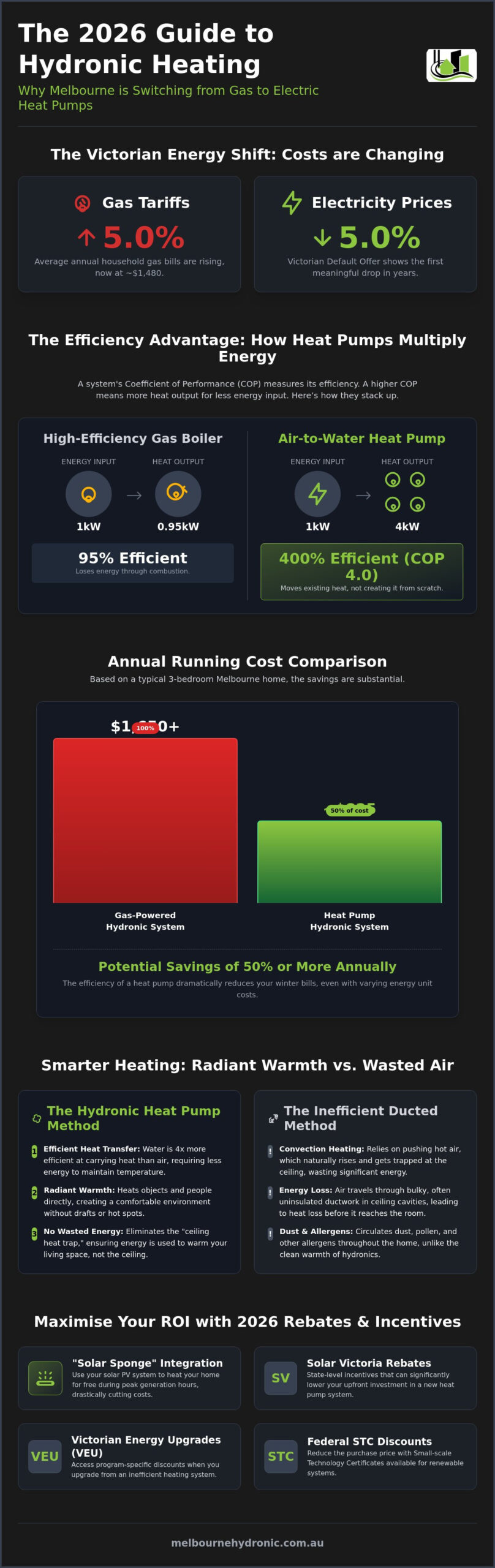
- Learn how air-to-water heat pumps achieve a COP of 4.0, turning 1kW of electricity into 4kW of clean, consistent warmth for your home.
- Compare the annual running cost of hydronic heating with heat pump against traditional gas boilers to see how 2026 tariff changes impact your household budget.
- Discover how to use your solar PV system as a “solar sponge” to heat your home for free during peak generation hours.
- Identify the specific 2026 rebates and Victorian Energy Upgrades (VEU) incentives that can significantly lower your upfront transition costs.
- Understand why expert system design and professional pipework insulation are the most critical factors in preventing energy waste and ensuring long-term reliability.
Understanding the Efficiency of Heat Pump Hydronics in 2026
An electric heat pump doesn’t generate heat through combustion or high-resistance coils; instead, it acts as a sophisticated energy mover. By leveraging the principles of heat pump technology, these systems extract ambient warmth from the outside air and transfer it into the water circulating through your home. This process is fundamentally more efficient than burning fossil fuels because it requires significantly less primary energy to move heat than it does to create it from scratch. It’s a shift from consuming resources to managing them with precision.
The most critical metric for any homeowner evaluating the running cost of hydronic heating with heat pump is the Coefficient of Performance (COP). COP is the ratio of heat output to energy input. In a modern, well-designed system, a COP of 4.0 means that for every 1kW of electricity the unit consumes, it delivers 4kW of thermal energy into your living spaces. This 400% efficiency rating is the primary reason electric systems are rapidly replacing traditional gas boilers across Victoria. When you compare this to a high-efficiency gas boiler, which might reach 95% efficiency at best, the economic advantage becomes clear.
Water is nearly four times more efficient at carrying heat than air. While traditional ducted systems struggle to push warm air through bulky, often uninsulated ceiling cavities, hydronic systems use high-density water to deliver warmth directly to radiator panels. Because water holds its temperature far longer than air, the system doesn’t need to cycle as frequently to maintain a comfortable environment. This thermal stability is a key factor in keeping the running cost of hydronic heating with heat pump predictable and low, even during Melbourne’s most erratic winter weather.
The COP Breakdown: Melbourne Climate Edition
Melbourne’s winter climate is actually an ideal environment for these systems. With average daytime temperatures typically ranging between 8°C and 14°C, heat pumps operate in their “sweet spot,” maintaining high efficiency without straining the compressor. Even when the temperature drops toward 0°C on a frosty Mornington Peninsula morning, modern units use advanced defrost cycles to manage ice buildup. While efficiency dips slightly during these brief cold snaps, the overall seasonal performance remains incredibly high compared to any other heating method available in 2026.
Radiant Heat vs. Convection Efficiency
The way we experience warmth is just as important as how it’s generated. Conventional ducted systems rely on convection, which pushes hot air to the ceiling where it’s trapped and wasted. Hydronic systems use radiant heat to warm the objects and people in a room directly. Understanding what is hydronic heating reveals that by using radiator panels at lower flow temperatures, you eliminate the “ceiling heat trap.” This targeted approach ensures that every cent spent on electricity goes toward warming the areas of the home where you actually live, rather than heating the empty space above your head.
2026 Running Cost Comparison: Heat Pump vs. Gas vs. Ducted
The energy landscape in Victoria has shifted significantly as we move through 2026. For decades, gas was the standard for Melbourne homes, but rising network tariffs have changed the math for local families. Current data shows the average annual gas bill for a Victorian household has reached approximately $1,480, a 5.0% increase from 2025. In contrast, the Victorian Default Offer for electricity has decreased by an average of 5% for the 2026-2027 period. When you evaluate the running cost of hydronic heating with heat pump, these diverging trends make a compelling case for electrification.
For a typical 3-bedroom Melbourne home, a gas-powered hydronic system can cost over $1,650 annually to run. An electric heat pump system, operating with a COP of 4.0, reduces this figure dramatically. Even though electricity costs more per unit than gas, the heat pump’s ability to “multiply” energy means it uses far less total power to achieve the same level of comfort. This efficiency gap is the reason why electric systems are now the more economical choice for the modern Victorian budget. Maintenance also enters the equation; while gas systems require essential safety checks to manage combustion risks, heat pumps operate on sealed refrigerant cycles, which typically results in lower long-term service costs.
The Victorian Gas Transition Factor
The 2024 ban on new gas connections was just the beginning of a broader transition. As more households disconnect, the cost of maintaining the aging gas network is shared among fewer customers, driving up individual bills. Transitioning now allows you to access Solar Victoria heat pump rebates, which remain a vital tool for offsetting the initial setup. Choosing an all-electric path isn’t just about immediate savings; it’s about future-proofing your home against further gas price volatility. You can explore the specific radiator heater cost in Melbourne to see how these modern components fit into a high-efficiency electric upgrade.
The Hidden Cost of Ducted Heating Waste
Many Melbourne homes still rely on gas ducted heating, which is notoriously inefficient. These systems lose between 25% and 30% of their heat through uninsulated or leaky ductwork hidden in ceiling cavities. You’re effectively paying to heat your roof space. Hydronic pipework is different. It’s heavily insulated and retains roughly 98% of the thermal energy from the heat pump to the radiator panel. This lack of waste accelerates your return on investment. While the upfront cost of a heat pump is higher than a basic gas heater, the combined impact of lower monthly bills and government incentives often leads to a “break-even” point much sooner than most homeowners expect. If you’re looking to eliminate waste, a professional assessment of your current system is the best place to start.
Maximising ROI: How to Lower Your Heat Pump Running Costs
Efficiency is about more than just the hardware you install; it’s about how you manage the energy flow within your home. To truly minimise the running cost of hydronic heating with heat pump, you need to look at your house as a complete system. In 2026, the most successful Melbourne retrofits are those that combine high-performance technology with smart usage habits. By making a few strategic adjustments to your daily routine, you can shift from simply paying bills to actively managing your household’s thermal economy.
The “solar sponge” effect is your greatest ally in reducing monthly expenses. Since Melbourne’s electricity tariffs are now influenced by the massive influx of daytime solar power, running your heat pump during peak production hours (typically 10 am to 4 pm) allows you to heat your home for a fraction of the standard cost. If you have a rooftop solar array, this becomes even more effective. You’re essentially using the sun to “pre-load” your home with warmth, which the structure then holds well into the evening. Experts at MarGav Solar have highlighted how such solar integration can drastically reduce annual energy bills. This strategy turns your floor or radiator panels into a thermal battery, storing energy when it’s cheapest or free.
Zoning is another powerful tool for cost control. Unlike old-fashioned ducted systems that blast air into every corner of the house, a professional hydronic setup allows you to heat only the rooms you’re using. By closing off guest rooms or formal dining areas, you reduce the load on the heat pump and lower your power consumption. For those living in Melbourne’s iconic Victorian-era homes, combining zoning with simple draught proofing and secondary glazing can prevent up to 25% of heat loss. Strengthening your home’s “envelope” ensures that the running cost of hydronic heating with heat pump remains low by keeping the warmth exactly where it belongs.
Smart Controls and Weather Compensation
Modern thermostats have evolved far beyond simple on-off switches. By monitoring Melbourne’s outdoor conditions, weather compensation technology adjusts the water flow temperature in real-time. Weather compensation prevents energy spikes by ensuring the unit doesn’t work harder than necessary to maintain your desired comfort level. Additionally, using a “night setback” mode—where the temperature drops by just 2 or 3 degrees overnight—is often more efficient than turning the system off entirely and forcing a heavy morning re-heat.
Solar PV Integration: The Path to $0 Running Costs
Sizing your solar system to match your heating demand is the ultimate way to achieve energy independence. A well-proportioned 6.6kW or 10kW solar array can often cover the entire daytime load of a modern heat pump during the shoulder seasons and a significant portion during mid-winter. This synergy is a core part of any high-performance heat pump hydronic heating strategy. When your system is designed to talk to your solar inverter, you can automate your heating cycles to trigger only when excess green energy is available, pushing your running costs toward zero.
Rebates and Incentives for Melbourne Homeowners in 2026
The transition toward an all-electric Victoria is well underway, and the state government is providing significant financial levers to help you make the move. While the initial investment in a heat pump can be higher than a standard gas unit, these incentives are designed to lower the barrier to entry. The math is simple. By stacking multiple rebates, you can drastically reduce your net capital outlay. This strategic approach to financing your upgrade directly improves the long-term running cost of hydronic heating with heat pump by shortening your payback period from the very first day of operation.
Beyond state-level support, federal Small-scale Technology Certificates (STCs) provide an additional upfront discount. For a typical 2026 installation, these certificates can offer a reduction of approximately $570 to $650, depending on the system’s efficiency and your location. Small businesses in Melbourne and Geelong aren’t left out either, as many can access specific tax incentives or low-interest green loans through local councils. These programs aim to decarbonise the commercial sector while helping owners manage energy volatility. If you’re ready to see how these savings apply to your home, a professional assessment of your property is the first step toward securing your funding.
Accessing Solar Victoria Rebates
As of July 2026, the Solar Victoria Hot Water Rebate remains a primary source of funding for those switching to heat pump technology. To be eligible, your combined household income must now be below $150,000 per year, a reduction from previous thresholds designed to target support where it’s needed most. The rebate provides up to $1,000 off the cost of a standard system, or up to $1,400 if you choose a locally manufactured unit. This incentive alone can shave years off your ROI. The process is streamlined through accredited providers, who handle the technical paperwork on your behalf during the quoting stage.
The VEU Program Explained
The Victorian Energy Upgrades (VEU) program works by generating Victorian Energy Efficiency Certificates (VEECs) based on the greenhouse gas emissions your new system will save. For a standard hydronic heat pump, these certificates often translate into a substantial upfront discount applied directly to your invoice. This is different from a post-install rebate because you see the savings immediately. Efficiency pays dividends. To ensure your system continues to meet the standards required for these programs, regular hydronic heating service melbourne is essential. Maintaining your equipment not only preserves your warranty but also protects the running cost of hydronic heating with heat pump by keeping the unit operating at its peak COP.
Expert Design: Why Installation Quality Dictates Running Costs
A high-performance heat pump is only as good as the network it feeds. While the hardware provides the potential for efficiency, the actual running cost of hydronic heating with heat pump is determined by the precision of the installation. Many homeowners focus solely on the unit’s brand, but poor system design can easily double your energy consumption. If a unit is under-sized, it will struggle to maintain temperature during a Melbourne cold snap, running constantly at maximum power. Conversely, an over-sized unit will “short cycle,” turning on and off too frequently, which wastes electricity and shortens the lifespan of the compressor.
Specialist installers like D-technix emphasize that the correct sizing and integration of heat pump units are the most vital steps in securing a home’s long-term energy savings.
Beyond sizing, the quality of pipework insulation and system cleanliness are vital. Amateur installations often leave critical pipe runs exposed in sub-floors or ceiling cavities, allowing thermal energy to bleed away before it reaches your radiators. We also prioritise power flushing during retrofits to remove old sludge and magnetite. Clean water allows for maximum heat transfer; even a thin layer of internal buildup can force your system to work 15% harder to achieve the same result. Maintaining 2026 efficiency levels requires this level of technical attention to detail from the very first day.
Custom Pipework and Manifold Design
The “brain” of a modern hydronic system is the manifold and hydraulic separation design. By ensuring the heat pump can operate at its peak COP regardless of which zones are active, custom manifolds prevent the system from “fighting” itself. This low-friction design reduces the energy consumed by circulating pumps and ensures even heat distribution across every room. One local Melbourne family recently saw their winter energy bills drop by 40% simply by having us redesign their manifold and balance their radiator flow rates. It is a clear example of how engineering expertise translates directly into household savings.
The Melbourne Hydronic Heating Difference
With over 30 years of local experience in Melbourne and Geelong, we understand the specific thermal challenges of Victorian architecture. Whether you are installing high-efficiency radiator panels or modern underfloor heating, our team ensures every component is calibrated for the running cost of hydronic heating with heat pump that fits your budget. We don’t believe in “off-the-shelf” solutions because every home has a unique thermal footprint. Your comfort and long-term savings are built on our foundation of technical precision and local pride. If you’re ready to make the switch, you can request a professional running cost assessment for your home today.
Secure Your Home’s Energy Future
Transitioning to an all-electric home is no longer just an environmental choice; it’s a strategic financial move for Victorian families. By moving away from volatile gas prices and embracing high-efficiency technology, you can achieve a level of comfort that’s both sustainable and affordable. We’ve explored how professional design, smart zoning, and solar integration work together to significantly minimize the running cost of hydronic heating with heat pump. These systems offer a dust-free, premium warmth that traditional ducted heating simply cannot match.
With over 30 years of local experience as Victorian Government Approved Installers, our team specializes in these technical heat pump transitions. We understand that every Melbourne home requires a bespoke approach to ensure peak performance and long-term reliability. We’re here to help you navigate the available 2026 rebates and design a system that pays for itself through lower energy bills. Don’t leave your family’s winter comfort to chance or outdated systems that drain your household budget.
Get a Custom Running Cost Estimate for Your Melbourne Home and start your journey toward a cleaner, more efficient sanctuary today.
Frequently Asked Questions
Is hydronic heating with a heat pump cheaper than gas in Melbourne?
Yes, a heat pump is considerably cheaper to run than a gas boiler in 2026. Because a heat pump moves heat rather than creating it, it can achieve efficiencies of 400%, whereas even the best gas boilers top out at 95%. When you factor in the 5.0% gas tariff increase this year, the running cost of hydronic heating with heat pump becomes the most sustainable choice for a Melbourne budget.
How much does it cost to run a hydronic heat pump per month in winter?
A typical Melbourne household can expect to pay roughly 30% to 50% less on their monthly heating bill compared to traditional gas systems. While exact figures depend on your home’s insulation and size, the high efficiency of the compressor ensures that your electricity usage remains predictable. By utilizing smart zoning and modern thermostats, you can further lower these expenses and avoid the “bill shock” often associated with aging gas infrastructure.
Do heat pumps work effectively in Melbournes zero-degree mornings?
Modern air-to-water heat pumps are designed to operate effectively even when temperatures drop well below freezing. Melbourne’s zero-degree mornings are easily handled by advanced defrost cycles that prevent ice buildup on the outdoor unit. While the system works slightly harder during these brief cold snaps, it maintains a consistent indoor temperature without the massive energy spikes seen in traditional electric resistance heaters.
Can I use my existing radiators with a new electric heat pump?
Most existing radiator panels can be integrated with a new heat pump system after a professional technical assessment. Because heat pumps typically operate at lower flow temperatures than gas boilers, we evaluate your current panels to ensure they have enough surface area to heat your rooms effectively. In some cases, we might suggest upgrading a few specific panels to high-efficiency models to maximize your overall system performance.
How much can solar panels reduce my hydronic heating running costs?
Solar panels can reduce your running cost of hydronic heating with heat pump to near zero during the shoulder seasons. By timing your heating cycles to align with peak solar production between 10 am and 4 pm, you use free energy to pre-warm your home’s thermal mass. This “solar sponge” strategy is the most effective way to achieve energy independence; you can discover Eastern Electric to see how high-performance solar and battery storage systems are designed to shield households from future utility price hikes.
What is the lifespan of a hydronic heat pump compared to a gas boiler?
A high-quality heat pump typically has a lifespan of 15 to 20 years, which is comparable to a premium gas boiler. Because there is no internal combustion, these units don’t suffer from the heat-related stress that eventually degrades boiler components. Regular professional servicing is essential to maintain the sealed refrigerant system and ensure the electronics continue to operate at peak efficiency throughout the unit’s life.
Are there specific Victorian government rebates for hydronic heat pumps in 2026?
Several significant incentives are available in 2026, including the Solar Victoria Hot Water Rebate and the Victorian Energy Upgrades (VEU) program. Eligible households with an annual income under $150,000 can access up to $1,400 for locally made systems. These rebates, combined with federal STC discounts, can significantly lower the initial transition cost, making the switch to all-electric hydronics more accessible for Melbourne homeowners.
Does hydronic heating increase the resale value of a Melbourne home?
All-electric homes are increasingly sought after in the Melbourne property market, often commanding a premium from health-conscious and energy-savvy buyers. With the Victorian government’s shift away from gas, a home equipped with a modern hydronic system is seen as future-proof and “move-in ready.” The promise of dust-free warmth and low monthly overheads provides a distinct competitive edge that can significantly boost your property’s long-term resale value.