Hydronic Heating for High Ceiling Rooms: The 2026 Melbourne Guide
Why are you paying to heat the three meters of empty space above your head while your toes are still freezing? It is a common Melbourne winter struggle: the heater is on and the gas bill is climbing, yet the warmth immediately retreats to the highest point of your ceiling. Many homeowners are told that hydronic heating for high ceiling rooms lacks the power to handle large voids, but this ignores the fundamental science of radiant heat. Unlike ducted air that rises and disappears, hydronic systems warm the objects and people in the room first.
You likely know the frustration of a noisy system that blows dust around while leaving your floors ice-cold. It’s a common pain point in modern architectural homes, but it doesn’t have to be your reality. This guide will show you how radiant hydronic systems provide silent, floor-to-shoulder warmth that can reduce your space heating running costs by up to 70% compared to traditional methods. We will explore the latest 2026 Victorian energy rebates, the shift toward electric heat pumps, and why these European-style solutions are the gold standard for Melbourne’s high-void living spaces.
Key Takeaways
- Learn how thermal stratification traps warm air at the ceiling and why radiant energy is the only way to keep heat at floor level.
- Discover why underfloor and trench systems are the most effective forms of hydronic heating for high ceiling rooms by neutralizing cold bridge effects near large glass windows.
- Understand the comfort profile of water-based heating, which offers a silent and allergen-friendly environment without the dust circulation of ducted air.
- Find out how modern electric heat pumps can reduce your winter running costs by up to 70% while future-proofing your home against upcoming Victorian gas regulations.
- See why a professional heat-load calculation is vital for high-void areas to ensure your system is perfectly sized for Melbourne’s unique architectural styles.
The High Ceiling Heat Trap: Why Traditional Heating Fails in Voids
High ceilings and open voids are the hallmarks of premium Melbourne architecture, from the grand Victorian terraces of Carlton to the modern, glass-heavy designs in Brighton. While these spaces offer a sense of luxury and light, they present a significant engineering challenge for climate control. The primary culprit is thermal stratification. This is the natural physical process where warm air, being less dense, rises to the highest point of a room while cooler air settles at floor level. In a room with a four-metre void, the air at the ceiling can be up to 10 degrees warmer than the air at your feet.
Traditional ducted systems struggle in these environments because they rely on convection, or moving air. They attempt to heat the entire volume of the room from the top down. This creates the infamous “hot head, cold feet” effect, where you feel a stuffy warmth near your face while your toes remain like ice on the floorboards. It’s an expensive exercise in futility to pay for heating four metres of air just to feel comfortable at 1.5 metres. To understand a better way, it helps to look at what is hydronic heating and how it shifts the focus from air volume to surface temperature.
The Physics of Convection in Tall Rooms
Forced-air systems often lose 20% to 30% of their efficiency in high-ceiling environments. Because the air is pushed out of vents at high speeds, it rapidly rises to the ceiling before it has a chance to warm the inhabitants. This movement also creates a “draught effect.” Even if the air is warm, the constant movement across your skin can make you feel cooler, leading you to turn the thermostat up even higher. In Melbourne’s historic homes with 3.5-metre ceilings, this cycle leads to shockingly high gas bills and a home that never feels truly cozy.
Radiant Heat: The Hydronic Advantage
Radiant heat works differently. Instead of warming the air, it warms objects and people directly, much like the rays of the sun on a winter day. When you install hydronic heating for high ceiling rooms, the energy is emitted as long-wave radiation. This energy doesn’t immediately fly to the ceiling; it stays in the “living zone,” which is the first two metres of space from the floor up. This ensures that the warmth remains where you actually live, rather than being wasted in a roof void.
Whether you choose floor coils or radiator panels, the system creates a consistent heat profile that doesn’t rely on turbulent air. Hydronic radiant heat is the most efficient method for high-void spaces because it delivers warmth to the occupant without the energy waste of air-based convection. By choosing hydronic heating for high ceiling rooms, you ensure that every dollar spent on energy is felt exactly where you need it most.
Radiant Heat vs. Convective Air: Which Wins for Your Home?
Choosing between air-based and water-based systems is the most critical decision for any Melbourne homeowner with a high-void floor plan. While ducted systems are common, they operate on a principle that is fundamentally flawed for tall spaces. They push dry, recycled air into the room, which immediately creates a turbulent environment where heat escapes to the ceiling. In contrast, water-based systems provide a steady, silent warmth that anchors itself to the floor. This difference in “comfort profiling” is why hydronic heating for high ceiling rooms is widely considered the premium standard in European and high-end Australian architecture.
You might encounter the “Builder Myth” during your renovation or build. Some contractors claim that hydronic systems aren’t “powerful enough” for massive open-plan areas. This usually stems from a preference for ease of installation rather than operational performance. Ducted systems are faster to install, but they cannot compete with the radiant energy of water. Beyond comfort, the health benefits are significant. Because there are no fans blowing air, your home remains free from the dust and allergens that typically circulate in high-void areas. This creates a “pormentes” (dust-free) environment that is essential for families with asthma or hay fever.
Comfort Profiling: Air vs. Water
Imagine a home where the warmth is as silent as the architecture. Large, open spaces are often prone to echoes, and the constant hum of a ducted fan only amplifies this acoustic issue. Hydronic systems operate in complete silence. They provide a gentle, even heat that feels natural, much like the warmth of a sun-drenched stone wall. For those starting their journey, our Complete Melbourne Homeowner’s Guide provides a deep dive into how these systems transform the living experience.
The Efficiency Gap in High-Void Architectures
Efficiency in a tall room is measured by how long heat stays where you need it. Air loses its temperature almost instantly once the heater cycles off. However, the thermal mass of a concrete floor or a steel radiator panel retains energy for hours. This is especially effective when paired with modern technology. By 2026, many Melbourne residents are moving away from gas. Transitioning to Electric Heat Pumps can reduce your space heating running costs by up to 70% compared to traditional gas-fired air systems. If you’re planning a new project, you can consult with a Melbourne specialist to ensure your system is engineered for maximum thermal retention.

Top Hydronic Solutions for High-Ceiling Melbourne Homes
Choosing the right hardware is the most critical step in ensuring your high-void space remains comfortable throughout a Melbourne winter. While the physics of radiant heat provides the foundation, the specific emitters you select will determine how effectively that warmth is distributed. For homeowners navigating the complexities of hydronic heating for high ceiling rooms, the goal is to match the system to the architectural features of the property, such as floor-to-ceiling glass, polished concrete, or heritage wall details.
Modern systems offer a range of solutions that go beyond simple wall heaters. In large open-plan areas, you need emitters that can handle the massive volume of space without cluttering your interior design. Whether you are retrofitting a Victorian terrace or designing a contemporary masterpiece, these specific technologies ensure that your investment translates into genuine, floor-level comfort.
Underfloor Heating: Maximum Radiant Coverage
For those embarking on a new build or a major structural extension, underfloor heating stands as the gold standard. This system turns your entire floor into a massive, low-temperature radiator. It’s the most effective way to combat the pooling of cold air at ground level because the heat source is directly beneath your feet. In Melbourne homes with polished concrete or tiled floors, the thermal mass of the slab stores energy and releases it slowly. This creates a consistent heat profile that remains stable even when doors are opened or outside temperatures drop rapidly.
Trench Heating: The Invisible Perimeter Guard
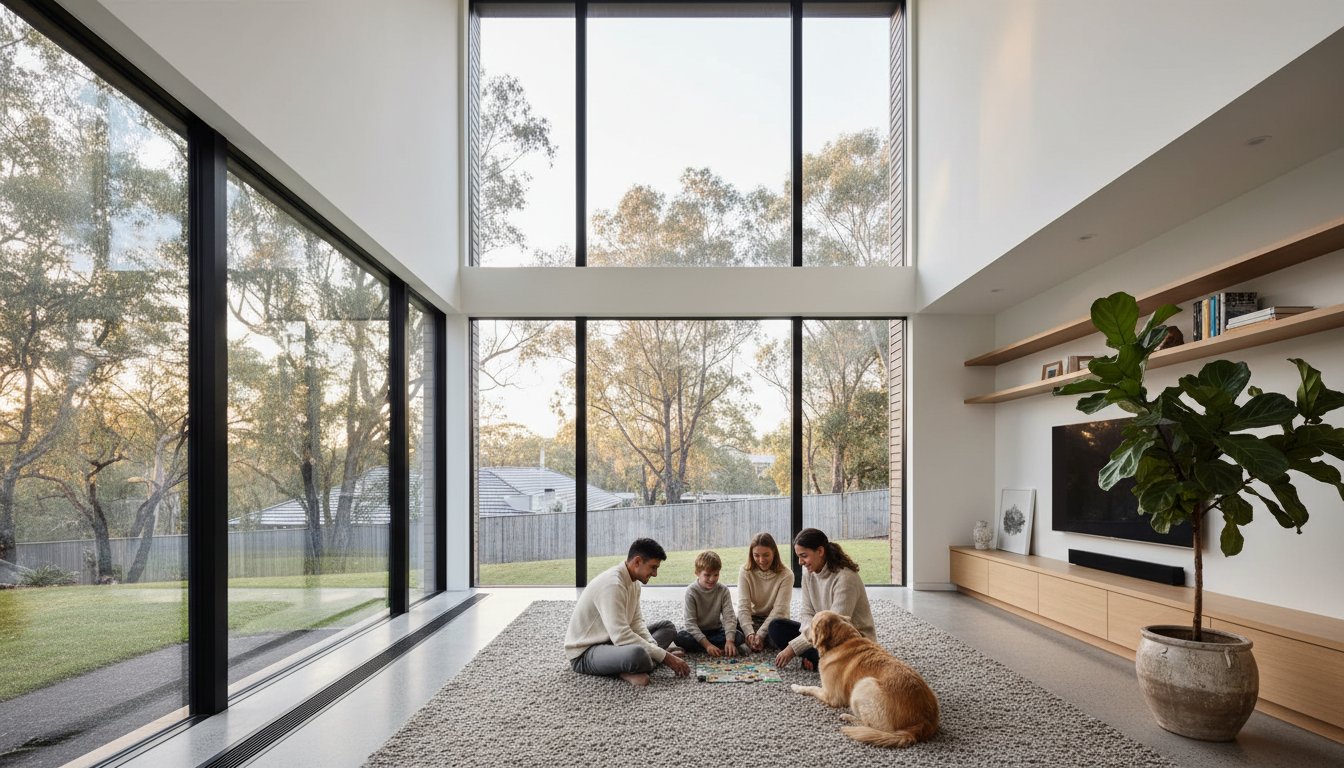
Large glass sliders and floor-to-ceiling windows are staples of Melbourne’s modern architecture, but they are also significant sources of heat loss. Trench heating is the essential solution for these areas. These units sit flush within the floor, usually covered by a discreet grille that matches your timber or stone. They create a “curtain of warmth” that rises directly in front of the glass, neutralizing the “cold bridge” effect before it can chill the rest of the room. This allows you to enjoy your garden views without feeling the bite of the winter wind through the glass. It’s a minimalist’s dream, providing powerful hydronic heating for high ceiling rooms without a single visible wall unit.
In period renovations where floor-based systems aren’t an option, vertical or oversized radiator panels are the preferred choice. These units provide the necessary surface area to radiate heat across a large room while taking advantage of vertical wall space. If you have a particularly large void that requires rapid heating, hydronic fan coils can be integrated. These provide a quick “boost” of warm air when you first arrive home, while the radiant panels take over to maintain a steady, dust-free environment for the rest of the evening.
Managing Heat Loss: Glass, Voids, and Melbourne Winters
Large expanses of glass are a staple of modern Melbourne design, but they often behave like thermal holes in a home’s envelope. When planning hydronic heating for high ceiling rooms, you must account for the way glass surfaces accelerate heat loss. Even high-quality double glazing has a lower R-value than an insulated wall. During a July night in Melbourne, the internal surface of a large window becomes significantly colder than the room air. This temperature difference triggers a cold bridge effect. The air near the window cools, becomes denser, and falls to the floor, creating a noticeable draught even if the window is perfectly sealed.
To mitigate this, your heating system must be strategically placed to intercept this falling cold air. This is where the synergy between hydronic technology and building insulation becomes vital. A well-insulated home keeps the radiant energy within the living zone for longer, allowing the system to operate at lower, more efficient temperatures. Without this balance, even the most powerful heater will struggle to overcome the constant thermal drain of an uninsulated void.
Combating the “Window Draught”
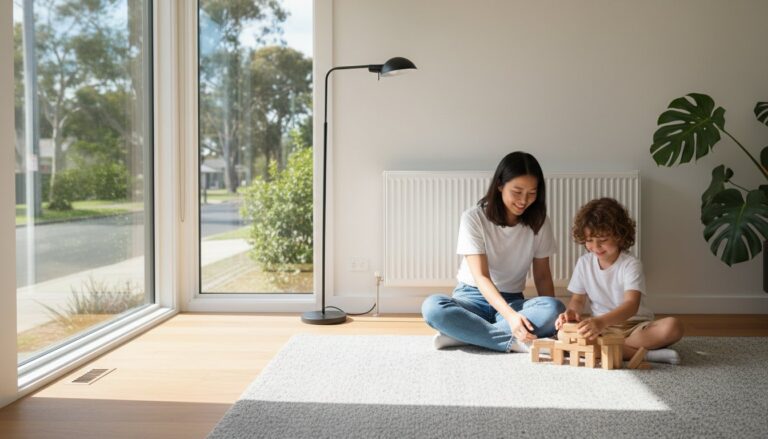
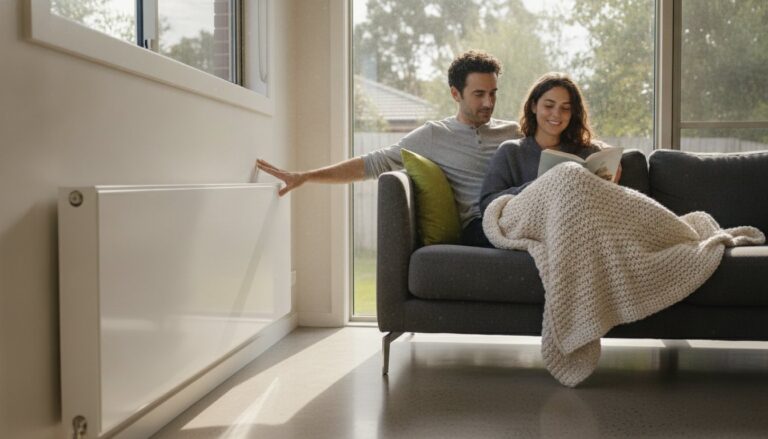
Even the best double-glazed windows can feel cold to the touch without perimeter heating. The most effective way to neutralize this is by placing Hydronic Radiator Panels directly under or adjacent to large glass areas. As the panel radiates heat, it creates an upward current of warmth that meets the falling cold air from the window. This effectively cancels out the draught before it reaches your living space. When we calculate heat requirements for rooms with 4-metre ceilings, we don’t just look at floor area. We calculate the total cubic volume and the specific U-values of your glass to ensure the system has enough capacity to counter the peak winter chill.
Smart Zoning for Open Plan Living
Zoning is a technical necessity for high-void architectures. These spaces have a unique thermal inertia, meaning they take longer to warm up and cool down than a standard 2.4-metre bedroom. You shouldn’t have to heat your entire home just because you’re spending the evening in the high-ceiling lounge. By using independent thermostats and manifolds, you can manage these large-volume zones separately. This ensures the system doesn’t overwork in smaller rooms while the lounge is still reaching its target temperature. Professional design is required to balance flow rates in large-void systems to ensure the water reaches the furthest emitters at the correct temperature. If you want to ensure your open-plan home remains efficient, contact our team for a professional heat-load assessment.
- Zoning Tip: Use smart thermostats to pre-heat high-void areas 30 minutes earlier than standard rooms.
- Insulation Check: Ensure R-6.0 ceiling insulation is present above voids to minimize upward heat migration.
- Glazing Synergy: Pair trench heating with low-E glass to maximize the “air curtain” effect.
Designing Your High-Ceiling System with Melbourne Hydronic
Designing a system for a standard home is one thing. Engineering hydronic heating for high ceiling rooms requires a deeper level of technical precision. With over 30 years of experience in the Melbourne market, we’ve seen how poorly designed systems fail to reach the living zone in high-void properties. A simple “rule of thumb” calculation based on floor area often results in a home that feels perpetually under-heated. Instead, we perform rigorous heat-load calculations that account for total air volume, glazing U-values, and the specific thermal properties of your building materials. This ensures your system is sized correctly from day one.
Our end-to-end service covers every stage of the process. We manage everything from initial design and boiler selection to expert installation by licensed technicians. We are committed to energy-efficient heat sources, including premium European condensing boilers and the latest air-to-water electric heat pumps. By 2026, the shift toward electrification is accelerating in Victoria. We help you choose a system that meets current performance needs while future-proofing your home against upcoming gas regulations. Our goal is to provide a silent, dust-free, and allergen-friendly environment that enhances your quality of life.
Why Local Expertise Matters for Tall Rooms
Melbourne’s architectural landscape is incredibly diverse. A heritage Victorian terrace in South Melbourne with 3.8-metre ceilings presents different challenges than a modern, glass-heavy coastal build in Geelong. Older properties often require complex boiler replacements and system upgrades to handle the heat loss typical of lath-and-plaster walls. We understand these nuances. Whether we are retrofitting an existing property or installing a full in-slab system for a new build, our local knowledge ensures the warmth stays where you need it. To keep your system running at peak efficiency for decades, we also provide a comprehensive Hydronic Heating Service Melbourne, covering everything from power flushing to annual safety checks.
Next Steps: Consultation and Design
A professional consultation is the first step toward a comfortable home. We don’t just sell products; we design solutions. During a site visit or plan review, we look at your home’s orientation, window placement, and void heights. We work closely with builders and architects to integrate hydronic components seamlessly into your interior design. This collaborative approach prevents costly mistakes and ensures that your trench heaters or radiator panels are positioned for maximum radiant effect. If you’re ready to stop losing heat to your ceiling and start enjoying a truly cozy winter, contact us for a custom design quote today.
Transform Your High-Void Home into a Warm Sanctuary
You no longer have to settle for a home where the warmth remains out of reach. The science of radiant energy ensures that hydronic heating for high ceiling rooms keeps the comfort at floor level where it belongs. By combining underfloor or trench systems with modern heat pump technology, you can neutralize the draughts from large glass expanses while reducing your running costs by up to 70%. It is about more than just temperature; it is about creating a silent, dust-free environment that supports your family’s health and well-being.
As a Victorian family-owned and operated company with 30 years of experience, we are specialists in high-void and period home renovations. We understand the unique thermal challenges of Melbourne’s architecture and the precision required to heat them effectively. Our team provides the engineering expertise needed to ensure your investment delivers lasting value and premium comfort throughout the winter months. Request a Custom Hydronic Design for Your High-Ceiling Home to see how we can optimize your living space. Your home should be a place of total comfort, regardless of how high the ceilings reach.
Frequently Asked Questions
Is hydronic heating powerful enough for a 4-metre ceiling?
Yes, it is the most effective solution because it warms objects and people rather than just the air volume. Since radiant energy doesn’t immediately rise to the ceiling like forced air, the warmth stays in the living zone. This makes hydronic heating for high ceiling rooms significantly more efficient than traditional air-based alternatives that lose 20% to 30% of their heat to the roof void.
Which is better for high ceilings: radiators or underfloor heating?
Underfloor heating is generally the gold standard for high ceilings because it provides the most even heat distribution from the ground up. It turns the entire floor into a low-temperature radiator, preventing cold air from pooling at your feet. However, vertical radiator panels are an excellent alternative for renovations where slab access is impossible, as they provide the necessary surface area to radiate heat across large voids.
How much does it cost to install hydronic heating in a high-void room?
Installation costs depend on the system type and total floor area. For a new build in 2026, a full in-slab system for a 200 square metre home typically ranges between A$28,000 and A$42,000. If you’re retrofitting a three-bedroom home with six radiator panels and a new gas boiler, prices usually fall between A$14,500 and A$19,500. These figures reflect current Melbourne market rates for premium components and expert installation.
Does hydronic heating work with floor-to-ceiling glass windows?
It works exceptionally well when paired with trench heating or perimeter radiators. These units create a curtain of warmth that rises in front of the glass, neutralizing the cold bridge effect. This prevents the common issue where cold air falls off the glass and creates draughts across the floor. It ensures your open-plan living area remains comfortable even with expansive glazing and significant glass surface area.
Can I install hydronic heating in an existing high-ceiling Victorian home?
Absolutely, we specialize in retrofitting heritage properties with radiator panels. These systems integrate seamlessly with period architecture, using slimline panels that provide high heat output without requiring structural changes to the floors. It’s a popular choice for Melbourne homeowners looking to replace inefficient systems before the March 1, 2027 rental property regulations take effect, ensuring long-term compliance and comfort.
Why is my high-ceiling room still cold with a ducted heater?
Your room is likely cold because of thermal stratification, where the warm air from your ducted system immediately rises to the ceiling. This leaves a layer of dense, cool air at floor level. Because air is a poor conductor of heat, the system has to work much harder to warm the lower half of the room, leading to high energy bills and persistent discomfort at foot level.
Does hydronic heating take longer to warm up a large room?
While radiant systems have a slower start-up time than ducted air, they provide much more stable heat. An in-slab system may take several hours to reach temperature, but it retains that warmth for a significant period after the system is turned off. For a faster response in high-void areas, we often recommend radiator panels or fan coils, which can provide noticeable warmth within 20 to 30 minutes.
What is trench heating and do I need it for my open-plan void?
Trench heating consists of heating units installed in a recessed trench within the floor, usually covered by a decorative grille. It’s highly recommended for open-plan voids with large glass sliders because it provides a powerful heat barrier without blocking your views. It’s the most discreet way to deliver hydronic heating for high ceiling rooms, keeping the floor area clear of wall-mounted panels while protecting against window draughts.