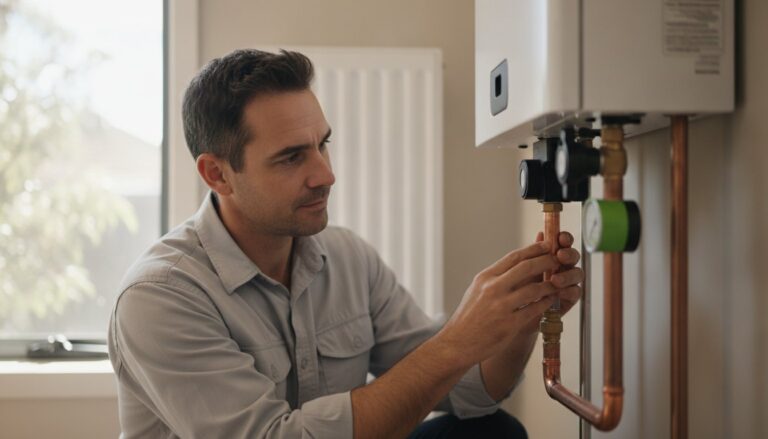

How to Choose a Hydronic Heating Installer in Melbourne: A 2026 Expert Guide
Why do two “identical” hydronic quotes for your Melbourne home differ by thousands of dollars? It’s a common frustration for homeowners who simply want a warm, healthy environment without the stress of technical guesswork. You’ve likely felt that sting of confusion when one installer suggests a gas boiler replacement while another insists on an electric heat pump, leaving you to wonder if they’re designing for your comfort or their own convenience. We agree that a heating system is a significant investment in your family’s well-being, and you shouldn’t have to worry about cold spots or noisy pipes after the job is done.
Learning how to choose a hydronic heating installer Melbourne specialists can stand behind is about more than just checking a license. It’s about finding a partner who treats your home like a precision engineering project. In this 2026 expert guide, we’ll show you the critical criteria for selecting a qualified specialist who understands the latest Victorian energy regulations and heat-loss calculations. You’ll gain the confidence to look past the price tag and identify the technical expertise required for a high-performing, silent system. We’ll preview the essential questions to ask about certificates of compliance and future-proofing your home with energy-efficient technology, ensuring your long-term reliability and peace of mind.
Key Takeaways
- Distinguish between a general plumber and a dedicated hydronic specialist to ensure your system zoning is perfectly tailored to Melbourne’s varied Victorian home styles.
- Identify the essential Victorian Building Authority (VBA) endorsements and professional indemnity insurance required to guarantee a safe, compliant, and high-performing installation.
- Learn how to choose a hydronic heating installer Melbourne residents can rely on by looking beyond the lowest quote to find value in correctly sized radiators and premium system commissioning.
- Future-proof your home by understanding the 2026 shift toward full electrification, including the benefits of modern heat pumps and hybrid gas-electric configurations.
- Prioritize long-term reliability by selecting a provider with decades of local experience who manages the entire design and installation process in-house without outsourcing.
Why Specialist Expertise Matters for Melbourne Hydronic Systems
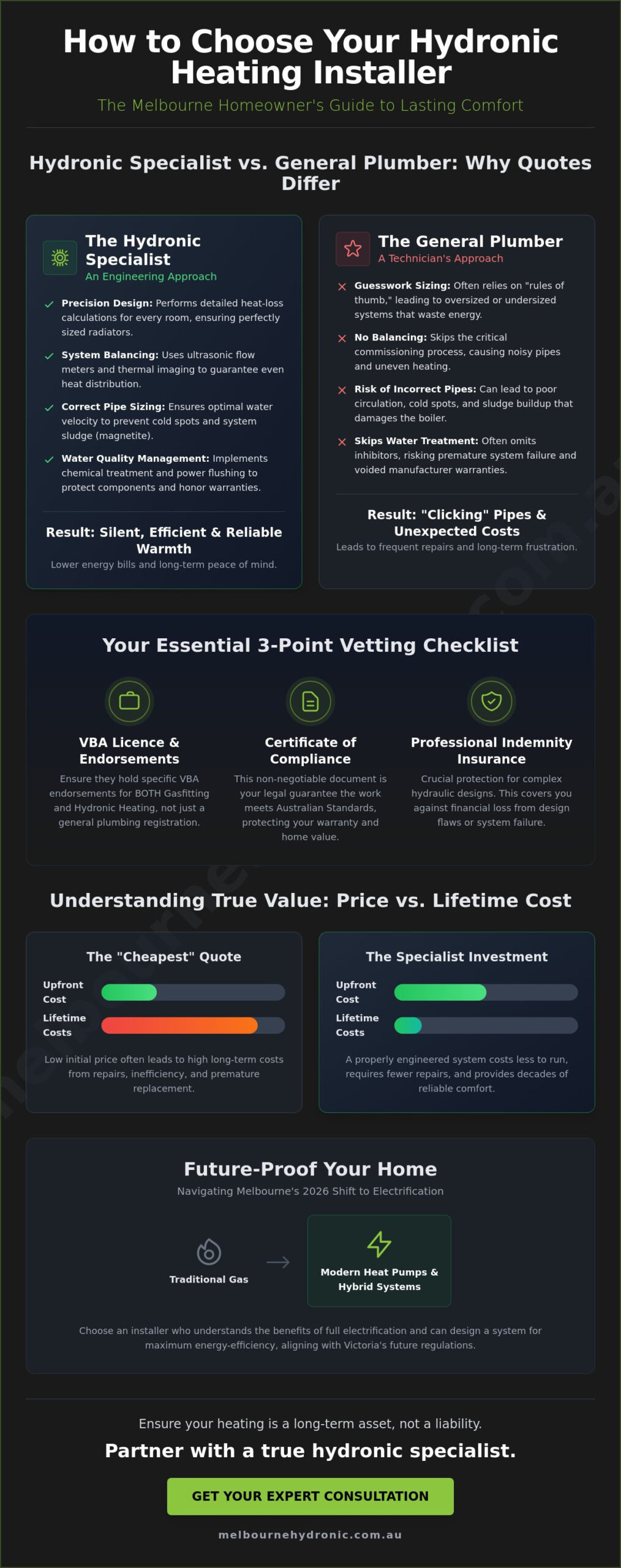
Hydronic heating is a sophisticated engineering solution that relies on precise thermodynamics rather than just basic plumbing. While many local tradespeople are skilled at fixing a leaky tap, designing a system that provides silent, consistent warmth throughout a drafty Victorian terrace requires a different level of mastery. To understand the complexity involved, it’s helpful to look at what hydronic heating is and how it uses liquid as a heat-transfer medium. When you’re researching how to choose a hydronic heating installer Melbourne experts recommend, the first thing to verify is whether they’re a thermal designer or simply a technician. A dedicated specialist understands that every room in your home has a unique heat-loss profile based on window size, ceiling height, and insulation levels.
Poorly installed systems often manifest as “clicking” pipes behind walls or boilers that cycle on and off too frequently. These aren’t just minor annoyances; they’re symptoms of poor system balancing. Specialists use ultrasonic flow meters and thermal imaging to ensure each radiator receives the exact flow rate required. Without this commissioning process, your premium boiler will work harder than necessary, shortening its lifespan and inflating your energy bills. A specialist approach ensures your home stays warm without the mechanical noise associated with amateur installations.
The Risks of Choosing a Generalist
The pipework in a hydronic system is the “arteries” of your home’s comfort. If these pipes are sized incorrectly, the water velocity won’t be sufficient to carry heat to the furthest rooms. This often leads to cold spots and the eventual buildup of magnetite, a black metallic sludge that clogs heat exchangers. A general plumber might not prioritize the chemical water treatment or the specific power flushing protocols needed to keep the system clean. Skipping these steps can lead to premature pump failure and a voided manufacturer’s warranty within just a few years of operation.
Melbourne-Specific Environmental Factors
Melbourne’s climate is notorious for its “four seasons in one day” volatility. High-ceiling period homes in suburbs like Fitzroy or Armadale present unique thermal challenges that a standard calculation won’t cover. Local installers must account for Victorian water quality, which can be surprisingly corrosive to certain radiator metals if not properly inhibited. Additionally, the local humidity levels directly affect the response times of underfloor heating systems. A specialist knows how to calibrate your thermostats and sensors to anticipate these outdoor temperature swings, ensuring your slab doesn’t overheat or leave you shivering during a sudden cold snap.
Vetting Your Installer: Essential Qualifications and Skills
In Victoria, hydronic heating isn’t a “wild west” industry; it’s strictly regulated for your safety and comfort. When you are evaluating how to choose a hydronic heating installer Melbourne homeowners should start by verifying their Victorian Building Authority (VBA) license. It isn’t enough for a technician to be a registered plumber. They must hold specific endorsements for both gasfitting and hydronic heating to legally perform the work. This ensures that upon completion, you’ll receive a VBA Certificate of Compliance. This document is your legal guarantee that the work meets Australian standards, protects your home’s resale value, and ensures your manufacturer’s warranty remains valid.
Beyond licensing, ask about professional indemnity insurance. Since hydronic systems involve complex hydraulic designs, this insurance protects you if a design flaw leads to property damage or system failure. Expertise is also proven through a portfolio of diverse property types. A specialist who only works on new builds might struggle with the heritage restrictions of an inner-city retrofit. Look for a “design-and-construct” specialist who takes full responsibility for the hydraulic layout rather than just following a generic set of plans. This holistic approach prevents common issues where the heat source and pipework don’t communicate effectively, leading to energy waste.
Thermal Design and Heat-Loss Calculations
A reputable specialist never guesses. They perform a room-by-room heat-loss calculation before a single pipe is laid. This process considers your home’s orientation, window glazing, and wall insulation levels. It’s how hydronic heating panels are correctly sized to ensure they can actually combat a cold Victorian morning. “Rule of thumb” sizing is a dangerous shortcut. It leads to undersized systems that never reach a comfortable temperature or oversized systems that cycle too frequently, increasing wear on your heat pump or boiler.
In-House Teams vs. Subcontracting
Reliability often comes down to who is actually on your roof or under your floor. Companies with permanent, specialized workforces offer a level of accountability that subcontracted “gig” workers can’t match. When you use an in-house team, the person who designed your system is directly connected to the person installing it. This creates a single point of contact and ensures the finish quality meets a consistent, high standard. If you want to see how a professional design-first approach works, you can explore our specialized installation process to see the difference in technical precision. Using a dedicated team means your project won’t be delayed by a subcontractor’s external schedule, providing you with a predictable timeline for your home’s transformation.
Comparing Quotes: Price vs. Long-Term Value
When you’re evaluating how to choose a hydronic heating installer Melbourne homeowners often find themselves staring at quotes that vary by thousands of dollars. It’s tempting to focus on the final figure, but a professional proposal is a reflection of the system’s future reliability. A comprehensive quote should be transparent. It must clearly separate the cost of premium materials, specialized labor, and the critical commissioning phase. If a quote is suspiciously low, it’s usually because the installer has undersized the radiator panels or selected a lower-grade boiler with poor modulation ranges. This results in a system that struggles to reach temperature on a frosty July morning, ultimately costing you more in energy bills and repairs.
Hidden costs can disrupt your budget if they aren’t addressed upfront. A specialist quote includes essential items that generalists often omit to keep their price low. These include high-accuracy thermostats, zoning valves for room-by-room control, and the initial chemical water treatment required to protect your heat exchanger. Choosing electric heat pumps instead of traditional gas units represents a shift toward long-term value. While the initial investment is higher, the efficiency gains and compatibility with solar power provide a significant return on investment as Victorian energy prices continue to fluctuate.
Component Quality Matters
Not all radiator panels are created equal. European-standard panels offer superior thermal output and durability compared to generic alternatives. They’re designed to resist the internal corrosion that plagues cheaper models. For those installing underfloor systems, high-quality manifolds and oxygen-barrier piping are non-negotiable. These components are buried in your home’s structure, so choosing the highest quality now prevents catastrophic failures later. Reputable brands for boilers and heat pumps also ensure that spare parts are readily available in the local market, preventing long delays during a breakdown.
Warranty and After-Sales Support
Understanding how to choose a hydronic heating installer Melbourne residents can trust also means looking at the support provided after the installation is complete. You must distinguish between a manufacturer’s warranty on the equipment and an installation guarantee on the workmanship. A local, Melbourne-based team is vital for winter emergencies when you can’t afford to wait days for a response. Your agreement should include a structured hydronic heating service plan. Regular maintenance is often a condition of the manufacturer’s warranty and ensures your system continues to operate at its peak efficiency for decades.
Navigating the 2026 Melbourne Heating Landscape
In 2026, the Victorian energy market is evolving rapidly. The government’s push for full electrification is no longer a future goal; it’s a current reality for every homeowner. When considering how to choose a hydronic heating installer Melbourne residents should prioritize professionals who understand the nuances of “Hybrid” configurations. These systems allow you to retain a gas boiler for extreme peak loads while using a heat pump for the bulk of the heating season, maximizing efficiency without sacrificing reliability during a sudden cold snap. A forward-thinking specialist will help you navigate this transition, ensuring your home remains compliant with changing Victorian energy regulations.
Navigating rebates is another critical hurdle in the current landscape. Programs through Solar Victoria and various energy-efficiency incentives can significantly offset the initial cost of high-performance hardware. A savvy installer won’t just fit the pipes. They’ll guide you through the necessary paperwork to ensure you access all available financial support. This level of administrative and technical literacy is a hallmark of a modern specialist who views your heating project as a long-term investment in your property’s value.
The Heat Pump Transition
Transitioning to heat pump hydronic heating requires a deeper understanding of water temperatures than traditional gas systems. Unlike gas boilers that typically run at 70°C, heat pumps are most efficient at lower temperatures, often around 45°C to 55°C. If you’re retrofitting an existing home, your installer must calculate if your current radiators are large enough to provide sufficient warmth at these lower temperatures. In the context of Melbourne winters, the Coefficient of Performance (COP) represents the ratio of heat energy delivered to the electrical energy consumed, typically ranging from 3.0 to 5.0 for premium systems.
Health and Allergy Benefits
Beyond the technical specifications, hydronic heating offers profound wellness advantages that are often overlooked. Because the system relies on natural convection and radiant heat, it eliminates the aggressive dust and allergen circulation common in forced-air ducted systems. This makes it the gold standard for families managing asthma or respiratory sensitivities. A professionally designed system also operates in near-total silence, removing the mechanical roar of fans. When you understand how to choose a hydronic heating installer Melbourne experts recommend, you’re choosing an environment that is as healthy as it is warm.
Modern systems now integrate seamlessly with home automation, allowing you to zone your home with surgical precision through smart thermostats. If you’re ready to modernize your home’s comfort and take advantage of the latest efficiency standards, you can book a consultation with our design team to discuss a tailored electrification strategy for your property.
Why Melbourne Hydronic Heating is Your Trusted Partner
When you’re deciding how to choose a hydronic heating installer Melbourne homeowners can trust for the long haul, experience is the ultimate metric. We’ve spent over 30 years perfecting the indoor climate of homes across the Melbourne and Geelong regions. This legacy isn’t just about the number of years on the clock. It’s about three decades of navigating the specific architectural and climatic challenges unique to Victoria. Whether you’re looking to install elegant hydronic radiator panels in a renovated villa or require a complex hydronic underfloor heating layout for a modern new build, our depth of local knowledge ensures your system performs exactly as promised.
Our commitment to quality starts with our people. Unlike many providers who rely on a rotating door of subcontractors, we maintain a permanent, in-house team of specialized technicians. This allows us to maintain total control over the finish quality and technical precision of every project. By keeping the design and installation process under one roof, we eliminate the fragmented accountability that often leads to delays or design compromises. You’ll have a single point of contact who understands every technical nuance of your home’s system, from the initial pipework to the final commissioning report.
Our Design-First Philosophy
We believe that a high-performing heating system begins on the drawing board. Our team uses advanced thermal modeling to guarantee comfort in every corner of your home, ensuring that no room is left with a cold spot. This technical rigor is how we deliver on our promise of energy efficiency and future-proofing. As we discussed earlier regarding the shift toward electrification, our designs are optimized for the latest technology, including high-efficiency gas boilers and modern electric heat pumps. Our 30-year legacy is built on this intersection of traditional workmanship and international engineering standards, earning the trust of thousands of local families.
Start Your Comfort Journey
Beginning your project with us is a straightforward, professional process. During your initial consultation, we’ll assess your property’s specific thermal needs and discuss your lifestyle requirements. We specialize in seamless boiler replacements and system upgrades, ensuring that the transition to a more efficient heat source causes minimal disruption to your daily life. We don’t believe in generic estimates or “one size fits all” solutions. Instead, we provide a comprehensive, transparent quote that details every component and labor stage. If you’re ready to secure the health and comfort of your home, reach out to our Melbourne team today to request a tailored proposal for your property.
Secure Your Home’s Thermal Future
A hydronic system is more than just a heating appliance; it’s a long-term investment in your family’s health and comfort. We’ve explored the importance of moving beyond generic plumbing to embrace specialized thermal design, ensuring your system remains silent and efficient for decades. You now understand that verifying VBA licensing and prioritizing technical heat-loss calculations are non-negotiable steps in the 2026 landscape. Ultimately, knowing how to choose a hydronic heating installer Melbourne residents rely on comes down to finding a partner who values precision as much as you value your home’s well-being.
With 30+ years of industry experience and a team of VBA licensed specialists, we’re dedicated to future-proofing Victorian homes. Our custom thermal system design ensures your transition to modern gas or electric heat pump technology is seamless and reliable. Don’t leave your comfort to chance. Book a Professional Consultation with Melbourne’s Hydronic Experts today and experience the difference that engineering mastery makes. We’re ready to help you create a warm, healthy environment that lasts a lifetime.
Frequently Asked Questions
Do I need a specialist for hydronic heating or can my regular plumber do it?
You should hire a specialist because hydronic heating is a precision engineering project requiring sophisticated thermal design expertise. While general plumbers are skilled at drainage and standard fixtures, they often lack the specialized tools and training for hydraulic balancing and boiler commissioning. A specialist ensures your system operates silently and efficiently without the common issues of noisy pipes or uneven heat distribution that often plague amateur installations.
What licenses should a Melbourne hydronic heating installer have?
A qualified professional must hold a Victorian Building Authority (VBA) license with specific endorsements for both gasfitting and hydronic heating. This is non-negotiable for legal compliance and safety. When researching how to choose a hydronic heating installer Melbourne residents should always ask for a VBA Certificate of Compliance upon completion to guarantee the work meets Australian standards and protects their home’s warranty and resale value.
How long does a typical hydronic heating installation take in Melbourne?
A standard hydronic radiator retrofit in a three-bedroom Melbourne home typically takes between three to five business days to complete. Complex underfloor heating installations in new builds or extensive heritage renovations may take longer, often requiring multiple stages synchronized with other trades. Your installer should provide a clear, methodical timeline during the design phase to ensure minimal disruption to your household routine while maintaining technical precision.
Can I switch from a gas boiler to an electric heat pump with my current radiators?
You can often switch to an electric heat pump, but your installer must first conduct a technical assessment of your existing radiator sizing. Because heat pumps operate at lower water temperatures than traditional gas boilers, your current radiators may need to be larger to deliver the same amount of warmth. A specialist will perform these calculations to ensure your new electric system provides consistent comfort during the coldest months.
Are there Victorian government rebates available for hydronic heating in 2026?
Yes, Victorian homeowners can currently access rebates through the Victorian Energy Upgrades (VEU) scheme and Solar Victoria for installing energy-efficient heating systems. These incentives are designed to support the state’s transition toward electrification and reduce household carbon footprints. Your specialist can help you identify which specific hardware qualifies for these 2026 incentives and assist with the necessary compliance documentation for your rebate application.
What is the most common mistake people make when choosing an installer?
The most frequent error is selecting an installer based solely on the lowest quote without verifying if a room-by-room heat-loss calculation was performed. Undersized systems are a common result of “rule of thumb” quoting, leading to high energy bills and poor performance. Understanding how to choose a hydronic heating installer Melbourne experts recommend involves looking for technical depth and design-and-construct capability rather than just the cheapest price tag.
How often should a hydronic system be serviced to maintain its warranty?
Professional servicing is recommended every 12 to 24 months to ensure the longevity of your system and maintain your manufacturer’s warranty coverage. Regular maintenance includes checking water chemistry, inspecting the heat exchanger, and verifying the expansion tank’s pressure. This proactive approach prevents the buildup of magnetite sludge and ensures your boiler or heat pump continues to operate at peak energy efficiency throughout its lifespan.
Do you provide hydronic heating installations in Geelong and regional Victoria?
We provide comprehensive installation and maintenance services throughout the Greater Melbourne area and the Geelong region. Our local expertise allows us to understand the unique coastal and inner-city architectural challenges across these Victorian zones. Whether you’re in a bayside terrace or a regional new build, our in-house team manages the entire process from custom design to final commissioning without ever outsourcing to third-party contractors.