
Boiler Replacement Cost Melbourne: 2026 Pricing & Efficiency Guide
Is your current heating system a reliable source of warmth or a ticking financial time bomb? In 2026, the true boiler replacement cost melbourne homeowners must consider isn’t just the installation day invoice; it’s the 15-year cost of rising energy prices. We know that a sudden breakdown during a Melbourne frost is more than just a nuisance. It’s an unwanted stress that forces you to choose between a rushed repair and a significant investment under pressure.
You’ve likely felt the pinch of Victoria’s shifting energy market and the confusion surrounding which systems qualify for government help. This guide provides a transparent look at your options. We cover everything from high-efficiency gas units to the latest electric heat pumps that integrate seamlessly with your existing radiators. We’ll explain how the July 2026 income threshold changes affect your eligibility for rebates up to A$1,400 and how to navigate the new Building and Plumbing Commission regulations. You’ll gain a clear roadmap to a more efficient home that maximises every available incentive.
Key Takeaways
- Understand the factors influencing the total boiler replacement cost melbourne homeowners face, including unit capacity and essential Victorian safety compliance items.
- Compare the long-term efficiency of standard gas units against premium electric heat pumps to future-proof your home’s heating system.
- Identify “hidden” installation requirements like system power flushing that prevent future breakdowns and maintain your manufacturer’s warranty.
- Learn how to navigate the 2026 rebate landscape to secure significant savings through the VEU program and STC incentives.
- Discover why specialized hydronic expertise is vital for ensuring your new boiler works perfectly with your existing radiator panels or floor heating.
What Determines Boiler Replacement Cost in Melbourne?
Calculating the boiler replacement cost melbourne residents face requires looking beyond the price tag on the unit itself. It’s a combination of precision engineering, local compliance, and the unique thermal demands of our Victorian winters. Unlike a standard hot water heater, a hydronic boiler is the heart of a closed-loop system. Its performance depends on how well it interacts with your existing infrastructure. A simple “like-for-like” swap might seem cheaper initially, but it often misses the opportunity to correct flow issues or upgrade to more efficient technology that pays for itself over time.
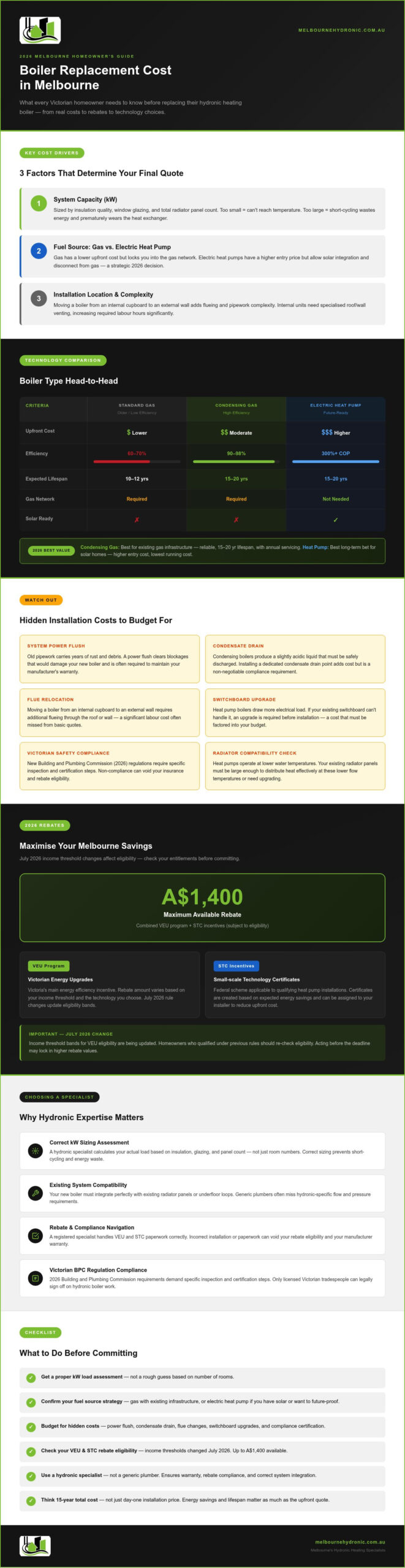
Three primary factors drive the final investment. First, the system capacity (measured in kW) must match your home’s volume. Second, the choice of fuel source dramatically shifts the balance between upfront costs and long-term savings. Finally, the physical location of the installation matters. Moving a boiler from an internal cupboard to an external wall adds complexity to the flueing and pipework, which increases the required labour hours. Melbourne’s climate is significantly more demanding than northern states. Our winter heating season is longer and deeper. This means we often require higher-capacity boilers to maintain comfort during a July cold snap. An undersized unit in a draughty Victorian terrace won’t just leave you cold; it’ll work overtime, leading to higher bills and a shorter lifespan.
System Capacity and Sizing for Melbourne Homes
Getting the sizing right is a technical task that requires more than a guess based on room numbers. We calculate the required kW by assessing your home’s insulation, window glazing, and the total number of hydronic radiator panels in your circuit. If the boiler is too small, it can’t reach the target water temperature quickly enough to heat the house effectively. If it’s too large, it “short cycles,” turning on and off too frequently. This wastes energy and wears out the heat exchanger prematurely. A professional assessment ensures your new unit is perfectly balanced for your specific floor plan and lifestyle.
Fuel Source: Gas vs. Electric Heat Pumps
In 2026, the decision between gas and electric is a strategic one for any Victorian household. Many homeowners are opting for modern condensing boiler technology when replacing existing gas units. These systems capture heat that would otherwise escape through the flue, offering much higher efficiency than older cast-iron models. However, there is a growing shift toward electric heat pumps. While the initial investment for a heat pump is higher, it allows you to disconnect from the gas network and leverage Victorian solar incentives. Your choice often depends on whether your current electrical switchboard can handle the additional load or if your existing radiators are large enough to run efficiently at lower water temperatures.
Comparing Replacement Costs by Boiler Technology
Choosing the right technology is the most significant variable in your final quote. While standard efficiency gas boilers once dominated the market due to their lower entry price, their higher emissions and lower efficiency make them a less attractive long-term prospect in 2026. Most modern Victorian homes now opt for high-efficiency condensing units or electric heat pumps to offset rising energy prices. The physical placement of these units also dictates the final installation invoice. An external boiler is often simpler to install, but an internal unit requires specialized flueing to safely vent combustion gases through the roof or wall, which adds to the specialized labour required.
Condensing Gas Boiler Replacement Specifics
When choosing the best hydronic boiler for a gas-to-gas swap, we focus heavily on modulation ratios. A high modulation ratio allows the boiler to reduce its output during milder weather, preventing the energy-wasting “on-off” cycling common in older models. These systems require a dedicated condensate drain to handle the slightly acidic liquid produced during the high-efficiency combustion process. While a condensing unit has a slightly higher upfront boiler replacement cost melbourne residents should expect a lifespan of 15 to 20 years with regular annual servicing. This technology remains the standard for those with functional gas infrastructure who want a reliable, powerful heat source without a full electrical overhaul.
The Shift to Electric Heat Pump Hydronics
Melbourne homeowners are increasingly moving toward heat pump hydronic heating as Victoria transitions away from residential gas. This premium choice offers the highest possible efficiency by moving heat rather than creating it through combustion. Although the integration costs are higher, the ability to power your heating via rooftop solar panels can virtually eliminate winter running costs. To help manage the initial investment, many households leverage Victorian Government hot water rebates, which can provide up to A$1,000 for eligible heat pump systems, or up to A$1,400 for Australian-made units. As of July 2026, it’s vital to remember that the household income threshold for these specific rebates has been adjusted to A$150,000 per year. If you’re unsure which technology fits your home’s current pipework, a professional system efficiency audit can clarify your best path forward.
The Hidden Costs of Boiler Installation in Victoria
When budgeting for a new system, many homeowners focus only on the boiler unit’s retail price. However, the total boiler replacement cost melbourne residents pay includes several mandatory safety components and system preparation steps required by Victorian law. In our state, plumbing regulations are strict to ensure resident safety. You’ll likely need a new expansion tank to manage water volume changes as the system heats up, along with a tempering valve to ensure any domestic hot water delivery remains at a safe, compliant temperature. These aren’t optional extras; they’re essential for a legal and safe installation.
The physical removal of your existing equipment also carries a fee. Many older Melbourne homes in suburbs like Malvern or Northcote still house heavy, cast-iron boilers. Decommissioning and disposing of these units safely requires specialized equipment and often two technicians to manage the weight. If you’re transitioning to a high-power electric boiler or heat pump, you should also factor in potential electrical switchboard upgrades. Older Victorian homes weren’t designed for the high-amperage loads of modern electric heating, and ensuring your home’s wiring is up to the task is a vital part of the project’s scope.
Plumbing Labour and Compliance in Melbourne
Professional hydronic installation is a niche skill that goes beyond general residential plumbing. In the Melbourne and Geelong regions, specialized labour rates reflect the technical expertise required to balance a complex radiator circuit correctly. Every professional installation must be accompanied by a VBA Compliance Certificate. This document is your legal guarantee that the work meets Victorian safety standards. It’s also a prerequisite for maintaining your manufacturer’s warranty. Choosing a budget installer who skips this step or fails to balance your radiator panels often results in uneven heating and cold spots throughout your home.
Power Flushing and System Protection
The most overlooked expense is the “sludge factor” lurking in your old pipes. Over decades, iron oxide builds up inside your radiator panels and pipework. If you connect a high-efficiency boiler to a dirty system, that sludge will immediately begin to clog the new, narrow waterways of your heat exchanger. Investing in a professional hydronic heating service during the replacement process is the most effective way to protect your new investment. We also strongly recommend the installation of a magnetic dirt separator. This device continuously captures metallic debris before it can enter and damage the boiler’s internal components. Power flushing is non-negotiable for 2026 replacements because modern high-efficiency heat exchangers have much narrower waterways that clog easily.
Maximising Melbourne Rebates and ROI in 2026
Investing in a new heating system is a significant financial decision, but the Victorian government provides several levers to lower the barrier. The Victorian Energy Upgrades (VEU) program remains a primary tool for reducing the upfront boiler replacement cost melbourne families face when switching to more efficient technology. Unlike traditional grants that require a long wait for reimbursement, VEU discounts are typically applied directly at the point of sale by accredited providers. This immediate reduction makes premium, high-efficiency systems accessible to more households across Melbourne and Geelong.
For those choosing electric heat pumps, Small-scale Technology Certificates (STCs) offer additional financial relief. These certificates represent the renewable energy your system displaces over its lifetime. The value of STCs fluctuates based on market demand, but they consistently provide a substantial discount on the total project price. We understand that the administrative side of these incentives can be daunting. Our team manages all the rebate paperwork and compliance documentation for you, ensuring you receive the maximum benefit without the technical headache.
Calculating Your Long-Term Savings
Payback periods for modern systems are shrinking as energy prices remain volatile. A high-efficiency condensing boiler can reduce gas consumption by up to 30% compared to a 20-year-old cast-iron unit. The return on investment becomes even more compelling when you pair a heat pump with existing underfloor heating. These systems thrive at lower water temperatures, which is the exact “sweet spot” for heat pump efficiency. This integrated design approach shifts the focus from the initial hot water installation cost to a 15-year view of energy independence and comfort.
Future-Proofing for a Gas-Free Victoria
Victoria’s transition away from residential gas is accelerating. By mid-2026, the government’s push for all-electric homes has made heat pump technology the gold standard for new builds and major renovations. Understanding what is hydronic heating in a modern context means seeing it as a flexible, sustainable asset. A home equipped with a high-efficiency electric system is increasingly viewed as a premium property. It signals to future buyers that the residence is efficient, compliant with future regulations, and protected from rising gas network charges. Ready to see how much you can save? Book a rebate eligibility assessment with our expert team today.
Choosing the Right Boiler Replacement Specialist
Selecting the right partner for your installation is just as critical as selecting the unit itself. While many general plumbers can connect a gas line, a hydronic system is a complex network of thermal dynamics that requires a higher level of technical precision. A specialist understands that your boiler replacement cost melbourne investment depends on the system’s ability to circulate water at the correct pressure and temperature. If the flow rate isn’t perfectly matched to your radiator panels, you’ll end up with a noisy system that costs more to run and fails prematurely. We focus on the engineering behind the heat, ensuring every component works in harmony.
Experience in the Melbourne and Geelong region is invaluable when dealing with our local architecture. Our climate presents specific challenges, from draughty heritage homes with original pipework to modern builds with expansive glass and high ceilings. With over 30 years of local expertise, we’ve encountered every possible configuration. This history allows us to anticipate potential hurdles before they arise, ensuring your installation is smooth and your home remains a sanctuary of warmth. We don’t just install equipment; we provide the peace of mind that comes from three decades of specialized practice.
The Melbourne Hydronic Heating Difference
We take a design-led approach to every project we undertake. As a family-owned and operated Victorian business, we don’t simply “swap boxes” under a sink or on an external wall. We optimize environments for long-term comfort and health. We exclusively use high-quality European components because they’re built to withstand the rigours of a demanding Melbourne winter. Our team specializes in the intricate work of integrating new boilers with existing floor loops or radiator panels to ensure maximum efficiency. We believe in transparent pricing and clear communication, so you always understand the technical necessity behind every part of your quote.
A professional installation marks the beginning of a long-term relationship. We provide comprehensive warranties and structured maintenance plans to keep your system running at peak performance for its entire 15 to 20 year lifespan. Annual servicing isn’t just a recommendation; it’s a vital step to protect the health and hygiene of your home environment. By catching minor issues during a scheduled check, we help you avoid the stress of surprise repair bills when the temperature drops in July.
Next Steps: Getting Your Custom Quote
We always recommend an on-site inspection for every replacement project. “Rough” phone estimates often overlook the nuances of your home’s layout, which can lead to unexpected variations once the work begins. During a consultation, we assess your home’s insulation levels, the condition of your existing pipework, and your electrical switchboard capacity. This thoroughness ensures your final quote is accurate and your new system is sized for comfort, not just the lowest entry cost. To prepare for our visit, it’s helpful to note the age of your current system and any specific rooms that have been difficult to heat in the past. Book your professional boiler replacement assessment today to secure a reliable, energy-efficient future for your home.
Secure Your Home’s Future with a Modern Heating Solution
Deciding on a new system is about more than just replacing a part; it’s about future-proofing your home against Victoria’s changing energy landscape. You now understand that the true boiler replacement cost melbourne residents manage is a combination of unit technology, specialized hydronic labour, and maximizing 2026 government rebates. By prioritizing high-efficiency components and professional system protection like power flushing, you ensure your investment delivers premium comfort and lower energy bills for decades to come.
Our team at Melbourne Hydronic Heating brings 30+ years of Melbourne and Geelong expertise to your doorstep. As a family-owned Victorian business, we specialize in high-efficiency VEU-approved systems designed specifically for our unique local climate. We’re here to guide you through the technical choices and rebate applications to make your upgrade as seamless as possible. Ready to experience the health and hygiene benefits of a precision-engineered hydronic system? Request a Professional Boiler Replacement Quote and enjoy the peace of mind that comes with expert local service. We look forward to helping you create a warmer, more sustainable home.
Frequently Asked Questions
How much does a boiler replacement cost in Melbourne in 2026?
The total boiler replacement cost melbourne homeowners pay depends on the system’s kilowatt capacity, the chosen fuel source, and the complexity of the installation. Mandatory Victorian safety items, such as tempering valves and expansion tanks, also influence the final invoice. While a straightforward gas swap might have a lower entry price, a transition to a high-efficiency heat pump involves a larger initial investment that is offset by long-term energy savings and government incentives.
Can I swap my gas hydronic boiler for an electric heat pump?
You can definitely swap a gas boiler for an electric heat pump, and it’s a growing trend as Victoria moves toward all-electric homes. This process involves decommissioning your old gas unit and installing an outdoor heat pump that integrates with your existing radiator panels or underfloor pipework. It’s an ideal way to leverage rooftop solar panels and significantly reduce your household’s carbon footprint while maintaining the premium comfort of hydronic heating.
Do I qualify for a Victorian rebate when replacing my boiler?
Most Melbourne residents qualify for incentives through the Victorian Energy Upgrades (VEU) program or Solar Victoria. From 1 July 2026, the household income threshold for the Solar Victoria Hot Water Rebate is A$150,000 per year. This rebate can provide up to A$1,000 for eligible heat pumps, or A$1,400 for Australian-made systems. Additionally, VEU discounts are applied at the point of sale by accredited providers, regardless of your household income.
How long does it take to install a new hydronic boiler?
A professional boiler replacement typically takes between one and two days to complete. A standard “like-for-like” gas swap is often finished within a single day, causing minimal disruption to your home’s routine. If you’re switching technologies or moving the unit’s location, the project may extend into a second day. This allows our technicians enough time to manage new flueing, condensate drainage, and the essential task of balancing your radiator circuit for peak performance.
Will a new boiler work with my existing hydronic radiator panels?
Yes, modern boilers and heat pumps are designed to work seamlessly with existing steel or cast-iron radiator panels. During the installation, we’ll perform a system flush to remove any old sludge and ensure the water flows freely. If you’re upgrading to a heat pump, we’ll also verify that your current radiators are sized appropriately to deliver enough warmth at the lower, more efficient water temperatures those systems use to save you money.
What is the most energy-efficient boiler for Melbourne winters?
Electric heat pumps are the most energy-efficient choice for Melbourne’s climate in 2026, often achieving efficiency ratings of 300% to 400%. They move heat rather than creating it, which is far more effective than traditional combustion. For homes that prefer to stay with gas, a high-efficiency condensing boiler is the best alternative. These units capture heat from exhaust gases that older systems simply waste, providing a significant boost in thermal performance during our coldest months.
Is it worth repairing an old boiler or should I replace it?
If your boiler is over 15 years old or requires a major part like a cracked heat exchanger, replacement is almost always the better financial move. Older units are significantly less efficient, meaning you’re paying a “hidden tax” on your monthly energy bills. A new installation provides you with a reliable system for the next 15 to 20 years, a full manufacturer’s warranty, and the peace of mind that your home’s heating won’t fail during a frost.
Do I need an electrician for a boiler replacement in Melbourne?
You will need a licensed electrician to assist with your boiler replacement, especially when upgrading to a modern electric heat pump. These units require dedicated electrical circuits and safety switches that older gas boilers didn’t need. Our team coordinates with both licensed gasfitters and electricians to ensure your installation meets all Victorian regulations. This collaborative approach ensures your system is safe, compliant, and covered by all relevant work certificates and warranties.