

Gas Boilers for Hydronic Heating: 2026 Melbourne Guide
With the 2027 gas connection ban for new builds looming, you might think the era of the gas boiler for hydronic heating is already over. It’s an understandable concern for many Melbourne homeowners. You’re likely seeing winter energy bills climb while hearing confusing reports about the Victorian gas transition and what it means for your current system.
We understand that a noisy, unreliable boiler is the last thing you want to deal with when the July frost hits. This guide will show you why a modern, high-efficiency gas boiler for hydronic heating remains a superior choice for homes with existing Hydronic Radiator Panels, offering warmth that electric alternatives often struggle to match in older Victorian properties.
We’ll explore how condensing technology captures wasted heat to lower your consumption, explain the precise sizing requirements for our unique local climate, and clarify the latest 2026 regulations. You’ll learn the difference between combi and heating-only models so you can future-proof your home with confidence. By the end, you’ll know exactly how to choose a quiet, reliable system that keeps your family comfortable without the technical headache.
Key Takeaways
- Understand how modern condensing technology recycles waste heat to significantly reduce your winter energy consumption and lower utility bills.
- Discover how to choose the most efficient gas boiler for hydronic heating by comparing the benefits of space-saving combi units versus dedicated heating-only models.
- Learn why accurate heat load calculations are the secret to maintaining consistent comfort during Melbourne’s rapid and unpredictable temperature shifts.
- Navigate the 2026 Victorian gas regulations to ensure your system replacement remains fully compliant with the latest building and safety standards.
- Identify why professional maintenance and power flushing are critical steps for protecting your Hydronic Radiator Panels and extending the lifespan of your new boiler.
What is a Gas Boiler for Hydronic Heating?
Think of your gas boiler for hydronic heating as the engine room of your home. It’s a specialized unit designed to heat water and circulate it through a closed-loop system. Unlike your standard shower heater, this water isn’t for washing; it’s a thermal medium that travels through the system to reach every corner of your living space. This specialized equipment relies on the principles of What is Hydronic Heating? to distribute thermal energy through your home. In a closed-loop system, the same water is recycled continuously, which prevents the buildup of minerals and oxygen that would otherwise corrode your pipes, ensuring your investment lasts for decades.
Most Victorian homes rely on reticulated natural gas, while regional properties around Geelong might use LPG. A gas boiler for hydronic heating remains a preferred choice for hydronic heating because gas provides the intense, rapid energy required to heat large volumes of water quickly. This is particularly effective when you have a network of Hydronic Radiator Panels that need to reach operating temperature fast to combat a 5-degree Melbourne morning. Gas allows for a smaller unit footprint while delivering much higher heat loads compared to early-generation electric alternatives, making it ideal for retrofitting existing homes.
How Hydronic Boilers Differ from Standard Hot Water Units
You can’t just use a standard domestic hot water unit for your radiators. Hydronic boilers are engineered for durability and precision during long run times. While a tap heater might only run for ten minutes at a time, a boiler often runs for hours to maintain a steady temperature. They use robust components to handle this constant thermal stress:
- Temperature Precision: Radiators often require water at 60 to 80 degrees Celsius, which is much higher than the 50 degrees used for domestic taps.
- Construction Materials: Boilers feature stainless steel or cast iron heat exchangers designed for high-frequency thermal cycling.
- Modulating Burners: These adjust flame height to match the exact heat demand, preventing the wasteful stop-start cycling found in older units.
The Health and Allergy Benefits of Gas-Powered Hydronics
One of the most significant advantages for local families is the hygiene of the system. Traditional ducted heating relies on fans that blow air, dust, and pet dander through every room. Gas-powered hydronic systems use natural convection and radiation, meaning there are no filters to clean and no vents to trap allergens. This creates a much cleaner indoor environment for everyone. Hydronic systems provide radiant heat that warms objects directly, preventing the circulation of airborne allergens and dust common in forced-air systems.
Types of Gas Boilers: Condensing vs. Conventional vs. Combi
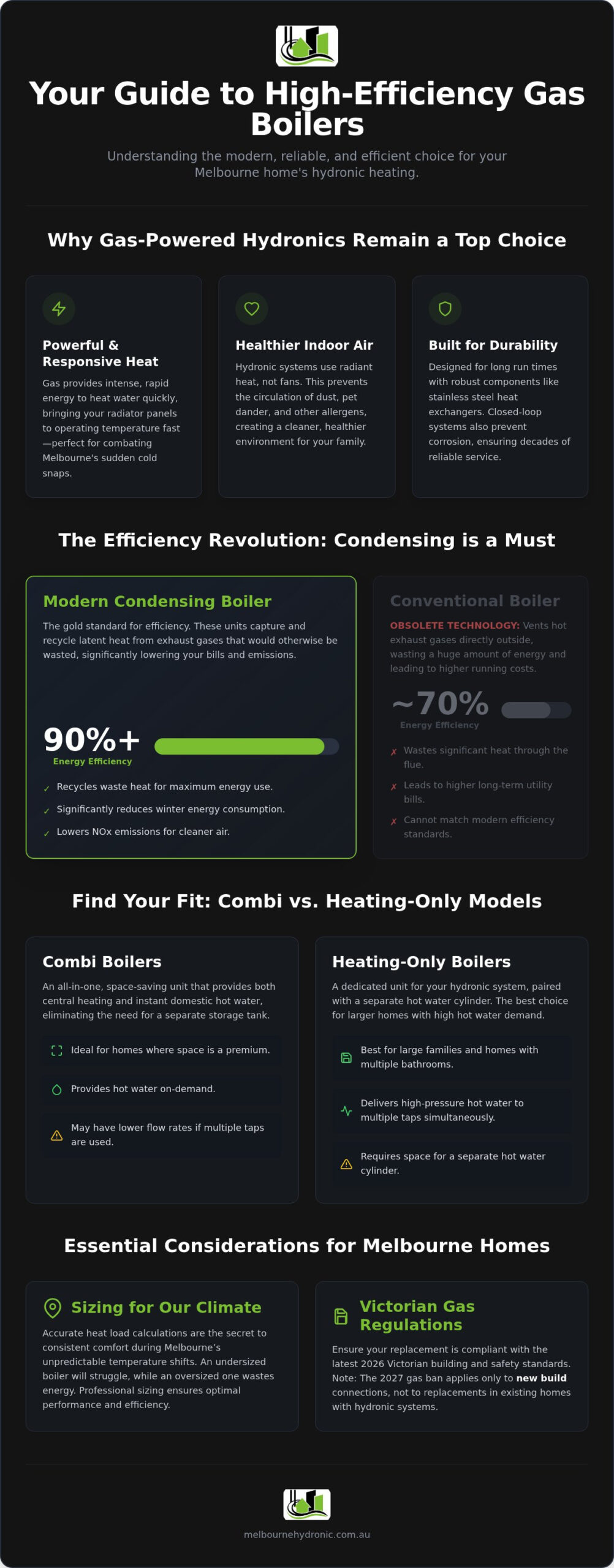
Selecting the right gas boiler for hydronic heating depends on your home’s layout and your specific hot water demands. In 2026, the industry has shifted almost entirely toward condensing technology. Older conventional boilers, which vented hot exhaust gases directly out the flue, are now considered obsolete. They simply can’t match the 90% plus efficiency ratings of modern units. Choosing an outdated model today often leads to higher running costs and a shorter system lifespan.
Modern units are available in both internal and external configurations. Internal boilers are often tucked away in laundry cupboards or kitchens, while external models are mounted on an outside wall to save precious indoor square footage. For homeowners in inner-city Melbourne terraces where space is at a premium, these compact footprints are a significant advantage. According to the federal Boiler efficiency factsheet, upgrading to a high-efficiency model is one of the most effective ways to reduce residential energy waste in Australian climates.
The Efficiency Revolution: Why Condensing is Mandatory
Condensing boilers are the gold standard because they capture latent heat that would otherwise escape through the flue. By cooling the exhaust gases until they turn back into liquid, the system extracts every possible megajoule of energy. This process requires specialized flueing to manage the slightly acidic condensate, which we safely drain away during installation. Beyond lower bills, these units significantly reduce NOx emissions, contributing to cleaner air in our urban Melbourne suburbs.
Combi Boilers: Pros and Cons for Melbourne Households
A combination or “combi” gas boiler for hydronic heating serves a dual purpose. It heats your Hydronic Radiator Panels and provides instantaneous hot water for your taps from a single unit. This eliminates the need for a bulky hot water storage tank, freeing up space in your garage or backyard. It’s an elegant, streamlined solution for smaller households or apartments.
However, flow rates are a critical consideration. While a combi unit is perfect for a one or two-bathroom home, it might struggle to provide enough hot water if three showers are running simultaneously in a large family residence. In those cases, we typically recommend a dedicated heating boiler paired with a separate high-recovery storage cylinder. One major benefit of the combi setup is maintenance simplicity; you only have one appliance to service each year instead of two. If you’re unsure which configuration suits your floorplan, our team can provide a tailored boiler replacement assessment for your property.
Sizing Your Boiler for Melbourne’s Climate
Melbourne is famous for its “four seasons in one day” weather. This erratic climate means your gas boiler for hydronic heating must be versatile enough to handle a 2 degree morning and a 16 degree afternoon. Getting the size right isn’t just about making sure you’re warm; it’s about system longevity and efficiency. Many people fall into the trap of thinking “bigger is better,” but an oversized boiler is actually a liability. It leads to a phenomenon called short-cycling, where the unit turns on and off rapidly because it reaches the target temperature too quickly. This wastes gas and puts unnecessary strain on the internal components.
The total heat load of your home determines the required kilowatt (kW) output. We look closely at the number of hydronic heating panels installed throughout your property to ensure the boiler can provide enough energy to satisfy every room simultaneously. It’s also important to distinguish between radiator and underfloor systems. Radiators need high-temperature water delivered in shorter bursts, while underfloor heating requires a gas boiler for hydronic heating that can modulate down to lower temperatures for long, steady operation. A correctly sized boiler stays in its condensing “sweet spot” for as long as possible, which is where you see the most significant savings on your utility bills.
Factors Affecting Your Home’s Heat Demand
Your home’s architecture plays a massive role in sizing. High ceilings in renovated Victorian terraces or large open-plan living areas in modern builds create a high volume of air that needs warming. We also factor in your insulation levels and whether you have double glazing. A well-insulated home might only need an 18kW boiler, whereas the same sized house with draughty windows and no wall insulation could require a 30kW unit. We calculate these requirements based on Melbourne’s winter overnight lows to ensure your system has a fast recovery time when you wake up on a frosty July morning.
Zoning and System Control
Modern system design allows us to split your home into different zones. By using multi-zone manifolds and smart thermostats, you can tell the boiler to only heat the bedrooms at night or the living areas during the day. This precision prevents the boiler from working harder than it needs to. Smart controls allow the unit to modulate its flame height based on the actual demand, further reducing energy consumption. This level of control ensures a quiet, premium lifestyle where your comfort is managed with engineering precision, extending the life of your boiler by years.
Installation and Victorian Gas Regulations
There is a lot of noise regarding the Victorian gas transition, but it’s vital to separate the rules for new builds from those for existing homes. From 1 January 2027, all new Victorian homes must be all-electric. However, for the thousands of Melburnians currently living in properties with established hydronic systems, you can still install a high-efficiency gas boiler for hydronic heating to replace an aging or broken unit. There is currently no legislative requirement to switch to electric space heating in existing residential dwellings, which is a relief for those who prefer the high-output warmth of natural gas.
Safety and compliance are non-negotiable when dealing with gas infrastructure. In Victoria, any installation must be performed by a VBA-licensed plumber who holds a specific gas-fitters endorsement. Once the work is complete, your installer must provide an Energy Safe Victoria (ESV) Certificate of Compliance. This document is your proof that the system meets rigorous Australian safety standards. It’s also the primary piece of evidence required by manufacturers to honor your product warranty. Without this certificate, you risk both your home’s safety and your financial investment.
The Replacement Process: What to Expect
A professional installation begins long before the new unit arrives at your door. We perform a comprehensive pre-installation site audit to check the integrity of your existing copper pipework and map out the most efficient flue path for a condensing model. We then decommission the old unit, ensuring the safe removal of all components according to local environmental regulations. Scheduling a comprehensive hydronic heating service melbourne is the best time to assess boiler health and determine if a full replacement is more cost-effective than ongoing repairs. Our goal is to ensure your transition to a modern system is seamless and causes minimal disruption to your daily routine.
Protecting Your Investment: Power Flushing
The most common mistake homeowners make is connecting a sophisticated new gas boiler for hydronic heating to an old, dirty pipe network. Over decades, a black sludge known as magnetite builds up inside your radiators. If this debris enters your new boiler, it can destroy the stainless steel heat exchanger in months. We perform a specialized power flush during every replacement to cleanse the entire system. This process ensures your home meets 2026 efficiency standards and keeps your 10-year boiler warranty valid through proper commissioning. If you’re ready to upgrade your home’s comfort, you can contact our Melbourne experts for a professional installation assessment today.
Why Choose Melbourne Hydronic Heating for Your Gas Boiler?
Selecting a gas boiler for hydronic heating is a decision that impacts your home’s comfort for the next 15 to 20 years. It’s not a task for general residential plumbers. Melbourne Hydronic Heating offers over 30 years of dedicated industry experience across Victoria, specializing in the complex engineering required for closed-loop systems. We’ve built our reputation on technical precision and a commitment to premium lifestyle outcomes. Being family-owned and operated means we treat your home’s comfort as if it were our own. We don’t just replace a box on the wall; we optimize your entire thermal network to ensure maximum efficiency and reliability.
Our comprehensive system knowledge means we understand how every component interacts. Whether your home uses sleek Hydronic Radiator Panels or invisible underfloor coils, we ensure the boiler is tuned to the specific flow rates and pressure requirements of your property. This holistic approach prevents common issues like uneven heating or premature pump failure. We are local experts who take pride in delivering a quiet, zavartalan operation that genuinely improves your quality of life during the long Victorian winter.
Our Design-First Approach
Every project begins with a design-first mindset. We understand the specific challenges of Melbourne’s architecture, from draughty heritage homes in the inner north to glass-heavy modern designs in the bayside suburbs. We ensure your gas boiler for hydronic heating is perfectly matched to your home’s thermal mass, balancing heat output for a silent, consistent warmth. Our experts handle the integration of towel rails and trench heating with a level of detail that only three decades of local experience can provide. We pride ourselves on transparent communication, offering honest advice without the confusing industry jargon.
Contact Us for a Professional Consultation
Reliability is built on consistent care. Your system’s longevity depends on annual maintenance and servicing to prevent the buildup of magnetite and ensure your condensing technology is operating at its peak. Whether you’re in the heart of Melbourne, the coastal suburbs of Geelong, or the Mornington Peninsula, our specialist technicians are available for ongoing support. We are local patriots who understand the unique heating demands of our region and are committed to keeping your family warm.
We invite you to experience the difference that specialist knowledge makes. We’ll visit your property for a detailed site audit and provide a fixed-price quote that covers everything from the initial design to the final safety certification. Contact the Melbourne Hydronic Heating team today to book your professional consultation and secure your home’s comfort for the years ahead.
Invest in Lasting Winter Comfort
Upgrading your home’s heating is a significant investment in your family’s long-term well-being. By choosing a modern gas boiler for hydronic heating, you aren’t just lowering your energy bills; you’re creating a cleaner, healthier environment free from the dust and allergens of ducted systems. We’ve explored how high-efficiency condensing technology and precise sizing ensure your system remains reliable despite Melbourne’s unpredictable winter shifts.
At Melbourne Hydronic Heating, we combine over 30 years of local expertise with global quality standards. As VBA licensed and Energy Safe Victoria compliant specialists, we ensure every installation meets the strict 2026 safety and warranty requirements. We take pride in helping homeowners across Melbourne and Geelong navigate the evolving gas landscape with confidence and technical precision. Don’t let another shivering winter pass with an unreliable or inefficient unit.
Our team is ready to design a solution that fits your home’s unique architecture and your lifestyle needs. Get a Professional Quote on Your Boiler Replacement today and enjoy the peace of mind that comes with expert local service. Your journey to a warmer, more efficient home starts with a simple conversation.
Frequently Asked Questions
Can I still install a gas boiler for hydronic heating in Victoria in 2026?
Yes, you can still install one in existing homes. The ban starting 1 January 2027 only applies to new residential builds and most new commercial buildings. For current homeowners with established systems, replacing an old unit with a modern gas boiler for hydronic heating remains a legal and highly effective way to maintain comfort. It’s often the most practical solution for those with existing radiator networks in Melbourne’s older suburbs.
How much does a gas boiler replacement cost in Melbourne?
Costs vary significantly based on the unit’s capacity, the complexity of the flue path, and whether you require internal or external mounting. A professional assessment considers your home’s unique heat load and existing pipework integrity. While we don’t provide flat rates without a site visit, a customized quote will include the unit, licensed installation, and the required Energy Safe Victoria safety certificates. This ensures you receive a system tailored to your specific architectural needs.
What is the difference between a condensing boiler and a standard one?
Condensing boilers are significantly more efficient because they capture heat from exhaust gases that standard units simply vent outside. By cooling these gases, the system extracts latent heat, achieving efficiency ratings above 90 percent. Standard boilers are effectively obsolete in 2026 because they waste a large portion of the energy they consume. Upgrading ensures you get more warmth from every megajoule of gas used, which is vital as Victorian utility tariffs continue to rise.
How long does a hydronic gas boiler typically last?
A high-quality gas boiler for hydronic heating typically lasts between 15 and 20 years when maintained correctly. Longevity depends heavily on the quality of the initial installation and regular annual servicing. Protecting the heat exchanger from internal corrosion is the most critical factor in extending this lifespan. Systems that receive consistent professional attention often outperform those that are neglected, providing reliable warmth well beyond their standard warranty period for local Melbourne families.
Does my hydronic system need a power flush when I get a new boiler?
Yes, we strongly recommend a power flush during every boiler replacement. Over time, black magnetite sludge builds up inside your radiators and pipes. If you connect a sophisticated new boiler to a dirty system, this debris can quickly damage the sensitive stainless steel heat exchanger. A power flush cleanses the entire network, ensuring your new unit operates at peak efficiency and protecting your manufacturer’s warranty from being voided by poor water quality.
Is it better to repair my old boiler or replace it with a condensing model?
If your current boiler is over 12 years old or requires frequent, expensive repairs, replacement is usually the smarter financial choice. Older non-condensing models are far less efficient, meaning you’re paying more in monthly gas bills for less heat. A new condensing model provides a quieter operation and superior reliability. The long-term savings on energy bills often outweigh the cost of keeping a failing, obsolete unit on life support during a cold winter.
Can a gas boiler work with both radiators and underfloor heating?
Modern boilers are exceptionally versatile and can easily manage “mixed” systems. We use specialized mixing valves and manifolds to deliver high-temperature water to your Hydronic Radiator Panels while providing lower-temperature water to your underfloor coils. This allows you to enjoy the fast response of radiators in bedrooms and the steady, luxurious warmth of floor heating in living areas, all powered by a single, high-efficiency unit that is specifically sized for your home’s floorplan.
Will a new gas boiler help reduce my carbon footprint?
Yes, upgrading to a condensing model reduces your environmental impact by significantly lowering your gas consumption. Because these units capture waste heat, they use less fuel to produce the same amount of warmth as older appliances. Modern burners are also designed to minimize NOx emissions in urban environments. While Victoria is transitioning toward electrification, choosing the most efficient gas technology available is a responsible way to manage energy use in established homes right now.