
Troubleshooting Hydronic Boiler Ignition Failure: A 2026 Melbourne Homeowner’s Guide
Imagine waking up on a crisp, sub-zero Melbourne morning, only to find your radiators are stone cold and your boiler is making a rhythmic clicking sound that leads nowhere. It’s a scenario many Victorian homeowners face, and the immediate fear of a costly breakdown or a dangerous gas fault can be overwhelming. You’re likely staring at a flashing red light or a cryptic error code, wondering if your home’s comfort is gone for the season.
We understand that a failing heating system is more than just a technical glitch; it’s a disruption to your family’s well-being and safety. The good news is that troubleshooting hydronic boiler ignition failure doesn’t always lead to a full system replacement. In fact, ignition failure is often a built-in safety response designed to protect your property. This guide will walk you through the most common causes of these lockouts, from simple pressure drops to complex electrical faults. You’ll learn exactly which steps are safe for a DIY check and when it’s time to call a Melbourne specialist to ensure your premium heating system returns to its peak, efficient performance.
Key Takeaways
- Understand the boiler’s start-up sequence to recognize that a lockout is a protective safety feature rather than a total system failure.
- Learn how to perform safe homeowner checks, such as verifying gas availability and power supply, before calling a technician.
- Master the basics of troubleshooting hydronic boiler ignition failure by identifying common issues like blocked condensate pipes during Melbourne’s frosty mornings.
- Gain the confidence to decode specific error codes for brands like Vaillant and Baxi, helping you communicate effectively with a specialist.
- Apply the “50% Rule” to determine whether repairing your current unit or investing in a modern, efficient boiler replacement is the best long-term financial choice.
The Anatomy of a Start-Up: How Your Boiler Ignites
When you turn up your thermostat on a chilly morning, you’re initiating a complex mechanical ballet inside your unit. Most homeowners see their boiler as a simple box that provides warmth, but it’s actually a precision-engineered system that follows a strict logical sequence. Understanding this process is the first step in effective troubleshooting hydronic boiler ignition failure. If one component fails to perform its role within a specific timeframe, the entire system shuts down to protect your home and your family.
Modern hydronic heating systems are designed with safety as the primary priority. Before a single flame appears, the boiler’s Printed Circuit Board (PCB) runs a series of checks to ensure the environment is safe for combustion. If you hear your boiler clicking or humming but no heat follows, the sequence has been interrupted at a specific checkpoint.
The 5-Step Ignition Sequence Explained
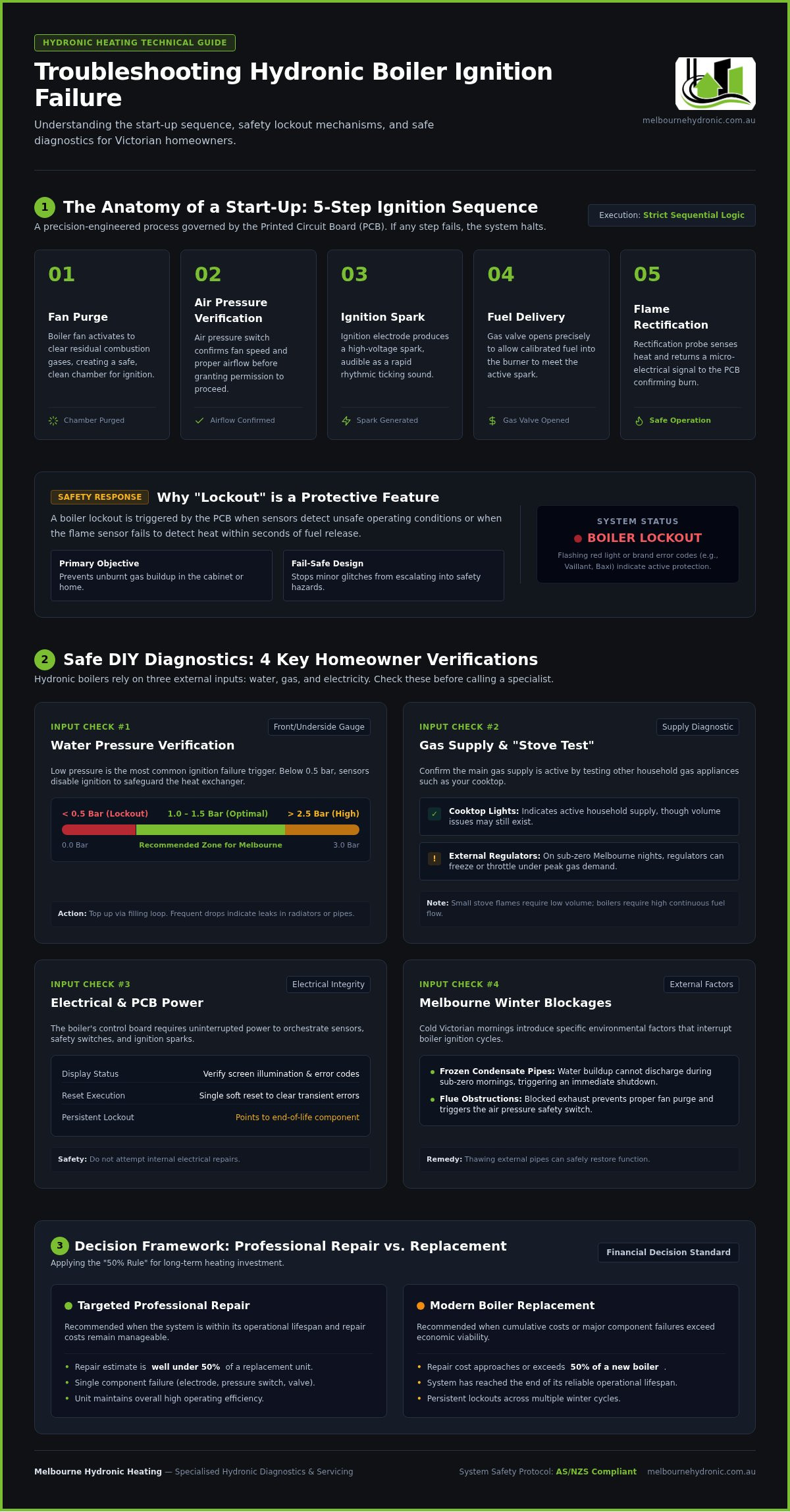
- Step 1: The Fan Purge. The boiler activates its fan to clear any residual gases from the combustion chamber. This ensures a clean, safe environment for the new flame to ignite.
- Step 2: Air Pressure Verification. An air pressure switch confirms the fan is spinning at the correct speed. If the switch doesn’t detect enough airflow, the boiler won’t proceed to the next step.
- Step 3: The Ignition Spark. The ignition electrode generates a high-voltage spark. You’ll often hear this as a rapid “ticking” sound coming from the unit.
- Step 4: Fuel Delivery. Once the spark is present, the gas valve opens. It allows a precise amount of fuel to enter the burner and meet the spark.
- Step 5: Flame Rectification. A flame sensor, also known as a rectification probe, detects the heat. It sends a tiny electrical signal back to the PCB to confirm a safe burn is established.
Why ‘Lockout’ is Your Boiler’s Safety Net
If the flame sensor doesn’t detect heat within a few seconds of the gas valve opening, the system enters a state called “lockout.” This isn’t just a frustrating malfunction; it’s a critical safety feature that prevents unburnt gas from building up inside the cabinet or escaping into your home. While a “soft reset” might clear temporary glitches, a persistent lockout usually points to a component that has reached the end of its reliable lifespan.
Boiler Lockout is a protective state triggered by the PCB when sensors detect unsafe operating conditions.
When troubleshooting hydronic boiler ignition failure, it’s vital to remember that these systems are designed to fail “safe.” Whether it’s a blocked flue or a worn-out electrode, the lockout ensures that a minor technical issue doesn’t escalate into a hazardous situation for your Melbourne household.
Safe DIY Checks: 4 Things to Verify Before Calling a Pro
Before you assume your system requires a major overhaul, it’s worth performing a few fundamental checks. Many instances of troubleshooting hydronic boiler ignition failure reveal simple, external issues rather than internal mechanical breakdowns. These steps are entirely safe for homeowners to conduct and can often restore your heating before the house loses its residual warmth.
While your boiler is a sophisticated piece of technology, it relies on three external inputs to function: water, gas, and electricity. If any of these are interrupted, the start-up sequence we discussed earlier will fail at the first hurdle. By methodically checking these inputs, you can determine if you’re facing a minor glitch or a situation that requires a specialist’s tools.
Verifying Water Pressure and Gas Supply
The most common reason a hydronic boiler refuses to ignite is low water pressure. Locate the pressure gauge on the front or underside of your unit. For optimal performance in Melbourne homes, the needle should ideally sit between 1.0 and 1.5 bar. If the pressure has dropped below 0.5 bar, the boiler’s internal sensors will prevent ignition to avoid damaging the heat exchanger. If you find the pressure is low, you can often top it up using the filling loop, but a frequent drop in pressure suggests a slow leak somewhere in your radiator panels or pipework.
Next, confirm your gas supply is active. A simple way to do this is the “stove test.” If your gas cooktop or other gas appliances are working normally, the main supply is likely fine. However, during Melbourne’s coldest winter nights, external gas regulators can occasionally struggle with high demand or even “freeze” if moisture is present in the line. This restriction might allow enough gas for a small stove flame but not the high volume required for a boiler to successfully fire up.
Thermostat and Electrical Basics
It sounds elementary, but the thermostat is often the culprit. Check that the batteries are fresh and that the display is clear. Ensure the unit is set to “Heat” mode and the target temperature is at least 3 degrees Celsius higher than the current room temperature. If the thermostat doesn’t send a clear “call for heat” signal, the boiler will remain idle, appearing as though it has failed to ignite.
Finally, check your home’s electrical switchboard for any tripped RCDs or circuit breakers. A power surge during a Victorian thunderstorm can easily trip the dedicated circuit for your heating system. If the power is on and the display shows a fault, you may try the “Reset” button. However, follow the rule of three: if the boiler fails to stay lit after three reset attempts, stop. Continually resetting a locking-out boiler can cause further wear on the ignition electrodes.
If these basic checks don’t resolve the issue, it is likely an internal component fault. In such cases, professional system servicing and maintenance is the safest way to restore your home’s premium comfort without risking further damage to the unit.
Common Causes of Ignition Failure in Melbourne Homes
While basic checks can resolve simple oversights, persistent troubleshooting hydronic boiler ignition failure often uncovers deeper technical issues. These internal faults usually stem from natural wear and tear or environmental factors specific to the Victorian climate. Because your boiler operates under high temperatures and pressures, even a small amount of component degradation can interrupt the precise start-up sequence required for a safe burn.
In Melbourne and Geelong, we often see boilers that have worked perfectly for years suddenly struggle when the first frost hits. This isn’t a coincidence. Cold snaps put additional strain on aging components, revealing weaknesses that might have stayed hidden during the milder months. Identifying these causes early is the key to maintaining a premium, high-efficiency heating system.
Mechanical Wear: Electrodes and Fans
The ignition electrode is the heart of the start-up process. Over time, these small metal rods can develop carbon deposits or fine cracks in their ceramic insulation. When this happens, the spark becomes too weak to ignite the gas, or it “tracks” to the wrong part of the burner. You might hear the boiler clicking repeatedly without catching. Similarly, the fan is a hard-working mechanical part. If you notice a high-pitched whine or a grinding sound during the start-up phase, the fan bearings may be failing. If the fan can’t reach the required speed, the air pressure switch won’t close, and the ignition sequence will stall. Regular Hydronic Heating Service Melbourne is essential to catch these worn parts before they leave you without heating on a winter morning.
The ‘Sludge’ Factor and Blocked Pipes
Melbourne’s water quality is generally excellent, but the inside of a closed-loop heating system can still develop “sludge”-a mixture of rust and mineral deposits. This debris often settles near sensitive components like flow sensors or the internal pump. If the sensor is coated in sludge, it might fail to detect water movement, causing the PCB to abort the ignition for safety. Utilising a professional Power Flushing treatment clears these contaminants, ensuring your sensors receive accurate readings and preventing the system from prematurely shutting down.
Another common local issue is a blocked condensate pipe. High-efficiency condensing boilers produce a small amount of acidic water during operation, which drains away through a plastic pipe. During a particularly frosty Melbourne night, if this pipe is exposed to the elements and isn’t properly insulated, the water inside can freeze. This creates a backup that triggers a safety sensor, instantly stopping the boiler from firing up. Ensuring these pipes are correctly routed and protected is a hallmark of a professional installation.
Decoding the Display: Common Boiler Fault Codes
When your heating system stops working, the digital display on your unit becomes the most valuable tool for troubleshooting hydronic boiler ignition failure. These codes are not meant to be cryptic; they are precise signals from the internal sensors to help you or your technician pinpoint exactly where the ignition sequence was interrupted. Understanding the difference between a simple maintenance alert and a critical safety lockout can save you hours of uncertainty on a cold morning.
In Melbourne, we see a wide variety of European and local brands. While each manufacturer uses its own logic, the core issues usually fall into two categories: those you can resolve by restoring pressure or fuel, and those that require a licensed specialist to handle internal gas or electrical components.
Brand-Specific Troubleshooting Tables
Most modern boilers installed in Victorian homes follow a predictable pattern of error reporting. Here are the most frequent codes we encounter during service calls:
- Vaillant: Codes F28 and F29 are the primary indicators of ignition failure. F28 usually means the unit failed to light at all, while F29 indicates the flame was lost during operation.
- Baxi and Potterton: Look for E119, which signifies low water pressure (often a DIY fix), or E133, which points to a gas supply or ignition sensing issue.
- Immergas: Error 01 indicates an ignition block that needs a manual reset, while Error 10 is the standard signal for insufficient system pressure.
If your display is blank or showing “ghost” symbols that don’t match the manual, it often indicates a power supply issue or a failing PCB. In cases where an aging unit begins throwing multiple, unrelated codes, it may be more cost-effective to explore choosing the best hydronic boiler in Melbourne for a more reliable, modern replacement.
When the Fault Code is Misleading
It’s vital to remember that a fault code is only as accurate as the sensor reporting it. For example, a boiler might display an ignition error code when the actual problem is a faulty flame rectification probe that can’t “see” a perfectly healthy flame. This is why professional diagnostic tools are essential. A specialist doesn’t just read the code; they verify the physical state of the gas valve, the spark strength, and the electrical resistance of the sensors.
Never ignore a recurring fault code that clears after a simple reset. While it’s tempting to keep pressing the button to get through the night, a “nuisance” lockout is often the final warning before a total component failure. If your boiler is communicating a persistent problem, it’s time to book a professional gas boiler repair and diagnostic service to ensure your system remains safe and efficient for the long term.
Professional Repair vs. Boiler Replacement
Once you’ve moved past basic troubleshooting hydronic boiler ignition failure and identified a persistent internal fault, you face a critical decision. Should you invest in a repair or consider a full system upgrade? At Melbourne Hydronic Heating, our approach is always to repair and optimise your existing system whenever it remains safe and economically viable. However, there’s a threshold where the technical limitations of an older unit begin to compromise your home’s comfort and your financial interests.
We’ve spent 30 years helping Melbourne and Geelong families navigate these choices. Our local expertise ensures that we don’t just look at the broken part; we look at the entire system’s health, from the radiator panels to the pipework insulation. This holistic view is essential for determining if a quick fix today will simply lead to another breakdown tomorrow.
When to Call a Licensed Gas Fitter
In Victoria, safety isn’t just a recommendation; it’s a legal requirement. Any repair involving the gas-tight seal of your boiler must be performed by a licensed gas fitter. If you notice a faint smell of gas, see soot marks on the boiler casing, or observe a yellow, lazy flame through the inspection glass, shut the unit off immediately. These are signs of incomplete combustion or gas leaks that require urgent professional attention.
Attempting DIY repairs on gas components doesn’t just put your family at risk. It also carries significant financial consequences. Most home insurance policies and manufacturer warranties are instantly voided if an unlicensed person interferes with the gas assembly. Choosing a professional ensures your system meets Australian safety standards and remains fully covered by your insurance provider.
Making the Choice: Repair or Replace?
To help our clients decide, we often suggest the “50% Rule.” If the cost of a repair approaches half the value of a new unit, or if the boiler is over 12 years old, a replacement is usually the smarter long-term investment. Modern condensing boilers operate with far greater efficiency than older models, significantly reducing gas bills for Melbourne homeowners. As we move toward 2026, many residents are also considering future-proofing their homes by switching to Heat Pump Hydronic Heating, which offers an all-electric, sustainable alternative to traditional gas systems.
Whether you need a simple electrode replacement or a completely new energy-efficient unit, our goal is to restore the clean, quiet warmth your home deserves. If your boiler is currently locked out or making unusual noises, don’t wait for the temperature to drop further. Book a professional diagnostic service with our expert team today to get a clear, honest assessment of your system’s health.
Restoring Your Home’s Premium Comfort
A cold home on a Victorian morning is a challenge no homeowner wants to face, but understanding the logic behind your system’s lockout mode provides immediate peace of mind. We’ve explored how troubleshooting hydronic boiler ignition failure often begins with simple checks like water pressure and gas supply. Whether you’re decoding a Vaillant fault code or clearing a blocked condensate pipe, remember that these safety mechanisms exist to protect your property. When basic DIY checks aren’t enough, relying on local expertise is the most efficient path back to a warm, healthy environment.
Melbourne Hydronic Heating brings 30+ years of industry experience to every service call. As a family-owned business of licensed gas fitters and hydronic specialists, we’re committed to repairing and optimising your system before considering a replacement. Don’t let a technical glitch compromise your quality of life. Book Your Hydronic Boiler Repair in Melbourne & Geelong today and ensure your system operates with the precision you expect. We’re here to keep your home warm and your family comfortable all winter long.
Frequently Asked Questions
Why is my boiler sparking but not lighting?
If your boiler is sparking but not lighting, the ignition sequence is working, but the flame isn’t establishing. This often points to a gas supply issue, such as a blocked valve or incorrect inlet pressure. It could also be caused by a carbon-coated electrode that isn’t directing the spark correctly into the gas stream. A technician will check the air-to-gas ratio to ensure the combustion chamber has the right mix for a successful burn.
Is it safe to keep resetting my boiler if it fails to ignite?
It isn’t safe to reset your boiler more than a few times in a row. Repeatedly clearing a lockout can cause unburnt gas to accumulate or put unnecessary strain on the ignition electrodes and the PCB. If the system won’t stay lit after three attempts, it’s a sign of a genuine safety fault. Professional troubleshooting hydronic boiler ignition failure is necessary to identify if a sensor or mechanical part has failed completely.
How much does it cost to fix a boiler ignition failure in Melbourne?
Repair costs in Melbourne depend on the specific component that has failed and the age of your system. While we avoid providing fixed estimates without a physical diagnostic, the total depends on whether you need a minor sensor replacement or a major part like a gas valve. We focus on repairing and optimising your current unit first. Investing in a professional diagnostic is the only way to get an accurate assessment of the required work.
Can low water pressure cause ignition failure?
Low water pressure is a very frequent cause of ignition failure in hydronic systems. Modern boilers feature a safety sensor that prevents the burner from firing if the pressure drops below a safe threshold, usually around 0.5 bar. This protects the heat exchanger from damage caused by dry firing. If your gauge shows the needle in the red zone, topping up the water pressure can often restore your heating without needing a service call.
What does an F28 fault code mean on a Vaillant boiler?
The F28 code on a Vaillant boiler is a specific error indicating the unit failed to ignite after three attempts. This is often caused by a lack of gas, a faulty gas valve, or a malfunctioning ignition electrode. Because this code relates to the combustion process, it requires a licensed gas fitter to investigate the internal components. It’s a critical safety feature designed to prevent the unit from operating under potentially hazardous or inefficient conditions.
How do I know if my gas valve is faulty?
A faulty gas valve can be difficult for a homeowner to identify without specialised pressure gauges. Common signs include a boiler that clicks and sparks but never produces a flame, or a system that lights briefly and then immediately cuts out. Since the gas valve manages the fuel flow into the burner, it’s a high-precision component. You should never attempt to adjust it yourself, as incorrect settings can lead to dangerous carbon monoxide levels.
Why does my boiler only fail to ignite in the morning?
Morning ignition failures are frequently caused by Melbourne’s overnight temperature drops. A common culprit is a frozen condensate pipe, which creates a backup that triggers a safety shutdown. Cold, damp air can also make it harder for worn ignition electrodes to create a strong enough spark. If your system only struggles during the first startup of the day, it usually indicates that your boiler’s components are starting to degrade and require professional attention.
Do I need a new boiler if the ignition lead is broken?
You don’t usually need a new boiler just because an ignition lead or electrode is broken. These are considered wearable parts that are easily replaced by a specialist. Replacing these leads is a standard part of troubleshooting hydronic boiler ignition failure and can significantly extend the life of your unit. However, if your boiler is over 12 years old and experiencing multiple component failures, we might recommend a more efficient replacement to save on long-term costs.