

Best Heat Pumps for Melbourne Homes: The 2026 Buyer’s Guide
What if the most expensive part of heating your home isn’t the system itself, but the gas connection you’re still clinging to? Many Melbourne homeowners feel trapped between rising energy costs and the fear that an electric system won’t handle a biting 2-degree morning. You want a warm, healthy home, but finding the best heat pumps for Melbourne homes often feels like navigating a maze of technical specs and shifting government rules.
We understand that comfort is about more than just a thermostat setting; it’s about the well-being of your family. This 2026 guide cuts through the confusion to show you how modern air-to-water technology delivers premium hydronic warmth even in our dampest winters. We’ll explain how to secure up to $1,400 in Solar Victoria rebates and navigate the $150,000 income threshold that took effect this year. From underfloor integration to radiator panels, you’ll discover how to ditch gas for good while lowering your bills and future-proofing your property before the 2027 mandates arrive.
Key Takeaways
- Learn how to stack Solar Victoria, VEU, and Federal STC certificates to significantly reduce the initial cost of your system.
- Understand the critical difference between standard hot water units and “Air-to-Water” heat pumps designed for hydronic radiator and underfloor heating.
- Identify the best heat pumps for Melbourne homes based on low-ambient temperature performance and quiet operation for medium-density suburbs.
- Prepare for the March 2027 Victorian mandate that requires gas hot water systems to be replaced with efficient electric alternatives at end-of-life.
- Discover why professional engineering and 30 years of local experience are vital for matching a heat pump to your home’s specific winter heat load.
The Shift to Electric: Why Melbourne is Moving to Heat Pumps in 2026
2026 marks a defining turning point for Melbourne’s home energy landscape. The Victorian Government’s Gas Substitution Roadmap has evolved from a policy framework into a practical reality for every homeowner. As the state moves toward a carbon-neutral future, the search for the best heat pumps for Melbourne homes has become a priority for those looking to secure their property’s long-term value. Removing gas infrastructure isn’t just an environmental choice anymore; it’s a strategic move to insulate your household from rising gas connection fees and the inevitable phase-out of residential gas networks.
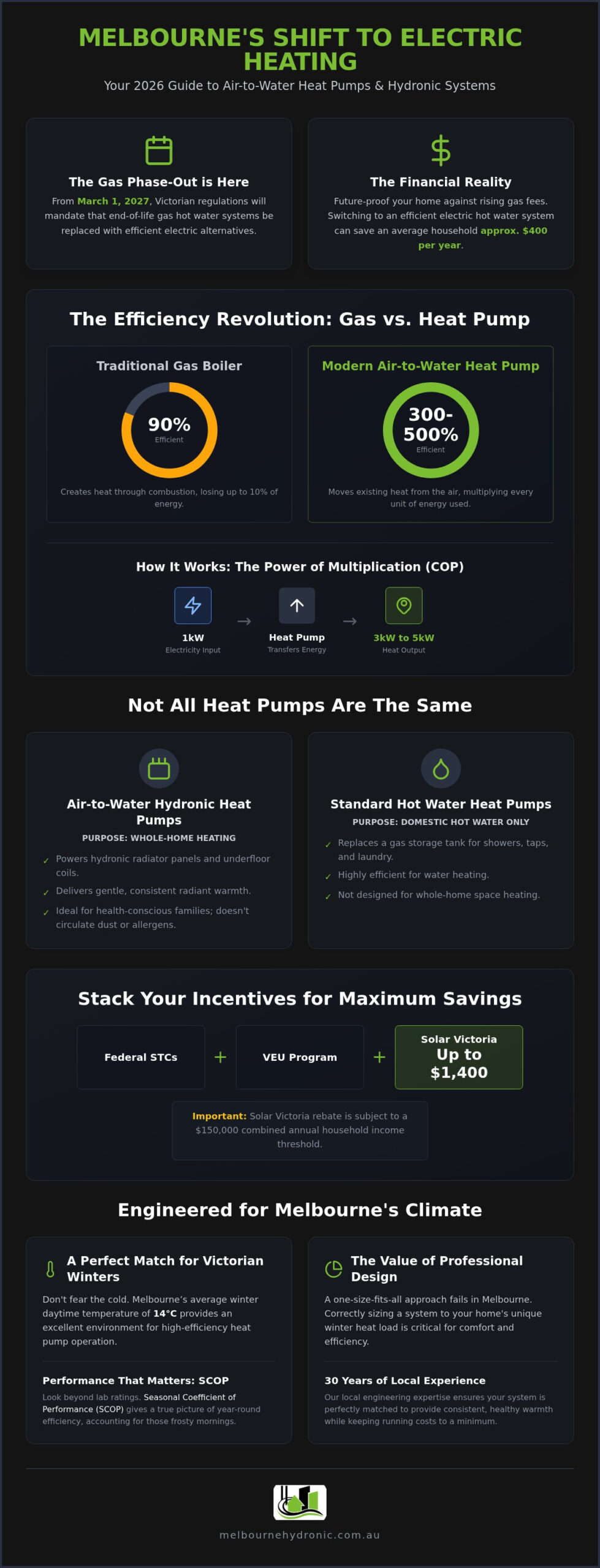
To understand why this shift is accelerating, we need to look at how heat pump technology works. Unlike traditional gas boilers that create heat through combustion, heat pumps simply move existing thermal energy from the outside air into your living space. This process is remarkably efficient. While a premium gas boiler might reach 90% efficiency, a modern heat pump operates at 300% to 500% efficiency. This means for every 1kW of electricity the system consumes, it delivers between 3kW and 5kW of heat to your home. It’s a level of performance that gas simply can’t match.
The End of Gas in Victoria
The regulatory environment in 2026 is unambiguous. From March 1, 2027, Victorian regulations will require that gas hot water systems reaching their end-of-life be replaced with efficient electric alternatives like heat pumps. This mandate reflects a broader trend across Melbourne and Geelong, where homeowners are proactively decoupling from the gas grid. Beyond compliance, the financial incentive is strong. Data indicates that switching from gas to an efficient electric hot water system can save a Victorian household approximately $400 a year on energy bills. By future-proofing your property now, you’re aligning with a cleaner Victorian grid and enhancing the resale appeal of a modern, all-electric home.
Heat Pump Efficiency (COP) Explained
When comparing the best heat pumps for Melbourne homes, you’ll encounter the term Coefficient of Performance (COP). In simple terms, this is the ratio of heat output to electrical input. Melbourne’s climate is actually an ideal partner for this technology. While some fear that heat pumps struggle in the cold, Melbourne’s average winter daytime temperature of 14°C provides an excellent environment for high-efficiency operation.
We always advise looking at the Seasonal Coefficient of Performance (SCOP) rather than just laboratory ratings. The SCOP provides a more accurate picture of how a system handles a full Victorian winter, including those occasional frosty mornings. A professionally designed system, backed by 30 years of local engineering experience, ensures your heat pump is correctly sized to handle the winter load. This precision allows your hydronic radiator panels or underfloor heating to provide a consistent, healthy warmth that improves your quality of life while keeping running costs at a minimum.
Hydronic Heating vs. Hot Water: Choosing the Right Heat Pump System
Many homeowners begin their search for the best heat pumps for Melbourne homes only to find themselves confused by two very different technologies. It’s common to conflate domestic hot water units with whole-home heating systems, but they serve entirely different purposes. While both use the same thermodynamic principles to extract heat from the air, the hardware required to warm a morning shower is vastly different from the system needed to keep a four-bedroom home cozy during a cold snap in July. A one-size-fits-all approach often results in systems that are either underpowered for winter or unnecessarily expensive to run.
Choosing the right architecture depends on your specific goals. Are you looking to replace a leaking gas storage tank, or are you ready to transition your entire property to a gas-free, climate-controlled sanctuary? Understanding the distinction between “Air-to-Water” hydronic units and dedicated hot water heat pumps is the first step toward a successful installation.
Whole-Home Hydronic Heat Pumps
These powerful air-to-water units are the engine behind modern hydronic radiator panels and underfloor coils. Unlike standard air conditioners that blow dry air, these systems circulate heated water through your home, providing a gentle, radiant warmth that doesn’t stir up dust or allergens. This makes them a superior choice for health-conscious families.
For many Melbourne residents, the ability to provide cooling via fan coils is a significant advantage. These units can reverse their cycle in summer, chilled water through the same network to provide a refreshing, draught-free cool. Because these systems are more complex, sizing the unit based on a precise “heat load” calculation is vital. If you’re unsure which architecture fits your block, our team can provide expert system design tailored to your home’s unique layout.
Domestic Hot Water Heat Pumps
If your primary goal is to lower your energy bills by replacing an old gas or electric storage tank, a dedicated Domestic Hot Water (DHW) heat pump is the most efficient path. These units are compact and designed specifically to maintain a tank of water at 60°C. When selecting a unit for the Victorian climate, tank size and recovery time are the two most important factors. You need a system that can recover quickly after several back-to-back showers on a frosty morning.
Homeowners can often leverage Victorian Government heat pump rebates to offset the cost of these installations. While “Combi” heat pumps that handle both hot water and space heating do exist, they require sophisticated engineering to ensure one function doesn’t compromise the other. In many Melbourne homes, installing two separate, specialised units provides better redundancy and ensures you never have to choose between a warm living room and a hot shower.
Comparing the Best Heat Pump Brands for the Victorian Climate
Selecting the right hardware for the Victorian climate requires more than a glance at a glossy brochure. The best heat pumps for Melbourne homes must be engineered to withstand high humidity and frequent frost cycles, particularly during those biting July nights. Reliability is paramount, but local support and spare parts availability are what truly define a premium investment. The ideal Melbourne heat pump brand is one with a proven defrost cycle specifically designed for humid 2°C nights.
In our medium-density suburbs, “Quiet Mode” isn’t a luxury; it’s a necessity. We often see homeowners overlook decibel ratings, only to find their unit disturbs the peace of a quiet Geelong evening or a compact inner-city courtyard. Choosing a brand with a strong Victorian presence ensures that if you ever need a technician, they’re just a local call away. This proximity is vital for maintaining the long-term health and hygiene of your system.
Premium Hydronic Brands
When we design a system for heat pump hydronic heating, we look for units that maintain a high COP even as temperatures drop toward zero in the Dandenongs. Brands like Daikin and Mitsubishi Electric have spent years refining their air-to-water technology for the Australian market. These units offer exceptional performance in frost, ensuring your radiator panels don’t lose their edge when you need them most. Modern units now feature seamless smart home integration, allowing you to adjust your floor coils or radiator panels from a smartphone before you even leave the office.
Top Hot Water Heat Pump Brands
For domestic hot water, the market is currently led by innovators like iStore, Reclaim Energy, and Sanden. Many of our clients are moving toward CO2 (R744) as a refrigerant because it’s the gold standard for environmental safety and efficiency in colder climates. Reclaim systems, for example, are highly regarded for their ability to recover quickly without excessive noise. When you apply for the Victorian Government hot water rebate, ensuring your chosen brand is on the approved list is the first step toward a successful, subsidized installation. This choice ensures your unit won’t wake the neighbours while it works efficiently overnight.
Navigating Costs, Rebates, and Installation in Melbourne & Geelong
Understanding the financial side of securing the best heat pumps for Melbourne homes involves looking beyond the initial sticker price. A successful transition to electric heating is a balance of high-quality hardware and the professional engineering required for a flawless installation. While the hardware itself represents a significant portion of your investment, the labour component accounts for the technical precision needed to integrate these units into your home’s existing infrastructure. This is particularly true for hydronic systems, where pipework and hydraulic balancing are critical for efficient operation.
The installation process is a journey that begins with a comprehensive site audit. This step ensures your property can support the new system, both physically and electrically. From the initial design to the final commissioning, every stage must be handled by accredited professionals to ensure the system meets Melbourne’s specific winter heat loads. Skipping these technical details can lead to underperformance when the temperature drops, making expert guidance essential for long-term satisfaction.
Maximising Victorian Government Incentives
The 2026 rebate landscape offers substantial support for Victorian households, but eligibility rules have recently tightened. The Solar Victoria Hot Water Rebate currently provides up to $1,000 for eligible systems, or up to $1,400 if you choose a locally-made product. It’s important to note that as of July 1, 2026, the combined household income threshold for this rebate was reduced to $150,000 per year. Staying within these guidelines is the key to reducing your out-of-pocket expenses.
Beyond the primary rebate, homeowners can leverage Small-scale Technology Certificates (STCs) and Victorian Energy Efficiency Certificates (VEECs). These incentives act as an upfront discount, often ranging from several hundred to over a thousand dollars depending on the system’s efficiency. For the ultimate energy-saving setup, combining a heat pump with an existing solar PV system allows you to run your heating for “free” during peak daylight hours. If you want to see how these incentives apply to your property, you can request a professional system assessment from our local team.
Installation Challenges in Melbourne
Location is another vital factor. Heat pumps require significant airflow to operate at their rated efficiency, so they shouldn’t be tucked away in tight, unventilated side passages. Managing condensate drainage is also essential to prevent dampness around your home’s foundations. By addressing these structural and electrical requirements during the audit phase, we ensure your system provides the clean, quiet, and reliable warmth your family deserves.
Designing Your Energy-Efficient Home with Melbourne Hydronic Heating
Designing a high-performance home involves more than just selecting a brand from a list. It requires a meticulous approach to engineering that considers the thermal envelope of your specific property. With over 30 years of industry experience across Melbourne and Geelong, we focus on creating systems that provide consistent comfort without the environmental or financial burden of gas. The best heat pumps for Melbourne homes are those that have been professionally sized and integrated to work in harmony with your home’s unique layout and insulation levels. We pride ourselves on being more than just installers; we are local consultants who understand the specific climatic challenges of a Victorian winter.
Professional installation is the only way to guarantee the energy savings promised by modern heat pump technology. A poorly designed system will run frequently, struggle to maintain temperature, and ultimately lead to higher bills. By contrast, a system engineered with technical precision ensures that every kilowatt of electricity is used effectively. This commitment to quality is why we specialise in “Air-to-Water” technology, ensuring your transition away from gas is seamless and provides a tangible improvement to your daily life.
The Melbourne Hydronic Design Process
Our process begins with room-by-room heat loss calculations. This level of detail is what separates a generic installation from a premium comfort solution. We don’t just swap a boiler for a heat pump; we evaluate how the new energy source interacts with your hydronic heating network. This often involves adjusting flow rates for radiator panels or recalibrating underfloor heating loops to ensure the lower water temperatures of a heat pump still deliver peak warmth.
Long-term peace of mind comes from knowing your investment is protected by local experts. Our commitment continues long after the unit is commissioned. We provide comprehensive system servicing and maintenance to ensure your heat pump continues to operate at its maximum efficiency for decades. Regular check-ups maintain the hygiene and performance of the system, preventing minor issues from becoming costly repairs and ensuring your home remains a sanctuary of well-being.
Get Your Custom Heat Pump Quote
Starting your transition to a gas-free home today is a straightforward and rewarding process. During a professional consultation, we’ll walk through your property, assess your current infrastructure, and provide a clear, logical roadmap for electrification. You can expect a transparent breakdown of how a heat pump will integrate with your existing radiators or floor coils, along with an explanation of the expected energy savings. We’ll guide you through the process of claiming all available Victorian incentives to ensure your investment is as economical as it is effective. To take the first step toward a warmer, healthier, and more sustainable home, you can Book a consultation with Melbourne Hydronic Heating today.
Future-Proof Your Home’s Comfort Today
Transitioning away from gas is no longer a distant goal; it’s a practical step toward a more sustainable and cost-effective lifestyle. By selecting the best heat pumps for Melbourne homes, you aren’t just installing a new appliance. You’re investing in a system engineered to handle our unique climate while significantly reducing your long-term energy expenditure. We’ve explored how modern air-to-water technology offers superior hygiene and comfort, especially when paired with the current Victorian rebates that make the shift more affordable than ever.
As a family-owned and operated business with 30+ years of Melbourne experience, we specialise in the complex integration of heat pumps with hydronic radiator panels and underfloor systems. We understand that every property has a different heat load, and our local expertise ensures your system is designed for peak performance on the coldest nights. Don’t leave your home’s comfort to chance or generic solutions. Ready to secure your energy future and enjoy a gas-free sanctuary? Request a Professional Heat Pump Design & Quote to see how we can transform your living environment. Your journey to a cleaner, warmer home starts with a single expert consultation.
Frequently Asked Questions
Are heat pumps effective during a Melbourne winter frost?
Modern heat pumps are highly effective in frosty conditions because they feature automated defrost cycles specifically designed for high-humidity environments. While efficiency may fluctuate slightly when temperatures drop toward 0°C, a professionally designed system ensures your radiators or floor coils maintain consistent warmth. Selecting the best heat pumps for Melbourne homes involves choosing units with a proven track record in low-ambient temperatures to ensure reliability on the coldest July mornings.
How much can I save by switching from a gas boiler to a heat pump?
Switching from a traditional gas boiler to an efficient electric heat pump can save Victorian households approximately $400 per year on energy bills. These savings are achieved because heat pumps operate at 300% to 500% efficiency, whereas even premium gas boilers rarely exceed 90%. If you have an existing solar PV system, you can reduce running costs even further by scheduling your heating cycles to run during peak daylight hours.
What is the difference between a split system and a monobloc heat pump?
A monobloc heat pump contains all its refrigeration components in a single outdoor unit, which simplifies the hydraulic connection to your home’s heating circuit. A split system separates the outdoor fan unit from an indoor heat exchanger, connected by refrigerant piping. Monobloc units are often the preferred choice for Melbourne properties due to their compact footprint and the ease of integrating them with hydronic radiator panels.
Do heat pumps require a lot of maintenance in Melbourne?
Heat pumps require significantly less maintenance than gas boilers, but an annual professional service is vital for maintaining peak efficiency and hygiene. This routine check includes inspecting refrigerant levels, cleaning the heat exchanger, and ensuring the condensate drainage is functioning correctly. As noted by raybrownairandheat.com, professional cleaning is essential for preventing mold and maintaining air quality. Regular servicing by a local expert protects your long-term investment and ensures the system continues to provide a healthy living environment for your family.
Can I use a heat pump for both my radiators and my shower water?
Yes, it’s possible to use heat pump technology for both space heating and domestic hot water through a specialised “Combi” system or separate units. While a single unit can be engineered to handle both tasks, many Melbourne homeowners choose two dedicated systems to ensure redundancy. This setup ensures that your domestic hot water recovery time is never compromised by the heavy demand of heating your entire home during winter.
How noisy are modern heat pumps, and will they bother my neighbours?
Modern, high-quality heat pumps are remarkably quiet and often include a “Quiet Mode” that reduces noise levels to a gentle hum. When the system is correctly positioned during the design phase, it won’t disturb your neighbours, even in medium-density suburbs. We prioritise brands with low decibel ratings and engineered fan blades that minimise vibration, ensuring your home remains a peaceful sanctuary in Geelong or Melbourne.
Is my home suitable for a hydronic heat pump retrofit?
Most Melbourne homes are suitable for a retrofit, provided there is adequate space for the outdoor unit and the electrical switchboard can handle the new load. During a professional site audit, we assess your home’s thermal envelope and existing pipework to ensure a seamless transition. Even older double-brick Victorian homes can benefit from the best heat pumps for Melbourne homes when the system is custom-designed for the property’s specific heat loss profile.
What government rebates are currently available for Melbourne residents in 2026?
Melbourne residents can currently access the Solar Victoria Hot Water Rebate, which offers up to $1,000 for eligible systems or $1,400 for locally-made products. Additional incentives include Victorian Energy Upgrades (VEU) discounts and Federal Small-scale Technology Certificates (STCs), which act as an upfront discount on the installation. It’s important to remember that as of July 2026, the household income threshold for the primary Solar Victoria rebate is $150,000 per year.