

How Often Should You Service a Hydronic System? The 2026 Melbourne Guide
Did you know that skipping just one annual check-up can slash your heating efficiency by as much as 15%? For many Melbourne homeowners, the hydronic system is a “set and forget” luxury until the pipes start banging or the energy bills suddenly spike. If you’re wondering how often should you service a hydronic system, the answer is usually found in the fine print of your warranty and the Victorian safety standards of 2026. You likely chose this system for its silent, healthy warmth, so it’s stressful when “kettling” noises or cold radiator spots begin to disrupt your comfort during a freezing July night.
We’ll show you how regular maintenance prevents the “silent” buildup of magnetite sludge and keeps your running costs at an absolute minimum. This guide reveals the ideal service schedule to protect your investment, maintain your manufacturer warranty, and ensure total peace of mind regarding gas safety. You’ll learn how a proactive approach to maintenance keeps your home whisper-quiet and efficient, whether you’re using traditional radiator panels or a modern electric heat pump. By the end of this article, you’ll have a clear roadmap to keep your system running perfectly for years to come.
Key Takeaways
- Learn exactly how often should you service a hydronic system to protect your manufacturer warranty and prevent a 15% drop in heating efficiency.
- Discover why professional power flushing is vital for removing “black sludge” (magnetite) that causes noisy pipes and uneven heating.
- Identify the five critical red flags, including cold spots on radiator panels, that signal your system requires immediate professional attention.
- Understand the essential safety components of a Melbourne service, including mandatory carbon monoxide testing and expansion vessel calibration.
- See how proactive maintenance “winter-proofs” your home, ensuring lower running costs and a longer lifespan for your boiler or heat pump.
The Recommended Frequency: How Often Should You Service Hydronic Heating?
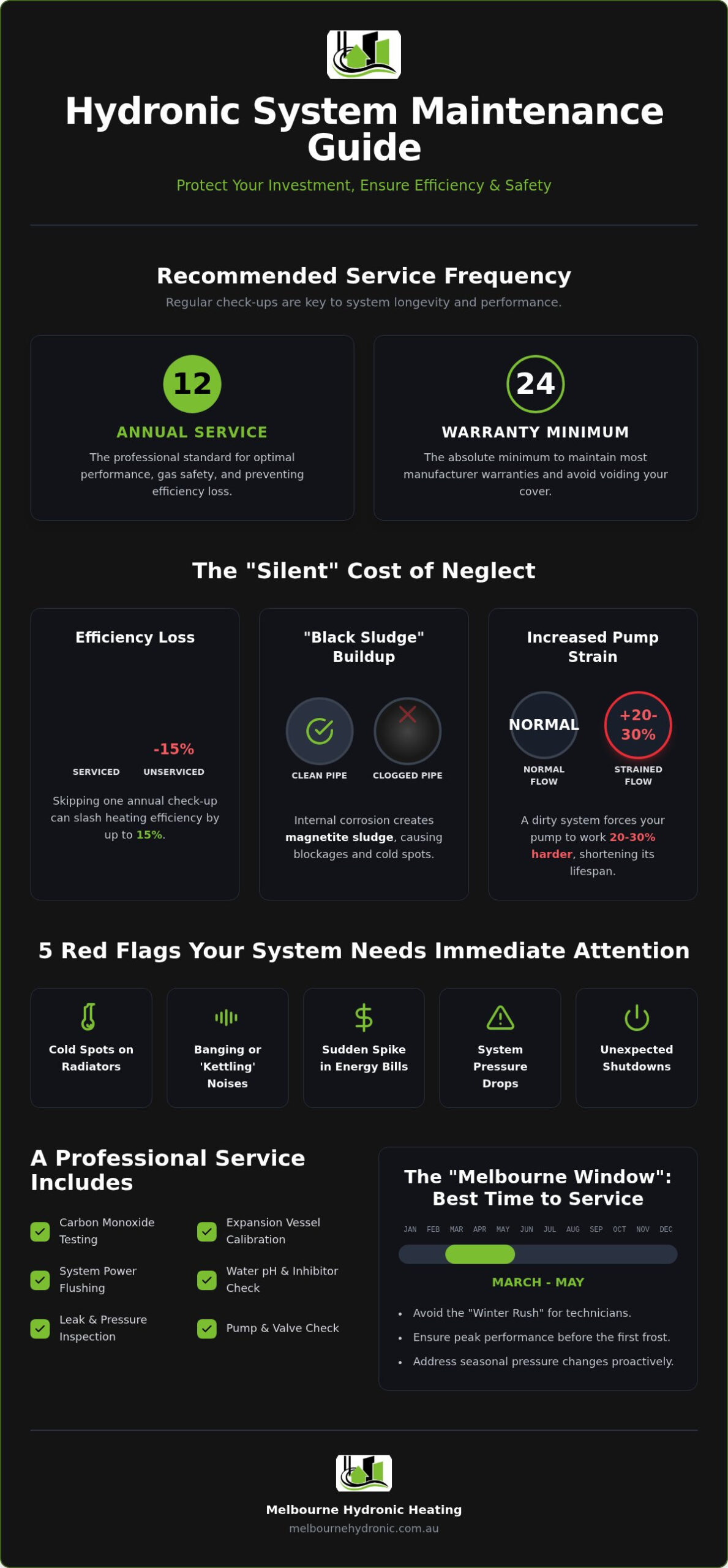
Maintaining a comfortable home in Victoria requires a bit of foresight, especially as we head into the colder months. Many homeowners treat their heating like a light switch; they expect it to work perfectly the moment they flick it on in late May. However, the technical reality of what a hydronic system is involves a complex balance of water chemistry, mechanical pumps, and heat exchange. When you ask how often should you service a hydronic system, the professional standard in Melbourne is every 12 months. This isn’t just a suggestion. It’s a strategy to prevent a documented 15% drop in energy efficiency that occurs when systems are left to accumulate debris and air pockets.
While some modern systems are incredibly robust, the absolute minimum interval is every 24 months. This is typically the threshold required to maintain manufacturer warranties for major brands. Missing this window doesn’t just risk a mechanical breakdown; it could void your protection entirely. That leaves you with a significant repair bill in the middle of a cold snap. A proactive schedule ensures that your system remains a “set and forget” luxury rather than a source of winter anxiety.
The Annual Service vs. The Bi-Annual Check
For those using gas boilers, a yearly service is vital due to carbon monoxide safety. Victorian regulations are strict for a reason. Gas-fired appliances must be tested for leaks and proper combustion to keep your family safe. If you’ve transitioned to an electric heat pump, your maintenance needs are slightly different but no less critical. Heat pumps rely on steady airflow and clean heat exchangers to hit high-efficiency targets. Regardless of your heat source, a skipped service directly impacts your 2026 energy budget. Modern energy prices mean that even a small drop in performance translates to hundreds of extra dollars spent on heating over a single winter.
Timing Your Service for the Melbourne Climate
The “Melbourne Window” for servicing falls between March and May. Booking your maintenance during this period is the smartest move a homeowner can make. By the time the first Victorian frost arrives, our team is usually flooded with emergency calls from people whose systems failed the moment they were pushed to the limit. Servicing early allows you to:
- Avoid the “Winter Rush” in June and July when technicians are at peak capacity.
- Ensure peak performance before the first significant temperature drop.
- Address pressure fluctuations caused by seasonal temperature swings.
When the mercury drops, water volume in your pipes changes. An unserviced expansion vessel can’t always compensate for these shifts, leading to system shutdowns. A pre-winter check ensures your system remains silent and steady when you need it most.
Why Servicing is Mandatory: The Science of Efficiency
Hydronic systems are designed to be elegant and quiet, but they aren’t chemically static. Inside your pipes, a constant chemical dance occurs between the water and the metal surfaces. When homeowners ask how often should you service a hydronic system, they’re often thinking about mechanical failure, but the real enemy is chemical degradation. Without the right balance of corrosion inhibitors, the water in your system becomes a catalyst for decay. This leads to the formation of magnetite; magnetite is the byproduct of internal oxidation in untreated water.
This “black sludge” is heavy and magnetic. It doesn’t just float; it clings to the most sensitive parts of your system. As this debris accumulates, it changes the viscosity of the water. A dirty system forces your pump to work 20-30% harder to maintain the same flow rate, which drastically shortens the pump’s lifespan and inflates your electricity bill. Beyond the pump, water pH balancing is the hidden key to preventing pinhole leaks in your radiator panels. If the water becomes too acidic, it’ll slowly eat through the metal from the inside out, leading to expensive property damage that a simple service could’ve prevented.
The Threat of System Sludge (Magnetite)
Sludge is the primary reason for uneven heating. Because magnetite is heavier than water, it naturally settles at the bottom of your radiators. This creates those frustrating cold spots where the panel feels icy at the base despite the top being warm. If left unaddressed, this sludge travels back to the heat exchanger. It acts like an abrasive, scouring the internal surfaces and reducing the system’s ability to transfer heat effectively. To restore a system that has reached this stage, you should learn What is Hydronic Power Flushing & Why Your System Needs It to clear the blockage.
Preserving the Life of Your Heat Source
Your boiler or heat pump is the heart of your home’s comfort. In gas boilers, “kettling” is a common symptom of neglect. This occurs when scale or sludge buildup traps pockets of water against the heat exchanger, causing them to flash-boil and create a loud banging noise. For those with modern electric heat pumps, maintenance focuses on coil cleanliness and airflow. A blocked heat pump coil can’t extract heat from the Melbourne air efficiently, forcing the unit to run for longer cycles. Our expert servicing team ensures these components are chemically protected and mechanically sound before the winter peak.
Red Flags: 5 Signs Your System Needs Immediate Professional Attention
While the standard answer to how often should you service a hydronic system is once every twelve months, your system might occasionally signal for help between scheduled visits. These “red flags” are early warnings that something is mechanically or chemically wrong. Catching these issues in May is far better than discovering them during a mid-July cold snap when repair teams are at their busiest. Ignoring small changes in performance often leads to a cascade of component failures that are much more expensive to rectify than a standard maintenance check.
One of the most obvious signs is a significant increase in warm-up times. If your home used to feel cozy within thirty minutes but now takes over an hour to reach the same temperature, your system is struggling. This lag is usually caused by a combination of air pockets and internal debris that prevents the water from transferring heat efficiently. When you’re paying for energy that isn’t actually reaching your living spaces, your utility bills will reflect that struggle long before the system finally breaks down.
Identifying Cold Spots and Uneven Heat
The condition of your hydronic radiator panels is the best diagnostic tool you have. If you notice cold spots at the top of a panel, it’s usually just trapped air that needs bleeding; a simple fix. However, if the bottom of the radiator feels icy while the top is hot, you’re likely dealing with heavy magnetite sludge. This heavy debris settles at the base and blocks the flow of hot water entirely. For those with underfloor systems, this failure manifests as “dead zones” in your slab where certain floor tiles remain cold regardless of the thermostat setting.
Noises and Pressure Issues
You should never ignore unusual noises like banging, whistling, or gurgling within your walls. While some light clicking is normal as pipes expand, loud “kettling” sounds indicate a serious blockage or scale buildup near the heat exchanger. Similarly, keep a close eye on your pressure gauge. A healthy hydronic system is a sealed loop that should maintain steady pressure for months. If you find yourself manually topping up the system every few weeks, you likely have a failing expansion vessel or a slow leak. When the pressure drops too low, the system will often lock out as a safety precaution, leaving you without heat when you need it most. If you see discoloured, dark water when bleeding your radiators, it’s a clear sign that the internal corrosion mentioned earlier has taken hold and requires immediate professional attention.
By staying vigilant, you can ensure that the question of how often should you service a hydronic system remains a matter of routine care rather than emergency recovery. Proactive observation is the key to maintaining the quiet, premium comfort you expect from hydronic heating.
What a Professional Melbourne Hydronic Service Includes
A professional maintenance visit is much more than a quick visual inspection. When homeowners ask how often should you service a hydronic system, they’re usually looking to balance cost with reliability. The depth of a professional service justifies the annual interval by addressing both the mechanical and chemical health of your installation. We perform a deep recalibration of the entire system, starting with the expansion vessel. By adjusting the air charge in this vessel, we ensure your system can safely handle the pressure changes that occur when water heats up. We also lubricate the circulating pumps and calibrate your thermostats to ensure your energy usage remains as lean as possible during the Victorian winter peak.
Safety is our absolute priority, particularly for gas-fired systems. Every standard service includes comprehensive carbon monoxide (CO) testing and flue gas analysis. This ensures that your boiler is burning fuel cleanly and that no dangerous gases are leaking into your home. These checks are essential for peace of mind and are often a requirement for insurance compliance in Victoria. By catching small ignition or sensor issues early, we prevent the need for expensive emergency repairs in the middle of July.
Gas Boiler vs. Electric Heat Pump Servicing
The technical requirements vary significantly depending on your heat source. For gas boilers, we focus on burner cleaning, heat exchanger integrity, and ignition timing. We ensure the combustion process is optimized for the specific gas pressure in your local Melbourne area. For those who have made the switch to modern electric technology, our Heat Pump Hydronic Heating Guide details a different set of priorities. Heat pump servicing involves checking refrigerant levels, cleaning the external fan coils to maintain airflow, and testing the electronic sensors that manage the defrost cycles during frosty mornings.
Hydronic Water Treatment and Balancing
The water inside your pipes is the lifeblood of your home’s comfort. During a service, we conduct a chemical analysis to measure the pH levels and the concentration of Total Dissolved Solids (TDS). If your corrosion inhibitor levels have depleted, we top them up to maintain that protective barrier on the inside of your radiator panels. We also isolate and clean your magnetic filter. By removing the metallic debris trapped in the filter’s internal sleeve, we prevent abrasive particles from circulating back into your pump or heat exchanger. This simple step can add a decade to the lifespan of your system. If you haven’t had your system checked in over a year, book your fixed-rate maintenance service today to ensure your home stays safe and efficient.
Long-term Care: Extending System Life with Melbourne Hydronic Heating
Investing in a hydronic system is a commitment to premium home comfort and long-term sustainability. To protect that investment, understanding how often should you service a hydronic system is the first step toward achieving a 25-year lifespan for your equipment. Transitioning from reactive repairs to proactive health doesn’t just save you from mid-winter breakdowns; it fundamentally changes the economics of your home heating. When your system runs at peak efficiency, it uses less fuel and places less strain on every mechanical component, from the heat pump sensors to the radiator valves. By winter-proofing your home now, you ensure that the quiet, consistent warmth you love remains a reliable reality for decades.
The goal of professional maintenance is to keep your system in a “like-new” state. While a neglected boiler might struggle to reach its tenth year, a well-cared-for system can easily double that age. This longevity is especially important as Victoria moves toward new energy standards in 2026 and 2027. Maintaining your current system’s health gives you the flexibility to plan for future upgrades on your own terms, rather than being forced into an emergency replacement during a freezing July cold snap.
The ROI of Regular Maintenance
Professional maintenance pays for itself through significantly lower utility bills. As we noted earlier, even a single missed service can lead to a 15% drop in efficiency. Over a full Melbourne winter, that loss adds up to a substantial amount of wasted energy. Beyond the financial return, there’s a vital health benefit. Because hydronic systems don’t rely on fans to circulate air, they’re already the gold standard for asthma and allergy sufferers. Regular servicing ensures that this “dust-free” environment remains pristine; for a truly comprehensive clean, many homeowners also rely on Best Carpet Steam Cleaning Melbourne to remove deep-seated allergens from their floors. You’re also reducing your home’s carbon footprint by ensuring every megajoule of gas or kilowatt of electricity is converted into heat with maximum precision.
Why Choose Melbourne Hydronic Heating?
We’ve spent over 30 years serving the unique climate challenges of Melbourne and Geelong. This local expertise matters because we understand how Victorian water chemistry and seasonal temperature swings affect different system types. Our commitment to fixed-rate, transparent maintenance fees means you’ll never face “bill shock” after a service. We don’t just fix problems; we act as consultants to help you get the most out of your heating. Our technicians are experts in both traditional gas boilers and the latest electric heat pump technologies. To ensure your home is ready for the coming season, you can Book Your Hydronic Service in Melbourne Online. Secure your spot before the autumn rush to guarantee a silent, safe, and efficient winter.
Secure Your Home’s Comfort for the Years Ahead
We’ve explored how a proactive approach to maintenance prevents “black sludge” from eroding your efficiency and protects your manufacturer warranty. By answering the question of how often should you service a hydronic system with a consistent twelve-month schedule, you ensure your home remains a sanctuary of silent, healthy warmth. Whether you’re managing traditional radiator panels or a modern electric heat pump, regular calibration is the only way to keep your running costs low and your system’s lifespan long. Timing your service before the winter peak avoids the stress of emergency repairs and keeps your energy budget under control.
With over 30 years of Victorian experience, our team specializes in winter-proofing Melbourne homes through technical precision and transparent, fixed-rate maintenance fees. We’re dedicated to ensuring your environment remains safe and your equipment operates at peak performance throughout the coldest months. Don’t wait for a mid-winter breakdown to realize the value of a professional check-up. Book your expert hydronic service with Melbourne Hydronic Heating today and enjoy the peace of mind that comes with true local expertise. We look forward to helping you maintain a warm, healthy home for many years to come.
Frequently Asked Questions
Do I really need to service my hydronic heating every year?
Yes, annual servicing is the professional standard to ensure your system remains safe, silent, and efficient. While you might wonder how often should you service a hydronic system if it seems to be running fine, most manufacturer warranties for major brands require a yearly check-up. Skipping this interval leads to a gradual buildup of debris that forces your pump to work harder and increases your monthly energy consumption.
How much does a hydronic heating service cost in Melbourne?
We provide fixed-rate maintenance fees for our standard servicing to ensure you have total price transparency before we arrive. The final cost generally depends on whether you have a single boiler or multiple units and the overall complexity of your installation. By choosing a professional team with over 30 years of local experience, you avoid the hidden costs associated with emergency repairs and inefficient operation.
What happens if I don’t service my hydronic system?
Neglecting your system leads to a “silent” loss of efficiency, often manifesting as rising energy bills and noisy operation. Internally, untreated water causes oxidation, creating a heavy black sludge that settles in radiators and blocks heat exchangers. Beyond the mechanical damage, skipping services on gas-fired boilers poses a genuine safety risk regarding carbon monoxide leaks, which can go undetected without professional testing equipment.
Can I service a hydronic heating system myself?
You shouldn’t attempt to service the core components of a hydronic system yourself. While homeowners can safely bleed air from radiators, a full service requires specialized tools for gas combustion analysis, expansion vessel recalibration, and chemical water testing. Handling gas components or refrigerant lines without the proper Victorian licenses is dangerous and will immediately void your system’s warranty.
Is carbon monoxide testing included in a standard hydronic service?
Yes, comprehensive carbon monoxide (CO) testing is a mandatory part of every service we perform on gas-fired boilers. Given the strict Victorian safety regulations, we use calibrated electronic sniffers to check for leaks and ensure your flue is venting correctly. This process is vital for the health and safety of your household, providing peace of mind alongside improved heating performance.
How long does a professional hydronic service take?
A standard professional service typically takes between 60 and 90 minutes to complete for a single-boiler home. This timeframe allows our technicians to perform a thorough safety check, test the water chemistry, and recalibrate the system pressure. If your system requires more intensive work, such as a specialized power flush to remove heavy sludge, we’ll discuss the additional time requirements with you beforehand.
Will a service fix cold spots on my radiators?
A routine service often resolves cold spots, but the solution depends on the technical cause. If the cold spot is at the top of the radiator, bleeding the air during the service will fix it instantly. However, if the base of the radiator remains cold, it signals a heavy accumulation of magnetite sludge. In these cases, we may recommend a power flush to restore full circulation and heat transfer.
Does underfloor hydronic heating need less maintenance than radiators?
The maintenance frequency remains the same regardless of whether you have radiator panels or underfloor coils. While underfloor systems are protected within the slab, the boiler or heat pump still requires annual attention to maintain efficiency and safety. When considering how often should you service a hydronic system, the focus is on the “heart” of the system, which must be chemically and mechanically balanced every year.