What to Expect During Hydronic Installation: The Complete 2026 Melbourne Guide
What if your Melbourne home could maintain a perfect, dust-free temperature all winter without a single visible pipe or a noisy outdoor unit? You’ve likely heard that hydronic heating is the gold standard for comfort, but the thought of retrofitting a Victorian terrace or a modern apartment can feel like a major hurdle. It’s normal to worry about hidden costs or the potential mess of installing new pipework through your floorboards. Understanding what to expect during hydronic installation is the first step toward a stress-free home upgrade.
We’re here to show you that a professional installation is a precision-engineered evolution of your living space, not a disruptive construction project. As Victoria moves toward electrification and the 2027 gas transition, this guide provides a comprehensive walkthrough of the entire journey, from initial heat-load designs to the final commissioning of your energy-efficient system. We’ll outline a clear day-by-day timeline for both underfloor and radiator systems while sharing expert tips to keep your heritage features intact. By the end, you’ll have a clear checklist to prepare your home and the confidence that your new system will deliver the premium lifestyle you deserve.
Key Takeaways
- Learn why a professional heat-load calculation is the foundation of your system’s efficiency and how site surveys protect the integrity of Melbourne heritage homes.
- Discover a day-by-day breakdown of what to expect during hydronic installation, from the initial rough-in phase to connecting your energy-efficient heat pump or boiler.
- Understand why retrofitting radiator panels is often less invasive than traditional ducted heating, making it a premium choice for existing Victorian properties.
- Uncover the technical secrets behind a silent, high-performance system, including the critical roles of hydraulic balancing and air purging during the commissioning phase.
- Gain peace of mind with a guide to the first 48 hours of operation and why hydronic systems are considered the ultimate “set and forget” heating solution.
The Design and Pre-Installation Phase: Calculating Your Comfort
Professional home comfort starts long before a wrench touches a pipe. In Melbourne, where grand heritage architecture meets strict modern energy standards, the design phase is the most critical part of the journey. One of the most vital parts of what to expect during hydronic installation is the technical audit. This isn’t a simple walkthrough; it’s a precision-engineered assessment that ensures your home meets the 2026 Victorian energy requirements. As of this year, all new dwellings in Victoria must meet a minimum 7-star NatHERS energy rating, and your heating system plays a central role in achieving that goal.
The science of Hydronics relies on the efficient movement of energy through water. To get this right, a specialist performs a site survey to identify the best pathways for pipework. For Melbourne’s iconic Victorian and Edwardian homes, this means finding routes that respect the original floorboards and ornate plasterwork. During this phase, you’ll finalise the choice between hydronic heating panels for rapid response or underfloor distribution for that luxurious, invisible warmth. It’s a balance of lifestyle needs and architectural possibilities.
The Technical Heat Load Assessment
We don’t believe in guesswork. Every room in your house has a unique thermal profile. We calculate the specific wattage required for each space by looking at insulation levels, window dimensions, and orientation. A room with floor-to-ceiling glass and north-facing exposure requires a completely different approach than a cozy, carpeted bedroom with standard ceilings. Ceiling height and floor material, such as concrete versus timber, also dictate the system’s flow temperature. Guessing radiator sizes is a recipe for disaster; it leads to inefficient boiler performance and bloated energy bills that stick with you for years.
Homeowner Preparation Checklist
While our team handles the heavy lifting, a little preparation on your end ensures a smooth start to the project. Clear access is the priority. We’ll need to reach the subfloor or ceiling cavity to run the primary pipe loops that connect your system. You’ll also work with our designers to select the final locations for thermostats and the central manifold, which acts as the “brain” of your heating distribution. Finally, ensure the outdoor area is ready for the heat pump or gas boiler placement. This area should be level and clear of obstructions to allow for proper airflow and easy maintenance access in the future.
- Subfloor Access: Ensure crawl spaces are clear of stored items.
- Manifold Location: Usually tucked away in a laundry or hallway cupboard for easy access.
- Outdoor Clearance: Maintain at least 500mm of space around heat pump units for peak efficiency.
A Typical Hydronic Installation Timeline: Day-by-Day
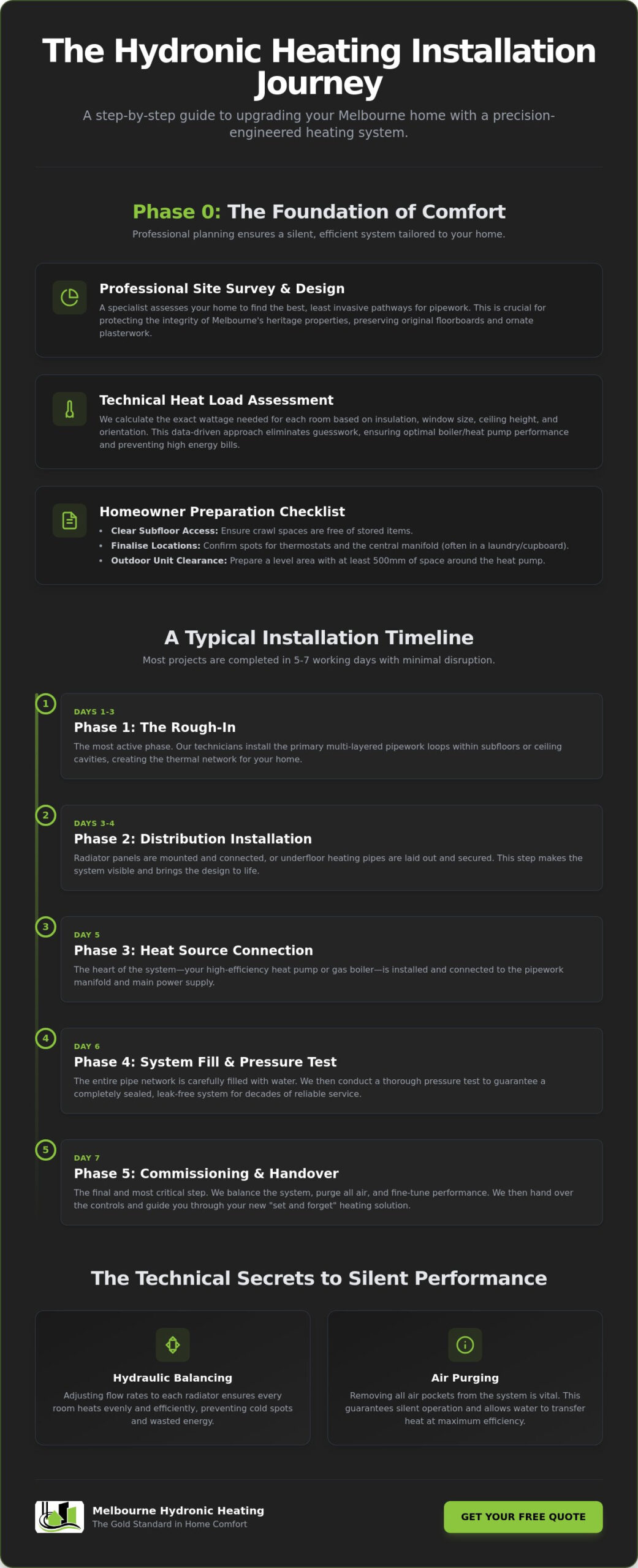
A structured timeline is the hallmark of a professional installation. While every Melbourne home presents unique architectural challenges, most projects follow a five phase sequence designed for efficiency and minimal disruption. Understanding what to expect during hydronic installation helps you plan your week with confidence, knowing exactly when the “heavy lifting” ends and the comfort begins. This process typically spans five to seven working days, depending on the complexity of your property and the chosen distribution method.
This journey is more than just plumbing; it’s the integration of a sophisticated thermal network into your home’s fabric. According to this U.S. Department of Energy guide to radiant heat, the efficiency of these systems relies heavily on proper installation and zoning. Our methodical approach ensures that every component, from the smallest valve to the main heat source, is positioned for peak performance and longevity.
Phase 1: The Rough-In (Days 1-3)
The first few days are the most active. Our team navigates subfloors or ceiling cavities to install multi layered PEX-AL-PEX piping. We use this specific material because its aluminium core prevents oxygen from entering the system, protecting your components from internal corrosion. During this stage, we also install the central manifold. Think of this as the distribution hub that controls the flow of warm water to every room. We take great care to manage dust and use floor protection throughout the internal pipework phase, ensuring your home remains respected and clean.
Phase 2 & 3: Hardware Mounting (Days 4-5)
Once the infrastructure is in place, we shift focus to the visible components. This involves the precision mounting of hydronic radiator panels to ensure they’re perfectly level and securely fixed to your walls. If you’ve opted for a modern electric heat pump, this phase includes setting up the outdoor unit on a stable, vibration dampened base. Unlike gas boilers, heat pumps require specific clearances for airflow and often involve the installation of a buffer tank to maintain steady water volume. We then connect the primary flow and return lines, creating a closed loop system ready for testing.
The final stages involve electrical integration, where we wire your thermostats and connect the system to your home’s power supply. We then fill the network with water, conduct a rigorous pressure test to ensure there are zero leaks, and perform the final commissioning. If you’re ready to see how this timeline fits your specific floor plan, you can request a detailed site assessment from our local experts.
- Day 1-3: Pipework rough-in and manifold installation.
- Day 4: Heat pump or boiler mounting and external connections.
- Day 5: Radiator mounting and internal connections.
- Day 6: Electrical wiring and thermostat setup.
- Day 7: Pressure testing, air purging, and homeowner handover.
Retrofitting vs. New Builds: Managing Disruption
One of the biggest misconceptions about what to expect during hydronic installation is that your home will become a major construction zone for weeks. This is especially true for those considering a retrofit in an older Melbourne property. While ducted heating requires large, intrusive vents and bulky ceiling units, hydronic systems are remarkably discreet. The pipework used is typically no thicker than a standard garden hose, allowing us to integrate it into the existing structure with surgical precision. This small footprint makes it one of the least invasive upgrades you can perform on a finished home.
The most common question we hear from homeowners is whether floorboards need to be removed. In almost every case, the answer is no. We utilise the natural voids in your home, such as subfloor crawl spaces or ceiling cavities, to route the network. This approach preserves the integrity of your heritage features while delivering a modern, premium heating solution. Whether you’re upgrading a terrace in Carlton or building a new home in the suburbs, the disruption is far less than most people anticipate. You won’t have to deal with the dust and structural changes associated with large ductwork runs.
Retrofitting Radiator Panels
For existing homes, wall-hung radiator panels are the gold standard. We use the subfloor access common in many Melbourne houses to hide the main flow and return lines from view. Our technicians are experts at “fishing” the final connections through wall cavities, leaving only the elegant panel visible in your living space. Because the work is localized to specific areas each day, you can usually stay in your home throughout the process without any significant loss of comfort. It’s a clean, methodical process that respects your daily routine.
Underfloor Installation in New Builds
In a new build, the process is a choreographed dance between different trades. The timing for underfloor heating is critical; we must coordinate perfectly with the plumber, the steel fixer, and the concrete team. We lay the coils once the steel mesh is in place but before the concrete pour begins. A crucial part of what to expect during hydronic installation in a new build is the pressure test. We keep the system under pressure during the concrete pour. This immediate feedback ensures that the coils remain airtight and undamaged as the slab is formed. We also work closely with your cabinet makers to ensure the central manifold is tucked away discreetly inside kitchen or hallway joinery.
- Retrofit Advantage: No large holes in ceilings or floors; uses existing 16-20mm cavities.
- Slab Coordination: Precise scheduling ensures the heating is installed between the steel and concrete phases.
- Heritage Protection: Preserves original plasterwork and floorboards by using subfloor routing.
Commissioning and Handover: Ensuring Peak Performance
Once the final pipe is crimped and the hardware is securely mounted, the most technical phase of the project begins. Commissioning is the bridge between a completed construction project and a high performance heating system. This stage is a vital part of what to expect during hydronic installation, as it transforms a silent network of pipes into a responsive, energy efficient environment. We don’t just turn the system on; we meticulously “tune” it to match the unique thermal requirements of your Melbourne home, ensuring every watt of energy is used effectively.
Modern systems, particularly those using electric heat pumps, require precise calibration to achieve the high efficiency ratings expected in 2026. While a gas boiler might be more forgiving of poor setup, a heat pump relies on specific flow rates to maintain its Coefficient of Performance (COP). We spend significant time during this phase ensuring the water temperature and flow speeds are perfectly aligned with your system’s design. This precision is what separates a standard heater from a premium comfort solution.
The Balancing Act
Hydraulic balancing is the secret to uniform warmth. Without it, the radiator closest to the heat source would receive all the energy, while the furthest bedroom remains chilly. We adjust the lockshield valves on every individual radiator to “tune” the resistance within the network. This process ensures that warm water is distributed evenly throughout the entire house, regardless of distance from the manifold. We monitor the temperature differential, known as Delta T, between the flow and return pipes. Achieving the correct Delta T is essential for your bills; it prevents the heat source from short cycling and ensures your home reaches the desired temperature quickly and quietly.
The Homeowner Handover
We believe that a premium system should be easy to use. During the handover, we’ll walk you through the central manifold and show you how to use the isolation valves if you ever need to renovate a specific room. We also provide comprehensive training on your new smart thermostat and mobile app. You’ll learn how to program schedules that align with your lifestyle and take advantage of off peak energy rates. We’ll also review your hydronic heating service schedule. While these systems are remarkably durable, a quick annual check ensures they continue to operate at peak health for decades.
Before we leave, we ensure all regulatory requirements are met. You’ll receive a Victorian Building Authority (VBA) Certificate of Compliance, which is your guarantee that the work meets all local safety and engineering standards. This document is essential for your home insurance and future property value. If you want to ensure your existing system is performing at its best, you can book a professional commissioning audit with our expert technicians today.
- Air Purging: We remove every micro bubble from the lines to ensure a completely silent system.
- Smart Integration: We’ll help you sync the system with your home automation for seamless control.
- Compliance: Every installation includes a formal VBA Certificate for your records.
Life After Installation: Maintenance and Longevity
The transition from a construction project to a permanent part of your home’s comfort is almost immediate. Once our technicians leave, the first 48 hours are about the system settling into its natural rhythm. While we perform extensive air purging during the final commissioning, it’s normal for microscopic bubbles to migrate through the network as the water heats and cools for the first time. You might hear a faint trickling sound in a radiator panel. This is a standard part of what to expect during hydronic installation and is easily resolved with a minor air bleed. After this initial period, the system enters its “set and forget” phase, providing a consistent thermal mass that maintains your home’s temperature without the constant cycling of air-based heaters.
Hydronic networks are sealed environments. Unlike traditional forced air systems that require frequent filter changes and duct cleaning, the water used to heat your home stays inside the pipes for years. To keep this water clean, we use chemical inhibitors that prevent the formation of magnetite, often called “black sludge.” This sludge is a byproduct of internal corrosion that can clog pumps and reduce efficiency if left unchecked. Scheduling your first annual service is the best way to monitor these levels and ensure your warranty remains fully protected.
Protecting Your Investment
We install a magnetic dirt separator as a standard part of our premium setups. This device captures any metallic debris before it can reach the sensitive components of your heat pump or boiler. Because it’s a sealed system, you should never need to “top up” the water levels under normal operating conditions. If you notice a pressure drop on your gauge, it’s a sign that the system needs a professional look rather than a DIY fix. High-quality hydronic components are designed for a lifespan exceeding 25 years. This makes it one of the most durable investments you can make in your property’s infrastructure.
The Health Benefits of Hydronic Comfort
The most striking change you’ll notice isn’t just the warmth; it’s the stillness of the air. Because there are no fans blowing air across dusty heat exchangers, the indoor air quality improves significantly. This is a major lifestyle win for families with asthma or allergies. You’ll also experience the “radiant” effect. Radiant heat warms objects and people directly, similar to the sun’s rays. Because of this, a room kept at 19°C with hydronic panels often feels warmer and more comfortable than a room at 21°C heated by dry, moving air. Ready for a warmer home? Request a custom hydronic quote for your Melbourne home today.
- Settlement Phase: Minor air bleeds may be needed in the first 48 hours.
- Sludge Prevention: Chemical inhibitors and magnetic separators protect the system.
- Longevity: Expect 25+ years of service with minimal annual maintenance.
Invest in a Lifetime of Sustainable Comfort
Choosing a hydronic system is an investment in your family’s well-being and your property’s future value. You now understand that the process is a methodical, precision-engineered evolution of your living space. From the initial heat-load calculations that ensure efficiency to the final hydraulic balancing that guarantees silent operation; every step is designed for peak performance. Knowing what to expect during hydronic installation empowers you to make informed decisions as Victoria moves toward a cleaner, more efficient energy future.
At Melbourne Hydronic Heating, we bring over 30 years of local experience to every project. Our team consists of fully licensed VBA plumbers and gasfitters who specialise in both modern electric heat pumps and high-efficiency gas boilers. We pride ourselves on delivering a premium life experience through technical excellence and a deep respect for Melbourne’s unique architecture. It’s time to leave behind the dry, dusty air of the past and embrace the healthy, radiant warmth that only water-based heating can provide.
Ready to start your journey toward a more comfortable home? Book your professional hydronic installation consultation with Melbourne Hydronic Heating today. We look forward to helping you create the perfect climate for your home.
Frequently Asked Questions
How long does a full hydronic heating installation take?
A standard installation typically takes 5 to 7 business days to complete. This timeframe covers the full process from the initial rough-in of pipework to the final pressure testing and commissioning. While larger homes or complex retrofits might extend slightly beyond a week, our team works methodically to ensure you aren’t without comfort for long.
Will I need to move out of my house during the installation?
You don’t need to move out of your home during the installation process. We work in a structured, room-by-room manner that allows you to maintain your daily routine. Since the pipework is routed through subfloors or ceiling cavities, the living areas remain largely undisturbed throughout the week.
Do I need to upgrade my electrical board for a hydronic heat pump?
Most electric heat pump installations require a dedicated 20-amp or 32-amp circuit. While a standard gas boiler uses very little electricity, a modern heat pump is a powerful appliance that needs its own connection to your switchboard. We assess your current electrical capacity during the design phase to ensure your home can support the new high-efficiency system.
Can I install hydronic heating in a double-storey Melbourne home?
Yes, we frequently install hydronic systems in double-storey Melbourne homes. We use internal wall cavities, wardrobes, or existing service ducts to route pipes between levels without damaging your ceilings. This approach is a standard part of what to expect during hydronic installation in more complex architectural layouts.
Is the installation of hydronic panels messy?
The installation process is remarkably clean compared to other major renovations. We use drop sheets and industrial vacuums to manage any debris from the small 16mm to 20mm holes required for pipe entry. Because we don’t need to install large ductwork, there is no need to rip up floors or cut large openings in your plasterwork.
What is a VBA Certificate of Compliance and why do I need one?
A VBA Certificate of Compliance is a legal document issued by a licensed plumber for any work valued over $750. It serves as your official guarantee that the installation meets all Victorian safety and engineering standards. You’ll need this certificate for your home insurance and to protect the long-term value of your property.
How much noise does a hydronic heat pump make once installed?
Modern hydronic heat pumps are designed to operate at very low noise levels, typically between 50 and 60 decibels. This is roughly equivalent to the hum of a modern refrigerator or a quiet conversation. Inside the home, the radiator panels and floor coils are completely silent, providing a peaceful environment free from the “whooshing” sound of fans.
Can I add more radiators to my system later?
You can add more radiators later if your heat source was originally sized with extra capacity. We recommend discussing your future renovation plans during the design phase so we can install a manifold with spare ports. This foresight makes it simple to extend the comfort of your system to a new extension or attic conversion down the track.