
Hydronic Heating Pressure Loss: Causes, Risks, and 2026 Repair Guide
What if that small, weekly chore of topping up your boiler is actually a sign that your heating system is slowly corroding from the inside out? Many homeowners treat a minor dip on the gauge as a routine maintenance task, but persistent hydronic heating pressure loss is often a silent killer that introduces fresh oxygen into your pipework, leading to internal sludge and expensive component failure. It’s incredibly frustrating to wake up to a freezing house because your boiler hit a safety lockout overnight, leaving you to wonder if a hidden leak is currently damaging your carpets or floorboards.
You deserve a stable, reliable system that doesn’t require constant manual intervention or cause anxiety every time you look at a valve. We’ll help you identify why your system is losing its charge and teach you how to stop the cycle of top-ups before serious damage occurs. This 2026 repair guide covers everything from simple expansion vessel issues to professional power flushing, providing a clear path to lower energy bills and a restored sense of home comfort.
Key Takeaways
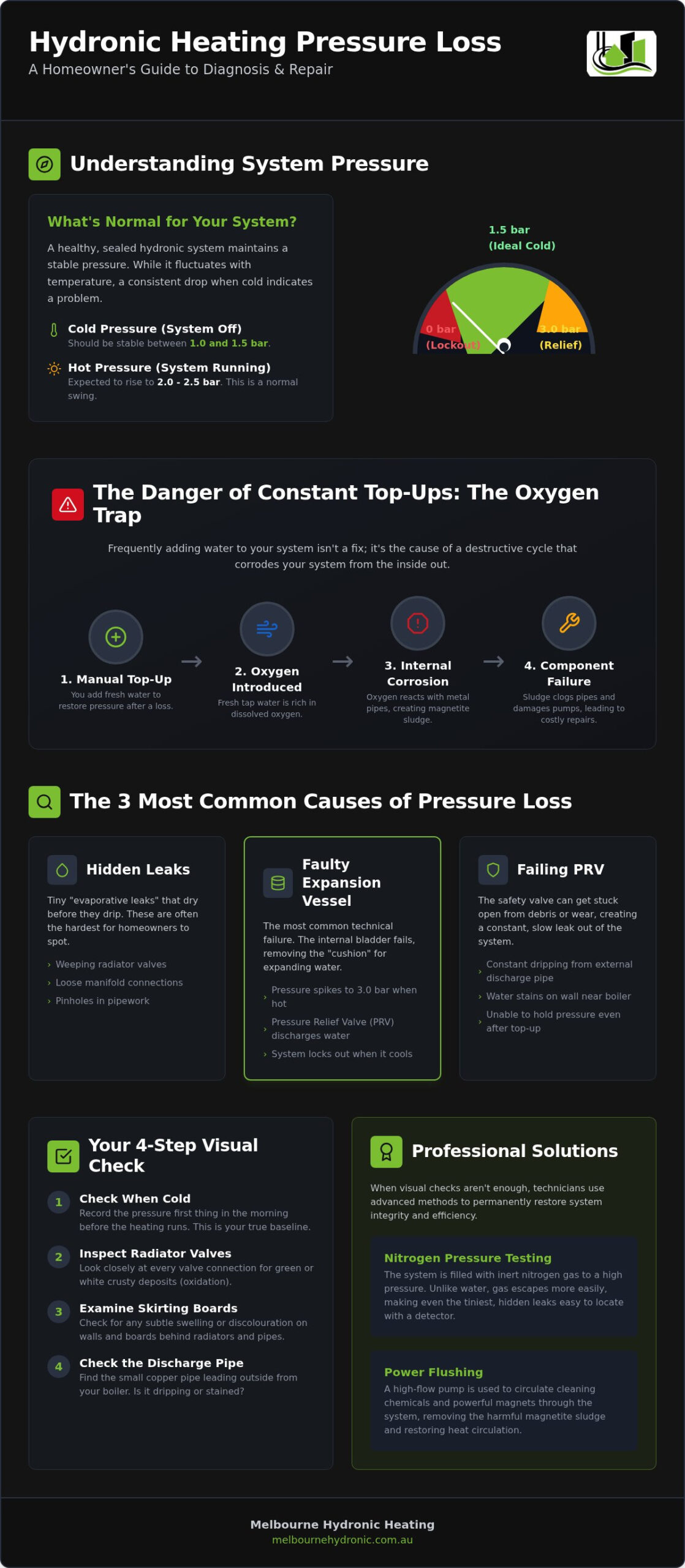
- Recognise that a healthy system should maintain a static cold pressure between 1.0 and 1.5 bar to avoid sudden safety lockouts.
- Identify the common triggers for hydronic heating pressure loss, such as weeping radiator valves or a failing internal expansion vessel bladder.
- Understand the “oxygen trap,” where constant manual top-ups introduce fresh water that leads to internal corrosion and restrictive magnetite sludge.
- Learn a simple step-by-step visual inspection method to locate hidden leaks across your radiators, towel rails, and exposed pipework.
- Discover how professional diagnostics, including nitrogen pressure testing and power flushing, can permanently restore your system’s efficiency and longevity.
Understanding Hydronic Pressure: What is Normal for Melbourne Homes?
Think of your hydronic system as a living circuit. The water inside isn’t just sitting there; it’s being circulated by a precisely calibrated force. In the specialized field of Hydronics, we describe this as the “heartbeat” of your home’s comfort. System pressure is the force required to move water through the entire loop, ensuring heat reaches every corner of your property, from the master bedroom to the living room slab. For the vast majority of Victorian residences, the standard cold pressure range should sit comfortably between 1.0 and 1.5 bar.
It’s vital to understand the “Normal Pressure Swing.” Just as a balloon expands when filled with air, water expands as it heats up. When your boiler or electric heat pump is running, you’ll see the gauge rise, sometimes reaching 2.0 or even 2.5 bar. This is a healthy, expected fluctuation. The real concern is a “Steady Decline.” If your gauge consistently drops below its original starting point after the system cools down, you’re experiencing hydronic heating pressure loss. Unlike a car tyre that might lose a tiny amount of air over a year, a sealed hydronic loop should hold its pressure indefinitely unless a component has failed or a leak has developed.
The Role of the Pressure Gauge
Most Melbourne homes utilize boilers with either a classic analogue needle or a modern digital display. These tools are your first line of defence in system monitoring. You’ll often notice a “Red Zone” on the gauge, usually starting around 3.0 bar. If the pressure climbs this high, the system’s safety relief valve will trigger to discharge water and prevent pipe damage. On the flip side, if the pressure falls into the bottom “Low” zone, the system will trigger a safety lockout. This stops the unit from operating while dry, which protects the internal pump from burning out.
Why Pressure Varies by Building Height
Not every home in Victoria requires the exact same pressure setting. A single-storey unit in Geelong has different requirements than a sprawling double-storey residence in Toorak. This is due to “static head,” which is the vertical distance the water must travel. Gravity works against your system; it takes more force to push water up to a second-floor radiator than it does to circulate it through a ground-floor slab. For taller homes, we often set the filling loop slightly higher to ensure the top-floor panels don’t starve of heat. To get an accurate reading of your system’s health, always check the gauge when the water is completely cold. This provides the true baseline for your home’s unique architectural requirements.
The 3 Most Common Causes of Hydronic Heating Pressure Loss
While a sudden drop in pressure is alarming, it is usually narrowed down to three primary culprits. Identifying the root cause of hydronic heating pressure loss early prevents the internal corrosion that occurs when fresh water is constantly introduced to the loop. Most issues stem from mechanical failure or physical breaches in the sealed circuit that your boiler or heat pump relies on to function correctly.
Identifying Hidden Leaks in Melbourne Installs
Leaks aren’t always obvious puddles on the floor. In Melbourne’s diverse housing stock, we often find “evaporative leaks” at radiator tails or lockshield valves. The water seeps out so slowly that the heat of the pipe evaporates the moisture before it ever hits the carpet. You should look for green or white crusty deposits, known as oxidation, on brass fittings. It’s also wise to check your manifold connections and the skirting boards behind heating panels for any subtle swelling or discolouration. These small “weeps” can collectively cause a significant drop on your gauge over a week.
Testing the Expansion Vessel and PRV
This is the most common technical failure we encounter. The expansion vessel contains a rubber bladder that acts as a cushion for expanding water. If this bladder ruptures or loses its air charge, there is no room for the water to grow as it heats. This causes the pressure to skyrocket when the boiler is hot, often hitting the 3.0 bar limit and triggering the Pressure Relief Valve (PRV). Once the system cools, the pressure crashes back down, leading to a safety lockout. You can spot a faulty PRV by checking the external copper discharge pipe; if it is dripping or shows signs of water stains, the valve is likely stuck open. For a deeper technical dive into these mechanics, Understanding Pressures in Hydronic Heating Systems provides excellent industry context on these critical components.
Another often overlooked cause is air ingress. Paradoxically, trying to fix “cold spots” by bleeding radiators can cause the very pressure drop you are trying to avoid. Every time you release air, you are removing volume from the sealed loop. If you find yourself bleeding radiators monthly, you aren’t just removing air; you are likely managing a system with a vacuum issue or a slow leak. If your gauge continues its downward slide despite your best efforts, it’s time for a professional system maintenance check to pinpoint the exact failure point before it becomes a costly repair.
The Hidden Danger: Why Constant Topping Up Destroys Your System
Every time you open that filling loop to combat hydronic heating pressure loss, you aren’t just adding water. You’re adding a dose of fresh, oxygenated tap water into what should be a “dead” or inert system. In a healthy, sealed loop, the oxygen in the initial fill is quickly used up, leaving the water harmless to the components. By repeatedly topping up to keep the gauge steady, you provide a never-ending supply of fuel for a destructive chemical reaction. This process turns a minor maintenance annoyance into a systemic failure that can cost thousands in avoidable repairs.
When oxygen meets the steel inside your radiators, it creates iron oxide. This isn’t just surface rust; it’s the beginning of a systemic breakdown. Magnetite is the black sludge that results from internal corrosion. This heavy, metallic debris is the single greatest threat to your heating investment in 2026.
The Sludge Cycle and Boiler Longevity
Magnetite acts like liquid sand inside your system. As it circulates, it settles in low-flow areas, particularly the heat exchanger of your boiler or electric heat pump. Modern high-efficiency units are far more sensitive to this debris than the cast-iron boilers of the past. Their narrow waterways can clog easily, leading to localized overheating and “kettling” noises. This sludge significantly increases the resistance within the pipes, forcing your pump to work harder and driving up Melbourne energy bills. Eventually, the pump will seize or the heat exchanger will fail, leading to a total system lockout during the coldest week of the year.
Oxygen Ingress: The Silent Killer
While physical leaks are a major source of fresh water, oxygen can also enter via “non-barrier” piping. Some older installations in Melbourne and Geelong used plastic pipes that lacked an oxygen-diffusion barrier, allowing gas to permeate through the pipe wall over time. Additionally, if the system pressure is too low at the highest point of the house, a vacuum can form. This vacuum can actually suck air in through automatic air vents or radiator seals. This constant ingress accelerates the formation of magnetite, turning your premium heating system into a sludge factory from the inside out.
To break this cycle, simply fixing the leak isn’t enough. You must remove the existing contamination to protect your boiler’s internal components. A professional power flushing service is the most effective way to purge this heavy sludge and restore your system to its original efficiency. This ensures your home stays warm without the risk of a mid-winter breakdown or skyrocketing utility costs.
A Step-by-Step Diagnostic Guide for Homeowners
Before you call for a technician, you can perform a simple home audit to narrow down the source of your hydronic heating pressure loss. This process helps you determine if you’re dealing with a minor valve adjustment or a more serious leak hidden beneath your floorboards. Always start your diagnosis when the system is stone cold. Checking the gauge while the water is hot will give you a false reading due to natural thermal expansion. A healthy baseline for most Melbourne homes is between 1.0 and 1.5 bar on the analogue or digital display.
Begin a slow walk through your property, inspecting every radiator panel and towel rail. Pay close attention to the “tails” where the pipes enter the valves. Because these pipes are often hot, a tiny leak might evaporate before it creates a puddle. Use the “Paper Towel Test” by wrapping a dry piece of kitchen towel around each valve and securing it with a rubber band. Leave it for a few hours. If the paper shows any dampness or yellowing, you’ve found a weep. Finally, step outside and locate the small copper pipe exiting the external wall near your boiler. This is the Pressure Relief Valve (PRV) discharge. If you see a constant drip or a damp patch on the ground beneath it, the valve isn’t sealing correctly.
Diagnostic Differences for Heat Pumps
If you have transitioned to heat pump hydronic heating, your diagnostic process will be slightly more digital. These modern systems often feature advanced controllers that display specific error codes like “Low Flow” or “Pressure Lockout.” In complex installations, you may have a primary loop (near the heat pump) and a distribution loop (feeding the radiators). It’s possible for the heat pump itself to be at the correct pressure while the internal house circuit is failing. Check the digital interface for historical pressure logs to see if the drop happens suddenly or over several days.
When to Stop Topping Up
We recommend a simple “Once is Maintenance, Twice is a Leak” rule. If you top up your system and the pressure remains stable for months, it was likely just a small amount of air escaping. However, if you find yourself opening the filling loop again within 48 hours, you have an active leak. Never leave the filling loop valve partially open in an attempt to “auto-fill” the system. This can easily over-pressurise the circuit, causing the PRV to burst and potentially flooding your utility area. If the gauge won’t stay steady, close the filling loop tightly and book a professional system inspection to prevent oxygen from causing further internal corrosion.
Professional Solutions: Restoring System Stability in Melbourne
When homeowner diagnostics aren’t enough to stop hydronic heating pressure loss, it’s time to deploy professional-grade tools. While a visual check might find a weeping radiator tail, many leaks are truly hidden. Specialists use nitrogen pressure testing to isolate sections of your pipework. Unlike water, nitrogen is a dry gas that doesn’t cause damage if it escapes, yet it’s sensitive enough to reveal even the most microscopic breach in a sealed loop. This method is particularly effective for systems where pipes are buried within the building structure or running through inaccessible ceiling voids.
Restoring your system’s stability often involves more than just plugging a hole. We frequently find that expansion vessels require professional re-gassing. By restoring the correct air cushion with a high-accuracy gauge, we prevent the wild pressure swings that trigger safety valves. If a component like a Pressure Relief Valve (PRV) or an automatic air vent has failed, we replace them with high-specification parts designed for longevity. To break the corrosion cycle permanently, we often recommend installing a magnetic filter. This device acts as a continuous guard, trapping the metallic magnetite debris before it can settle in your boiler’s heat exchanger.
Why Choose Melbourne Hydronic Heating?
With 30+ years of industry experience in Victoria, we understand the unique climate challenges faced by homes in Melbourne and Geelong. Our team doesn’t just guess where a leak might be; we utilize advanced thermal imaging and acoustic detection technology. This is especially critical for maintaining in-slab underfloor heating, where precise location is the difference between a minor repair and a major floor renovation. Every repair and component we install comes with a professional guarantee, giving you the peace of mind that your home’s comfort is in expert hands.
Booking Your System Health Check
A proactive annual service is the most cost-effective way to manage your heating. By identifying a weakening expansion vessel or a tiny manifold weep during a routine check, we prevent the sudden boiler lockouts that occur during a July cold snap. A small investment in maintenance today saves thousands in potential boiler or heat pump replacements later. Our technicians ensure your system is perfectly balanced, clean, and pressurized for the season ahead. Don’t let a minor gauge drop turn into a major repair bill. Contact Melbourne Hydronic Heating for a pressure diagnostic today.
Secure Your Home’s Comfort and System Longevity
Managing your heating system shouldn’t be a source of daily anxiety. While a small drop on the gauge might seem like a minor task to manage; persistent hydronic heating pressure loss is a clear signal that your system needs professional attention. By addressing leaks and expansion issues early, you prevent the destructive “oxygen trap” that creates restrictive magnetite sludge. This proactive approach doesn’t just stop the cycle of constant top-ups; it protects your high-efficiency boiler or heat pump from premature failure and keeps your energy bills under control.
With over 30 years of experience serving Melbourne and Geelong, our team specializes in finding the hidden faults that others miss. Whether you have a modern electric heat pump or a traditional gas boiler, we provide expert leak detection for both in-slab underfloor systems and radiator panels. Don’t wait for a total system lockout to occur during a cold snap. Book a Professional Hydronic Pressure Diagnostic today to restore your system to its peak efficiency. You’ve invested in a premium heating solution; let’s ensure it provides reliable, silent warmth for many years to come.
Frequently Asked Questions
How often should I have to top up my hydronic heating pressure?
In a perfectly sealed system, you should rarely need to top up the pressure. It’s normal to see a slight dip once a year after the summer period, which a technician usually corrects during a routine annual service. However, if you’re topping up monthly or weekly, you’re dealing with active hydronic heating pressure loss. Constant manual intervention is a warning sign that a component has failed or a leak is slowly damaging your property.
Is it dangerous if my boiler pressure is too high?
While modern boilers have multiple safety features to prevent explosions, excessively high pressure is still a serious concern for your home’s infrastructure. If the gauge exceeds 3.0 bar, the Pressure Relief Valve (PRV) will trigger, discharging hot water through an external pipe. This can lead to localized water damage and puts unnecessary strain on your internal seals and heat exchanger. High pressure often indicates a failed expansion vessel that needs professional attention.
Why does my hydronic pressure drop only when the heating is turned on?
This phenomenon usually indicates a failure in the expansion vessel’s internal bladder. When the water heats and expands, there’s no air cushion to absorb the extra volume, causing the pressure to spike and trigger the relief valve. Once the system cools, the loss of that discharged water results in a significant pressure drop. It could also suggest a “thermal leak” where a pipe joint only opens up as the metal expands.
Can a leaking radiator cause my whole system to stop working?
Yes, even a small, persistent weep from a single radiator valve can eventually lead to a total system lockout. Most modern boilers and heat pumps feature a low pressure sensor as a safety mechanism. Once the water level drops below a certain threshold, usually 0.5 bar, the unit will stop firing to protect the internal pump from running dry. Fixing the individual leak is essential to restore the heartbeat of your home’s loop.
What is the “filling loop” and how do I use it safely?
The filling loop is a temporary or permanent pipe connection that links your heating circuit to your main water supply. To use it safely, slowly open the valve while watching the gauge until it reaches the 1.2 to 1.5 bar range, then close it tightly. Never leave this valve open or “cracked” to auto-fill the system. Doing so can over-pressurise the pipes and lead to a major discharge or an unexpected internal flood.
Will a power flush fix my system’s pressure loss problems?
A power flush doesn’t physically plug a leak, but it’s often a necessary part of the restoration process. If your hydronic heating pressure loss has led to constant topping up, your system likely contains heavy magnetite sludge caused by fresh oxygen. This sludge restricts flow and damages pumps. Once the leak is repaired, a power flush clears out this metallic debris, restoring the efficiency and quiet operation your system was designed to provide.
How much pressure should a double-storey home in Melbourne have?
For a double-storey residence in Melbourne or Geelong, we generally recommend a cold starting pressure of approximately 1.5 bar. This slightly higher baseline helps overcome the “static head,” which is the gravity your system must fight to push water to the upstairs radiators. If the pressure is too low, the top-floor panels might stay cold or gurgle with trapped air. Always check this reading when the system is completely cold.
Can I fix a dropping pressure gauge myself or do I need a plumber?
You can safely perform a minor top-up using the filling loop, but persistent pressure issues require a specialist hydronic technician. General plumbers often lack the specific diagnostic tools, like nitrogen testing kits or expansion vessel gauges, needed for these sealed systems. If the pressure drops again within 48 hours of a refill, it’s a mechanical fault or a breach that requires professional intervention to prevent expensive damage to your boiler’s internal components.