
Hydronic Heat Pump Running Costs in Melbourne: 2026 Homeowner Guide
What if your home’s heating system could act like a thermal battery, storing cheap energy during the day to keep you warm all night? As gas prices across Victoria continue their steep climb, many homeowners are rightfully anxious about their winter utility bills. You’ve likely heard that switching to electricity is the future, but understanding hydronic heat pump running costs melbourne can feel like trying to decode a foreign language filled with confusing technical jargon. It’s frustrating to face rising costs when you just want a comfortable, healthy home for your family without the fear of a massive bill arriving in July.
We’ve spent over 30 years designing and installing premium systems across Melbourne and Geelong, so we understand the specific challenges of our local climate. In this 2026 guide, you’ll discover exactly how much it costs to run a modern electric heat pump today. We’ll break down the real world math of replacing an old gas boiler with a high efficiency unit, especially when paired with solar panels. Whether you’re considering radiator panels or underfloor heating, we’ll show you how to achieve a premium level of comfort while significantly lowering your monthly energy expenses.
Key Takeaways
- Understand how Coefficient of Performance (COP) ratings translate to 300-500% efficiency, making electric heat pumps significantly more effective than traditional gas boilers.
- Compare the long-term hydronic heat pump running costs melbourne homeowners face against rising gas tariffs to validate your financial transition.
- Learn how Melbourne’s unique winter humidity and defrost cycles impact system performance and what to look for in a climate-resilient design.
- Master the “Solar Soak” strategy to turn your underfloor heating into a thermal battery, potentially reaching near-zero running costs during peak daylight hours.
- Discover why professional system sizing and pipe insulation are the most critical factors in preventing high electricity bills and unnecessary system wear.
Understanding the Efficiency: What is COP and Why Does it Matter?
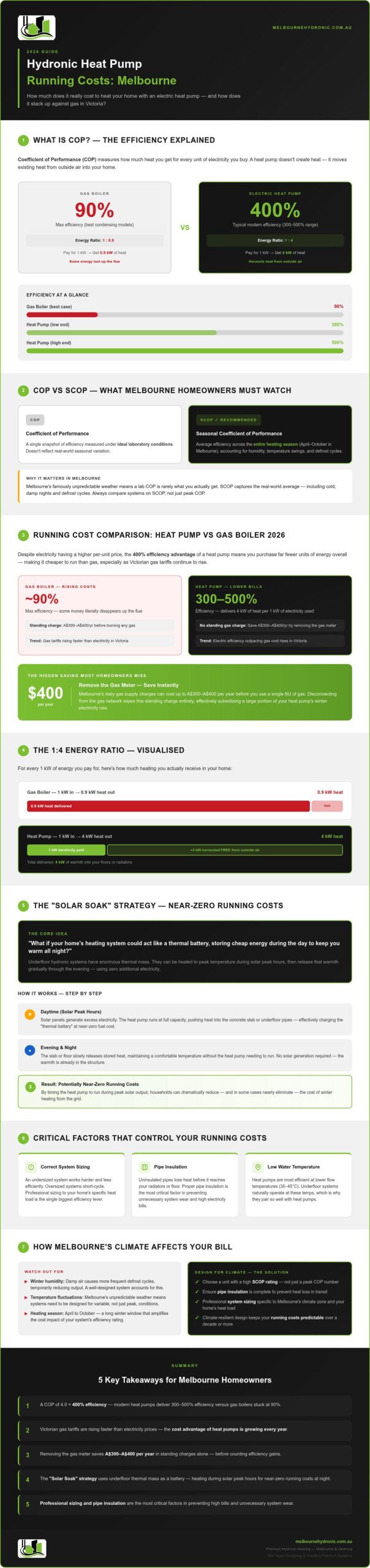
Technical jargon like COP often creates a barrier for homeowners trying to make an informed decision. At its simplest level, the Coefficient of Performance (COP) is a measure of efficiency that tells you exactly how much heat you get for every unit of electricity you buy. COP is the ratio of heat output to energy input. If a system has a COP of 4.0, it means you’re receiving four units of heat for every one unit of electricity consumed. This isn’t magic; it’s physics. While a gas boiler creates heat by burning fuel, a heat pump simply moves existing heat from the outside air into your home.
Traditional gas boilers are limited by the laws of combustion. Even the most advanced condensing models only reach about 90% to 95% efficiency, meaning some of your money literally disappears up the flue. In contrast, modern electric heat pumps operate at 300% to 500% efficiency. By 2026, technology has advanced to the point where these systems maintain high performance even during Melbourne’s coldest nights. This massive efficiency gap is the primary reason why hydronic heat pump running costs melbourne have become so much more attractive than gas alternatives.
The 1:4 Energy Ratio Explained
To visualize the financial benefit, think of your energy use as a ratio. A high-efficiency gas boiler has a 1:0.9 ratio. You pay for 1kW of gas energy and receive roughly 0.9kW of heat. With a modern heat pump, that ratio shifts to 1:4. For every 1kW of electricity the pump draws from the grid or your solar panels, it delivers 4kW of heat into your floor or radiators. This 400% efficiency return drastically reduces the amount of energy you need to purchase to maintain a premium level of comfort throughout the winter months.
Why SCOP is the Metric Melbourne Homeowners Should Watch
A single COP rating is just a snapshot in time, usually measured under perfect laboratory conditions. However, Melbourne’s weather is famously unpredictable. This is why we focus on the Seasonal Coefficient of Performance (SCOP). This metric represents the average efficiency of the system across the entire heating season, from the first autumn chill in April to the final cold snaps in October.
A high SCOP accounts for Melbourne’s variable humidity and temperature fluctuations. When we design a system, we ensure it’s optimized to maintain a high SCOP over the long term. Proper pipe insulation and correct unit sizing prevent the system from overworking, which keeps your hydronic heat pump running costs melbourne predictable and low. Choosing a system based on its seasonal performance, rather than just a peak efficiency number, ensures your investment delivers the financial well-being you expect for a decade or more.
Heat Pump vs. Gas Boiler: Running Cost Comparison in 2026
By 2026, the energy landscape in Victoria has shifted dramatically. Families who once relied on gas as a budget friendly fuel now face consistent tariff hikes as the state moves toward a cleaner, all electric future. When analyzing hydronic heat pump running costs melbourne residents often find that the math has flipped in favor of electricity. While gas is billed in megajoules (MJ) and electricity in kilowatt-hours (kWh), the superior efficiency of a heat pump means you’re buying far fewer units of energy overall. Even with higher per unit electricity prices, the 400% efficiency of a heat pump makes it cheaper to operate than a gas boiler that struggles to hit 90%.
The myth that electric heating is always a luxury expense stems from old fashioned resistive heaters like portable plug in units. A modern hydronic system is a different beast entirely. It doesn’t create heat through high resistance wires; it harvests it from the ambient air. This fundamental difference is why Melbourne homeowners are seeing lower monthly bills after making the switch, especially as gas prices continue to outpace electricity price growth in the Victorian market.
The “All-Electric” Bonus: Removing the Gas Connection
One of the most overlooked financial benefits of switching is the total removal of the gas meter. In Melbourne, daily gas supply charges can add up to A$300 or even A$400 per year before you’ve even turned on a burner. By disconnecting from the gas network, you immediately wipe this standing charge from your household budget. These hidden savings effectively subsidize a large portion of the electricity your heat pump uses during the winter months. It’s a proactive way to simplify your utilities while protecting your wallet from future gas price volatility.
Operational Costs for Radiators vs. Underfloor Systems
The type of heat emitters you choose will influence your daily expenses. Hydronic underfloor heating is exceptionally efficient because it operates at very low flow temperatures, usually around 35°C. This allows the heat pump to work in its most efficient sweet spot. However, you can still achieve excellent results with hydronic heating panels if they are sized correctly for low temperature operation. Modern panels have a larger surface area, which allows them to warm your rooms effectively without requiring the heat pump to work at high, energy draining temperatures. If you’re unsure which setup fits your home, our team can help you design a tailored hydronic solution that maximizes every dollar spent on energy.
How Melbourne’s Climate Influences Your Monthly Bill
Melbourne winters are characterized by a biting, damp cold that differs significantly from the dry winters of inland Australia. With average daytime temperatures usually fluctuating between 5°C and 14°C, your system isn’t just fighting the thermometer; it’s fighting humidity. When we analyze hydronic heat pump running costs melbourne residents need to understand that the “dampness” of our air is just as important as the temperature. High humidity combined with low temperatures creates an environment where frost can form on the outdoor unit’s heat exchanger, which can temporarily impact efficiency if the system isn’t designed for local conditions.
Proper system sizing is the cornerstone of keeping these costs under control. We don’t just design for an “average” July day; we look at Melbourne’s coldest mornings to ensure the unit has enough capacity to maintain comfort without overworking. For our clients in Geelong or coastal suburbs like Brighton, we also account for coastal winds. A unit placed in a wind tunnel or exposed to salt spray will work harder and corrode faster than one positioned in a sheltered, well ventilated spot. Local expertise ensures your unit is placed where it can breathe easily, keeping your long term hydronic heat pump running costs melbourne stable and predictable.
Managing the Defrost Cycle Efficiency Drop
A defrost cycle occurs when the heat pump briefly reverses its operation to melt ice build up on the outdoor coils. In Melbourne’s damp cold, this is a normal part of winter operation. While this process uses a small amount of energy, modern inverter technology manages these cycles with surgical precision. By avoiding “blast” heating and maintaining a steady temperature, the system minimizes the frequency of these cycles. We focus on positioning units away from damp, south facing alcoves where frost lingers, ensuring the sun can assist in keeping the coils clear naturally.
Night-time vs. Daytime Operation in Victoria
Efficiency varies significantly based on when you run your system. A heat pump operating at 12°C during a sunny Melbourne afternoon is far more efficient than one working at 2°C at 3 am. This is why we often recommend “trickle feeding” heat into your home’s thermal mass during the day. If you live in a classic Melbourne brick veneer home, your walls can store this warmth, reducing the need for the pump to work during the freezing overnight hours. Weatherboard homes have less thermal mass, so they require a slightly different strategy to ensure you aren’t “blast heating” in the morning, which is the least efficient way to use a heat pump.
Optimising for Zero-Cost Heating: Solar PV & Off-Peak Strategies
The true power of an electric system lies in its ability to integrate with your home’s energy production. By treating your hydronic underfloor heating as a thermal battery, you can shift your energy consumption to the middle of the day when the sun is brightest. This “Solar Soak” strategy involves running your heat pump between 10 am and 3 pm to pre-heat the concrete slab or the water in your system. Because the thermal mass of a floor slab holds heat for hours, your home stays warm well into the evening without drawing expensive electricity from the grid during peak times. This approach is the most effective way to drive down hydronic heat pump running costs melbourne families face during the winter.
For most Melbourne households, a 6.6kW solar system is the ideal size to support a hydronic heat pump. Working with professional installers like GridFree Solar ensures this capacity provides enough headroom to run the pump comfortably during the day while still powering other household appliances. When you use your own solar power, you’re bypassing the need to buy electricity at retail rates, which are significantly higher than what you’d receive for exporting that same energy back to the grid. It’s about being proactive with your energy rather than just reacting to the bill at the end of the month.
Maximising Solar Self-Consumption
The financial logic is simple but powerful. In Victoria, feed-in tariffs have dropped, making it much more profitable to use your energy than to sell it. Using 1kWh of solar energy to heat your home is worth approximately 3 to 4 times more than the feed-in tariff you’d receive for exporting it. Smart controllers can automate this process, monitoring your solar production and ramping up the heat pump’s output when a surplus is detected. This ensures that every ray of Melbourne sunshine is converted into premium home comfort without any manual intervention.
Smart Thermostats and Time-of-Use Tariffs
If you don’t have solar, or on those particularly overcast Melbourne days, you can still optimize your bill by playing the time of use game. Most Victorian energy retailers now offer tariffs that are significantly cheaper outside the 4 pm to 9 pm peak window. Programming your system to do the heavy lifting during off-peak hours or during specific free power windows offered by some local retailers can lead to substantial savings.
Zoning is another critical tool in your efficiency kit. By only heating the rooms you actually use, such as bedrooms at night or living areas during the day, you can reduce your energy consumption by 20% to 30%. Modern smart thermostats allow you to manage these zones from your phone, giving you total control over your environment. To see how these technologies can work together in your home, request a custom solar-ready heating design from our expert team.
Professional Design: The Secret to Low Running Costs
The efficiency of your system isn’t just about the unit sitting outside. It’s about the engineering behind the scenes. At Melbourne Hydronic Heating, we know that a poorly designed system can easily double your expected hydronic heat pump running costs melbourne. If a unit is oversized, it will cycle on and off too frequently, which wastes energy and wears out the compressor. If it’s undersized, it will struggle to reach your desired temperature during a July frost, running at maximum power for hours. Professional design ensures your system operates in its most efficient sweet spot for the vast majority of the year.
Investing in high quality components and a precise installation might have a higher upfront cost, but the long term ROI is undeniable. Cheap installations often cut corners on pipe insulation or skip the necessary water treatment. Over time, “sludge” build up in the pipes acts as an insulator in the wrong place, forcing your pump to work harder to push heat into your rooms. Clean, well insulated systems maintain their high performance for decades, protecting your household budget from unnecessary spikes.
The Importance of Correct Pipe Sizing and Flow Rates
Heat pumps operate differently than the gas boilers of the past. They require a much higher flow rate to deliver the same amount of warmth because they work at lower water temperatures. This means your home often needs larger diameter piping to move that volume of water without creating excessive friction. Restrictive, narrow pipes act like a bottleneck, forcing the circulation pump to draw more power than it should. Regular hydronic heating service is also vital. It ensures your system remains free of debris and that the flow rates are perfectly balanced to keep your hydronic heat pump running costs melbourne as low as possible.
Why 30+ Years of Melbourne Experience Matters
Melbourne’s building landscape is diverse, from heritage weatherboards in Geelong to modern, high performance homes in the eastern suburbs. Our 30 years of local experience means we understand how Victorian building codes and varying insulation levels impact your specific heating load. As a family owned and operated business, we don’t offer one size fits all solutions. We take the time to calculate the specific heat loss of every room, ensuring your system is a perfect match for your lifestyle and your property’s architecture.
Get a custom efficiency audit and quote from Melbourne Hydronic Heating today.
Take Control of Your Home’s Energy Future
Transitioning from a traditional gas boiler to a modern electric system is a significant step toward long-term financial security and home comfort. We’ve explored how hydronic heat pump running costs melbourne homeowners face can be slashed through smart solar integration and the “thermal battery” effect of underfloor heating. Efficiency isn’t just about the hardware; it’s the result of precise engineering, correct pipe sizing, and a design that respects Victoria’s unique climate. By eliminating gas connection fees and leveraging daytime solar production, you can enjoy a premium living environment without the stress of volatile utility prices.
With over 30 years of industry experience in Victoria, our family-owned and operated team specializes in seamless gas-to-electric transitions. We understand that every home requires a tailored approach to maximize every kilowatt of energy. If you’re ready to see how these savings apply to your specific property, we’re here to help. Request a 2026 Running Cost Estimate for Your Melbourne Home today. You deserve a heating solution that’s as sustainable for your wallet as it is for the environment.
Frequently Asked Questions
Is a hydronic heat pump cheaper than gas in Melbourne in 2026?
Yes, a heat pump is significantly cheaper than gas in 2026. While gas boilers lose energy through combustion, heat pumps deliver four units of heat for every unit of electricity consumed. By disconnecting gas entirely, you also save hundreds in annual supply charges. This shift makes the hydronic heat pump running costs melbourne homeowners pay much more manageable than the volatile pricing of the Victorian gas market.
How much does it cost to run a hydronic heat pump per day?
Daily costs depend on your home’s insulation and size, but the efficiency remains constant. A well designed system using solar power can operate for a fraction of the cost of a gas alternative. Instead of paying for expensive fuel, you’re utilizing high efficiency electricity. Most families find that by shifting their heating schedule to daylight hours, they can significantly reduce their daily spend compared to running a traditional gas boiler.
Can I run my hydronic heat pump entirely on solar panels?
You can certainly power the bulk of your heating with solar during daylight hours. By using your floor slab as a thermal battery, you store solar energy as heat to use after the sun goes down. While Melbourne’s shorter winter days might require some grid support at night, a 6.6kW solar system provides a substantial portion of the energy needed to keep your home comfortable for zero operational cost.
Do heat pumps work effectively when Melbourne temperatures drop below zero?
Modern heat pumps are engineered to operate effectively even when the mercury dips below zero. While efficiency slightly decreases in extreme cold, these systems are common in much colder climates like Northern Europe. They use specialized refrigerants and inverter technology to harvest heat from freezing air. The system might enter a brief defrost cycle to clear ice, but your indoor comfort remains consistent and reliable throughout the night.
How often does a hydronic heat pump need servicing to stay efficient?
We recommend a professional service once every twelve months to maintain peak efficiency. During this visit, we check the refrigerant levels, clean the heat exchanger, and ensure the water quality is free of system damaging sludge. Regular maintenance is the best way to protect your investment and ensure your hydronic heat pump running costs melbourne stay at their theoretical minimum for the life of the system.
What is the best temperature to set my hydronic heat pump to for lowest costs?
For the best balance of comfort and economy, set your internal thermostat between 18°C and 20°C. Every degree higher can increase energy use by about 10%. Additionally, keeping your water flow temperature as low as possible, typically around 35°C for floors or 45°C for radiators, allows the heat pump to operate at its highest Coefficient of Performance. This low and slow approach is much cheaper than blast heating.
Are there Victorian government rebates for switching from gas to heat pump hydronics?
Yes, the Victorian government provides incentives through the Victorian Energy Upgrades (VEU) program for households transitioning away from gas. These rebates are designed to reduce the upfront cost of high efficiency electric upgrades. The exact amount varies based on the system you’re replacing and the efficiency of the new unit. It’s a great way to accelerate your return on investment while supporting the state’s transition to a cleaner energy grid, a goal shared by international specialists like Carbon Saving Group who provide similar energy-efficient transformations for residential and commercial properties.
How noisy are the outdoor units for modern hydronic heat pumps?
Modern outdoor units are remarkably quiet, typically producing about 45 to 55 decibels. This is roughly the same volume as a quiet conversation or a modern kitchen dishwasher. When we design your system, we carefully select a location that minimizes any sound transfer to your bedrooms or your neighbor’s property. Proper mounting on vibration dampening pads further ensures that the system operates discreetly in the background of your daily life.