
Cost of Running Hydronic Heating in Winter: Melbourne 2026 Guide
What if your winter heating bill dropped by thousands of dollars while your home stayed warmer than ever? With Victorian gas prices rising by 5% this year, many families are feeling the chill in their bank accounts before the frost even hits the ground. Understanding the cost of running hydronic heating in winter Melbourne is now a priority for homeowners who want to escape the cycle of rising utility costs. While traditional systems often struggle to heat large period homes evenly, the latest technical advances are proving that luxury comfort doesn’t have to come with a premium price tag.
We know how frustrating it is to balance a warm house with the reality of soaring energy rates and the health concerns of dusty ducted air. You shouldn’t have to choose between your budget and your family’s well-being. This guide reveals exactly how to lower your monthly bills by leveraging modern electric heat pumps and the 5% decrease in the Victorian Default Offer. We’ll walk you through the current rebates available in 2026, compare running costs across different fuel sources, and show you how to transform your living space into a consistent, allergy-friendly sanctuary.
Key Takeaways
- Understand why radiant heat is the superior choice for Melbourne’s damp winters compared to traditional forced-air systems.
- Learn how modern electric heat pumps achieve a 400% efficiency rate, significantly reducing your reliance on volatile gas prices.
- Discover the real-world cost of running hydronic heating in winter Melbourne through detailed scenarios for both heritage terraces and modern family homes.
- Identify how professional maintenance and power flushing prevent “magnetite” buildup from inflating your energy consumption.
- Explore how a custom-engineered system provides a better return on investment and a healthier, allergy-friendly living environment.
The Economics of Comfort: Why Hydronic Heating Wins in Melbourne
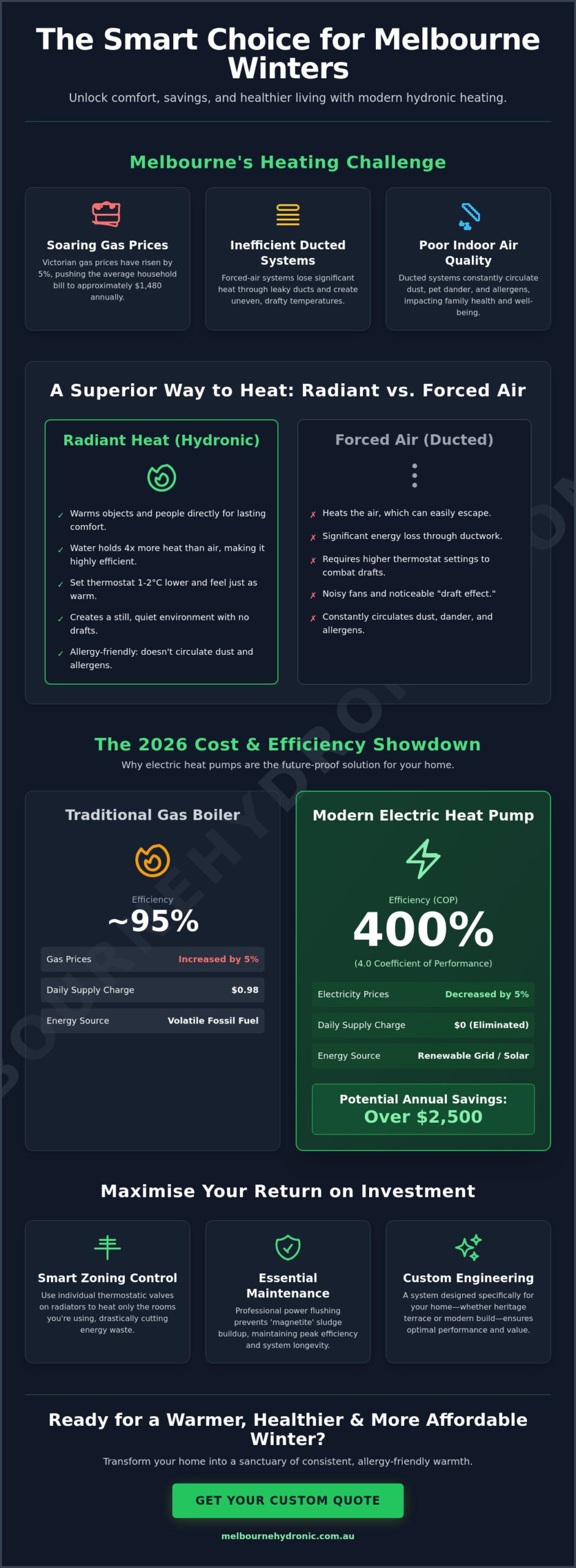
Melbourne winters are notoriously fickle. One moment it’s clear and biting, the next it’s damp and bone-chilling. To understand the cost of running hydronic heating in winter Melbourne, you first have to understand the physics of how water carries heat. Unlike traditional ducted systems that push dry, heated air through vents, a hydronic system uses water as its energy carrier. This technical foundation, or how hydronic heating works, relies on the high thermal mass of water. Water can hold about four times more heat than air per unit of mass. This means your system moves energy through the house with far less effort and waste than a fan-forced alternative.
For Melbourne families, there’s a hidden “Health Dividend” that rarely shows up on a standard utility graph. Traditional ducted heating is a major contributor to poor indoor air quality. It circulates dust, pet dander, and allergens throughout every room. In a city where asthma rates are a genuine concern, switching to radiant heat offers a cleaner environment. Because hydronic radiator panels or underfloor systems don’t rely on fans, the air stays still and the dust stays settled. This creates a premium living experience that prioritises well-being alongside warmth.
Radiant Heat vs. Forced Air: A Cost Comparison
Ducted systems are prone to significant energy leaks. Heat often escapes through unsealed ceiling vents or poorly insulated ductwork before it ever reaches your living room. In contrast, hydronic heating delivers radiant warmth directly to the objects and people in the room. This is much more efficient. You’ll likely find that you can set your thermostat 1 to 2 degrees lower than you would with a ducted system while feeling exactly as warm. Those few degrees make a substantial difference in your monthly energy consumption. Additionally, the lack of air movement means you won’t deal with the “draft effect” that often makes forced-air homes feel colder than the thermostat suggests.
Melbourne Winter Climate Factors
Our local climate is high in humidity during the colder months. Damp air can make a house feel much colder than the actual temperature reading. Radiant heat is particularly effective here because it warms the structure of the home itself. In Melbourne’s iconic double-brick or weatherboard homes, this helps manage “thermal lag,” where the building’s bones stay cold long after the heater is turned on. Zoning is your secret weapon for efficiency. By using hydronic radiator panels with individual thermostatic valves, you only heat the rooms you’re actually using. You aren’t paying to keep a guest bedroom or a formal dining room at 21 degrees all night, which is where the true savings are found.
Gas Boilers vs. Electric Heat Pumps: 2026 Running Costs
The energy landscape in Victoria is undergoing a significant transformation. As of June 2026, the average household gas bill has climbed by 5%, reaching approximately $1,480 annually. In contrast, the Victorian Default Offer for electricity decreased by 5% on July 1, 2026. This divergence is a critical factor when calculating the cost of running hydronic heating in winter Melbourne. Choosing between a traditional boiler and a modern heat pump isn’t just about the initial price; it’s about future-proofing your home against volatile fossil fuel tariffs.
Modern systems rely on a concept called the Coefficient of Performance (COP). While a high-efficiency gas boiler might reach 95% efficiency, an air-to-water heat pump operates with a COP of 3.5 to 4.0. This means for every 1 kW of electricity consumed, the system produces 3.5 to 4.0 kW of heat. You’re essentially harvesting free energy from the ambient air, even when the outside temperature is low. This technical leap allows homeowners to bypass the 2.95 c/MJ gas usage rates that continue to rise across the state.
The Rise of the Electric Heat Pump in Victoria
The performance of electric heat pumps has advanced significantly. They no longer struggle on those frosty 2-degree Melbourne mornings. By eliminating the $0.98 daily gas supply charge and switching to electricity, many homeowners are seeing their annual energy costs drop by over $2,500. This is especially true when the system is paired with solar PV, allowing you to run your heating during peak daylight hours for almost zero cost. According to official government running cost data, the long-term savings of electrification are becoming undeniable.
Government incentives are also accelerating this shift. The Solar Victoria Hot Water Rebate currently offers up to $1,000 for eligible heat pumps, but you need to act fast. From July 1, 2026, the combined household income threshold for this rebate drops from $210,000 to $150,000. Stacking these rebates with Victorian Energy Upgrades (VEU) discounts can significantly lower the barrier to entry for a premium electric system.
Gas Boilers: Still a Contender?
Despite the push toward electricity, choosing the best hydronic boiler is still a valid consideration for specific Melbourne renovations. If your home has a restricted electrical switchboard or existing high-quality gas infrastructure, a condensing boiler remains a powerful option. These units are far superior to older models, capturing heat from exhaust gases that would otherwise be wasted. However, keep the Victorian transition timeline in mind. From March 1, 2027, mandatory regulations will require end-of-life gas systems to be replaced with electric alternatives. If your current boiler is nearing its tenth year, now is the time to plan your transition strategy.
We can help you navigate these technical choices to ensure your home remains a haven of efficiency. Our team is ready to provide a detailed assessment of your current system to see which path offers the best return on investment for your specific property.
Calculating Your Monthly Bill: Melbourne Home Scenarios
The total cost of running hydronic heating in winter Melbourne depends heavily on your home’s unique footprint and architectural style. While general estimates exist, the way you use your system in a drafty Victorian terrace differs wildly from a 6-star rated modern build. To get an accurate picture, you need to look at the thermal performance of your property. According to the Australian Government guide to heating options, insulation quality can swing your energy consumption by up to 40%. This makes your home’s “envelope” just as important as the heat source itself.
Consider two common Melbourne scenarios. Scenario A is a classic 2-bedroom Victorian terrace with high ceilings and original timber floors. Because these homes often lack wall insulation, radiator panels are the ideal choice. They provide quick, intense heat that combats the “chill factor” of older materials. Scenario B is a modern 4-bedroom family home featuring open-plan living and a concrete slab. Here, underfloor systems excel by using the slab as a massive thermal battery. While the modern home might be twice the size, its superior insulation often results in a monthly bill similar to the much smaller, older terrace.
Radiator Panels vs. Underfloor Costs
The type of emitter you choose changes your daily running costs. For example, hydronic heating panels are exceptionally responsive. They heat up in minutes, making them perfect for bedrooms or home offices that you only use for specific parts of the day. You aren’t paying to heat a room three hours before you walk into it. In contrast, underfloor heating requires a longer “warm-up” period, sometimes several hours, but it operates at lower water temperatures. This makes it incredibly efficient for large, high-traffic areas where you want a consistent, gentle heat throughout the day and night.
The Impact of Thermostats and Smart Zoning
Zoning is the single most effective way to slash the cost of running hydronic heating in winter Melbourne. Many homeowners make the mistake of heating the entire house to 21 degrees, including guest rooms and storage areas. By using smart thermostats and individual radiator valves, you can create a custom heating schedule. Dropping the temperature in unused zones can reduce your monthly bill by 15% to 20%. It’s about active management. Instead of a “set and forget” approach that wastes energy in empty spaces, modern smart systems ensure you only pay for the comfort you’re actually enjoying. This level of control is what transforms a premium heating system into a truly economical investment.
Maintenance: The Hidden Factor in Running Costs
Many homeowners focus solely on fuel prices, but the internal health of your system is what dictates the actual cost of running hydronic heating in winter Melbourne. Over time, a black, muddy substance known as magnetite, or system sludge, can build up inside your pipes and radiators. This sludge acts as a layer of insulation in the worst possible place. It prevents heat from transferring efficiently from the water to the radiator surface. This forces your boiler or heat pump to run for longer cycles just to reach your desired temperature, quietly inflating your energy bills month after month.
Beyond the immediate impact on your wallet, annual maintenance is essential for protecting your investment. Most manufacturers require documented servicing to keep your warranty valid. A professional hydronic heating service in Melbourne pays for itself by ensuring every component is tuned for peak performance. If you notice cold spots at the bottom of your radiators or hear a rhythmic humming from your pump, your system is likely struggling against internal resistance. These aren’t just minor annoyances; they are clear indicators that your system is wasting energy. You can ensure your system operates at peak efficiency by booking a comprehensive system health check before the peak of winter arrives.
What is Power Flushing and Why Does it Save Money?
When sludge buildup becomes severe, a standard service might not be enough. This is where power flushing becomes necessary. Power flushing is a deep-clean that restores heat transfer efficiency to factory levels. By using high-velocity water and specialised chemicals to purge debris, we remove years of accumulated magnetite. This process significantly reduces the strain on your pump and heat source. Industry professionals report that a well-maintained system can easily last 20 to 25 years, whereas a neglected one often suffers from premature component failure within a decade.
The Annual Service Checklist for 2026
Our technical team follows a rigorous process to ensure your system remains economical. We test the concentration of chemical inhibitors, which are vital for preventing internal corrosion and future sludge formation. We also verify pump speeds and expansion tank pressures to ensure the system isn’t under unnecessary stress. Professional maintenance is a proactive cost-saving measure that preserves the premium life-quality you expect from hydronic heating. It ensures your home stays warm without the hidden penalty of a degraded system. This methodical approach gives you the peace of mind that your comfort is built on a foundation of engineering precision.
Maximising ROI with Melbourne Hydronic Heating
Investing in a premium system is only the first step toward home comfort. To truly control the cost of running hydronic heating in winter Melbourne, the system must be engineered for your specific floor plan and lifestyle. Our 30-year history in the region means we’ve seen every architectural challenge Melbourne and Geelong have to offer, from drafty heritage weatherboards to sprawling modern glass-fronted estates. We’ve learned that “off-the-shelf” solutions almost always lead to higher running costs because they aren’t calibrated for the unique thermal demands of our local climate.
A custom-designed system ensures that every component works in harmony. When a system is under-designed, the heat source works twice as hard to reach the set temperature. When it’s over-designed, you’re paying for energy you don’t need. By tailoring the layout to your home’s specific insulation levels and orientation, we ensure your investment delivers the maximum possible return through lower monthly bills and a significantly longer system lifespan. This precision is what separates a standard heater from a high-performance hydronic environment.
Expert Design for Long-Term Savings
Technical details like pipe sizing and pump selection are where the real savings are found. If pipes are too narrow, the pump must work at a higher electrical draw to move water through the system. Our engineers calculate the exact flow rates required to keep your home warm while minimising electricity consumption. We prioritise high-efficiency emitters like hydronic radiator panels and hydronic trench heating, which provide rapid heat transfer and allow for precise zoning. Our clients frequently report that these custom-engineered systems feel warmer at lower thermostat settings, resulting in real-world bill reductions that generic systems simply can’t match.
Don’t forget the “Health Dividend” mentioned earlier in this guide. While it’s hard to put a price on a night of uninterrupted sleep for an asthma sufferer, the reduction in dust-related cleaning and healthcare needs adds another layer to your return on investment. A clean, radiant system is a choice for long-term well-being.
Next Steps for Your Melbourne Home
If you’re ready to escape the cycle of rising gas prices and inefficient heating, a professional audit is your best starting point. We can assess your current infrastructure and provide a roadmap for a transition to modern heat pump technology. This includes checking your electrical capacity and identifying the best locations for new radiator panels or underfloor zones. Taking these steps now ensures your home is ready for the 2027 gas transition while providing immediate relief from high winter bills. You can request a professional hydronic heating quote today to begin your journey toward a more efficient, comfortable home.
Future-Proofing Your Home Comfort for 2026 and Beyond
Transitioning to a more efficient home starts with understanding the data. We’ve explored how the shift toward electric heat pumps and proactive maintenance can dramatically lower the cost of running hydronic heating in winter Melbourne. By moving away from rising gas tariffs and investing in a system designed for your home’s unique thermal profile, you’re choosing a lifestyle of superior air quality and consistent, radiant warmth. These choices don’t just lower bills; they improve your daily quality of life and the long-term value of your property.
As a family-owned and operated Victorian business with over 30 years of Melbourne experience, we specialise in high-efficiency electric heat pumps tailored to our local climate. We believe that technical precision and premium comfort should always go hand in hand. Whether you’re retrofitting a heritage terrace or planning a modern build, the right engineering makes a significant difference to your monthly energy consumption. You can take the first step toward a more sustainable and healthy home today.
Get a Tailored Running Cost Estimate for Your Melbourne Home
You deserve a living environment that’s as healthy as it is warm. We look forward to helping you create a sanctuary that serves your family for decades to come.
Frequently Asked Questions
Is hydronic heating more expensive to run than split systems?
While split systems are often cheaper to install, hydronic heating provides a superior quality of warmth that split systems can’t match. Split systems heat the air, which quickly rises to the ceiling and escapes through gaps. Hydronic systems provide radiant heat that stays at the floor level where you actually live. This means you don’t need to set the thermostat as high to feel comfortable, which helps balance the total energy consumption over a long Melbourne winter.
How much does it cost to run hydronic heating per hour in Melbourne?
Hourly costs vary based on your home’s size and the efficiency of your heat source. For a gas boiler, you’re looking at usage rates around 2.95 c/MJ plus the daily supply charge. If you’ve switched to a heat pump, your hourly cost is tied to your electricity tariff, which recently saw a 5% decrease in the Victorian Default Offer. The most accurate way to determine the cost of running hydronic heating in winter Melbourne is to look at your total seasonal usage rather than hourly snapshots.
Does hydronic heating use a lot of electricity?
A traditional gas-fired system uses very little electricity, as power is only needed for the small circulator pump and the boiler’s internal controls. Modern electric heat pumps use more electricity because they are the primary heat source. However, they are incredibly efficient. Because they produce up to 4kW of heat for every 1kW of power consumed, they remain one of the most economical ways to heat a large family home without relying on fossil fuels.
Can I run my hydronic system on solar power to save money?
Yes, electric heat pumps are perfectly suited for solar PV integration. By running your system during the day when your panels are producing peak energy, you can “pre-heat” your home for free. This thermal energy is stored in your furniture, walls, and floors, keeping the house warm well into the evening. This strategy significantly reduces your reliance on the grid and slashes your winter energy bills.
How often should I service my system to keep running costs low?
You should book a professional service at least once every 12 months. Regular maintenance ensures that the water chemistry is correct and that no air is trapped in the system. Small issues like a slightly blocked pump or low inhibitor levels can quietly increase your energy usage. A yearly check-up keeps the system running at factory-level efficiency and prevents the buildup of magnetite sludge that forces your heater to work harder.
What happens to running costs if I switch from gas to a heat pump?
Switching to a heat pump typically leads to a major reduction in your annual energy spend. By removing your gas connection, you eliminate the $0.98 daily supply charge and move to a more efficient fuel source. Homeowners who make this switch often see their annual costs drop by thousands of dollars, especially as Victorian gas prices continue to rise while electricity price caps are trending downward.
Is underfloor hydronic heating more expensive to run than radiators?
Underfloor heating is generally more efficient for large, open-plan areas because it operates at lower water temperatures. Radiators are more responsive and better for rooms that you only use occasionally, such as guest bedrooms or home offices. The most cost-effective approach is often a hybrid system that uses the right emitter for each specific zone, ensuring you aren’t wasting energy in empty spaces.
Do I need to leave hydronic heating on all day in winter?
If you have an underfloor slab system, it’s more efficient to leave it on at a steady, lower temperature throughout the day. Reheating a cold concrete slab from scratch uses a massive amount of energy. For radiator-based systems, you can use smart zoning to turn the heat off when you aren’t home. This flexibility allows you to customise your usage and keep the cost of running hydronic heating in winter Melbourne as low as possible.