
Gas Boiler to Heat Pump Conversion in Camberwell: The 2026 Electrification Guide
Can your classic Camberwell home truly stay warm during a Victorian winter without the roar of a gas boiler? If you’re considering a gas boiler to heat pump conversion Camberwell experts will tell you that the biggest hurdle isn’t the technology, it’s the myth that electric systems can’t handle traditional radiators. You’ve likely noticed your gas bills climbing while your aging boiler becomes noisier and less reliable. It’s natural to feel uncertain about the 2027 Victorian mandate requiring electric replacements for end-of-life hot water systems, especially when you want to preserve the character of a heritage property.
We’re here to show you that transitioning to an energy-efficient electric heat pump is a bespoke engineering project that maintains your comfort without ripping out your beloved hydronic panels. You’ll discover how to access up to $5,530 in VEU rebates and achieve a carbon-neutral home that costs significantly less to run. This guide previews the 2026 electrification landscape, explaining how modern air-to-water systems deliver silent, consistent warmth while integrating perfectly with your existing home infrastructure.
Key Takeaways
- Learn how to evaluate your existing radiator panels to ensure they provide consistent warmth when switching to lower-temperature heat pump technology.
- Discover the step-by-step engineering requirements for a successful gas boiler to heat pump conversion Camberwell homeowners need to ensure system longevity.
- Understand the 2026 financial landscape, including how to stack Victorian Energy Upgrades (VEU) rebates to reduce your upfront transition costs.
- Identify the critical role of heat load calculations and switchboard assessments in creating a silent, carbon-neutral heating solution.
- Realize the long-term benefits of moving to a premium electric system that preserves your home’s heritage aesthetics while slashing annual energy bills.
The Shift to Electric Hydronic Heating in Camberwell
Camberwell is famous for its leafy streets and stately period homes, but many of these properties still rely on aging gas infrastructure that’s rapidly becoming a financial liability. A gas boiler to heat pump conversion Camberwell project is more than just a simple equipment swap; it’s a strategic upgrade to your home’s core comfort system. This process involves decommissioning your existing gas-fired boiler and integrating a high-efficiency electric air-to-water unit. By doing so, you transition from a fossil-fuel-dependent system to one that can be powered entirely by renewable energy, aligning perfectly with Victoria’s 2026 Gas Substitution Roadmap.
Beyond the policy shifts, moving away from methane gas offers significant health and safety benefits for your family. Gas combustion inside the home carries inherent risks and contributes to indoor air quality issues, whereas electric hydronics provide a cleaner, safer alternative. For residents in the Boroondara area, this shift isn’t just about following government mandates. It’s about future-proofing property value. As Victoria moves toward its 2027 requirement for electric hot water replacements, all-electric homes are increasingly seen as the gold standard for premium real estate in Melbourne’s inner east.
Why Gas Boilers are Becoming Obsolete
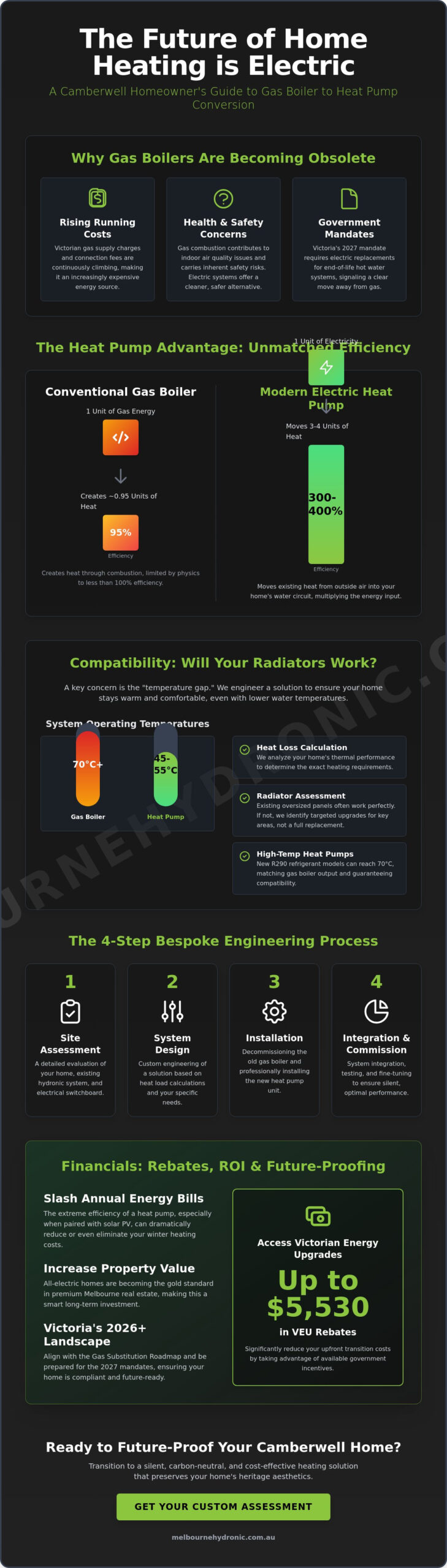
Traditional heating is facing a perfect storm of rising costs and regulatory pressure. Supply charges and gas connection fees in Victoria continue to climb, making the fixed cost of staying on the gas grid harder to justify for many households. Even the most advanced condensing gas boilers are limited by the laws of physics, rarely exceeding 95% efficiency. In contrast, modern electric alternatives offer a path to a carbon-neutral lifestyle. The push for all-electric luxury homes is no longer a trend; it’s a practical response to a changing energy market where gas is no longer the most economical choice for Melbourne homeowners.
The Heat Pump Advantage for Hydronics
The core reason for this transition lies in pure efficiency. While a gas boiler creates heat through combustion, how heat pumps work is by moving existing thermal energy from the outside air into your home’s water circuit. This allows heat pump hydronic heating systems to achieve efficiencies between 300% and 400%. For every unit of electricity used, you get three to four units of heat. When you pair this with a solar PV system, your running costs can drop toward zero. This combination of technical precision and environmental stewardship makes a gas boiler to heat pump conversion Camberwell homeowners can trust for decades of reliable, silent warmth.
Compatibility Check: Existing Radiators vs. New Heat Pumps
One of the most common questions we hear regarding a gas boiler to heat pump conversion Camberwell homeowners are planning is whether their existing radiators will still work. Traditional gas boilers are designed to run at high temperatures, often pushing water through your pipes at 70°C or higher. Standard heat pumps typically operate between 45°C and 55°C. This 20 degree difference is what engineers call the “temperature gap.” In a drafty house, this lower temperature might result in a chilly room, but Camberwell’s heritage brick homes often have high thermal mass. This mass helps maintain a steady internal climate once the system reaches its set point. We analyze your home’s heat loss to see if your current radiators can bridge this gap or if they need a technical boost.
Evaluating your existing panels for low temperature performance is a critical part of the engineering phase. If your home was originally fitted with oversized radiators, you might find they work perfectly with a modern heat pump. However, if the panels were sized strictly for 70°C water, they may lack the surface area required to heat the room at 50°C. In these cases, we don’t necessarily need to replace everything. Sometimes, upgrading just one or two key panels in the largest living areas is enough to maintain total comfort throughout the Victorian winter.
High-Temperature vs. Low-Temperature Heat Pumps
Technological leaps in 2026 have introduced high temperature heat pumps using R290 refrigerant, also known as propane. These units can reach 70°C, matching the output of a gas boiler and allowing you to keep your existing hydronic heating panels without any modifications. Choosing the right unit for a gas boiler to heat pump conversion Camberwell depends heavily on your home’s architectural style. While R290 units are excellent for heritage homes, a low temperature system paired with larger panels can often be even more efficient if you have the wall space to accommodate them.
System Balancing and Flow Rates
Unlike gas boilers that rely on high heat and lower water volume, heat pumps require significantly higher flow rates to move energy efficiently. This often necessitates the installation of a buffer tank. Think of this tank as a thermal battery that prevents the heat pump from “short cycling,” which occurs when the unit turns on and off too frequently. Short cycling can wear out the compressor and reduce the system’s overall lifespan. A precise system balance ensures every room stays warm by managing the resistance in your pipework and ensuring the heat is distributed exactly where it is needed most. If you are unsure about your current setup, you can consult with a local hydronic specialist to determine the best path forward for your specific layout.
The Conversion Process: Stepping from Gas to Electric
Executing a successful gas boiler to heat pump conversion Camberwell project requires a methodical sequence that prioritizes engineering over simple plumbing. We don’t just swap one box for another; we recalibrate your entire home’s thermal delivery. The process begins with a comprehensive heat load calculation. This involves a room by room analysis of your Camberwell property, accounting for ceiling heights, window orientations, and insulation levels. This data ensures the new heat pump is sized perfectly to maintain comfort even during a July cold snap without wasting energy through over-specification.
Once the engineering blueprint is ready, we move to the physical transition. This includes several critical steps:
- Electrical Assessment: We evaluate your existing switchboard to ensure it can handle the load of a powerful compressor.
- Gas Decommissioning: Safe removal of the old boiler and professional capping of gas lines. We also assist with the meter abolishment process if you’re aiming for a completely gas-free home.
- Outdoor Unit Placement: Identifying a location that maximizes airflow while remaining visually discreet. In the quiet streets of Camberwell, acoustic considerations are paramount to ensure your system doesn’t disturb the neighbors.
- System Commissioning: Filling the system, purging air, and calibrating the smart controller to manage flow rates and temperatures automatically.
Managing the Electrical Upgrade
Many larger heritage homes in the area require significant heating capacity, which may raise the question of whether you need 3-phase power. While many modern heat pumps run efficiently on single-phase, high-capacity systems often perform better on a 3-phase supply. We also focus on integrating your heating with existing solar PV systems. By setting your heat pump to “buffer” heat during peak daylight hours, you effectively turn your hydronic system into a thermal battery. This maximizes your self-consumption of solar energy and slashes your reliance on the grid.
Heritage and Aesthetic Considerations
Preserving the visual integrity of a Camberwell Edwardian or Victorian home is a non-negotiable part of our process. We specialize in discreetly placing outdoor units behind screens or in side-passages where they remain out of sight. For those undertaking a larger renovation, we often integrate underfloor heating in new extensions while retaining classic radiator panels in the original front rooms. If you have large open-plan areas with floor-to-ceiling glass, we can supplement the system with trench heating or fan coils to provide a curtain of warmth without obscuring your garden views.
Financials: ROI, Rebates, and Running Costs in 2026
Investing in a gas boiler to heat pump conversion Camberwell residents prioritize often feels like a significant upfront commitment, but the 2026 financial landscape has shifted the ROI firmly in favor of electrification. Data from Sustainability Victoria shows that households can save up to 72% annually on heating costs by moving away from gas. For a typical three bedroom home in Melbourne’s inner east, running a gas hydronic system through winter costs between $480 and $680. In contrast, a modern heat pump system costs only $260 to $420 for the same period. These savings are amplified when you leverage off-peak tariffs or utilize smart thermostats to pre-heat your home during the day when solar generation is at its peak.
Beyond immediate bill relief, an all-electric home carries a premium in the Camberwell real estate market. As gas connection bans for new homes take effect and the 2027 mandate for electric hot water replacements approaches, properties with existing heat pump infrastructure are viewed as future-proofed assets. Buyers are increasingly wary of aging gas boilers that will eventually require mandatory replacement. This makes your conversion a savvy long-term investment in property equity that pays dividends in both comfort and resale value.
Navigating Victorian Government Rebates
The Victorian Energy Upgrades (VEU) program remains a powerful tool for reducing capital expenditure. Households can receive a discount of up to $5,530 when replacing inefficient gas systems with high-efficiency electric alternatives. Additionally, the Solar Victoria hot water rebate offers up to $1,000 for owner-occupiers with a combined household income under $210,000 and a property value below $3 million. Our team handles the complex rebate paperwork to ensure you receive every cent of the upfront discounts you’re entitled to under current 2026 regulations.
Long-term Maintenance and Reliability
Electric heat pumps are engineered for longevity, often outlasting traditional gas boilers due to the absence of high-temperature combustion stresses. While gas boilers require frequent safety checks for carbon monoxide and burner integrity, heat pumps operate on a more stable refrigeration cycle. Regular hydronic heating service in Melbourne is still essential to maintain system pressure and check glycol levels, but the overall maintenance burden is lower. Most premium European brands now offer extended warranties that provide peace of mind for decades. If you are ready to calculate your specific savings and start your transition, reach out to our specialist consultants today.
Why Melbourne Hydronic Heating for Your Camberwell Conversion?
Choosing the right partner for your gas boiler to heat pump conversion Camberwell project is the most critical decision in your electrification journey. Melbourne Hydronic Heating brings over 30 years of specialist experience to Melbourne’s inner suburbs, focusing specifically on the complex engineering required for premium residential systems. We don’t view a heat pump as a standalone appliance. Instead, we treat it as the heart of a sophisticated thermal network. Our team manages every aspect of the project, from the initial hydraulic design and electrical switchboard upgrades to the final commissioning of your smart controllers. This full-service approach ensures that your transition to electric heating is technically precise and entirely stress-free.
Our deep understanding of what is hydronic heating allows us to solve the unique challenges posed by Camberwell’s varied housing stock. Whether you live in a high-ceilinged Edwardian or a modern architectural masterpiece, we calculate the exact flow rates and water temperatures needed to maintain comfort. We pride ourselves on being consultants rather than just installers. We take the time to explain how your new system will interact with your home’s thermal mass, ensuring you get the silent, consistent warmth that defines a luxury hydronic experience.
Our Local Track Record
We’ve built a reputation across Camberwell and Hawthorn for successful gas-to-electric conversions that respect the character of heritage homes. Our engineers specialize in aesthetic integration, finding discreet locations for outdoor units that satisfy both heritage requirements and acoustic standards. We understand that our clients value peace and quiet, so we only specify premium European heat pumps known for their whisper-silent operation. As a family-owned, specialist contractor, we offer a level of accountability and local pride that larger, generalist firms can’t replicate. When you work with us, you’re trusting your home’s comfort to local experts who know exactly how to handle the Victorian climate.
Start Your Electrification Journey
Ready to take the first step toward a carbon-neutral home? Booking a professional consultation is the best way to understand the specific requirements for your gas boiler to heat pump conversion Camberwell. During our first home assessment, we’ll evaluate your existing radiator panels, check your electrical capacity, and identify the most efficient placement for your new heat pump. To make the most of this visit, it’s helpful to have your recent energy bills and any available floor plans on hand. Our goal is to provide you with a clear, data-driven roadmap for your upgrade. You can get a tailored quote for your Camberwell conversion today and join the growing number of Melbourne families enjoying a cleaner, more efficient way to stay warm.
Future-Proof Your Camberwell Home Today
Transitioning your home from gas to electric is a defining step toward a sustainable future. We’ve explored how air-to-water heat pumps preserve the warmth of your existing radiators while providing a cleaner, carbon-neutral solution. By integrating these systems now, you avoid the rush of the 2027 mandates while instantly reducing your annual running costs. A successful gas boiler to heat pump conversion Camberwell project ensures your property remains a premium, comfortable asset in a changing energy market.
At Melbourne Hydronic Heating, our team brings decades of technical precision to every installation. Our specialist engineers handle the entire process from hydraulic design to switchboard upgrades, ensuring your system operates at peak efficiency. As a VEU accredited partner, we streamline the rebate process to make your transition as smooth as possible. We pride ourselves on delivering a premium life experience through silent, reliable warmth that respects the heritage character of your home.
Ready to start? Book Your Camberwell Gas-to-Electric Consultation Today and secure the future of your home’s comfort. Our experts are here to guide you through every step of this rewarding transition.
Frequently Asked Questions
How much does it cost to convert a gas boiler to a heat pump in Camberwell?
The total investment for a conversion varies based on your home’s size and existing pipework. While industry data provides general ranges, we recommend a bespoke quote to account for your specific thermal requirements. This ensures you aren’t overpaying for capacity you don’t need or under-specifying a system that struggles in winter. Factors like switchboard capacity and outdoor unit distance also influence the final project scope.
Will I need to replace my existing radiator panels?
Most existing radiator panels are compatible with high-temperature heat pump models using R290 refrigerant. These units reach 70°C, matching the performance of a traditional gas boiler. If you opt for a low-temperature system, we might suggest upgrading specific panels to a larger surface area. This ensures every room reaches its set temperature efficiently without requiring a complete overhaul of your home’s hydronic infrastructure.
Are heat pumps noisy enough to bother my neighbours in Camberwell?
Premium heat pumps are designed for whisper-quiet operation, typically producing noise levels comparable to a modern refrigerator. During a gas boiler to heat pump conversion Camberwell neighbors won’t be disturbed if the unit is placed according to local acoustic guidelines. We carefully select installation sites that maximize airflow while minimizing sound travel. This ensures your home remains a sanctuary of silent, consistent warmth throughout the year.
How long does the conversion process typically take?
A standard conversion usually takes between two and four business days to complete. The first stage involves decommissioning your old gas unit and preparing the site for the new electric compressor. Following this, our specialist engineers install the heat pump, buffer tanks, and smart controllers. We finish with a comprehensive commissioning process to ensure the water flow and pressure are perfectly balanced for your home’s layout.
Can a heat pump provide enough heat during a Melbourne winter?
Modern heat pumps provide ample warmth during a Melbourne winter by extracting heat from the outdoor air even in sub-zero temperatures. These systems operate with a high coefficient of performance, meaning they produce multiple units of heat for every unit of electricity consumed. This technology ensures your living spaces stay cozy and comfortable regardless of how low the temperature drops outside. It’s a reliable, year-round heating solution.
What happens to my gas connection after the conversion?
After your conversion, you have the option to either cap the gas line or undergo a full meter abolishment. Meter abolishment is popular for homeowners who want to disconnect from the gas grid entirely and stop paying daily supply charges. This process involves your gas distributor removing the meter and service pipe. It’s a key step in creating a truly carbon-neutral and all-electric Victorian household.
Do I need to upgrade my electrical switchboard for a heat pump?
Most heat pump installations require a dedicated electrical circuit and an assessment of your home’s switchboard capacity. Depending on the size of the unit and your home’s total electrical load, you might need an upgrade to handle the compressor’s power requirements. We evaluate your current setup during the design phase to determine if 3-phase power is necessary or if your existing single-phase supply is sufficient for reliable operation.
Are there still government rebates available for gas-to-electric swaps in 2026?
Victorian households can still access substantial financial incentives through the VEU program and Solar Victoria in 2026. These rebates are designed to lower the entry cost for a gas boiler to heat pump conversion Camberwell residents are planning. To qualify, you generally need to use an accredited installer and meet specific income or property value thresholds. We help navigate the eligibility criteria to ensure you maximize your available government discounts.