
Can You Install Hydronic Heating in an Existing House? The 2026 Retrofit Guide
You’re likely tired of that one drafty corner in your lounge or the dry, dusty air that old ducted systems push through your home every winter. It’s a common frustration for many homeowners who crave consistent comfort but fear a messy renovation. You might find yourself wondering, can you install hydronic heating in an existing house without tearing everything apart? The answer is a definitive yes. Modern retrofit techniques allow for a surgical installation that integrates seamlessly into your current layout; providing that premium, radiant warmth you’ve been dreaming of without the need for a total demolition.
We understand that protecting your home’s character and your family’s health is a top priority. In this 2026 guide, we’ll show you how to upgrade to an energy-efficient system that eliminates cold spots and slashes long-term running costs. You’ll discover how radiator panels and air-to-water heat pumps can be installed in as little as three to five days. We also cover the latest 2026 electrification trends and Solar Victoria rebates that make future-proofing your home more accessible than ever. It’s time to trade those high energy bills for a silent, healthy, and consistently warm environment.
Key Takeaways
- Understand the specialized techniques that prove you can install hydronic heating in an existing house without the need for a major, destructive renovation.
- Explore why hydronic radiator panels are the most efficient distribution method for established homes, providing rapid warmth and a premium aesthetic.
- Discover the surgical installation process that hides pipework within existing wall and roof cavities to preserve your home’s character.
- Learn how modern electric heat pumps can reduce long-term heating costs and eliminate the health issues associated with dust-circulating ducted systems.
- Get a clear roadmap for your Melbourne retrofit, from initial floor plan preparation to a professional on-site assessment.
Yes, You Can Install Hydronic Heating in an Existing House
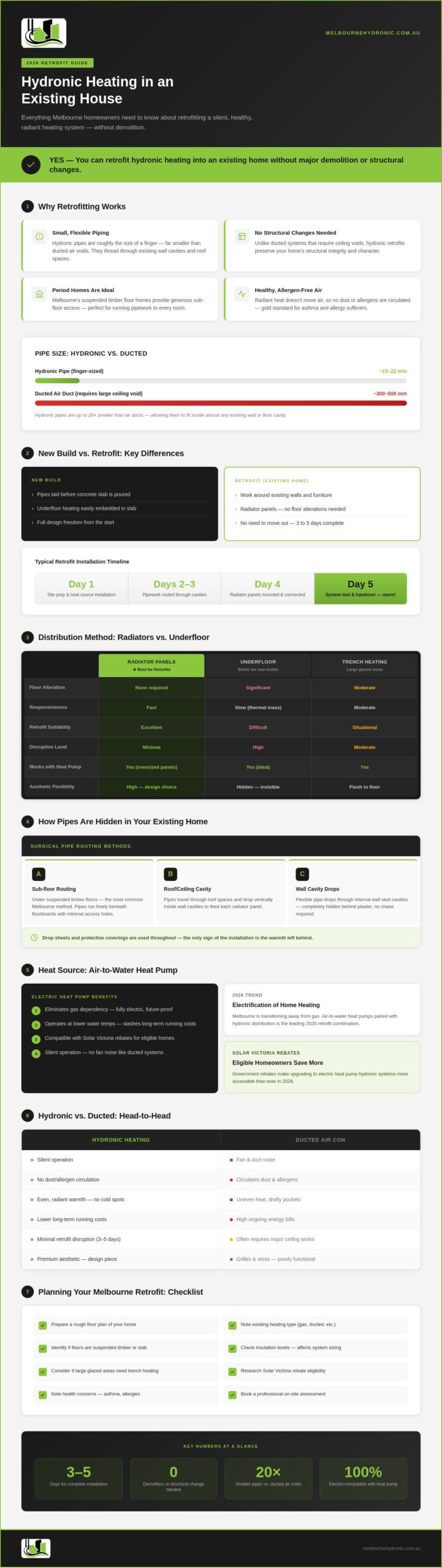
One of the most frequent questions we hear from local homeowners is: can you install hydronic heating in an existing house? Many people assume that this level of comfort is reserved strictly for new architectural builds or major construction projects. However, hydronic retrofitting is a common and highly successful practice across Melbourne. A hydronic retrofit is a non-invasive installation of water-based heating into an established structure. Unlike bulky forced-air systems that require massive ceiling voids for ductwork, hydronic systems use small, flexible piping that can be integrated into almost any floor plan with surgical precision.
The adaptability of water-based systems makes them far superior to traditional ducted air conditioning for established homes. While ducts often require significant structural changes or lowered ceilings, hydronic pipes are roughly the size of a finger. This allows us to thread them through existing wall cavities, roof spaces, or under floorboards without compromising the integrity of your home. The reality is that you can install hydronic heating in an existing house with surprisingly little disruption to your daily life, transforming a cold, drafty property into a sanctuary of consistent, radiant warmth.
The Feasibility of Retrofitting in Melbourne Homes
Melbourne’s diverse architecture, particularly our beautiful period homes with suspended timber floors, provides the perfect canvas for a retrofit. These homes often have generous sub-floor access, making it straightforward to run pipework to every room. During a professional site visit, a specialist looks for these access points and evaluates your home’s insulation levels. We also consider the health of your family. Traditional heating often circulates dust and allergens; however, hydronic heating provides a clean, radiant heat that doesn’t move air, making it the gold standard for asthma and allergy sufferers. While Underfloor heating systems are a popular topic for slab-based homes, many Melbourne retrofits focus on high-efficiency radiator panels for their incredible responsiveness and ease of installation.
New Build vs. Retrofit: Key Differences
The primary difference between a new build and a retrofit is the installation timeline and the distribution method. In a new build, pipes are often laid before the concrete slab is poured. In a retrofit, we work around your existing furniture and structural walls to find the most efficient path for the system. You don’t need to move out during the process. Most retrofits are completed within 3 to 5 days, and we take great care to ensure your daily routine remains undisturbed. We use drop sheets, specialized tools, and a methodical approach to ensure that once we leave, the only sign of our presence is the gentle, silent warmth that fills your home.
Radiator Panels vs. Underfloor: Which is Best for Retrofitting?
When you’re determining how you can install hydronic heating in an existing house, the distribution method is your first major decision. You have two primary paths: radiator panels or underfloor heating. While both offer that signature “sun-like” radiant warmth, they differ significantly in terms of installation complexity and responsiveness. Choosing the right one depends on your home’s structure, your lifestyle, and your long-term energy goals.
Hydronic radiator panels are widely considered the gold standard for retrofits. They provide the most direct route to comfort because they don’t require altering your floor structure. For homes with floor-to-ceiling windows where wall space is limited, we often integrate hydronic trench heating. This system sits flush within the floor and creates a warm air curtain, preventing cold drafts from entering through large glass surfaces. It’s also vital to consider your heat source. Modern electric heat pumps operate at lower temperatures than traditional gas boilers. If you’re opting for a heat pump, we simply size the radiator panels slightly larger to ensure they deliver the same cozy environment with maximum efficiency.
Hydronic Radiator Panels: The Non-Invasive Choice
Panels are incredibly versatile. They mount directly to your existing walls, acting as functional pieces of home design. You aren’t stuck with one look; you can choose from classic steel hospital-style radiators that suit heritage homes or sleek, modern designer panels for a contemporary feel. One of the greatest benefits is zoning. You can easily control the temperature of individual rooms, ensuring you aren’t wasting energy on guest bedrooms you aren’t using. This precision helps keep your running costs low while maintaining peak comfort where you need it most.
Retrofit Underfloor Heating: Is it Possible?
Yes, underfloor heating is achievable in an existing property, but it requires a more specialized approach. For homes on concrete slabs, we use thin-profile “screed-over” systems that add minimal height to your floor. If your home has suspended timber floors, we can often install the pipes between the joists from underneath. This preserves your floorboards while providing that luxurious barefoot warmth. This is an excellent choice if you’re already planning to replace your flooring or have excellent sub-floor access. If you’re unsure which method suits your floor plan, our team can provide a professional consultation to help you decide which system best fits your home’s unique layout.
Ultimately, the question isn’t just can you install hydronic heating in an existing house, but which distribution method will preserve your home’s character while maximizing your wellbeing. Whether you choose the rapid response of radiators or the invisible luxury of underfloor pipes, you’re investing in a system that will provide decades of reliable, silent warmth.
The Retrofit Process: How We Hide Pipes in Your Existing Home
The most common fear homeowners express is the image of their floorboards being ripped up or their walls being demolished. It’s a valid concern, but the reality of a modern installation is far more refined. When you ask can you install hydronic heating in an existing house, you’re looking for a solution that respects your home’s architecture. We use what we call a surgical approach. This means we treat your home’s structure as a series of pre-existing pathways, using the “veins” of the building to distribute warmth. Approximately 95% of pipework in a professional retrofit is completely hidden from view.
For multi-storey homes, the challenge of hiding pipes is solved through clever routing. We often utilize internal wall cavities, the back of wardrobes, or even laundry chutes to transition between levels. This ensures that you don’t end up with unsightly external pipework running down the side of your house. Every decision is made to preserve the aesthetic value of your property while delivering the technical precision required for a high-performance system. You can install hydronic heating in an existing house without sacrificing the clean lines and interior design you’ve worked hard to create.
Utilizing Sub-Floors and Roof Space
Melbourne’s traditional “stumps and joists” construction is an incredible asset for these projects. This design provides a crawl space that allows our technicians to run insulated piping directly beneath your rooms. We take insulation seriously; every meter of pipe in an unconditioned space is wrapped to prevent heat loss before it reaches your radiators. To get started, our team typically only needs clear access to your sub-floor hatch or roof manhole. We’ve mastered the art of navigating these tight spaces to keep the visible impact on your living areas at an absolute minimum.
Wall Penetrations and Finishing Touches
The final connection to your radiator panels requires precision. We bring the pipes through the floor or wall using small, targeted penetrations that are barely larger than the pipe itself. To ensure a premium look, we install elegant floor plates and wall “tails” that hide the entry point completely. These small details ensure the system looks like it was part of the original build. Before we consider the job done, the entire system is airtight and pressure-tested. This rigorous process guarantees that your new heating is not just beautiful and hidden, but also durable and leak-proof for decades to come.
Efficiency and ROI: Is Retrofitting Hydronic Heating Worth It?
When evaluating if can you install hydronic heating in an existing house, the return on investment extends far beyond your monthly utility bill. While the initial setup is a premium choice, the long-term financial logic is undeniable. Traditional gas ducted systems are notorious for heat loss through leaky vents and the ever-rising cost of fossil fuels. In contrast, a hydronic system in a typical three-bedroom Melbourne home costs approximately $480 to $680 per winter to run on gas. If you opt for a heat pump, those costs drop significantly to between $260 and $420. This efficiency ensures the system begins paying for itself from the very first frost.
Beyond daily savings, this upgrade serves as a powerful asset for your property’s market position. Research indicates that a high-quality hydronic installation can boost a Melbourne home’s resale value by approximately 4% to 6%. For a period home in the inner suburbs, this can represent a gain of tens of thousands of dollars. Buyers in 2026 specifically look for sustainable, high-end climate control. A well-maintained system is a generational investment. While a premium European boiler typically serves for 15 to 20 years, the radiator panels and pipework can easily exceed 30 to 40 years of service. If you’re ready to see how these numbers apply to your floor plan, you can book a professional consultation with our expert team.
When navigating the competitive Melbourne market for properties with these high-value features, Your Australian Property Buyers Agents can provide the expert guidance needed to secure a home that meets both your lifestyle and investment goals.
Future-Proofing with Electric Heat Pumps
2026 is a pivotal year for Victorian homeowners. With the state government’s Gas Substitution Roadmap in full effect, moving toward electric-powered comfort is no longer just an environmental choice. It’s a strategic financial move. By choosing electric heat pumps, you can achieve 300% to 400% efficiency. This means for every unit of electricity used, you get three to four units of heat. When integrated with a solar PV system, you can effectively heat your home for free during daylight hours, storing that warmth in your thermal mass for the evening.
The Health and Comfort Dividend
The true value of a hydronic retrofit often reveals itself in the improved wellbeing of the household. Because the system relies on radiant heat rather than blowing air, it eliminates the circulation of dust mites, pet dander, and allergens. This makes it a life-changing choice for families managing asthma. You’ll also notice the silence. There are no rattling fans or rushing air, just a quiet, consistent warmth. The heat distribution is perfectly uniform, solving the “cold feet, hot head” syndrome common with split systems. You can install hydronic heating in an existing house to finally achieve a home environment that is as healthy as it is comfortable.
Planning Your Melbourne Retrofit: Next Steps
By now, you’ve seen that the answer to can you install hydronic heating in an existing house is a clear, professional “yes.” Moving from the research phase to a warm, silent home requires a methodical planning process. The most successful retrofits begin with a detailed site assessment where we evaluate your home’s unique structural opportunities. Choosing a specialist like Melbourne Hydronic Heating ensures that your project is handled with a “no-mess” guarantee. We treat your living space with the respect it deserves, ensuring that the installation is as invisible as the heat it provides.
To get started, you don’t need to be a technical expert. We simply need a basic floor plan of your property to begin the journey. For an accurate remote quote, try to include room dimensions, the locations of large windows, and any known access points to your sub-floor or roof cavity. This information allows our engineers to calculate the precise heat loss for each room, ensuring your new system is perfectly sized for Melbourne’s specific climate challenges. You can install hydronic heating in an existing house with confidence when the foundation of the project is built on accurate data and local expertise.
Getting Your Custom Design and Quote
We pride ourselves on a streamlined 7-day quote turnaround. Once we have your floor plan and have conducted a site visit, we provide a comprehensive design that balances your aesthetic preferences with your budget. You aren’t limited to a one-size-fits-all solution. We can mix and match radiator styles or prioritize specific zones of the house to align with how you actually live. If you’re looking for the quickest turnaround, consider booking your installation during the off-season. While we work year-round, scheduling your retrofit in spring or summer ensures maximum availability and gives you the peace of mind that your home will be ready before the first cold snap of next year.
Ready to Upgrade Your Comfort?
Deciding to retrofit your home is an investment in your family’s long-term well-being and your property’s future value. You don’t have to settle for the dry air, noise, and inefficiency of outdated systems any longer. We’re here to prove that you can preserve your home’s character while enjoying the most advanced heating technology available today. Don’t wait until the Melbourne winter sets in to start the process. Take the first step toward a healthier, more comfortable lifestyle today. Book a retrofit consultation with Melbourne Hydronic Heating today and discover how we can transform your existing house into a sanctuary of radiant warmth.
Transforming Your Home for a Lifetime of Comfort
Transforming your living environment into a sanctuary of silent, radiant warmth is more achievable than you might’ve imagined. We’ve explored how a surgical installation approach preserves your home’s character while providing the health benefits of dust-free, allergen-free heating. Whether you choose the rapid response of designer radiator panels or the invisible luxury of underfloor pipes, you’re choosing a system built for decades of reliability. These modern solutions ensure your property remains at the forefront of efficiency and sustainability.
The question of can you install hydronic heating in an existing house is answered by the technical precision and local expertise we bring to every project. As a family-owned local business with over 30 years of experience, we specialize in upgrading Melbourne’s iconic Victorian and Edwardian period homes with modern, energy-efficient technology. We’re committed to helping you navigate the 2026 shift toward electrification while ensuring your home remains a haven of premium comfort and wellbeing.
Ready to take the next step toward a better lifestyle? Request a Retrofit Quote for Your Melbourne Home and let our specialists design a system that fits your floor plan perfectly. Your journey toward a warmer, healthier, and more efficient home starts with a simple conversation. We look forward to helping you create the perfect climate for your family.
Frequently Asked Questions
How long does it take to install hydronic heating in an existing house?
A standard retrofit for a typical Melbourne home usually takes between 3 to 5 days. This timeline depends on factors like the number of radiator panels being installed and the ease of access to your sub-floor or roof space. We work room by room to ensure your home remains functional throughout the process. Our team prioritizes a methodical approach to minimize any temporary impact on your daily routine.
Will retrofitting hydronic heating damage my heritage floorboards?
No, a professional installation is designed to preserve your home’s original features, including heritage floorboards. We use specialized tools to bring pipework through walls or discreetly from the sub-floor without the need to lift entire sections of flooring. This surgical precision is a hallmark of our service, ensuring that your property’s architectural character and value remain fully intact after the upgrade.
Can I install hydronic heating in a two-storey existing home?
Yes, you can install hydronic heating in an existing house with multiple storeys by utilizing internal pathways. We thread the necessary pipework through existing wall cavities, the back of built-in wardrobes, or laundry chutes to connect the levels. This method eliminates the need for visible external pipes on your facade. It allows for a seamless integration that provides consistent, radiant warmth across every floor of your home.
Is it more expensive to retrofit hydronic heating than install it in a new build?
Retrofitting involves more specialized labor than a new build because we navigate an established structure, but it avoids the costs of major demolition. While a new build lets us lay pipes before the slab is poured, our retrofit techniques provide the same premium performance. It’s a strategic investment that significantly boosts your home’s energy rating and resale value without the mess of a total renovation.
Can I use my existing gas boiler for a new hydronic radiator system?
It’s possible to use an existing boiler, but we generally recommend a high-efficiency replacement to maximize your system’s performance. Older units often lack the modulation capabilities required for modern radiator panels and may not be compatible with the latest smart zoning controls. Upgrading to a condensing gas boiler or an electric heat pump ensures you achieve the lowest possible running costs and the highest reliability for decades to come.
Do I need to move out of my house during the installation process?
You don’t need to move out during the installation. Our technicians are experienced in working in “lived-in” environments and take every precaution to keep your home clean and organized. We use drop sheets and methodical cleaning practices to ensure your living areas remain habitable. Most homeowners find that the process is much quieter and less intrusive than a standard kitchen or bathroom renovation.
For those considering a broader refurbishment or ongoing property maintenance to complement their heating upgrade, CFS group Limited offers professional expertise in managing high-quality residential improvements.
Can I add more radiator panels to the system later if I renovate?
Yes, you can expand your hydronic system in the future, provided the initial heat source is sized with growth in mind. During the design phase, we can discuss your future renovation plans and select a heat pump or boiler with the capacity to handle additional radiator panels or towel rails. This forward-thinking approach allows you to upgrade your home in stages while maintaining a consistent level of comfort throughout.