
Expert Hydronic Heat Pump Repair in Melbourne: The 2026 Homeowner’s Guide
It is a freezing July morning in Melbourne, and while your thermostat says the heat is on, your radiator panels are stone cold. You invested in a hydronic heat pump for its whisper-quiet efficiency and premium comfort. Discovering a noisy outdoor unit or a sudden spike in your electricity bill is more than just an inconvenience; it’s a disruption to your home’s wellbeing. Finding a specialist for hydronic heat pump repair Melbourne homeowners can trust shouldn’t be the hardest part of your winter.
We understand that your priority is a warm, healthy environment without the stress of unpredictable technical failures. This 2026 guide will help you identify common faults, troubleshoot minor issues yourself, and understand exactly when it’s time to call in the experts to restore your system to peak performance. We’ll explore the technical nuances of the modern refrigeration cycle, provide clarity on repair timelines, and show you how professional maintenance ensures your home remains a sanctuary of consistent, energy-efficient warmth throughout the coldest Victorian snaps. By the end of this article, you will have a clear path toward a quiet, functional, and cost-effective heating system.
Key Takeaways
- Learn to spot early warning signs of system failure, such as unusual compressor noises or a gradual drop in radiator temperatures.
- Understand when to book a professional hydronic heat pump repair Melbourne service to address complex refrigeration cycle issues or pump malfunctions.
- Evaluate the financial benefits of repairing an older unit versus upgrading to a high-efficiency 2026 model if your system is nearing its 15-year lifespan.
- Master safe troubleshooting steps and controller resets that can restore comfort quickly without the need for specialized tools.
- Discover how fixed-rate fees and 30 years of local expertise remove price anxiety and ensure your system returns to peak energy efficiency.
Common Signs Your Hydronic Heat Pump Needs Repair
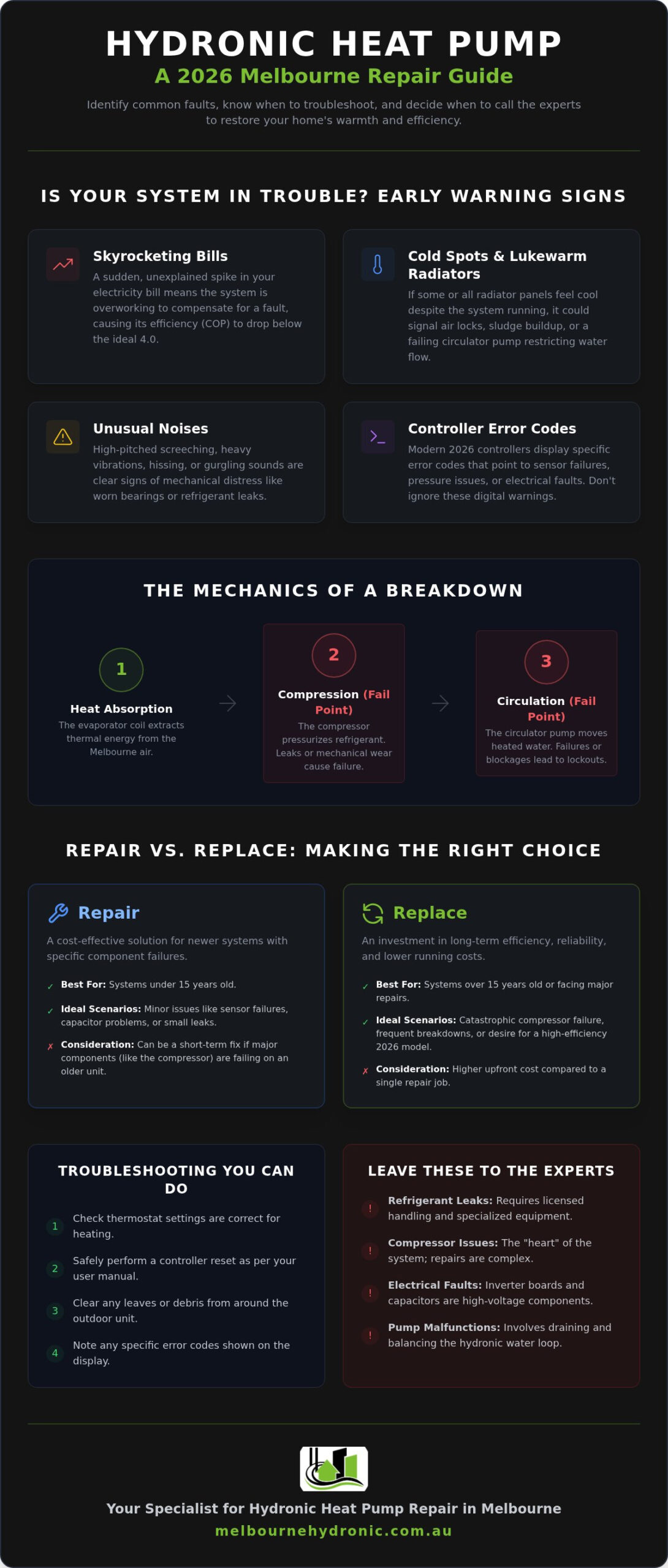
Melbourne winters are notoriously damp. When the air is thick with moisture on a typical July morning, your unit’s evaporator coils can ice over rapidly. Modern 2026 systems use an automated defrost cycle to manage this, but high humidity can push a struggling unit to its limit. If you notice your outdoor fan running constantly without producing much heat, or if your electricity bill shows a sudden, unexplained spike, your system is likely overworking to compensate for a mechanical fault. Prompt hydronic heat pump repair Melbourne services are essential to prevent these minor efficiency losses from turning into a total system shutdown during a cold snap.
Monitoring your energy consumption is often the first step in technical diagnostics. A well maintained system should maintain a Coefficient of Performance (COP) of around 4.0. When components begin to fail, this ratio drops. You’ll pay more for less warmth. Understanding the mechanics of hydronic heat pump failure provides a baseline for why these efficiency drops occur, often stemming from issues within the refrigeration cycle or a failing circulator pump.
Performance Issues and Cold Spots
Radiator panels should provide a consistent, radiant glow. If they feel lukewarm despite the pump running for hours, the system isn’t reaching its target flow temperature. This often happens when the outdoor ambient temperature drops, and the heat pump can’t extract enough thermal energy. However, if some panels are hot while others remain cold, you might be dealing with air locks or sludge buildup. These blockages mimic the symptoms of a failing pump by restricting water flow, forcing the heat pump to cycle on and off too frequently. It’s a technical imbalance that requires professional balancing to restore the premium comfort you expect.
Strange Noises and Error Codes
Modern 2026 controllers are sophisticated diagnostic tools. They don’t just show the temperature; they provide specific error codes that point to sensor failures or pressure issues. Beyond the digital display, listen to the outdoor unit. A healthy heat pump produces a steady, low frequency hum. High pitched screeching, heavy vibrations, or rattling pipes are clear indicators of mechanical distress. These sounds often signal:
- Worn bearings in the compressor or fan motor.
- Refrigerant leaks causing the system to hiss or gurgle.
- Loose mounting brackets that lead to excessive vibration through the home’s structure.
Don’t ignore these auditory warnings. Catching a vibration issue early can save the delicate copper pipework from developing fatigue cracks and costly leaks.
The Mechanics of Hydronic Heat Pump Failure
To understand why you might need hydronic heat pump repair Melbourne experts, you have to look under the hood of how these systems move energy. A heat pump doesn’t create heat; it extracts it. The evaporator coil absorbs low-grade thermal energy from the Melbourne air, even on a crisp 5-degree morning. The compressor then raises the temperature of the refrigerant gas, which passes through the condenser to heat your home’s water loop. If any part of this cycle is interrupted, your comfort disappears.
Once the heat is transferred to the water, the circulator pump takes over. This component is the engine that drives hot water through your underfloor coils or radiator panels. If this pump fails or slows down due to debris, the heat pump can’t shed its thermal load, leading to high-pressure lockouts. Sensor malfunctions often complicate this further. Faulty thermistors can trick the system into “short-cycling,” where the unit turns on and off every few minutes. This doesn’t just waste energy; it puts massive mechanical strain on the compressor and shortens the system’s life.
Electrical faults are also common in 2026-model systems that use inverter-driven compressors. These sophisticated electronics vary the motor speed to match your heating demand. While they’re incredibly efficient, a power surge or a failing capacitor can cause the inverter board to malfunction. This results in a system that either refuses to start or runs at a single, inefficient speed, stripping away the cost-saving benefits of your investment.
Refrigerant Leaks and Compressor Health
Refrigerant is the lifeblood of your heating system. A slow leak reduces the unit’s ability to absorb heat, forcing it to run for longer periods to meet the thermostat’s demand. This lowers your Coefficient of Performance (COP) and drives up running costs. The compressor serves as the heart of the electric hydronic system, pumping refrigerant through the cycle to maintain thermal transfer. If you notice a gradual decline in heating capacity or a strange gurgling sound from the outdoor unit, a leak test is a technical priority.
Hydronic Integration Faults
Repairing the heat pump itself is only half the battle. Often, the issue lies in how the unit communicates with the rest of your home. In smart-home setups, communication errors between the central hub and the heat pump controller can cause the system to ignore heating schedules entirely. At the manifold, poor water flow balancing leads to uneven room temperatures, where one bedroom is a sauna and the next is a fridge. We also check glycol levels during a specialist system service to ensure your internal pipework is protected from corrosion and freezing during those rare, sub-zero Melbourne nights.
Repair vs. Replacement: Making the Right Choice in 2026
Deciding whether to invest in a hydronic heat pump repair Melbourne service or commit to a full system replacement is a technical and financial crossroads. Most high-quality electric heat pumps are engineered for a 15-year service life. If your system is approaching this milestone, the math begins to shift. While a single repair might seem cheaper today, an older unit’s declining efficiency can quietly add hundreds of dollars to your annual energy bills compared to the latest 2026 standards. We prioritize transparent advice to ensure you aren’t pouring money into a system that has reached its mechanical limit.
Before you condemn a sluggish system, consider the state of your water loop. Often, what looks like a terminal pump failure is actually a circulation issue caused by internal magnetite buildup. A professional power flush can clear this sludge, restoring flow and potentially saving a system that appeared to be at the end of its life. This is particularly relevant for Melbourne homes that converted from gas to electric but retained their original radiator panels. However, for older gas-to-electric conversion units, the availability of specific spare parts can become a bottleneck as manufacturers pivot toward 2026-compliant components.
When to Choose Professional Repair
Repair is almost always the logical choice for systems under 10 years old that have a documented service history. Minor component failures, such as faulty sensors, zone valves, or even a seized circulator pump, are routine fixes that don’t require a total overhaul. When the core compressor and heat exchanger remain in good health, localized repairs can restore 100% functionality and maintain your system’s high Coefficient of Performance. It’s about protecting your initial investment while ensuring your home’s comfort isn’t compromised by a simple electronic glitch.
Signs It Is Time for a System Upgrade
If you’re facing frequent breakdowns and rising annual maintenance costs, your heat pump is likely signaling its retirement. A major compressor failure in a unit older than 12 years is often the tipping point where replacement becomes more cost-effective than repair. Upgrading to modern electric heat pumps offers significant advantages beyond just reliability. The latest 2026 models feature superior inverter technology and quieter operation, often achieving a COP of 4.0 or higher. This level of efficiency can reduce annual running costs to as little as $900, providing a much faster return on investment than keeping an aging, inefficient unit on life support.
Troubleshooting Your Melbourne Heat Pump Before Calling a Pro
For those looking to maximize the return on a new system, integrating solar power is a proven strategy. By utilizing a solar solution from GES Energy, you can power your high-efficiency heat pump with renewable energy, drastically reducing the net running costs and accelerating your investment’s payback period.
Before booking a hydronic heat pump repair Melbourne technician, a few non-invasive checks can save you time and potentially a call-out fee. Start at your hydronic manifold. Most modern systems feature a visible pressure gauge; if the needle has dropped below 1.0 bar, the heat pump may enter a safety lockout to protect the circulator pump from running dry. This isn’t always a sign of a major failure. Often, it’s simply the result of air being bled from the radiator panels during the start of the season. If the pressure is low, a quick top-up via the filling loop might be all that’s required to restore warmth.
It’s also worth performing a soft reset on your system controller if you encounter a minor glitch. For most 2026-model interfaces, this involves a specific button sequence found in your manual that clears temporary error codes without wiping your custom heating schedules. This can often resolve communication hiccups between the outdoor unit and the indoor sensors, especially after a power flicker or a heavy Melbourne storm.
Power and Controller Checks
Modern 2026 systems are sensitive to power fluctuations. Check your switchboard to ensure the dedicated heating circuit hasn’t tripped; for any underlying household electrical concerns, you can check out Electrical Repair 4U. It’s also surprisingly common for wireless thermostats to lose communication because of low battery levels. If your screen is blank or showing a “no comms” icon, a fresh set of batteries might be the only repair you need. Also, double-check that your controller hasn’t been accidentally toggled to “Summer Mode” or “Hot Water Only,” which prevents the system from sending thermal energy to your floor coils or radiator panels.
The outdoor unit needs consistent airflow to function at peak efficiency. Melbourne’s windy autumns often blow leaves and garden debris against the evaporator coils, choking the system’s ability to extract heat from the ambient air. A blocked evaporator coil can reduce your system’s energy efficiency by up to 30%, forcing the compressor to work harder and increasing mechanical wear. Clear away any foliage, cobwebs, or overhanging branches within a one-meter radius of the unit to ensure the fan can discharge air freely.
During a winter cold snap, look for excessive ice buildup. While a thin layer of frost is normal, a thick block of ice suggests the automated defrost cycle is failing. Also, check the condensate drain at the base of the unit. If this pipe is blocked by dirt or algae, water can pool and freeze, eventually causing a system fault. If these simple steps don’t restore your comfort, it’s time to consult the experts at Melbourne Hydronic Heating for a professional diagnostic service.
Specialist Repair Services by Melbourne Hydronic Heating
Choosing a specialist for hydronic heat pump repair Melbourne homeowners can rely on means looking beyond basic plumbing. These systems are intricate thermal machines that demand a deep understanding of both refrigeration cycles and hydronic water distribution. With over 30 years of industry experience, Melbourne Hydronic Heating provides the technical precision required to diagnose complex faults that general contractors might overlook. Whether your system uses hydronic heating panels or silent underfloor heating, we ensure every component operates at its design specification.
Transparency is at the core of our service. We know that unexpected heating failures bring enough stress without the added worry of mounting hourly rates. That is why we offer fixed-rate repair and maintenance fees. You’ll know the cost of the diagnostic and labor before the work begins. This approach removes price anxiety, allowing you to focus on restoring your home’s comfort rather than watching the clock while a technician works.
Our Diagnostic and Repair Process
We approach every repair with a methodical, engineering-first mindset. Our technicians conduct comprehensive health checks using advanced diagnostic tools to monitor system pressure, temperature differentials, and electrical draw. This data-driven approach allows us to pinpoint the exact cause of a failure, from a faulty inverter board to a subtle refrigerant leak. We never compromise on quality; we only use high-quality, genuine replacement parts to ensure longevity. Once the repair is complete, we perform rigorous post-repair testing to verify system balancing and ensure your unit is returning to its peak energy efficiency standards for 2026.
Booking Your Melbourne Hydronic Service
As a family-owned and operated specialist contractor, we understand that a cold home is a priority. We offer fast response times across Melbourne and Geelong, bringing decades of local expertise directly to your door. You aren’t just hiring a service provider; you’re partnering with a consultant who knows the specific challenges of the Victorian climate. This local patriot approach ensures your system is optimized for our unique weather patterns, providing a premium lifestyle experience and long-term peace of mind. Book your hydronic heat pump repair with Melbourne Hydronic today and restore the energy-efficient warmth your home deserves.
Securing Your Year-Round Comfort in Melbourne
Maintaining a high-performance heating system is about more than just surviving the winter; it’s about preserving a premium quality of life. From recognizing the first signs of mechanical distress to understanding when a 2026-model upgrade offers a better return on investment, you now have the tools to manage your home’s climate effectively. While simple troubleshooting can often resolve minor pressure issues, complex faults in the refrigeration cycle or inverter electronics demand the precision of a specialist. Professional intervention ensures your system remains a safe, hygienic, and cost-effective asset for your property.
When you need professional hydronic heat pump repair Melbourne homeowners have trusted for over 30 years, our family-owned team is ready to help. As local experts serving Melbourne and Geelong, we combine technical mastery with transparent, fixed-rate maintenance and repair fees to remove any uncertainty from the process. Don’t let a minor technical glitch compromise your home’s energy efficiency or your family’s wellbeing. Request a Specialized Heat Pump Repair Quote today and ensure your system continues to provide silent, consistent warmth for years to come. Your sanctuary deserves nothing less than peak performance.
Frequently Asked Questions
How much does a hydronic heat pump repair cost in Melbourne?
We provide transparent, fixed-rate repair and maintenance fees to eliminate price anxiety for our customers. While the total cost depends on the specific parts required for your 2026-standard system, you’ll know the labor and diagnostic charge before we begin. This approach ensures you aren’t watching a clock while we restore your home’s comfort. By choosing a specialist, you avoid the hidden costs of trial-and-error diagnostics common with general contractors.
Can any plumber fix my hydronic heat pump?
No, a standard residential plumber often lacks the specialized training required for complex electric heat pumps. These systems combine high-precision refrigeration cycles with hydronic water distribution. Effective hydronic heat pump repair Melbourne services require technicians who understand inverter technology and manifold balancing. Trusting your system to a specialist with over 30 years of experience ensures your warranty remains intact and your unit returns to peak energy efficiency without unnecessary risk.
Why is my heat pump outdoor unit icing up in winter?
A thin layer of frost is normal during a damp Melbourne morning, but heavy ice indicates a technical fault. This usually happens when the automated defrost cycle fails or the evaporator coils are blocked by debris. Choked airflow forces the system to overwork, reducing efficiency by up to 30%. If the ice doesn’t melt away during the cycle, it’s a sign that sensors or the refrigeration charge need professional attention to prevent mechanical distress.
How often should I service my hydronic heat pump to avoid repairs?
We recommend a professional service every 12 to 24 months to maintain peak performance and system longevity. Routine maintenance allows us to check glycol levels, verify refrigeration pressures, and clear sludge from your radiator panels. Preventive care is far more cost-effective than emergency repairs. Consistent servicing ensures your system operates at its design Coefficient of Performance, keeping your 2026 energy bills as low as possible while protecting your premium lifestyle.
What is the most common cause of heat pump failure?
Poor water flow is the leading cause of system shutdowns. When debris or magnetite builds up in your radiator panels or underfloor coils, the circulator pump struggles to move thermal energy. This leads to high-pressure lockouts and excessive wear on the compressor, which is the heart of your system. Regular power flushing and sensor calibration are essential to prevent these circulation issues from causing a total mechanical failure during a Victorian cold snap.
Is it worth repairing a 12-year-old hydronic heat pump?
It depends on the health of the compressor and the availability of spare parts. If the failure involves a minor component like a sensor or valve, a repair is a sound investment. However, if the compressor has failed, upgrading to a high-efficiency 2026 model may be more economical. Newer units offer superior inverter technology and significantly lower running costs, often providing a faster return on investment than repairing an aging, inefficient unit on life support.
How long does a typical hydronic repair take?
Most common repairs, such as replacing a circulator pump or clearing a sensor fault, are completed within two to four hours. Our technicians carry a range of high-quality replacement parts to ensure a fast turnaround for Melbourne and Geelong homeowners. If a major component like an inverter board or compressor is required, the timeline may extend based on part availability. We always provide a clear estimate of the repair duration after our initial diagnostic.
Does Melbourne Hydronic Heating offer emergency repair services?
We provide priority repair services across Melbourne and Geelong to restore your home’s comfort as quickly as possible. As a family-owned specialist with over 30 years of experience, we understand the urgency of a cold home during winter. While we don’t offer 24/7 call-outs, our local presence allows for fast response times. You can book a priority service through our website to ensure an expert technician attends to your system promptly and professionally.