
Benefits of a Heat Pump for Hydronic Heating in Melbourne: The 2026 Guide
What if your home’s gas boiler became a financial liability by next March? With Victoria’s strict new regulations mandating electric replacements for end-of-life gas systems starting in 2027, the traditional way we heat our homes is changing forever. You’ve likely noticed your gas connection fees and usage costs climbing every month, or perhaps you’re tired of the dry, dusty air pushed out by noisy split systems. It’s frustrating to feel like you’re paying more for a less comfortable environment. This guide reveals the benefits of a heat pump for hydronic heating Melbourne homeowners need to know to future-proof their comfort and slash energy bills by up to 70%.
We understand that technical terms like COP or R290 can feel overwhelming when you just want a warm house. You deserve a heating solution that’s as efficient as it is silent. We’ll explore the latest 2026 rebates, explain how air-to-water technology integrates with your radiator panels or underfloor pipes, and show you why this is the ultimate health-conscious choice for your family. By the end of this article, you’ll see exactly how to transition to a premium, all-electric lifestyle without sacrificing a degree of warmth.
Key Takeaways
- Navigate Victoria’s latest gas regulations and learn why transitioning to an all-electric system is essential for future-proofing your home’s long-term value.
- Discover the technical benefits of a heat pump for hydronic heating Melbourne residents can use to achieve superior efficiency through high Coefficient of Performance (COP) ratings.
- Learn how to maximize your return on investment by integrating your heating system with solar PV to power your home using self-generated energy.
- Compare the performance of low-temperature radiator panels and underfloor heating to find the perfect match for your home’s architectural layout and comfort needs.
- Understand why a professional heat load calculation is the most critical step in ensuring your new air-to-water system operates at peak performance.
Why Melbourne Homeowners are Switching to Heat Pump Hydronics in 2026
The energy landscape in Victoria has shifted permanently. For decades, gas was the default choice for heating Melbourne homes, but 2026 marks a clear tipping point. We’ve moved past the era of cheap fossil fuels into a future defined by electrification. Understanding the benefits of a heat pump for hydronic heating Melbourne residents are now prioritizing is essential for any homeowner looking to maintain both comfort and property value. Modern heat pump technology has replaced the gas boiler as the efficiency champion, offering a way to heat your home that’s cleaner, cheaper to run, and far more sophisticated.
Choosing a heat pump isn’t just about following a trend. It’s a strategic move to insulate yourself from rising gas connection fees and the inevitable phase-out of gas infrastructure. By removing gas reliance now, you’re future-proofing your home against the stricter regulations of the late 2020s. It’s about creating a premium living environment where the warmth is consistent, the operation is silent, and the air remains pure.
The End of Residential Gas in Melbourne
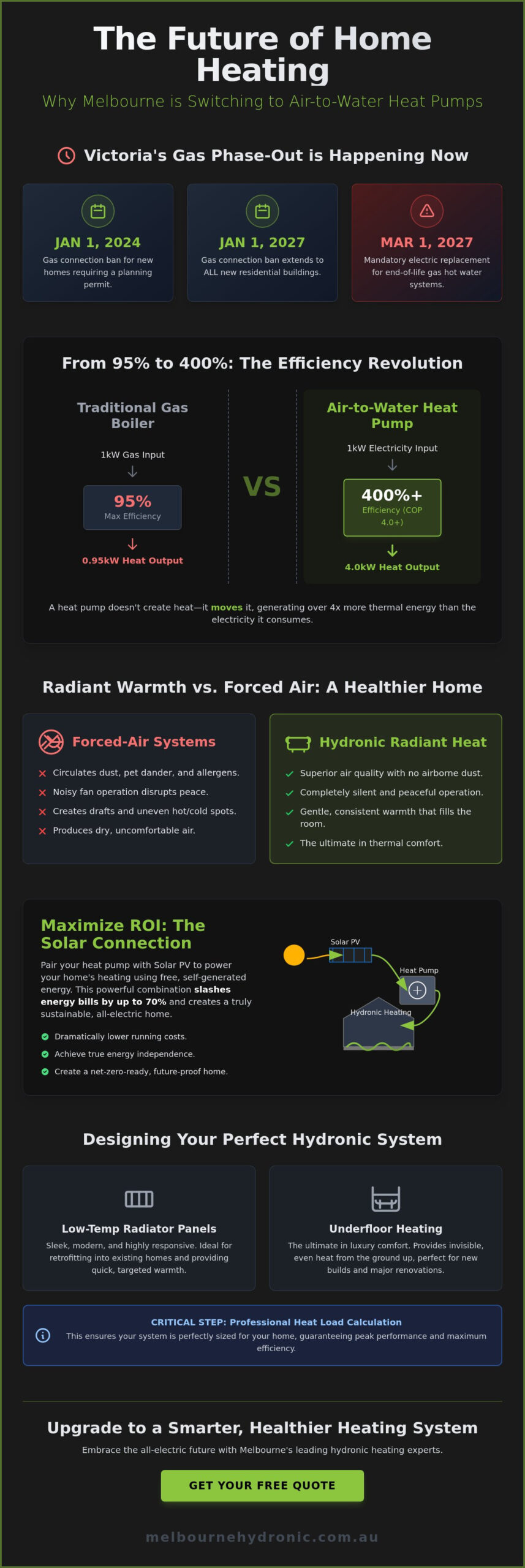
Victoria’s Gas Substitution Roadmap has fundamentally changed how we build and renovate. Since January 1, 2024, new homes and subdivisions requiring a planning permit have been prohibited from connecting to the gas network. Looking ahead to January 1, 2027, this ban expands to all new residential buildings. Even for existing homes, the pressure is mounting. From March 1, 2027, any end-of-life gas hot water system must be replaced with an electric alternative like a heat pump. These regulations aren’t just suggestions; they’re part of a state-wide transition to net-zero emissions. Upgrading to an electric heat pump now ensures you won’t be left with a stranded asset or facing emergency replacement costs when gas parts become scarce and expensive.
Radiant Heat vs. Forced Air: A Healthier Home
Beyond the economics, the health benefits of a heat pump for hydronic heating Melbourne families appreciate most involve indoor air quality. Traditional split systems and ducted heaters rely on fans to move warm air. This process inevitably stirs up dust mites, pet dander, and allergens, which can be a nightmare for asthma sufferers. Hydronic systems are different. They use radiator panels or underfloor piping to emit radiant heat, which warms objects and people directly rather than just the air. There are no cold spots, no draughts, and most importantly, no blowing dust. It’s a gentle, silent warmth that supports a healthier, more hygienic home environment while providing the highest level of thermal comfort available today.
How Air-to-Water Heat Pumps Deliver Superior Efficiency
Efficiency isn’t just a technical specification; it’s the engine behind your monthly savings. While even the best gas condensing boilers struggle to reach 95% efficiency, modern air-to-water systems operate in a different league entirely. They don’t create heat through combustion. Instead, they use a clever refrigeration cycle to move heat from the outside air into your home’s water circuit. This process is so effective that it provides one of the most significant benefits of a heat pump for hydronic heating Melbourne homeowners can access: the ability to generate more energy than they consume.
The global shift toward this technology is well-documented. According to The Future of Heat Pumps report by the IEA, these systems are now the primary solution for decarbonizing residential warmth. In 2026, we’re seeing a surge in high-performance models using R290 or R32 refrigerants, which offer better thermal transfer and a much lower environmental footprint than older chemicals.
Understanding COP: Turning 1kW into 4kW of Heat
The Coefficient of Performance, or COP, is the standard measure of a system’s efficiency. If a unit has a COP of 4.0, it means for every 1 kilowatt of electricity used to run the compressor, it delivers 4 kilowatts of heat into your radiator panels or underfloor pipes. That’s 400% efficiency. Modern inverter technology makes this possible by modulating the power. Rather than switching on and off like an old-fashioned heater, the system gently speeds up or slows down to maintain a perfect, steady temperature. If you’re currently planning a boiler replacement, moving from 95% to 400% efficiency represents a massive leap in long-term affordability.
Melbourne’s Climate and Heat Pump Reliability
A common myth is that heat pumps fail when the temperature drops. In reality, modern units are designed to extract heat even when it’s well below freezing outside. Melbourne’s sub-5°C winter mornings are well within the operating range of these systems. To maintain peak performance, quality units include an automated defrost cycle that prevents ice build-up on the external coils. Air-to-water systems function by compressing ambient air to raise its temperature, then transferring that concentrated heat into the water that flows through your hydronic network. It’s a reliable, tried-and-tested method that keeps Victorian homes cozy regardless of the frost on the lawn. Choosing a correctly sized unit for our specific local climate ensures the system never has to overwork, preserving its lifespan and your comfort.
Maximising ROI: The Solar PV and Heat Pump Connection
One of the most compelling benefits of a heat pump for hydronic heating Melbourne homeowners enjoy is the ability to run the system on free, self-generated electricity. By pairing your air-to-water unit with a solar PV system, you effectively turn your roof into a power station. This synergy transforms your heating from an ongoing monthly expense into a managed asset. While gas prices continue to fluctuate based on global supply and local network fees, the sun remains a consistent and free resource. In 2026, the goal is no longer just to heat your home, but to do so with zero operational cost during daylight hours.
For those with solar battery storage, the advantages grow even stronger. You can store excess solar energy generated during the day to power the heat pump’s compressor during the coldest parts of the night. This creates a closed-loop energy cycle that provides 24/7 hydronic comfort without drawing expensive power from the grid. Even without a battery, smart integration allows you to pre-heat your home when the sun is at its peak, using your house itself as a storage vessel for thermal energy.
The Strategy of Thermal Mass
Load shifting is the secret to maximizing your return on investment. By using Hydronic Underfloor Heating, you can take advantage of the thermal mass in your concrete slab. You program the heat pump to run during the day when your solar panels are producing maximum power. The concrete slab absorbs this heat and slowly releases it throughout the evening. This ‘thermal battery’ effect means your home stays warm long after the sun goes down, significantly reducing your reliance on the grid during expensive peak periods. Smart controllers now automate this process, monitoring weather forecasts and solar output to ensure your system only works when it’s most cost-effective.
Heat Pump vs. Gas Boiler: The 10-Year Outlook
When comparing a new Electric Heat Pump to a traditional Gas Boiler, the 10-year financial outlook is clear. While gas units might have a lower initial purchase price, their lifetime costs are rising. Victorian government policy is actively moving away from gas, which will likely lead to higher connection fees and decreased infrastructure support. In contrast, heat pumps are supported by significant incentives. Under the Victorian Energy Upgrades (VEU) program, homeowners can access discounts ranging from $900 to $1,200 for high-efficiency integrations. Additionally, Solar Victoria offers rebates of up to $1,000 for eligible heat pump hot water systems. By year five, the operational savings from a solar-linked heat pump typically outweigh the initial setup costs, making it the superior financial choice for the modern Melbourne property.
Designing Your System: Radiators, Underfloor, or Fan Coils?
Choosing the right distribution method is as critical as selecting the heat pump itself. While the heat pump acts as the heart of your system, the radiators or floor pipes are the delivery mechanism that determines your daily comfort. To capture the full benefits of a heat pump for hydronic heating Melbourne properties require a design that operates effectively at lower water temperatures. Traditional gas systems often run at 70°C, but heat pumps are most efficient when they maintain water between 35°C and 55°C. This shift requires a thoughtful approach to your home’s layout and thermal requirements.
Designing a system for a 2026 Melbourne home means looking at the specific needs of each room. You don’t have to stick to a single method. Many homeowners choose a hybrid approach, using different distribution tools to suit different zones. The goal is always the same: achieving maximum comfort with the lowest possible energy input.
Modern Radiator Panels for Heat Pumps
Traditional radiators were designed for the intense, short bursts of heat provided by old gas boilers. In contrast, modern hydronic heating panels are specifically engineered to provide consistent, gentle warmth at lower temperatures. Because the water isn’t as hot, these panels often feature a larger surface area or more advanced fin designs to ensure they meet the room’s heat load. If you’re retrofitting an existing home, we assess whether your current panels are large enough. In many cases, upgrading a few key units to sleek, high-efficiency models allows the heat pump to run at its peak COP without leaving you in the cold. From classic steel panels to vertical designer radiators, there’s a solution that fits your interior aesthetic.
Underfloor Heating and Fan Coils
For new builds or major renovations, underfloor heating stands out as the ultimate partner for air-to-water systems. It requires the lowest water temperatures of any distribution method, often just 35°C. This allows the heat pump to work less while providing a luxurious, even warmth that rises from the floor. If you want a year-round solution, fan coils are an excellent addition. Unlike standard radiators, fan coils can handle chilled water, allowing your heat pump to provide hydronic cooling during Melbourne’s scorching January afternoons. Combining these methods, such as underfloor in the living areas and fan coils in the bedrooms, creates a versatile system for multi-storey Melbourne residences. It’s about precision and luxury working in perfect harmony.
Retrofitting a heat pump into a home with an old gas boiler is entirely possible with the right expertise. It starts with a precise heat load calculation to ensure every room receives the energy it needs. If you’re ready to upgrade your home’s infrastructure, contact our expert team today for a professional system design.
Expert Installation with Melbourne Hydronic Heating
Experience counts. With over three decades of local expertise, we’ve seen how Melbourne’s unique architectural styles, from Victorian terraces to modern open-plan builds, interact with different heating technologies. To truly unlock the benefits of a heat pump for hydronic heating Melbourne properties require more than just high-end hardware; they need precise engineering. A system is only as good as its installation. Our team ensures that every component, from the external compressor to the internal radiator panels, is perfectly synchronized for the Victorian climate.
Technical precision is our hallmark. We don’t rely on guesswork or “rule of thumb” sizing. Instead, we perform a comprehensive heat load calculation for every room. This process considers your home’s orientation, insulation levels, and window sizes to determine the exact energy required to maintain comfort. It’s this level of detail that ensures your system runs at its peak Coefficient of Performance (COP) even on the frostiest July mornings. Proper system design doesn’t just improve comfort; it extends the lifespan of your investment by preventing the unit from overworking.
Precision Design and Engineering
When transitioning from a gas boiler to an electric heat pump, the health of your existing pipework is paramount. Over time, hydronic systems can accumulate magnetite or “sludge,” which restricts flow and reduces efficiency. This is why power flushing is a vital part of our retrofit process. By cleaning the system thoroughly, we ensure your new heat pump operates in a pristine environment, maximizing heat transfer. We’re committed to using Tier-1 European technology, selecting brands that have proven their durability in the toughest climates. Every installation we perform is backed by a Victorian Building Authority (VBA) Compliance Certificate, giving you the peace of mind that your home’s comfort is in expert hands.
Book Your Melbourne Consultation Today
Taking the first step toward an all-electric future is simple. During a site visit, we evaluate your home’s specific infrastructure, including your solar PV capacity and current distribution methods like radiator panels or underfloor pipes. We provide a customized quote that outlines the most efficient path to a future-proof home. Whether you’re planning a new build or looking to replace an aging gas boiler, we’re here to act as your advisors and partners in home comfort. Request a professional hydronic heating quote for your home and discover the difference that 30 years of local expertise makes for your family’s well-being.
Secure Your Home’s Comfort for the Decade Ahead
The transition away from gas in Victoria isn’t just a policy shift; it’s an opportunity to elevate your home’s quality of life. By choosing an all-electric solution, you’re investing in a system that offers silent, allergen-free warmth while protecting your property’s long-term market value. The benefits of a heat pump for hydronic heating Melbourne families experience go beyond simple utility savings. It’s about achieving a premium level of comfort that works in harmony with our local climate and your own solar energy production.
Whether you’re planning a new build or a complex retrofit, the right engineering makes the difference between a good system and a great one. We bring over 30 years of Melbourne-based expertise to every project, specializing in high-efficiency electric heat pumps and bespoke system design. Our team provides a full suite of services, including installation and ongoing maintenance, to ensure your investment stays at peak performance. Design your future-proof heating system with Melbourne’s experts and take the first step toward a cleaner, more economical home. Your journey to sustainable, radiant warmth starts with a simple conversation.
Frequently Asked Questions
Are heat pumps really worth it in Melbourne’s climate?
Yes, heat pumps are highly effective in our local climate. While Melbourne experiences cold winter mornings, temperatures rarely drop below the operating limits of modern air-to-water units. One of the primary benefits of a heat pump for hydronic heating Melbourne residents value is the system’s ability to extract heat even when the outside air is well below 5°C. These systems are engineered to handle Victorian winters with ease while maintaining far higher efficiency than any gas alternative.
Can I use my existing radiators with a new heat pump?
You can often use existing radiators, but they must be assessed for compatibility with lower water temperatures. Traditional gas boilers run at much higher temperatures than heat pumps. We evaluate your current radiator panels to ensure they have enough surface area to keep your rooms warm at a lower flow temperature. If some units are undersized, we can upgrade them to modern, low-temp panels to ensure your new system operates at peak efficiency.
How much noise does a hydronic heat pump make?
Modern external heat pump units are remarkably quiet. Most high-quality models operate at a decibel level similar to a quiet conversation or a light rainfall. During a professional installation, we focus on strategic placement and vibration dampening to ensure the unit doesn’t disturb your home’s peace or your neighbors. Once you’re inside, the radiant heat provided by your panels or underfloor pipes is completely silent.
Do I need a backup heater for very cold Melbourne nights?
No, a correctly sized and engineered heat pump system provides all the warmth you need without a secondary heater. Modern units include automated defrost cycles to prevent ice build-up on the external coils during frost. We perform precise heat load calculations before installation to ensure your system handles the coldest Victorian nights effortlessly, providing a reliable and consistent indoor environment regardless of the weather outside.
What is the lifespan of a modern air-to-water heat pump?
You can expect a high-quality air-to-water heat pump to last between 15 and 20 years with regular professional maintenance. This longevity is comparable to a traditional gas boiler, but the electric system offers greater long-term security as gas infrastructure becomes increasingly obsolete in Victoria. Regular servicing and power flushing of the system help maintain this lifespan by ensuring the internal components stay clean and efficient.
How much can I save on my bills by switching from gas to a heat pump?
Switching can reduce your heating energy costs by 60% to 70% per year, particularly when the system is paired with a solar PV array. One of the key benefits of a heat pump for hydronic heating Melbourne homeowners enjoy is the massive reduction in monthly energy bills. By moving away from rising gas usage costs and avoiding daily gas connection fees, the system typically pays for itself within a few years.
Does a heat pump require more maintenance than a gas boiler?
The maintenance requirements are very similar to a gas boiler, typically involving an annual professional check-up. We focus on cleaning the external unit’s fins, checking the water pressure, and ensuring the system filters are clear. This preventative care is essential for maintaining the unit’s high Coefficient of Performance (COP) and ensuring your home remains a healthy, dust-free environment for decades to come.
Can a hydronic heat pump also provide domestic hot water?
Yes, many modern air-to-water systems are designed to handle both your home’s space heating and your domestic hot water needs. This integrated approach is a cornerstone of the all-electric home transition. It allows you to decommission your gas connection entirely, which simplifies your home’s energy management and removes the need to pay a second set of daily connection fees to a gas provider.