
Hydronic Heat Pump vs Gas Boiler Cost: Melbourne 2026 Guide
The most expensive heating system you can buy for your Melbourne home in 2026 might actually be the one with the lowest upfront price tag. It’s a common dilemma for families facing the 5% rise in annual gas bills reported this June. Do you stick with what’s familiar or make the leap to electrification? Understanding the hydronic heat pump vs gas boiler cost Melbourne households face requires looking past the initial quote and focusing on the long-term impact on your lifestyle and bank balance.
We know that rising energy expenses and the 2027 regulations on gas appliances create uncertainty about how to future-proof your comfort. You’re likely looking for a solution that provides premium warmth while working seamlessly with your solar panels to slash monthly overheads. This guide provides a clear ROI calculation and explains how to navigate the latest Solar Victoria rebates before the income eligibility changes this July. You’ll discover how a well-designed system can save you over $2,500 per year on energy costs while delivering the clean, healthy, and silent heat your family deserves.
Key Takeaways
- Identify how to bridge the upfront investment gap using the latest Solar Victoria rebates and federal incentives available for 2026 installations.
- See the real-world impact of a 400% efficiency rating on your energy bills when analyzing the hydronic heat pump vs gas boiler cost Melbourne households typically pay.
- Compare the 20-year total cost of ownership to see why a higher initial investment often results in significantly lower lifetime expenses.
- Assess your home’s technical readiness for electrification by evaluating solar capacity and existing insulation levels for optimal system performance.
The 2026 Landscape: Hydronic Heat Pumps vs. Gas Boilers in Melbourne
Melbourne’s residential heating market has reached a definitive turning point. For decades, gas was the default choice for Victorian homes due to its low cost and high availability. Today, the conversation around hydronic heat pump vs gas boiler cost Melbourne homeowners encounter is driven by more than just monthly bills; it’s about shifting regulations and long-term asset value. As we move through 2026, the transition toward all-electric homes is no longer a niche preference but a mainstream movement supported by state policy and evolving consumer expectations.
An electric heat pump operates by extracting thermal energy from the outdoor air, even on a chilly Mornington Peninsula morning. To understand the technical specifics of how a heat pump works, one must look at the refrigerant cycle that amplifies low-grade heat into usable warmth for your home. In contrast, a gas boiler relies on the combustion of natural gas or LPG to create heat from scratch. One system moves energy while the other burns it, a distinction that has profound implications for your home’s carbon footprint and energy security.
How They Work: Radiant Heat vs. Combustion
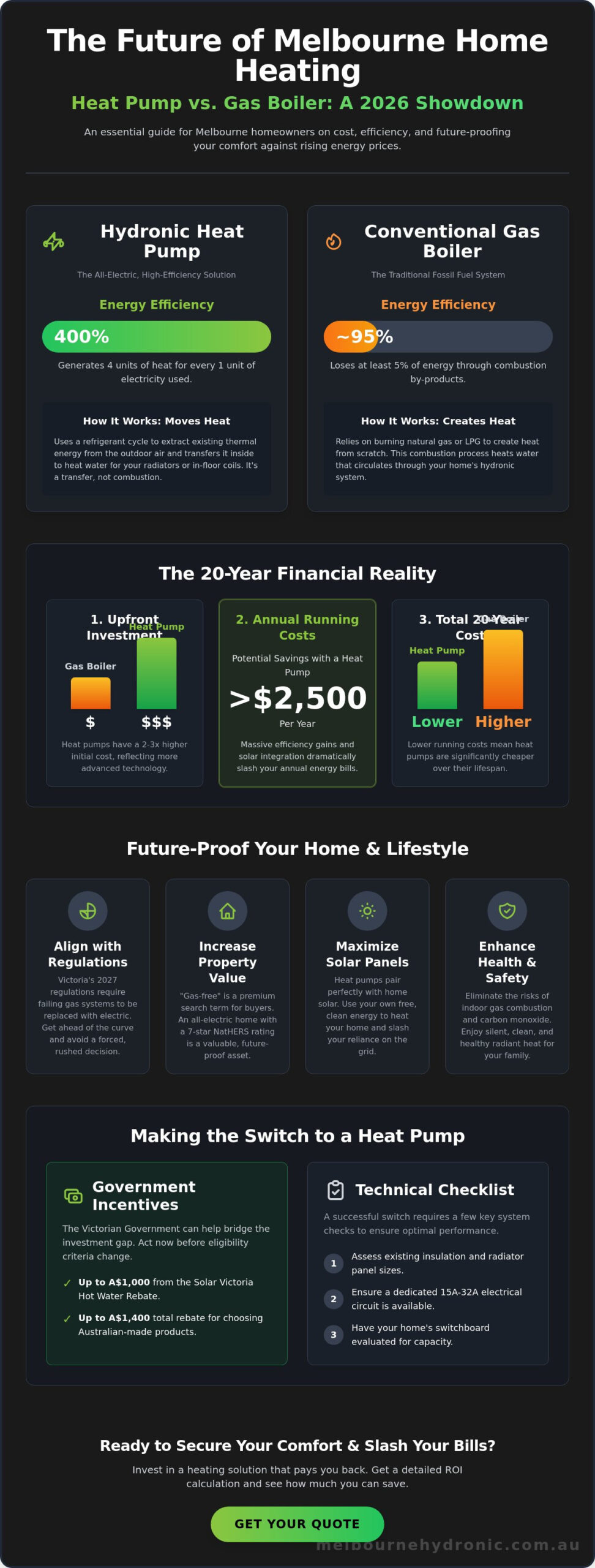
The fundamental difference between these two technologies lies in their thermal efficiency. A gas boiler is a “rapid fire” system, burning fuel to reach high temperatures quickly. While effective, it’s physically capped at roughly 95% efficiency. Heat pumps are “steady state” performers. They maintain a consistent, gentle warmth by being up to 400% efficient. This distinction is vital when considering What is Hydronic Heating? and why it remains the gold standard for comfort. You get the same luxurious radiant warmth through your floors or panels, but the method of delivery is evolving to meet modern standards of hygiene and sustainability. It’s a quieter, cleaner process that removes the risk of indoor combustion entirely.
Future-Proofing Your Melbourne Home
Victoria’s roadmap to net-zero emissions has fundamentally changed the residential landscape. From March 2027, the state will require gas hot water systems to be replaced with electric alternatives as they reach the end of their life. Choosing a heat pump in 2026 isn’t just about immediate efficiency; it’s about avoiding a stranded asset. Real estate trends in suburbs like Glen Iris and Brighton show that “gas-free” is a growing premium search term. Buyers want homes that already meet the 7-star NatHERS rating, and an electric hydronic system is often the most effective path to achieving that benchmark. It’s a strategic move that protects your property value while ensuring your family stays warm without relying on volatile fossil fuel markets. By investing in electric technology now, you’re aligning your home with a future where renewable energy and solar integration are the standard.
Upfront Investment: Installation Costs and Victorian Rebates
The most immediate hurdle for many homeowners is the “sticker price” gap. It’s a reality that electric heat pumps typically cost two to three times more than gas boilers for the initial unit and installation. This difference reflects the sophisticated technology inside a heat pump, which utilizes complex refrigerant cycles rather than simple burners. When calculating the hydronic heat pump vs gas boiler cost Melbourne families must budget for, it’s essential to look at the total system readiness, not just the box on the wall.
Switching to a heat pump often requires infrastructure updates. Because heat pumps operate most efficiently at lower flow temperatures, you might need to upsize your Hydronic Radiator Panels to ensure enough surface area is available to warm your rooms. There’s also the electrical side to consider. A standard gas boiler runs on a basic power point, but a heat pump requires a dedicated 15A to 32A circuit. Assessing your switchboard early is vital to avoid surprises. On the plus side, moving away from gas allows you to avoid the daily supply charges and potential gas abolishment fees, which adds up to significant long-term relief.
Victorian Government Incentives and Rebates
The Victorian government is actively easing the transition through several stackable incentives. The Solar Victoria Hot Water Rebate currently offers up to A$1,000 for eligible heat pump systems, which can increase to A$1,400 if you choose Australian-made products. You should act quickly if your household income is between A$150,000 and A$210,000, as the eligibility cap drops to A$150,000 on 1 July 2026. Additionally, the Victorian Energy Upgrades (VEU) program provides upfront discounts based on the energy efficiency certificates (VEECs) generated by your new system. We manage all this complex paperwork for you, ensuring every available dollar is deducted from your final quote.
Retrofitting vs. New Builds
Retrofitting a heat pump into an existing Bayside weatherboard home involves different challenges than a new build. Older homes may require pipework insulation and careful emitter sizing to maintain comfort levels. For those building from scratch, Underfloor Heating is the most cost-effective partner for a heat pump. By embedding the pipes in a concrete slab, you create a massive thermal mass that works perfectly with the steady, low-temperature output of electric systems. If you aren’t sure which path fits your floorplan, we can help you evaluate your home’s technical readiness for a seamless transition.
Running Costs: Comparing Gas Tariffs to Electric Efficiency
With the 5% climb in Victorian gas prices reported this June, the daily cost of staying warm has become a primary concern for local families. When we analyze the hydronic heat pump vs gas boiler cost Melbourne households actually experience, the conversation shifts from the unit price to operational efficiency. A high-efficiency condensing gas boiler is impressive, reaching roughly 95% efficiency, but it’s still burning a finite resource to create heat. In contrast, a heat pump utilizes a Coefficient of Performance (COP) typically between 3.5 and 4.0. This means for every 1kW of electricity consumed, the system delivers up to 4kW of heat into your living space. It doesn’t create heat; it captures and amplifies it from the ambient air.
Modern Heat Pump Hydronic Heating systems further enhance these savings through intelligent zoning. Unlike older central heating systems that warm the entire house regardless of occupancy, these setups allow you to heat only the rooms you’re using. This precision prevents energy waste in guest rooms or formal dining areas. Additionally, maintaining this efficiency requires consistent care. A well-serviced system ensures that pumps and heat exchangers operate without friction or blockages, keeping your running costs at their theoretical minimum year after year.
The ‘Solar Battery’ Effect
One of the most significant advantages for Melbourne homes is the ability to use your hydronic system as a “thermal battery.” If you have a solar PV system, you can run your heat pump during the day when the sun is out, essentially heating your home for free. The concrete slab in an underfloor system or the water in your radiator network holds that thermal energy, slowly releasing it throughout the evening. This strategy often provides a better return on investment than a chemical home battery. Instead of storing electricity to use later, you’re storing the actual warmth your family needs, bypassing the efficiency losses associated with battery charging cycles.
Gas vs. Electricity: A 10-Year Forecast
The financial argument for electrification grows stronger when you look at the long-term forecast. Beyond the cost of the gas itself, Melbourne residents pay significant daily supply charges just to stay connected to the network. By “getting off gas” entirely, the average household can save approximately A$300 per year in connection fees alone. While the Victorian Default Offer for electricity saw a 5% decrease in 2025, gas prices continue to trend upward as the infrastructure becomes more expensive to maintain for a shrinking user base. Furthermore, gas boilers suffer from gradual efficiency loss as they age, meaning they cost more to run every single winter, whereas a well-maintained electric system remains remarkably stable over its 20-year lifespan.
Total Cost of Ownership (TCO): The 20-Year Financial Reality
When evaluating the hydronic heat pump vs gas boiler cost Melbourne homeowners should project their expenses over two decades rather than two years. The initial savings of a gas boiler often vanish when you consider the replacement cycle. A standard boiler usually requires a complete unit replacement every 12 to 15 years as internal components like burners and heat exchangers succumb to the stress of constant combustion. In contrast, a premium electric heat pump is built to last 20 to 25 years. Over a quarter-century, you’ll likely pay for two gas boilers and two separate installation fees, while a single heat pump continues to operate reliably.
Maintenance remains a fixed requirement for both systems to ensure peak performance. Investing in a regular Hydronic Heating Service in Melbourne prevents the buildup of magnetite and ensures the refrigerant circuit in a heat pump or the gas valves in a boiler remain within factory specifications. While gas systems involve high-pressure combustion and potential carbon monoxide risks, heat pumps offer a “Health ROI” that’s harder to quantify but deeply felt. They provide a dust-free, non-combustion environment that’s safer for families, removing the risks associated with indoor gas appliances entirely.
The Payback Period: When Does the Heat Pump Win?
For most Melbourne residences, the payback period for a heat pump investment falls between five and eight years. This timeline accelerates significantly if you already have a 5kW+ solar PV system or if you’re heating a larger floor area where gas usage would otherwise be extreme. When you account for the rising cost of gas and the eventual need for a second boiler replacement, the “expensive” heat pump often becomes the most economical choice by the end of its first decade. It’s a shift from a monthly expense to a long-term home asset that pays for itself through avoided utility hikes.
Longevity in Melbourne’s Climate
Melbourne’s diverse climate, from the frosty Dandenong Ranges to the salt-laden air of Geelong and the Mornington Peninsula, tests the durability of any outdoor unit. High-quality European heat pumps are specifically designed with corrosion-resistant coatings to withstand these coastal conditions. Choosing a professional team to design and install your system ensures that your investment is protected from the elements, avoiding the high cost and stress of emergency boiler replacements during a mid-winter cold snap. By planning your upgrade now, you ensure your home remains a sanctuary of comfort for decades to come.
Choosing Your System: A 2026 Melbourne Decision Framework
Selecting the right heating solution isn’t just about the hardware; it’s about matching technology to your specific living situation. When weighing the hydronic heat pump vs gas boiler cost Melbourne families encounter, the decision often hinges on property readiness. A home with high-quality ceiling insulation and double-glazed windows is a perfect candidate for a heat pump. These homes retain the gentle, steady warmth produced by electric systems, allowing the unit to operate at its most efficient “steady state.” If your home is older and drafty, the rapid thermal output of a gas boiler might feel more effective, though it comes at a higher long-term operational price.
Your energy profile is the next critical factor. If you’ve already invested in a 5kW+ solar system, the financial argument for a heat pump becomes almost undeniable. You’re harvesting free energy to heat your water, bypassing the 5% rise in gas tariffs reported this June. Lifestyle also plays a part. Heat pumps are designed for “set and forget” operation, maintaining a consistent temperature throughout the day. If you prefer a system that you turn on only for a few hours of intense heat, a boiler might suit your habits, even if it’s less efficient over the long run. Balancing your immediate budget with these operational realities is the key to a comfortable home.
When to Choose a Gas Boiler
There are specific scenarios where a gas boiler remains a practical choice. If you’re undertaking a short-term “flip” renovation where the primary goal is to minimize immediate capital expenditure, the lower upfront cost of a boiler is attractive. Some inner-city terraces or compact apartments have zero outdoor space for a heat pump’s external unit, making a compact wall-mounted boiler the only viable option. Additionally, if your property has a restricted electrical supply and the cost of a switchboard upgrade is prohibitive, gas might be your temporary default while you plan for future electrification.
When to Choose an Electric Heat Pump
For homeowners planning to stay in their property for seven years or more, the electric heat pump is the superior investment. It’s the ideal choice for new builds aiming for 7-star efficiency ratings and full solar integration. Families with asthma or respiratory concerns also benefit greatly, as there’s no indoor combustion or risk of carbon monoxide. You should act quickly if your household income is above A$150,000, as the Solar Victoria rebate eligibility cap drops from A$210,000 on 1 July 2026. By selecting a heat pump now, you’re securing a future-proof asset that aligns with Victoria’s transition away from fossil fuels and protects your home’s resale value.
Securing Your Home’s Comfort for the Next Generation
Deciding on the right heating system is a choice that defines your home’s comfort and financial health for decades. While gas boilers provide a familiar and lower upfront entry point, the unmatched efficiency of electric heat pumps offers a clear path toward energy independence. This global shift toward high-efficiency climate control is supported by industry leaders like Ultra Air Heating and Cooling, who specialize in modern residential and commercial HVAC solutions. By integrating your system with solar PV and taking advantage of current Victorian incentives, you can effectively lock in your heating costs while shielding your family from volatile gas markets. It’s a strategic move that transforms a standard utility into a high-performing home asset.
The total hydronic heat pump vs gas boiler cost Melbourne homeowners experience is best understood through a personalized lens. As a family-owned Victorian business with 30+ years of specialist experience, we pride ourselves on delivering technical precision in both high-efficiency gas and electric heat pump installations. We’re here to help you weigh the technical readiness of your property against your long-term lifestyle goals to ensure your investment delivers maximum well-being.
Ready to see the real numbers for your floorplan? Request a Custom Hydronic Cost Comparison for Your Melbourne Home and take the first step toward a more sustainable, premium living environment. We look forward to helping you create a sanctuary of warmth that stands the test of time.
Frequently Asked Questions
Is a hydronic heat pump more expensive to run than a gas boiler in Melbourne?
No, a hydronic heat pump is significantly cheaper to run, often reducing annual heating bills by more than 50% compared to gas. While gas prices continue to trend upward, a heat pump uses electricity so efficiently that it delivers up to four units of heat for every unit of power consumed. This efficiency makes it the most cost-effective way to maintain a premium level of comfort in the Victorian climate.
How much does it cost to switch from a gas boiler to a heat pump?
A straightforward transition from a gas boiler to a hydronic heat pump typically starts from approximately A$15,000. This investment covers the high-efficiency outdoor unit, the dedicated electrical circuit required for operation, and any necessary plumbing modifications. While the upfront price is higher than a simple boiler-for-boiler swap, the long-term operational savings and government incentives help offset the initial capital expenditure.
Can my existing radiator panels work with a new heat pump?
Your existing panels can often be integrated into a new system, but they must be assessed for their thermal output at lower water temperatures. Heat pumps operate most efficiently at flow temperatures between 45°C and 55°C, whereas old gas boilers often ran at 70°C. We may recommend upsizing specific panels in larger rooms to ensure they provide enough surface area to warm your home effectively at these lower, more consistent temperatures.
What Victorian government rebates are available for hydronic heat pumps in 2026?
Eligible households can access the Solar Victoria rebate of up to A$1,000, which increases to A$1,400 for Australian-made systems. You can also benefit from upfront discounts through the Victorian Energy Upgrades (VEU) program. It’s important to remember that the combined household income limit for the Solar Victoria rebate will decrease to A$150,000 on 1 July 2026, so acting before this date is vital for many families.
Do heat pumps work effectively during Melbourne’s zero-degree winter nights?
Modern air-to-water heat pumps are engineered specifically to extract thermal energy even when outdoor temperatures drop to zero or below. They utilize advanced refrigerant cycles and automatic defrost functions to ensure consistent heat delivery during the coldest Victorian nights. You won’t experience a drop in indoor comfort, as the system is designed to maintain a steady, radiant warmth regardless of the frost outside.
How long is the payback period for a hydronic heat pump?
The typical payback period for a Melbourne home is between 5 and 8 years. This timeline is often shorter for families who have already installed a solar PV system, as they can run the heat pump using their own generated power. When analyzing the hydronic heat pump vs gas boiler cost Melbourne residents face over a decade, the avoided gas connection fees and lower running costs make the heat pump the more economical choice.
Is it worth keeping gas just for cooking if I switch to a heat pump?
Financially, it’s rarely worth keeping a gas connection solely for a cooktop. You’ll still be charged approximately A$300 per year in daily supply fees just to keep the account active. Most homeowners find that switching to a high-performance induction cooktop allows them to disconnect from the gas network entirely, which significantly increases the overall return on their electrification investment.
Which system adds more value to my Melbourne property?
An electric heat pump adds significantly more value to a property in the current market. With Victoria’s transition toward all-electric homes and the 2027 regulations on gas appliance replacements, buyers are prioritizing homes that are already “future-proofed.” An electric hydronic system helps achieve a 7-star NatHERS rating, positioning your home as a premium, energy-efficient asset that is cheaper to maintain and more environmentally responsible.