

Hydronic Heat Pump Cost Melbourne: 2026 Price & ROI Guide
Your old gas boiler isn’t just a heating system anymore; it’s a ticking financial clock. With Victorian regulations set to mandate electric replacements for failed gas units by early 2027, the choice to switch has moved from a “maybe” to a “when.” We understand that the initial hydronic heat pump cost in Melbourne can feel daunting, especially when you’re balancing rising gas prices against the promise of long-term efficiency. It’s a significant investment in your home’s comfort and well-being, and you deserve a clear picture of what that looks like in the current market.
This guide provides a transparent breakdown of installation versus running costs, tailored specifically for the 2026 energy landscape. You’ll discover how to navigate the latest Solar Victoria rebates, which now offer up to $1,400 for Australian-made products, and how the VEU program can further slash your upfront expenses. We’re going to show you exactly how a professionally designed electric system pays for itself through energy independence and premium, silent warmth. By the end, you’ll have the confidence to transition your home to a cleaner, more economical future.
Key Takeaways
- Understand how Victoria’s gas substitution roadmap and 2027 regulations make transitioning to electric hydronics a priority for Melbourne homeowners today.
- Identify the primary factors influencing the total hydronic heat pump cost melbourne, including equipment selection and the choice between radiator panels or underfloor heating.
- Compare the seasonal running costs of gas versus heat pumps and see how solar PV integration can further reduce your monthly energy bills.
- Learn how to stack 2026 Victorian Energy Upgrades (VEU) and federal STC rebates to significantly lower your initial investment and accelerate your return.
- Discover why specialized design and 30 years of local expertise are essential for ensuring your system provides the premium, silent comfort your home deserves.
Why Melbourne is Switching to Hydronic Heat Pumps in 2026
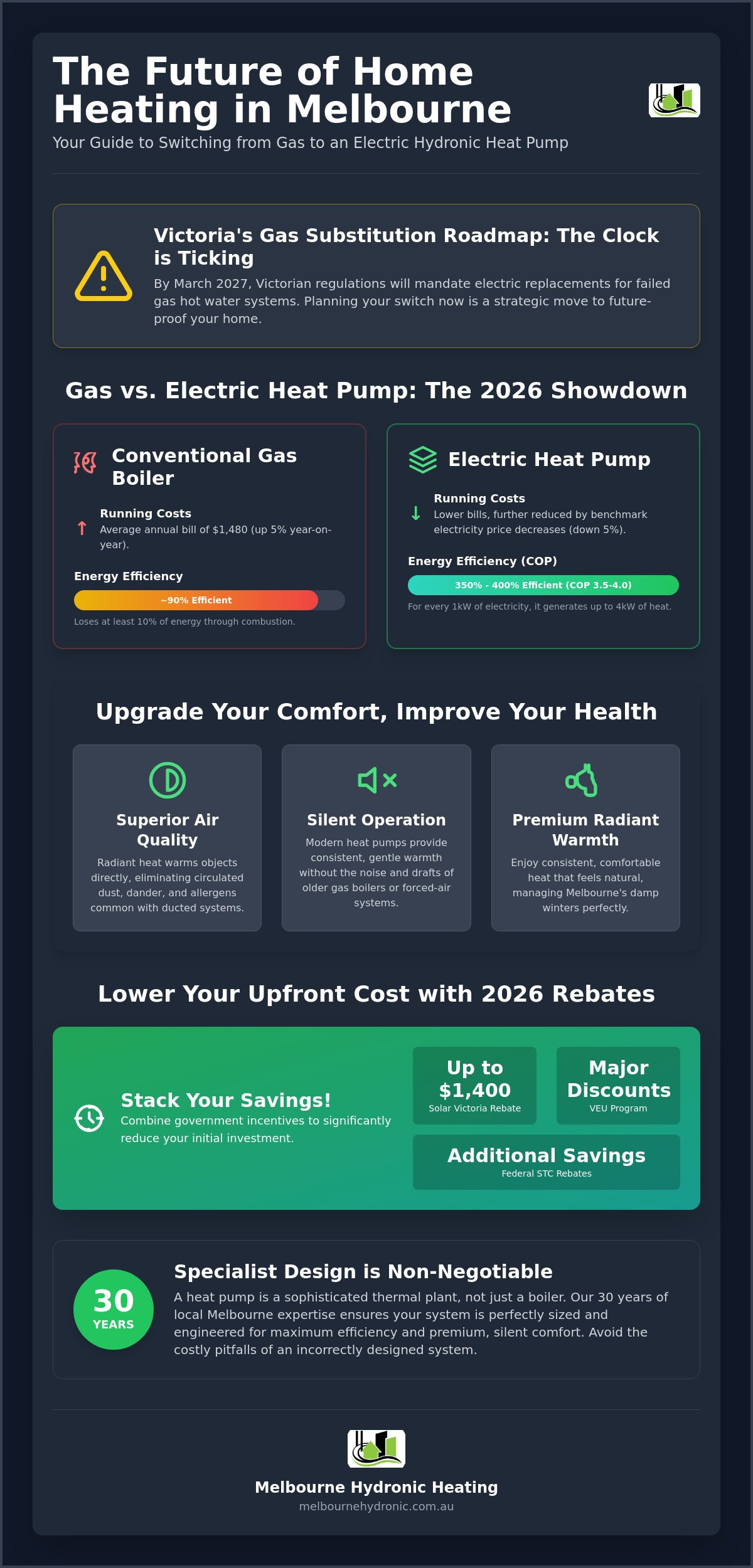
Melbourne’s energy landscape is changing faster than many homeowners expected. The Victorian Government’s Gas Substitution Roadmap has set a clear path toward electrification, making the decision to move away from gas boilers a matter of timing rather than preference. By March 2027, regulations will require failed gas hot water systems in existing homes to be replaced with electric alternatives. This shift makes understanding the hydronic heat pump cost melbourne a vital part of long-term home planning. It’s not just about compliance; it’s about securing a system that offers superior efficiency as gas prices continue to climb.
The Shift from Gas to Electric
For decades, gas was the default choice for Melbourne hydronics. Those days are over. In 2026, the average annual gas bill for a Victorian household reached $1,480, representing a 5% increase from the previous year. Meanwhile, benchmark electricity prices have seen a 5% decrease. This divergence makes electric systems significantly more attractive. By understanding how heat pumps work to move heat rather than create it through combustion, you can see why they are the most sustainable option for our local climate.
Transitioning to an all-electric home isn’t just a green choice. It’s a strategic move to future-proof your property’s value. The Melbourne real estate market increasingly prioritizes energy-independent homes, particularly those that have already decoupled from the gas grid. Investing in an electric heat pump now ensures you aren’t left with an obsolete system when you eventually decide to sell.
Health and Comfort Benefits
Beyond the financial logic, there’s a “health premium” associated with hydronic systems that traditional ducted heating can’t match. Standard split systems or ducted heaters rely on blowing hot air, which inevitably circulates dust, pet dander, and allergens throughout your living spaces. This can be a major trigger for asthma and allergy sufferers. Hydronic radiator panels and underfloor heating provide radiant warmth that heats objects and people directly. There are no drafts and no airborne particles, creating a much cleaner indoor environment.
Modern heat pump units also operate with a level of silence that gas boilers struggle to achieve. You get a consistent, gentle warmth that manages Melbourne’s damp, biting winters without the noise or dry air of older technologies. For those seeking year-round utility, these systems can also integrate with fan coils to provide energy-efficient cooling. While the initial hydronic heat pump cost melbourne might be higher than a basic gas replacement, the improvement in life quality and indoor air hygiene is immediate and profound. It’s an investment in your family’s daily well-being.
Breaking Down the Hydronic Heat Pump Cost
When you evaluate the total hydronic heat pump cost melbourne, you’re looking at more than just a replacement for a gas boiler. You’re investing in a sophisticated thermal energy plant. A standard installation includes the outdoor heat pump unit, a buffer tank to maintain consistent water volume, and advanced system controllers. Because these systems are more complex than traditional combustion heaters, the engineering and specialist design required represent a significant portion of the value. Our 30 years of local experience ensures that every component is sized precisely to avoid the inefficiency of an oversized system or the discomfort of an undersized one.
Heat Pump Unit vs. Gas Boiler Prices
The upfront price gap between a gas boiler and an electric heat pump is notable. However, this is justified by the technology’s efficiency. While a gas boiler might operate at 90% efficiency, a heat pump utilizes a Coefficient of Performance (COP) typically between 3.5 and 4.0. This means for every 1 kW of electricity consumed, the system delivers up to 4 kW of heat into your home. Brand selection also plays a major role in your budget. Premium European units often carry a higher price tag due to their superior acoustic insulation and long-term reliability, though high-quality local options are becoming increasingly competitive. To help manage these initial expenses, many homeowners utilize Victorian Government hot water rebates, which provide a point-of-sale discount for eligible heat pump installations.
Radiators vs. Underfloor: Impact on Budget
The method you choose to distribute heat through your home will change the final hydronic heat pump cost melbourne. Retrofitting hydronic heating panels is generally the most practical and cost-effective path for existing Melbourne homes. Panels are easier to install without major floor renovations and respond quickly to temperature changes.
In contrast, underfloor heating is often the preferred choice for new builds or major extensions. It requires a different heat pump configuration because it operates at lower water temperatures than radiators. When planning your budget, don’t forget to include functional luxuries like hydronic towel rails or trench heating for floor-to-ceiling glass areas. These additions enhance the premium feel of your home while utilizing the same energy-efficient heat source. If you’re ready to see how these options fit your floor plan, our specialists can provide a detailed system design tailored to your specific needs.
Finally, consider your home’s electrical infrastructure. Larger heat pump systems may require 3-phase power to operate at peak efficiency during Melbourne’s coldest nights. If your current switchboard isn’t up to the task, an upgrade will be necessary. While this adds to the initial labor cost, it ensures your system runs safely and reliably for decades to come.
Operating Costs and ROI: Is It Worth It?
Determining if the hydronic heat pump cost melbourne is worth the initial investment requires a shift in perspective from upfront price to long-term value. While a gas boiler creates heat through combustion, a heat pump harvests it from the ambient air. This fundamental difference means your daily running costs are no longer at the mercy of volatile gas tariffs. In 2026, the average annual gas bill for a Victorian household reached $1,480. By switching to an electric heat pump, you can significantly reduce these operational expenses, particularly when the system is paired with a solar PV array. Using your own generated power during the day to pre-heat your home’s thermal mass is the most effective way to achieve near-zero heating costs.
The lifespan of these systems is another critical factor in the ROI equation. A high-quality electric hydronic system is built to last 15 to 20 years, often outlasting modern condensing gas boilers. To ensure you reach this milestone, regular maintenance is essential. Scheduling a hydronic heating service Melbourne once every two years keeps the system running at peak efficiency. This proactive approach prevents small issues from becoming expensive repairs, protecting your investment for the long haul.
Efficiency in Melbourne’s Climate
Melbourne’s winters are notorious for damp, sub-5 degree nights that can challenge lesser heating systems. Modern air-to-water heat pumps are engineered to maintain high efficiency even in these cold snaps. However, the system’s performance depends entirely on precision design. An undersized unit will struggle to meet demand, while an oversized one will cycle on and off too frequently, wasting energy. Our 30 years of local expertise ensures your system is sized perfectly for your floor plan. Integrating smart thermostats further optimizes performance by scheduling heating cycles during off-peak energy windows or peak solar production hours.
Calculating the Payback Period
Your payback period is accelerated by several factors beyond just lower monthly bills. By removing gas entirely, you eliminate the daily gas supply charge, which can save a household roughly $300 per year in fixed fees alone. You can also offset the initial hydronic heat pump cost melbourne by accessing the Victorian Government’s hot water rebate, which provides a significant point-of-sale discount for eligible households.
To maintain your return on investment, the system’s internal hygiene must be preserved. Over several years, magnetite and sludge can accumulate within the pipework, acting as an insulator that forces the pump to work harder. This is why power flushing is a vital service for older systems or those being converted to heat pumps. By keeping the water clean and the heat exchange surfaces clear, you ensure the system operates at its maximum rated efficiency, keeping your running costs as low as possible for decades.
2026 Rebates and Incentives in Victoria
The Victorian energy landscape has shifted significantly in 2026, making the transition to electric systems a priority for the state government. While the initial hydronic heat pump cost melbourne is higher than traditional gas units, the available financial incentives have been designed to bridge this gap. By combining state-based rebates with federal certificates, homeowners can lower their out-of-pocket expenses while investing in a future-proof heating solution. These programs aren’t just about saving money; they’re part of a broader strategy to move Melbourne homes toward energy independence and away from rising gas tariffs.
Solar Victoria and VEU Schemes
As of July 1, 2026, the Solar Victoria Hot Water Rebate remains a primary source of support for those installing heat pump technology. The program now features a revised household income threshold of $150,000 per year, down from previous levels, to target support where it’s needed most. Eligible households can access a point-of-sale discount of up to $1,000 for standard heat pumps. If you choose Australian-made products, this incentive increases to $1,400, supporting local manufacturing while you upgrade your home’s comfort.
The Victorian Energy Upgrades (VEU) program is also evolving. A new activity specifically for hydronic space heating has been proposed, with a final response to public consultation expected in September 2026. This addition aims to incentivize the direct replacement of gas-fired hydronic boilers with high-efficiency heat pumps. When you book your hydronic heating installation, your specialist will require specific documentation, such as proof of income and existing system details, to process these claims on your behalf.
Maximizing Your Financial Support
Timing is a critical factor in securing the best possible ROI. Government programs often have capped allocations, so aligning your installation with the start of the financial year can be advantageous. It’s also vital to avoid “cheap” units that aren’t listed on the VEU or Solar Victoria approved product lists. Choosing a non-compliant system doesn’t just risk lower performance; it can completely disqualify you from thousands of dollars in rebates.
Federal Small-scale Technology Certificates (STCs) provide another layer of relief. These certificates are generated based on the expected carbon displacement of your system over its lifetime. Most reputable installers will quote your hydronic heat pump cost melbourne with the STC value already deducted, simplifying the process for you. Navigating these overlapping schemes requires professional guidance to ensure every eligibility box is checked. If you’re unsure which rebates apply to your property, our team can help you navigate the 2026 rebate landscape to maximize your savings.
Professional consultation is the best way to ensure your system design meets the strict technical standards required by these government bodies. A system that isn’t designed with the correct flow rates or buffer tank capacity may fail to meet the efficiency benchmarks necessary for rebate approval. We handle the technical complexities so you can focus on the long-term comfort and health benefits of your new system.
Choosing the Right Specialist in Melbourne
The technical success of your new system depends entirely on the expertise of the person who designs it. While the initial hydronic heat pump cost melbourne is a significant factor, the “cheapest” quote often results in the most expensive system over time. Poorly sized heat pumps or incorrectly spaced pipework lead to higher energy consumption and premature equipment failure. Selecting a specialist with 30 years of local industry experience ensures that your investment provides the premium, silent comfort you expect while operating at peak efficiency for decades.
A professional installation isn’t a one-off transaction; it’s the beginning of a long-term relationship with your home’s infrastructure. It is vital to choose a partner who offers dedicated local support for ongoing maintenance and hydronic heating repairs. If an issue arises during a mid-winter cold snap, you need a team that understands the specific hydraulic layout of your home and can respond quickly with technical precision.
What to Look for in a Quote
When you evaluate different proposals, ensure you’re comparing “apples with apples” by looking beyond the bottom line. A high-quality quote must include a full heat loss calculation for your specific property. This engineering step determines the exact wattage required to keep your home warm when Melbourne temperatures drop toward zero. Without this data, a system is merely a guess, which often leads to an oversized unit that cycles inefficiently or an undersized one that fails to provide comfort.
Check for comprehensive warranties that cover both parts and labor. You should also verify if the installer is a dedicated hydronic specialist or a general plumber. Hydronic design is a niche field that requires a deep understanding of water chemistry, flow rates, and thermal dynamics. A specialist will provide a detailed commissioning report at the end of the project, proving that the system meets its rated performance benchmarks.
This emphasis on specialized expertise and high-quality components is shared by other technical industries; for instance, those maintaining heavy machinery can discover Storm Parts Australia for expert support and reliable engine parts for Volvo, Caterpillar, and Komatsu equipment.
Why Melbourne Hydronic Heating?
We’ve spent three decades refining our specialized design process to meet the unique challenges of Melbourne and Geelong’s residential architecture. Our commitment to energy-efficient electric heat pumps means we don’t just install heaters; we create sustainable thermal environments. We manage the entire process from the initial consultation and heat loss analysis to the final commissioning of your system, ensuring every component integrates perfectly with your lifestyle.
Transitioning away from gas is a major step toward energy independence and improved home wellness. We’re here to provide the technical precision and reassuring expertise you need to make that move with confidence. If you’re ready to secure a future of clean, radiant warmth, Request a specialized hydronic quote today and let our experienced team design the perfect solution for your home.
Secure Your Home’s Future with Sustainable Comfort
Transitioning to electric hydronics is no longer just a luxury choice; it’s a strategic response to Victoria’s evolving energy landscape. By understanding the real-world hydronic heat pump cost melbourne, you can look beyond the initial price tag and focus on the decades of silent, dust-free warmth your family will enjoy. Between the significant 2026 government rebates and the elimination of rising daily gas supply charges, the path to energy independence has never been clearer or more financially viable.
As a family-owned and operated local business with over 30 years of Melbourne experience, we specialize in these high-efficiency electric integrations. We don’t just supply equipment; we design tailored thermal solutions that respect the unique architecture of our local area. Taking the first step toward a cleaner, healthier home starts with a consultation that prioritizes your long-term comfort and budget. Our expertise ensures your system is sized perfectly for maximum efficiency and reliability.
This dedication to long-term local service is mirrored by other established professionals in the region, such as the accounting experts at Brown Hamilton Partners, who have also supported the community with financial guidance for over three decades.
Get a Professional Hydronic Heat Pump Quote for Your Melbourne Home
We look forward to helping you create a living environment where premium comfort and environmental responsibility go hand in hand. Your journey toward a modern, gas-free home is an investment that will pay dividends in well-being and savings for years to come.
Frequently Asked Questions
How much does a hydronic heat pump cost to install in Melbourne?
The total price for installation depends on the specific design requirements of your home, including the number of radiator panels or the complexity of your underfloor layout. Factors such as your existing electrical infrastructure and whether you choose to integrate domestic hot water will also influence the final budget. A specialized design ensures you don’t overpay for an incorrectly sized system while maximizing your long-term energy savings.
Are there government rebates for hydronic heat pumps in Victoria?
Yes, there are several incentives available in 2026 to help offset the hydronic heat pump cost melbourne. Eligible households can currently access Solar Victoria rebates of up to $1,400 for Australian-made products or $1,000 for standard units. You can also benefit from federal Small-scale Technology Certificates (STCs) and specific discounts through the Victorian Energy Upgrades (VEU) program, which are typically applied at the point of sale.
Can I replace my existing gas boiler with a hydronic heat pump?
You can definitely replace a gas boiler with a heat pump, provided your system is professionally redesigned for lower water temperatures. Most existing radiator networks are compatible with modern heat pump technology, though we often integrate a buffer tank to ensure stable and efficient operation. This transition is an excellent way to future-proof your home before the 2027 gas replacement regulations come into effect.
How much will I save on my energy bills with a heat pump?
Your savings depend on your previous gas usage, but many households see a significant reduction in seasonal running costs due to the system’s high efficiency. Because heat pumps operate at 350% to 400% efficiency, they use far less energy than a traditional gas boiler to produce the same amount of warmth. You’ll also save roughly $300 per year by eliminating the daily gas connection fee if you move to an all-electric property.
Do hydronic heat pumps work well in Melbourne’s cold winters?
Modern heat pumps are engineered to provide consistent, radiant warmth even when Melbourne temperatures drop toward zero. They maintain a high Coefficient of Performance (COP) by extracting ambient heat from the cold outside air, even on damp winter nights. Precision sizing by a specialist with local experience ensures the system meets your home’s specific heat loss requirements during the peak of winter.
What is the difference between an air-source and a ground-source heat pump?
Air-source heat pumps extract thermal energy from the outside air, while ground-source systems utilize the stable temperature of the earth through buried pipes. Air-source units are the preferred choice for most Melbourne residential projects because they’re easier to install and don’t require extensive excavation. They offer a practical, high-efficiency solution that integrates perfectly with both radiator panels and underfloor pipework.
How long does a hydronic heat pump system last?
A high-quality hydronic heat pump system typically has an operational lifespan of 15 to 20 years when maintained correctly. This durability often exceeds that of modern gas condensing boilers, providing better long-term value for your investment. Regular servicing is essential to protect the internal components and ensure the system continues to operate at its peak rated efficiency for two decades.
Is underfloor heating more expensive to run than radiator panels?
Underfloor heating is generally more efficient to run because it operates at lower water temperatures, which allows the heat pump to work at its most efficient level. While radiator panels provide a faster response time when you turn the system on, underfloor systems excel at maintaining a steady, comfortable baseline temperature. Both options provide superior comfort compared to ducted systems, with the choice usually depending on your home’s construction.