
Hydronic Heating for Schools and Offices in Melbourne: The 2026 Commercial Guide
Could the very system meant to keep your building comfortable be the primary source of your facility’s biggest headaches? For many Melbourne facility managers, the constant hum of inefficient ducted systems and the sting of soaring energy bills have become an expected part of winter. You likely already know that traditional forced-air heating often circulates dust and creates distracting noise in classrooms or boardrooms. It’s a constant struggle to maintain consistent temperatures across large, open-plan layouts without watching your operational budget disappear.
In this 2026 commercial guide, you’ll discover how hydronic heating for schools and offices Melbourne transforms these challenging environments into energy-efficient, healthy, and ultra-comfortable spaces. We’ll show you how to leverage the latest National Construction Code 2025 updates and new Victorian regulations to your advantage. You’ll learn how modern electric heat pumps can significantly lower running costs while providing silent, allergy-friendly warmth that lasts for over 25 years. We are diving into the technical precision and long-term benefits that make hydronic systems the smartest investment for Melbourne’s commercial future.
Key Takeaways
- Learn why eliminating fan-forced air is the gold standard for creating asthma-friendly classrooms and improving student focus through silent, radiant heat.
- Explore how bespoke zoning and trench heating can maximise premium floor space and staff productivity in modern Melbourne CBD office layouts.
- Understand the financial and regulatory benefits of transitioning to electric heat pumps as Victoria moves away from commercial gas connections in 2026.
- Discover how professional installation of hydronic heating for schools and offices Melbourne provides a 25-plus year solution with significantly lower maintenance than traditional HVAC.
- Identify the critical design factors that ensure your commercial heating system meets the rigorous energy efficiency standards of the National Construction Code 2025.
The Evolution of Commercial Heating: Why Melbourne Schools and Offices are Switching to Hydronics
Melbourne’s commercial landscape is moving away from short-term fixes. For years, schools and offices relied on forced-air systems that were often treated as disposable appliances with limited lifespans. Today, the focus has shifted toward long-term infrastructure. Commercial Hydronics is a water-based method of climate control that circulates heated water through a sealed network of pipes. This energy is delivered via radiator panels, underfloor piping, or sleek trench heaters. Because Melbourne’s climate fluctuates so rapidly, the stability offered by water-based systems provides a level of comfort that air-based alternatives simply cannot match.
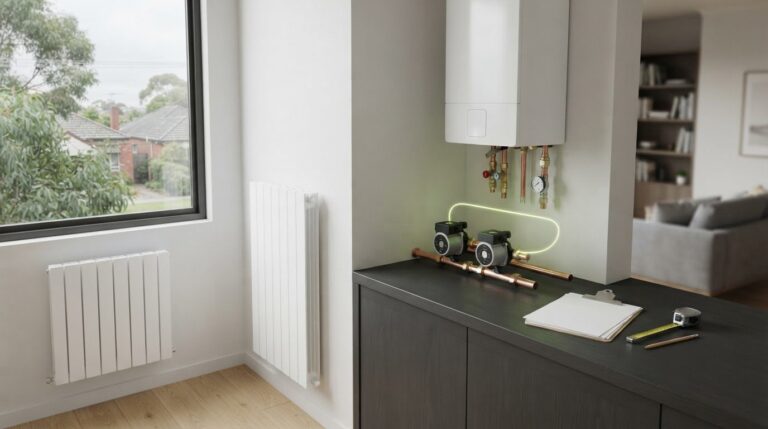
The core of these systems involves a central heat source, typically a high-efficiency gas boiler or a modern electric heat pump. This unit connects to various emitters designed to suit the specific architecture of the building. By choosing hydronic heating for schools and offices Melbourne, facility managers are investing in a system built for longevity and precision rather than a temporary solution. It’s a move toward permanent building infrastructure that adds tangible value to the property.
The Problem with Traditional Ducted Systems in Large Buildings
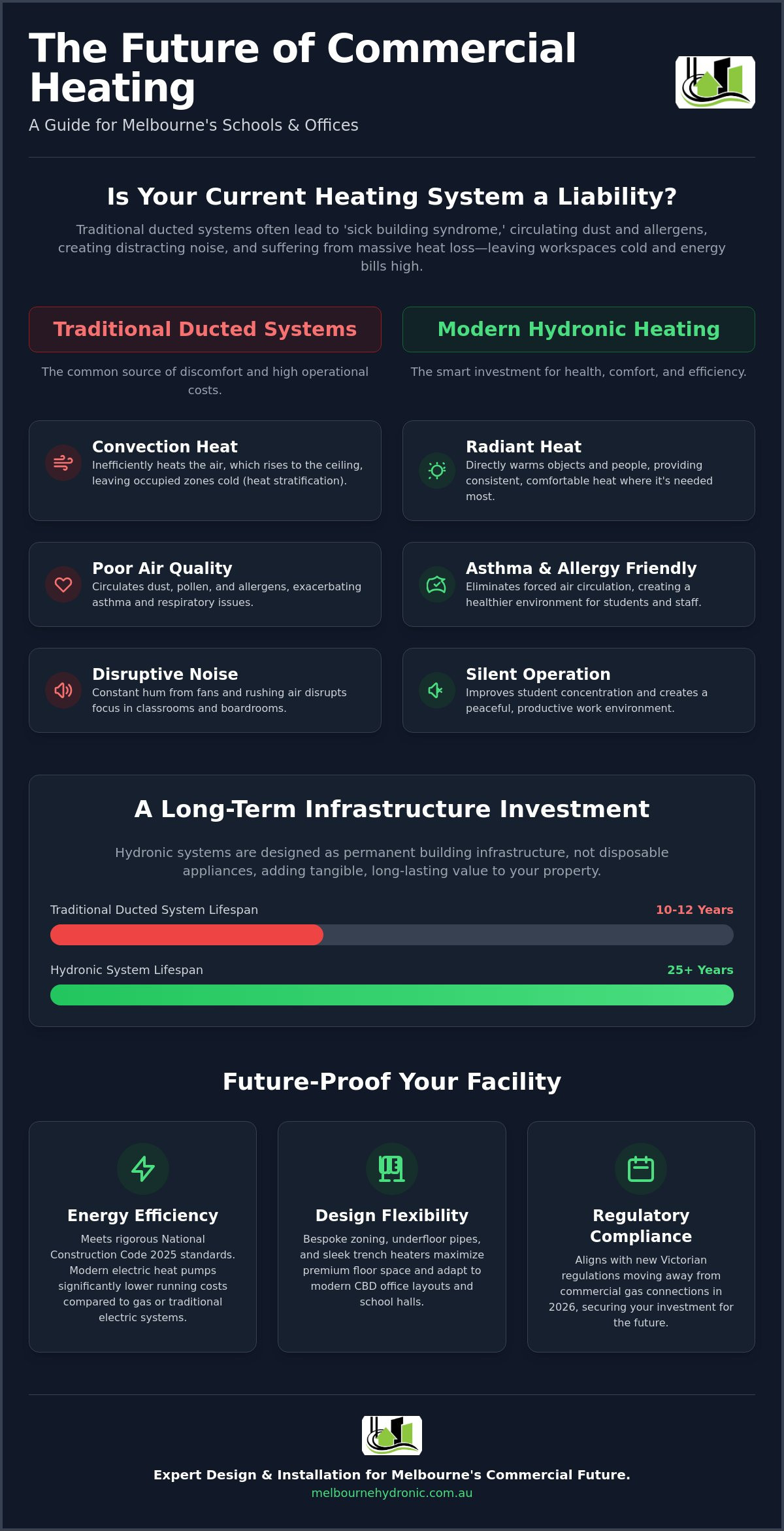
Traditional ducted systems often contribute to what experts call ‘sick building syndrome’. By constantly recirculating air, they move dust, pollen, and allergens throughout the entire facility. In a school setting, this can exacerbate respiratory issues for students; in an office, it impacts overall staff health. Acoustic pollution is another major drawback. The persistent drone of fan units and the rushing of air through ducts can significantly disrupt student learning and professional focus. These systems also suffer from heat stratification. Hot air naturally rises to the ceiling and stays there. This leaves the actual workspace or classroom floor cold while the energy bill continues to climb.
The Hydronic Advantage: Radiant vs. Convection Heat
The science behind radiant heat is what sets these systems apart. While convection systems try to warm the air, hydronic emitters warm objects and people directly. It’s the difference between a warm breeze and the direct heat of the sun. This method is far more effective for large school halls or open-plan office foyers with high ceilings. By leveraging the building’s thermal mass, the warmth remains consistent and low to the ground where it’s needed. A high-quality hydronic heating installation is designed to last 25 years or more. This far outpaces the typical 10 to 12-year lifecycle of standard commercial air conditioning units. It is a strategic choice for hydronic heating for schools and offices Melbourne that prioritizes long-term value over initial convenience.
Creating Healthier Classrooms: The Impact of Hydronic Systems on Student Wellbeing
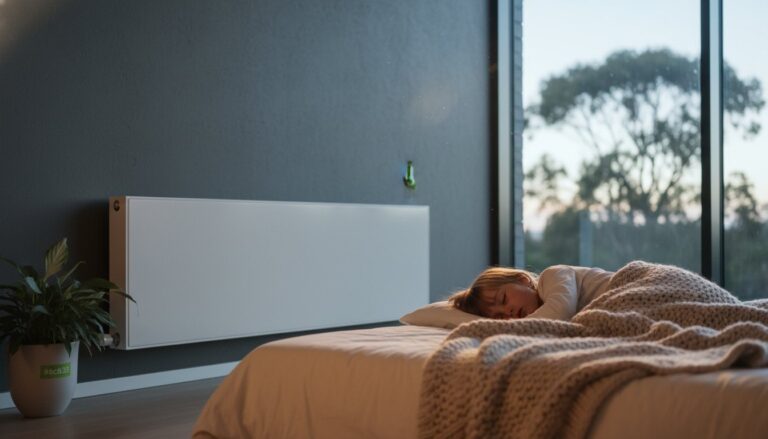
Design in educational spaces has evolved to prioritise the physical and mental health of students. When implementing hydronic heating for schools and offices Melbourne, the primary benefit isn’t just warmth; it’s the quality of the environment. Unlike traditional forced-air systems that blast air and circulate particulates, hydronic systems provide gentle radiant heat. This eliminates the “draft” effect, ensuring that the back of the room is just as comfortable as the front. This uniform distribution prevents cold spots that often lead to student disengagement during the colder Victorian months.
Safety remains a non-negotiable priority in school design. Modern hydronic systems utilise Low-Surface-Temperature (LST) radiators or hidden underfloor pipes to ensure there are no burn risks for younger students. These systems are designed to keep the casing cool to the touch while still delivering maximum thermal comfort. If you are planning a facility upgrade, you can consult with our local experts to determine which emitter style best suits your school’s specific traffic patterns and safety requirements.
Acoustics and Concentration in Learning Environments
Cognitive load is heavily influenced by background noise. Traditional split systems and ducted units often operate at 40 to 50 decibels, which can mask the teacher’s voice and disrupt concentration. Hydronic systems are virtually silent. This “Silent Classroom” factor is essential for students with sensory processing needs or those in neurodivergent-friendly environments. By removing mechanical hums, schools can improve speech clarity in libraries and exam halls, ensuring every student has an equal opportunity to focus. It’s a quiet revolution that directly supports better academic outcomes.
Hygiene and Air Quality Standards
Victorian health guidelines increasingly focus on indoor air quality as a pillar of student wellbeing. Because hydronic systems don’t rely on high-velocity air movement, they don’t spread airborne pathogens or stir up floor dust. This makes them the gold standard for asthma and allergy-friendly schools. For high-traffic corridors, hydronic heating panels are remarkably easy to clean and maintain compared to the intricate internal filters of ducted systems. This reduction in dust circulation directly correlates to fewer sick days and a more vibrant, healthy school community. It is a technical choice that serves a vital lifestyle and health purpose.
Maximising Office Productivity: Zoning, Trench Heating, and Modern Workspace Comfort
A cold employee is a distracted employee. In the competitive Melbourne corporate landscape, thermal comfort has transitioned from a basic utility to a critical tool for employee retention and workplace satisfaction. Alongside superior climate control, maintaining a pristine environment through professional services like Tidy Masters ensures that the modern workspace remains both healthy and inviting. When implementing hydronic heating for schools and offices Melbourne, the goal is to create an environment where the temperature is consistent, silent, and entirely unobtrusive. Unlike traditional systems that create “hot zones” near vents and “dead zones” in corners, hydronic systems provide a steady curtain of warmth that supports sustained focus throughout the workday.
This level of precision is achieved through advanced manifold systems and smart thermostats. By dividing an office floor into specific zones, facility managers can ensure that a sun-drenched corner office isn’t being overheated while a shaded boardroom remains freezing. This customisable approach doesn’t just improve comfort; it significantly slashes operational costs by ensuring energy is only directed where it’s needed. It’s a professional solution that respects both the wellbeing of the staff and the company’s bottom line.
Trench Heating for Glass Facades and High-Rise Offices
Modern Melbourne CBD offices often feature stunning floor-to-ceiling glass facades. While aesthetically pleasing, these windows are notorious for “cold downdrafts” during winter. As warm air hits the cold glass, it cools rapidly and “falls” to the floor, creating a chill at desk level. Hydronic trench heating provides the perfect architectural response. These units are recessed into the floor, usually along the perimeter of the glass, creating a thermal curtain that neutralises the cold before it enters the room. Because they sit flush with the floor, they preserve valuable premium floor space and integrate seamlessly with carpet, timber, or polished concrete finishes.
Smart Zoning and Energy Management
Efficiency in 2026 requires more than just a “set and forget” mentality. Modern commercial systems now integrate directly with Building Management Systems (BMS), allowing for automated scheduling based on actual occupancy data. For spaces that require a rapid thermal response, such as large boardrooms that remain empty for hours before hosting a major meeting, fan coils offer a strategic advantage. These units can quickly boost the temperature of a specific zone without needing to run the entire building’s heating at full capacity. This hybrid approach ensures that hydronic heating for schools and offices Melbourne remains the most flexible and energy-conscious choice for the modern workspace.
Future-Proofing Your Investment: Comparing Commercial Gas Boilers and Electric Heat Pumps
The energy landscape in Victoria reached a significant turning point on May 1, 2026, with the formal adoption of the National Construction Code (NCC) 2025. This update introduced mandatory on-site solar PV systems for new commercial buildings and set a clear trajectory away from new gas connections. For decision-makers overseeing hydronic heating for schools and offices Melbourne, this shift makes the choice of heat source a strategic financial decision rather than a simple utility preference. Electric solutions are now the primary driver for meeting corporate net-zero targets and school sustainability charters.
Selecting the right heat source for hydronic heating for schools and offices Melbourne requires balancing immediate capital expenditure with a 25-year operational outlook. If your facility already has an established radiator network, it’s often possible to retrofit the system by replacing a failing gas unit with an electric heat pump. This transition requires a detailed technical assessment to ensure the existing pipework can handle the lower flow temperatures typical of heat pumps; however, the long-term energy independence is a powerful motivator for most Melbourne organisations.
The Rise of Commercial Electric Heat Pumps
Electric units have become the gold standard for new developments due to their incredible efficiency. A modern air-to-water heat pump hydronic heating system can achieve a Coefficient of Performance (COP) of 4.0 or higher. This means for every 1 kW of electricity used, the system delivers 4 kW of heating energy. When paired with the solar PV arrays now mandated by the NCC 2025, schools can theoretically run their heating for near-zero operational costs during daylight hours. Noise is a factor in dense Melbourne suburbs, but professional placement and acoustic shielding ensure these units operate without disrupting the local community.
When to Choose a Commercial Gas Boiler
Despite the electric trend, a high-efficiency condensing boiler remains a viable path for specific scenarios. Heritage-listed schools or older CBD offices may have structural or electrical grid limitations that make a full electric transition difficult. Gas boilers provide high-output heating that is ideal for large-scale industrial wings or sprawling multi-wing campuses where rapid heat recovery is essential. To ensure these systems remain cost-effective, regular hydronic heating service melbourne is critical. Proper maintenance prevents the buildup of magnetite and ensures the system operates at its peak 95% efficiency.
If you’re unsure which path fits your building’s 2026 requirements, you can request a commercial feasibility study from our engineering team to compare long-term ROI and system compatibility.
Implementing Your Commercial System: Custom Design and Local Expertise in Melbourne
Every commercial building has a unique thermal fingerprint. A heritage school building in Kew requires a fundamentally different engineering approach than a glass-fronted office tower in Docklands. This is why hydronic heating for schools and offices Melbourne demands a bespoke design-and-build strategy rather than an off-the-shelf solution. We bring over 30 years of local Victorian experience to every project, ensuring that technical precision meets the specific climatic challenges of our region. Our team understands that commercial installations must be managed with surgical efficiency. We coordinate closely with facility managers to minimize disruption to school terms or active office hours, often performing the most intensive work during holiday breaks or after-hours.
Choosing a local expert means you’re partnering with someone who understands the 2026 Victorian regulatory environment. From the recent NCC 2025 energy mandates to the specific plumbing codes enforced by the new Building and Plumbing Commission, we ensure your system is fully compliant and optimized for the highest possible efficiency. It’s a professional partnership that prioritizes long-term reliability and the wellbeing of everyone who uses the space.
The Design and Supply Process
We begin every project with rigorous heat load calculations. This isn’t a “rule of thumb” exercise; it’s a detailed analysis of your building’s footprint, insulation levels, and window-to-wall ratios. Getting the sizing right prevents the energy waste of an oversized unit or the persistent discomfort of an undersized one. Selecting the right emitters is equally vital for the functionality of the space. While radiator panels are often the most practical fit for existing classrooms, underfloor heating provides a superior, invisible solution for high-traffic foyers and large communal spaces. We work seamlessly with architects and builders from the early planning stages of new commercial developments to ensure the hydronic infrastructure is perfectly integrated into the building’s design.
Maintenance and System Longevity
A commercial system is a 25-plus year investment, and protecting that asset requires a proactive maintenance schedule. One of the most effective tools in our arsenal is power flushing. Over time, internal corrosion can create a metallic sludge known as magnetite, which restricts water flow and forces the heat pump or boiler to work harder. By performing a professional high-velocity flush, we remove these contaminants and restore the system to its original factory efficiency. For educational institutions, we recommend scheduled maintenance plans during the summer months. This ensures that when the first Melbourne cold snap hits, your hydronic heating for schools and offices Melbourne is primed for peak performance. It’s about providing peace of mind through engineering excellence and local accountability.
Contact Melbourne Hydronic Heating for a commercial consultation today to discuss how we can future-proof your facility’s comfort and sustainability.
Securing Your Facility’s Comfort and Sustainability for 2026 and Beyond
Investing in high-quality hydronic heating for schools and offices Melbourne is more than a simple utility upgrade; it’s a strategic move toward building health and energy independence. By moving away from noisy, dust-circulating ducted systems, you’re prioritizing the wellbeing of students and the productivity of staff. Whether you choose to transition to a modern electric heat pump to meet the latest NCC 2025 standards or optimize an existing boiler system, the result is a stable, silent, and incredibly durable environment that serves your community for decades.
With 30-plus years of experience across Melbourne and Geelong, we specialize in the custom design, supply, and installation of commercial-scale projects. Our expertise covers both traditional gas boilers and the latest electric heat pump technologies, ensuring your system is perfectly tailored to your building’s unique requirements. We’re here to help you navigate the technical complexities of 2026’s energy landscape with confidence and precision.
Request a Commercial Design & Quote for Your Melbourne Project
Take the first step toward a more efficient and comfortable future for your facility today. Our team is ready to guide you through every stage of the process with the expertise your project deserves.
Frequently Asked Questions
Is hydronic heating more expensive to install in an office than split systems?
The upfront capital expenditure for a hydronic system is generally higher than standard split systems. However, this initial cost is balanced by significantly lower operational expenses and a lifespan that is often double that of air-based units. For Melbourne businesses, it’s a long-term infrastructure investment rather than a disposable appliance purchase.
Can we retrofit hydronic heating into an existing school building?
Retrofitting is entirely possible and common in established Melbourne schools. While new builds often allow for in-slab piping, older buildings utilize wall-mounted radiator panels or trench heating. We design these systems to work with existing structural constraints, often scheduling the most intrusive pipework during holiday periods to ensure zero disruption to the school term.
How much can a school save on energy bills by switching to hydronic heat pumps?
Schools can typically reduce their annual heating costs by 20% to 35% when switching from traditional gas ducted systems. By utilizing hydronic heating for schools and offices Melbourne powered by electric heat pumps, facilities can see even greater savings. Modern air-to-water heat pumps achieve a Coefficient of Performance (COP) of 4.0, delivering four units of heat for every unit of electricity consumed.
Are hydronic radiator panels safe for primary school children?
Yes, provided they are specified as Low-Surface-Temperature (LST) radiators. These specialized panels are designed so the external casing remains cool to the touch, preventing any risk of burns. They are the standard choice for primary schools and childcare centers, providing safe, radiant warmth without exposed hot surfaces or sharp edges.
How long does a commercial hydronic heating installation take?
A standard commercial installation typically takes between two to six weeks, depending on the building’s scale and complexity. For schools, we often split the project into phases across term breaks to minimize impact. A precise timeline is established during the design phase, ensuring all stakeholders are aligned before any work begins on-site.
What is the lifespan of a commercial hydronic system compared to ducted HVAC?
A professionally installed hydronic system has an expected lifespan of 25 years or more. In contrast, standard commercial ducted HVAC units often require replacement after 10 to 15 years. The durability of copper piping and high-quality radiators makes hydronic heating for schools and offices Melbourne a far more sustainable choice for long-term facility management.
Can hydronic systems also provide cooling for offices in Melbourne?
Yes, by utilizing fan coils connected to a reversible heat pump. While traditional radiators only provide heat, fan coils can circulate chilled water to provide effective cooling during Melbourne’s summer months. This allows a single hydronic network to manage the building’s climate year-round, though it requires specific design considerations for insulation and condensation management.
Does hydronic heating require a lot of maintenance in a commercial setting?
Maintenance requirements are lower than those of complex ducted systems, but they are more specialized. An annual service check and occasional power flushing to remove internal sludge are essential for maintaining peak efficiency. Just as facility managers rely on specialized experts like Independent Scale Service to maintain the accuracy of industrial weighing equipment, professional hydronic servicing ensures your heating infrastructure remains reliable for decades while keeping ongoing labor costs for facility teams significantly reduced.