
Integrating Solar with Hydronic Heating in Melbourne: The 2026 Efficiency Guide
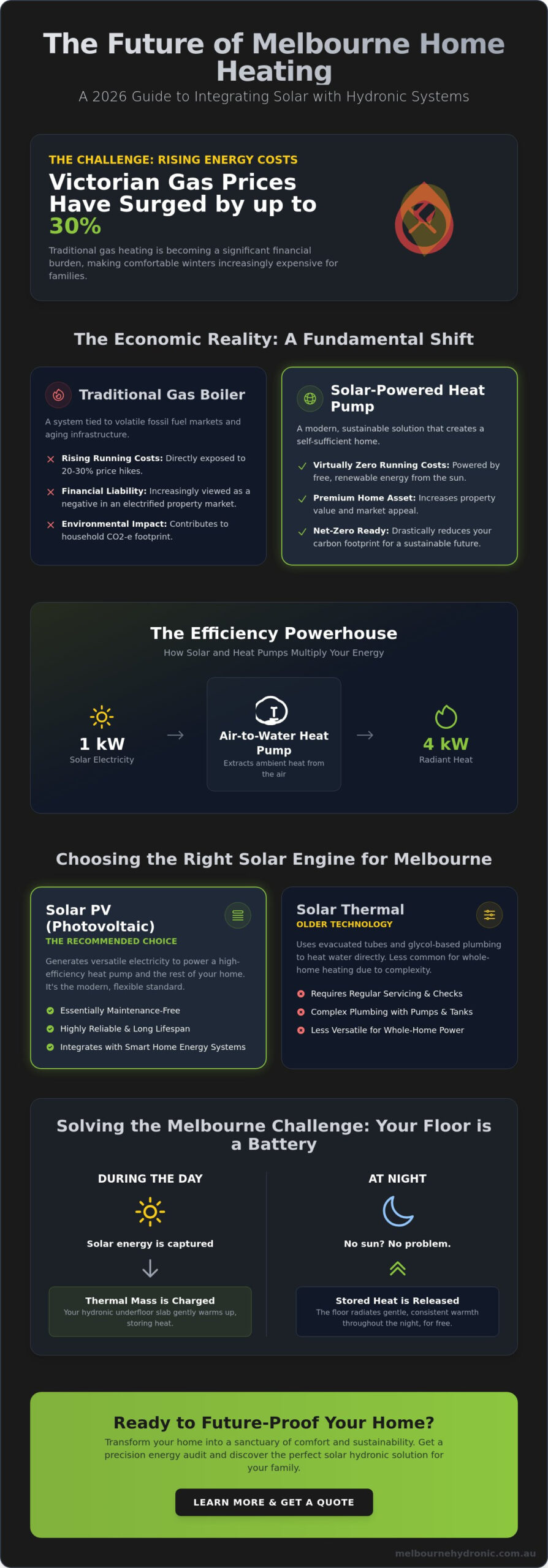
Could your home’s floor actually be the most efficient battery you own? With gas prices in Victoria rising by as much as 30% in recent cycles, the dream of a warm, cost-effective winter feels increasingly out of reach for many families. You might worry that Melbourne’s famously overcast July days won’t provide enough power to keep your radiators hot, or perhaps you’re confused by the technical jargon surrounding solar PV versus thermal systems. We understand these concerns because we live and work in the same climate you do.
By integrating solar with hydronic heating Melbourne homeowners can finally bridge the gap between premium comfort and environmental responsibility. This 2026 guide will show you how to slash your energy bills and achieve a carbon-neutral lifestyle by pairing high-efficiency electric heat pumps with renewable power. We’ll explore the best system configurations for our local weather, explain how to maximize the latest Solar Victoria rebates before the July income threshold changes, and reveal why your floor is the secret to “free” winter warmth. It’s time to transform your living space into a sanctuary of health and sustainable wellbeing.
Key Takeaways
- Learn why transitioning from gas to a solar-powered hydronic system is the most effective way to future-proof your home against rising Victorian energy tariffs.
- Understand the critical differences between Solar PV and Solar Thermal to determine which technology best suits your property’s specific heating demands.
- Discover how integrating solar with hydronic heating Melbourne systems turns 1kW of renewable energy into 4kW of heat through high-efficiency electric heat pumps.
- Master the “over-sizing” strategy to ensure your solar array provides enough power even during the shortest, coldest days of a Melbourne winter.
- Follow a professional step-by-step roadmap to upgrading your home, starting with a precision energy audit to select the perfect heat pump configuration.
The Shift to Solar-Hydronic Integration: Why Melbourne Homeowners are Decarbonising in 2026
Solar-hydronic integration is the synergy between renewable generation and radiant heat distribution. For many Melbourne families, this technology represents the definitive step in creating a truly self-sufficient home. By integrating solar with hydronic heating Melbourne households can capture free energy from the sun and transform it into the gentle, consistent warmth that only water-based systems provide. This shift is driven by more than just a desire for comfort; it’s a direct response to a rapidly changing energy landscape where gas is no longer the gold standard.
The “Melbourne Challenge” has always been the mismatch between when the sun shines and when we need heat. In the middle of July, peak solar gain occurs during the day, yet our homes demand the most warmth at night. Modern engineering solves this by using your home’s thermal mass as a battery. Whether it’s through hydronic underfloor heating or high-efficiency radiator panels, we can now store daytime solar energy within the very structure of your house. This approach also eliminates the health risks associated with indoor gas combustion, providing a cleaner environment for families concerned about respiratory wellbeing and indoor air quality.
Gas vs. Solar-Electric: The Economic Reality
The financial math has shifted dramatically. With gas prices in Victoria rising by 20% to 30% in recent cycles, the running costs of traditional gas boilers are becoming a significant burden for the average household. In contrast, an electric heat pump powered by a solar PV array offers a path to virtually zero running costs during the winter months. While a gas boiler might have a lower upfront price, it’s increasingly viewed as a liability in a market moving toward total electrification. Melbourne real estate data suggests that solar-ready, energy-efficient homes are now premium assets, often selling faster and holding value better than those tied to aging gas infrastructure.
The Environmental Impact of a Solar-Hydronic Home
Switching to 100% renewables isn’t just about saving money; it’s about a commitment to a net-zero future. A solar-hydronic system significantly reduces a household’s CO2-e footprint by replacing fossil fuel consumption with clean, harvested energy. This is why these systems are the backbone of high-performance “Passive House” designs across Victoria. Whether you utilize Solar water heating technology through evacuated tubes or use PV panels to drive a heat pump, you’re investing in a system that respects both the local environment and your family’s long-term comfort. It’s a professional, precise solution for a modern Melbourne lifestyle.
Solar PV vs. Solar Thermal: Choosing the Right Engine for Your Melbourne Home
Deciding between Solar Photovoltaic (PV) and Solar Thermal is the first technical hurdle for homeowners. Both systems harvest energy from the roof, but they do so in fundamentally different ways. When integrating solar with hydronic heating Melbourne residents are increasingly favoring Solar PV. This is because PV panels generate electricity that drives an electric heat pump, whereas solar thermal systems use evacuated tubes to heat water directly. The versatility of electricity makes PV a more flexible long term investment for the modern home.
Solar PV systems are essentially maintenance-free compared to their thermal counterparts. A PV setup involves simple electrical wiring and a central inverter. In contrast, solar thermal requires complex glycol-based plumbing, expansion tanks, and rooftop pumps that need regular servicing. Over a decade of operation, the reliability of a PV-driven heat pump usually outweighs the marginal efficiency gains of direct thermal collectors. If you’re looking for a system that just works without constant oversight, the electrical route is the professional choice.
Solar PV and Electric Heat Pumps: The Modern Duo
Air-to-water heat pumps are the heart of this configuration. They take one unit of solar electricity and multiply it into four units of heat by extracting energy from the ambient air. This setup integrates perfectly with Smart Home Energy Management Systems (HEMS). These systems allow you to pre-heat your slab or radiator panels during the sunniest part of the day, effectively storing energy for the evening. Homeowners can often offset these initial costs by accessing Victorian Government hot water rebates. It is worth noting that the household income threshold for this rebate drops from $210,000 to $150,000 on 1 July 2026, making now the ideal time to act.
Solar Thermal: When Does It Still Make Sense?
Solar thermal remains a powerhouse for specific high-demand scenarios. If you have a very large family or run a commercial space with constant hot water needs, evacuated tubes can be incredibly efficient. However, Melbourne’s winter presents a unique challenge. Without a massive storage tank, thermal systems can struggle to provide enough heat on consecutive overcast days. They also require a larger rooftop footprint to achieve the same heating load as a high-density PV array. If you’re unsure which setup fits your roofline, exploring a modern heat pump hydronic heating solution can clarify the best path forward for your specific floor plan.
Pairing Electric Heat Pumps with Solar: The Efficiency Powerhouse
The efficiency of an electric heat pump is not found in how much heat it generates, but in how effectively it moves it. Unlike traditional gas boilers or electric resistive heaters that create warmth through combustion or friction, a heat pump harvests existing thermal energy from the outdoor air. Integrating solar with hydronic heating Melbourne systems takes this a step further by using the sun’s free energy to drive the process. This creates a multiplication effect known as the Coefficient of Performance (COP). In a well-designed Melbourne home, 1kW of solar electricity can be transformed into 4kW of usable heat, making it four times more efficient than standard electric heating.
To maximize this efficiency, the system must operate at lower water temperatures. Modern hydronic heating panels are specifically engineered with larger surface areas to provide deep, radiant warmth even when the water is only 45 degrees Celsius. This lower temperature requirement allows the heat pump to work less and last longer. We also prioritize inverter-driven heat pumps to manage the “start-up” surge. These units ramp up their power consumption gradually, ensuring they stay within the limits of your solar inverter rather than drawing expensive peak-time electricity from the Victorian grid.
Using Underfloor Heating as a Thermal Battery
One of the most effective ways to bridge the gap between daytime solar production and evening heating needs is by treating your home as a battery. For homes with underfloor heating, the concrete slab acts as a massive thermal reservoir. By employing a “pre-heat” strategy, we program your system to run when the sun is at its peak. This charges the slab with thermal energy during the day. Because concrete has high thermal mass, it releases this radiant heat slowly over many hours. You’ll find the floor remains comfortably warm long after the sun goes down, providing a stable indoor climate without additional energy consumption.
Thermal Storage Tanks: The Alternative to Electrical Batteries
While chemical batteries are a popular choice for storing electricity, thermal storage is often a more cost-effective solution for heating. Buffer tanks allow you to store energy in the form of hot water, which is significantly cheaper than storing the equivalent energy in lithium-ion batteries. You can find more details on these technologies in the Australian Government guide to efficient hot water systems. A 500-litre buffer tank can store enough energy to provide consistent warmth throughout a typical Melbourne evening without needing additional power. This approach ensures your family stays warm during the coldest nights by utilizing the energy you harvested for free during the day.
Sizing Your System: How Much Solar Do You Need for a Melbourne Winter?
Correctly sizing your solar array is the difference between a system that merely offsets costs and one that provides total energy independence. When integrating solar with hydronic heating Melbourne homeowners must account for the shortest days of the year rather than the annual average. In June and July, Melbourne typically receives only two to three peak sun hours per day. This creates a significant energy gap compared to the twelve hours available in January. To ensure your heat pump has enough fuel during a cold snap, we often recommend an over-sizing strategy. Installing a 10kW PV system to power a 5kW heating load ensures that even on overcast days, you’re generating enough power to maintain a comfortable indoor temperature.
The success of this strategy also depends on your home’s envelope. Solar-hydronics perform best in houses with a high NatHERS rating, where high-quality insulation keeps the harvested heat trapped inside. While chemical battery storage is becoming more popular in 2026, many of our clients find that the thermal battery approach offers a better return on investment for space heating. By using a concrete slab or a large buffer tank, you can store energy as heat for a fraction of the cost of lithium-ion batteries. It’s a pragmatic solution that aligns with the specific climate challenges we face in Victoria.
Melbourne Climate Analysis: Solar Yield vs. Heating Load
Winter yield isn’t just about direct sunlight; it’s about maximizing diffuse light. Modern bifacial panels and cloud-tracking technology have improved winter performance by capturing reflected light from the ground and through cloud cover. While North-facing panels are ideal, East-West orientations are increasingly viable for hydronics. This layout allows for a longer, flatter generation curve. It matches the pre-heat cycle of a hydronic system better than a sharp midday peak, providing a steady stream of power from early morning until late afternoon.
The ‘Solar-Ready’ Checklist for Your Hydronic System
Before you commit to a solar array, your internal plumbing must be ready for the transition. Check your manifold compatibility to ensure it can handle the higher flow rates required by low-temperature water. If you’re currently using an old gas unit, consider upgrading your boiler to a solar-compatible electric heat pump. Modern systems also include smart monitoring apps. These tools show you exactly when your heating is running on 100% renewable energy, allowing you to adjust your thermostat to the rhythm of the sun.
To ensure your property is perfectly configured for the upcoming winter, speak with our consultants about a custom solar-hydronic sizing plan for your home.
Implementation: Steps to Integrating Solar with Melbourne Hydronic Heating
Successfully integrating solar with hydronic heating Melbourne homes requires a methodical approach that prioritizes engineering precision over guesswork. This transition is not as simple as placing panels on a roof; it’s about creating a synchronized ecosystem where renewable generation perfectly matches your home’s thermal demand. Following a structured implementation plan ensures you capture the maximum return on your investment while enjoying the premium comfort of radiant warmth.
- Step 1: Professional Energy Audit and System Design. We begin by assessing your property’s thermal envelope. This involves analyzing insulation levels, window orientation, and floor plan layout to determine the exact heating load required for the coldest Melbourne nights.
- Step 2: Selecting the Heat Pump. Choosing the right heat pump hydronic heating unit is critical. We match the unit’s capacity to your solar array’s output, ensuring the system can run efficiently even during low-light periods.
- Step 3: Navigating Incentives. We handle the technical documentation required for Solar Victoria rebates and Federal Small-scale Technology Certificates (STCs), ensuring you receive every dollar of government support available in 2026.
- Step 4: Precision Installation. Our technicians install the air-to-water heat pump, buffer tanks, and manifold systems with surgical accuracy. Commissioning includes programming your smart controller to prioritize “free” solar hours for peak operation.
- Step 5: Maintenance and Yield Optimization. Regular hydronic heating service in Melbourne is essential. Annual checks ensure your heat pump’s heat exchanger is clean and your solar panels are performing at their rated capacity.
Maximising Victorian Government Rebates in 2026
The financial landscape for electrification has never been more supportive for Melbourne residents. Currently, eligible households can access a Solar Victoria rebate of up to $1,000 for a heat pump system, which increases to $1,400 if you select an Australian-made product. When you combine this with the Victorian Energy Upgrades (VEU) program discounts, the total upfront savings can reach $2,030. It’s vital to act before 1 July 2026, as the household income threshold for these rebates will be reduced from $210,000 to $150,000. Our team guides you through the eligibility criteria to ensure your transition to a gas-free home is as cost-effective as possible.
Why Choose Melbourne Hydronic Heating for Your Solar Project?
With a 30-year history serving the Melbourne and Geelong communities, we offer a level of local expertise that “cookie-cutter” installers simply cannot match. We understand the specific climatic challenges of a Victorian winter and design systems that are robust enough to handle them. Our commitment to your wellbeing means we prioritize hygienic, dust-free radiant heat that improves your home’s air quality. We don’t just sell products; we provide a lifetime of comfort and sustainable energy security. Contact us today for a professional consultation and solar-hydronic quote to start your journey toward a carbon-neutral home.
Secure Your Energy Independence and Home Comfort
Transitioning to a gas-free home is no longer just an environmental choice; it’s a strategic move for long-term financial stability. By integrating solar with hydronic heating Melbourne homeowners can finally enjoy a warm, healthy living environment without the burden of rising gas tariffs. We’ve explored how the combination of high-efficiency electric heat pumps and solar PV creates a powerful synergy, turning your concrete slab or buffer tank into a thermal battery that carries you through the coldest Victorian nights.
With over 30 years of local experience, we specialize in seamless solar-electric heat pump transitions that are tailored to your specific floor plan. As a Victorian Energy Upgrade (VEU) accredited provider, we ensure you maximize every available government incentive while the 2026 rebate windows remain open. Don’t leave your winter comfort to chance. Book Your Solar-Hydronic Consultation with Melbourne’s Experts today and take the first step toward a cleaner, more cost-effective future. Your journey to a sustainable, premium lifestyle starts with a single, expert conversation.
Frequently Asked Questions
Can solar panels run hydronic heating on a cloudy Melbourne day?
Yes, solar panels continue to generate electricity on cloudy days, though their total output is reduced. Modern bifacial panels are particularly effective at capturing diffuse light that filters through cloud cover. By integrating solar with hydronic heating Melbourne homeowners can use energy harvested during sunnier periods, stored in thermal buffer tanks or concrete slabs, to maintain a consistent temperature when the sky is overcast.
How much money can I save by integrating solar with my hydronic system?
You can reduce your hot water energy costs by 60% to 70% by switching from a gas system to a solar-powered heat pump. This typically saves a family between $600 and $700 annually on hot water alone. Given that gas prices in Victoria have risen by up to 30% in recent cycles, the savings on space heating are even more substantial over the system’s lifespan.
Do I need a battery to use solar for hydronic heating at night?
You don’t necessarily need a chemical battery to enjoy solar warmth after sunset. We recommend using your home’s concrete slab or a large water buffer tank as a “thermal battery” instead. By pre-heating these elements during the day when your solar production is at its peak, you store “free” energy as heat. This radiant warmth is then slowly released throughout the evening.
Is it better to use solar PV or solar thermal for hydronic heating in Victoria?
Solar PV paired with an electric heat pump is the current gold standard for Melbourne homes. While solar thermal is efficient for heating water directly, PV panels are more versatile because they can power your entire household. PV systems also have lower maintenance requirements than glycol-based thermal collectors, making them a more reliable long-term investment for the average residential property.
Can I retrofit solar integration to my existing hydronic gas boiler system?
Retrofitting is a straightforward process that involves replacing your existing gas boiler with an air-to-water electric heat pump. Our team specializes in these transitions, connecting the new heat pump to your current hydronic radiator panels or underfloor pipework. This allows you to disconnect from the gas grid entirely and future-proof your home against upcoming Victorian gas regulations and price volatility.
How many solar panels do I need to power a hydronic heat pump?
Most Melbourne households require a solar array between 6kW and 10kW to effectively support a hydronic heat pump in winter. This over-sizing strategy is essential because it ensures you generate enough power even during the short, two-to-three-hour sun windows typical of June and July. A larger array helps maintain a carbon-neutral home without needing to draw expensive peak-time power from the grid.
What is the best type of heat pump for solar integration in Melbourne?
An air-to-water electric heat pump with inverter technology is the most efficient choice for solar-ready homes. These units are designed to modulate their energy consumption to match the real-time output of your solar panels. This prevents sudden spikes in electricity demand and ensures you’re using as much of your own harvested energy as possible to maintain a gentle, radiant indoor climate.
Are there Victorian government rebates for solar-hydronic heating in 2026?
Yes, Victorian residents can access several incentives to reduce the cost of integrating solar with hydronic heating Melbourne systems. The Solar Victoria rebate currently provides up to $1,000 for heat pumps, or $1,400 for eligible Australian-made products. When combined with Victorian Energy Upgrades (VEU) discounts, total savings can reach $2,030, though you should act before the income threshold drops on 1 July 2026.