

Getting Council Approval for Heating System Upgrade Victoria: 2026 Guide
Most Victorian homeowners assume that getting council approval for heating system upgrade Victoria projects is just a single piece of paper, but the reality is a three-tier compliance check that could save you thousands in fines. It’s easy to feel overwhelmed by the conflicting advice surrounding heritage overlays, EPA noise limits, and building standards. You’ve likely spent hours researching energy-efficient hydronic radiator panels or heat pumps, only to hit a wall of technical jargon and regulatory red tape.
We understand that you want a warm, comfortable home without the stress of a legal headache or a dispute with your neighbours over external unit noise. This guide simplifies the entire landscape, ensuring your new system meets every Victorian Building Authority (VBA) safety standard while keeping you fully compliant with local planning laws. We’ll provide a clear checklist of when a permit is actually required, show you how to leverage the VEU scheme for your hydronic upgrade, and explain the 2026 regulations that protect your investment and your peace of mind.
Key Takeaways
- Distinguish between local Planning Permits and mandatory VBA Building Permits to streamline your project and avoid costly legal delays.
- Identify if your home is subject to a Heritage Overlay and learn the aesthetic requirements for external heat pump units to maintain local compliance.
- Navigate the EPA Victoria Noise Protocol by calculating correct decibel setbacks, ensuring your system operates quietly and legally during prohibited hours.
- Secure your investment by getting council approval for heating system upgrade Victoria through a licensed professional who provides mandatory VBA safety certificates for all works.
- Adopt a “Design-First” methodology to ensure your hydronic radiator panels or underfloor heating systems are fully compliant before the first pipe is laid.
Understanding Victoria’s Regulatory Framework for Heating Upgrades
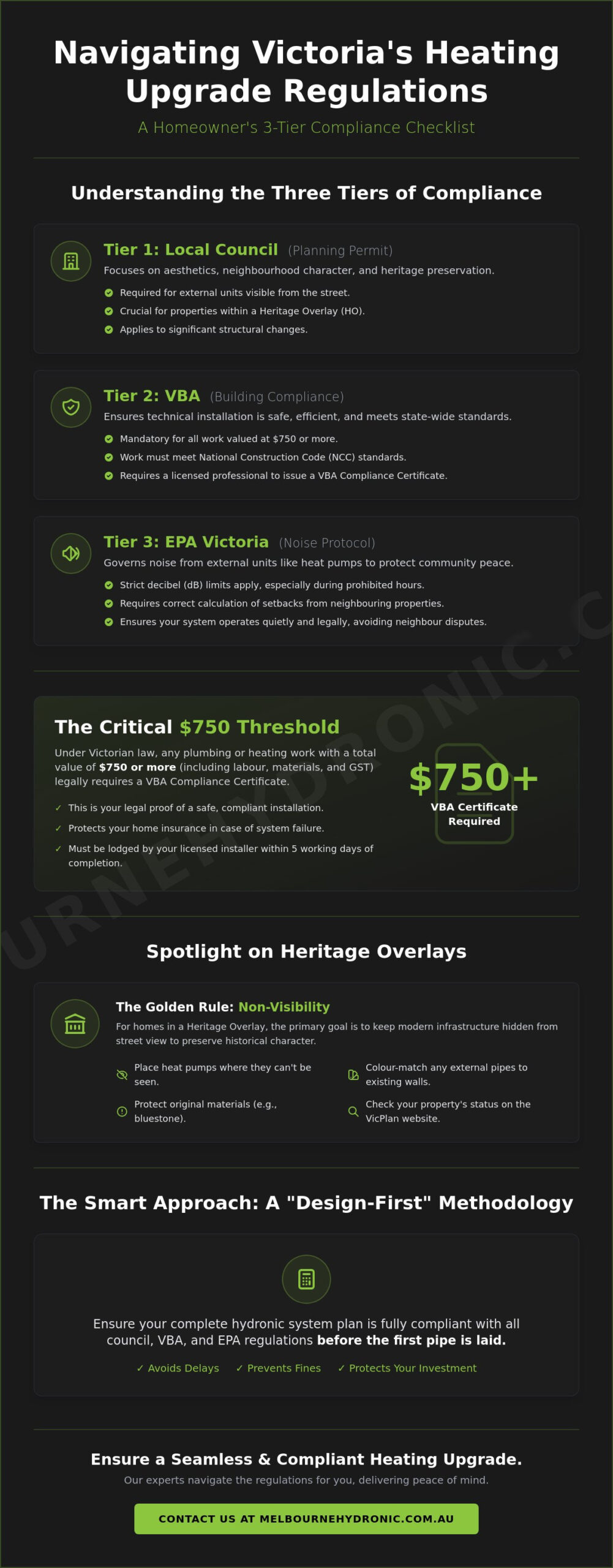
Many homeowners assume that getting council approval for heating system upgrade Victoria projects involves a single application to their local town hall. In reality, Victoria operates under a dual-layered regulatory system. You’ll deal with two distinct types of “approval”: Planning Permits, managed by your local council, and Building Compliance, overseen by the Victorian Building Authority (VBA). While the council focuses on how your home looks and impacts the neighbourhood, the VBA ensures the technical installation is safe and efficient.
For most residential properties, internal components like hydronic radiator panels or trench heating are considered “exempt” from standard building permits. This is because these upgrades typically don’t alter the structural integrity of your home. However, the work still falls under the National Construction Code (NCC), which dictates the minimum standards for safety and energy performance. Even if you don’t need a permit from the council, you must still comply with state-wide technical regulations.
The most critical legal benchmark to remember is the $750 threshold. Under Victorian law, any plumbing or heating work that costs $750 or more, including labour, materials, and GST, requires a VBA Compliance Certificate. Your licensed installer must lodge this certificate within five working days of finishing the job. This document is your legal proof that the system meets Energy Safe Victoria (ESV) standards and the high benchmarks set by the VBA.
When do you actually need a Council Planning Permit?
While internal work is often exempt, external changes are where local councils step in. If you’re installing an electric heat pump, the unit’s placement is vital. If the unit is visible from the street or positioned near a boundary, your council may require a Planning Permit to ensure it doesn’t clash with the local character. This is especially common in multi-unit developments or apartment complexes where shared space and noise aesthetics are strictly managed. If your underfloor heating installation requires significant structural changes, such as cutting into a load-bearing slab, you’ll likely need to consult your local planning department before proceeding.
The Role of the Victorian Building Authority (VBA)
The VBA acts as the ultimate guardian of Victorian building standards. They ensure that every technician working on specialized hydronic systems holds the correct license for both gas and pressure-piping work. The VBA maintains strict jurisdiction over all gas fitting, pressure-piping, and regulated plumbing systems to protect Victorian households from substandard workmanship. Without a valid Compliance Certificate, your home insurance might be voided in the event of a system failure. This certificate isn’t just paperwork; it’s a safety net that guarantees your upgrade has been pressure-tested and verified by a qualified professional.
Navigating Heritage Overlays and Planning Permits in Melbourne
Melbourne’s architectural history is a point of pride, but it adds a layer of complexity when getting council approval for heating system upgrade Victoria projects. If your home sits within a Heritage Overlay (HO), almost any external alteration requires a Planning Permit. You can check your property’s status through the VicPlan website or your local council’s planning portal. Properties are often classified as either “Significant” or “Contributory.” A “Significant” building is an individual landmark, while a “Contributory” home supports the historic character of the street. Both classifications carry strict rules about preserving the original facade and ensuring modern additions remain discreet.
The primary goal for heritage planners is maintaining the “non-visibility” of modern infrastructure. For those installing electric heat pumps, this means the unit must be placed where it cannot be seen from the street or public thoroughfares. Pipework is another consideration. Councils often require external pipes to be colour-matched to the existing walls or tucked behind original downpipes. These rules are part of Victoria’s building regulatory framework, which balances modern comfort with historical preservation.
Common Council Restrictions in Established Suburbs
In suburbs like Kew (Boroondara), Richmond (Yarra), or Albert Park (Port Phillip), planners are particularly protective of original materials. You might face restrictions on drilling through 19th-century bluestone foundations or original red brickwork. Inside the home, placing hydronic radiator panels under original leadlight windows or next to ornate timber skirting boards requires careful planning to avoid damaging historical features. Some councils even specify the type of mounting brackets allowed to ensure the installation is reversible. It’s often better to run pipework through floor voids rather than disturbing original plasterwork.
Applying for a Planning Permit: The Homeowner’s Checklist
A successful application depends on the quality of your documentation. You’ll need a clear site plan showing the exact location of the external unit, detailed elevations illustrating its height relative to fences, and manufacturer specifications for the heat pump model. Most Victorian councils take between four to eight weeks to process these applications in 2026. If you’re feeling overwhelmed by the paperwork, our team can help by providing the professional technical drawings and specifications needed to satisfy local planning departments. Having a clear design from the start significantly increases your chances of a stress-free approval and ensures your system remains fully compliant.
Heat Pump Noise Regulations and EPA Compliance in Victoria
Getting council approval for heating system upgrade Victoria projects often hinges on how well you manage acoustics. While modern electric heat pumps are remarkably efficient, they must operate within the strict EPA noise regulations to avoid neighbour disputes. These rules are designed to protect the quiet enjoyment of residential areas, particularly during the night. In Victoria, the Environment Protection Regulations 2021 define prohibited times for heating systems. For your heat pump, this means the unit shouldn’t be audible inside a neighbour’s bedroom or living area before 7 am or after 10 pm on weekdays. On weekends and public holidays, that morning restriction extends until 9 am.
Calculating “Decibel Setbacks” is a technical requirement for any compliant installation. This process determines the minimum distance required between the outdoor unit and the nearest window of a neighbouring property. If the unit’s sound pressure level exceeds the allowed limit at the boundary, the council may require an acoustic enclosure. These specialized cabinets are engineered to dampen sound waves while maintaining the high airflow required for the heat pump to function at peak efficiency. Getting these calculations right during the design phase ensures your system is legal from day one.
Selecting the Right Location for Your Heat Pump
The physical placement of your unit significantly impacts its noise profile. We generally advise against placing units in narrow side-passages, as these areas can act like echo chambers, bouncing sound off brick walls and amplifying the decibel level. Mounting choice is equally important. While wall-brackets save space, they can sometimes transmit vibrations through the home’s structure. We prefer ground-slab mounting on a dedicated concrete base with high-quality rubber isolators to keep operation whisper-quiet. For more detailed placement strategies, see our guide on heat pump hydronic heating.
Testing and Documenting Compliance
Manufacturer data sheets can be confusing, often listing both Sound Power Level (Lw) and Sound Pressure (Lp). Lw represents the total sound energy the unit emits, while Lp tells us how loud it sounds at a specific distance, such as three or five metres. A professional site assessment translates these laboratory numbers into real-world compliance for your specific property layout. This documentation is vital if a council officer ever visits following a neighbour’s query. Ensuring the final installation adheres to all EPA Victoria noise protocols and residential standards is the legal responsibility of your licensed installer.
The VBA Compliance Process: Your Real Safety Net
While the local town hall manages the aesthetic impact on your street, the Victorian Building Authority (VBA) focuses on the technical integrity of your home. Safety isn’t optional. When you’re getting council approval for heating system upgrade Victoria projects, the final piece of the puzzle is always the VBA Compliance Certificate. This document isn’t just a receipt; it’s a legal guarantee that your system has been installed by a licensed professional who assumes total liability for the work. The process begins with verifying your installer’s license. You must ensure they hold specific endorsements for hydronic heating and gas fitting if you’re installing a boiler.
The installation phase includes mandatory safety pressure testing. This step is vital for hydronic systems, where water circulates through a network of pipes at specific pressures. Your installer will test the system to ensure there are no leaks before the final commission. Once the work is complete, the licensed plumber is legally required to lodge the Compliance Certificate via the VBA’s online portal within five working days. You’ll receive a copy of this certificate, which triggers your mandatory six-year warranty on workmanship. This protects you against any defects that might arise long after the initial installation.
Why a Compliance Certificate is Non-Negotiable
Skipping this step can have severe legal ramifications. If you decide to sell your house, you’re legally required to disclose any uncertified building or plumbing works. A missing certificate can stall a sale or force you to pay for expensive retrospective inspections. Furthermore, most manufacturers will void your warranty on boiler replacements if they can’t see proof of a compliant installation. In 2026, this certificate is also the primary gatekeeper for the Victorian Energy Upgrades (VEU) rebates. Without it, you simply won’t be eligible for the financial incentives that make these systems so cost-effective.
Gas to Electric Transitions: Specific 2026 Rules
As Victoria moves toward electrification, many homeowners are switching from gas boilers to electric heat pumps. This transition requires a coordinated effort between trades. A licensed plumber must safely cap old gas lines and decommission the existing unit according to current safety standards. Simultaneously, an electrician must verify that your switchboard can handle the increased load of a modern heat pump. Both professionals must lodge their respective compliance documents. When getting council approval for heating system upgrade Victoria, ensure your team is communicating to avoid gaps in your documentation. To ensure your home meets every 2026 standard, you can book a professional compliance assessment with our experienced team.
Strategic Planning with Melbourne Hydronic Heating: Seamless Upgrades in 2026
With over 30 years of experience in the local industry, we’ve refined a process that takes the guesswork out of getting council approval for heating system upgrade Victoria projects. We don’t just install equipment; Melbourne Hydronic Heating engineers solutions that respect both your home’s architecture and the state’s strict regulatory environment. Our deep understanding of Melbourne’s diverse suburbs means we’ve already navigated the specific requirements of councils from Boroondara to the Surf Coast. This local knowledge ensures your upgrade isn’t just a technical success, but a fully compliant one that adds long-term value to your property.
Our “Design-First” approach is the cornerstone of our service. Before a single pipe is laid or a radiator panel is mounted, we conduct a comprehensive assessment of your property’s legal and physical constraints. We identify potential hurdles with heritage overlays or EPA noise boundaries early in the planning stage. By addressing these factors during the design phase, we prevent the costly delays and retrofitting issues that often plague unmanaged or cut-price installations. Our systems are built to exceed VBA and EPA standards. We handle the details.
From Consultation to Compliance: Our Workflow
Our methodology is structured to provide total peace of mind. Every project begins with an initial site audit where we evaluate existing infrastructure and identify any specific council risks. We then develop a custom system design tailored to Melbourne’s unique climate, whether you’re opting for hydronic underfloor heating or high-efficiency electric heat pumps. The final handover is the most critical step. We provide you with a complete documentation suite, including your mandatory VBA Compliance Certificate and detailed operation manuals. This ensures your six-year workmanship warranty is fully activated and your system is legally protected.
Get Started on Your Victoria Heating Upgrade
There has never been a better time to transition to premium hydronic comfort. In 2026, the Victorian government continues to push for high-efficiency electrification, and the Victorian Energy Upgrades (VEU) program has been extended until 2045 to support these transitions. We stay at the forefront of these policy changes, helping you maximize available incentives while ensuring every technical detail meets the latest safety codes. Whether you’re in central Melbourne or the Greater Geelong area, our team is ready to guide you through the process from initial design to final certification. If you’re ready to upgrade, request a hydronic heating quote for your Melbourne home today and secure your home’s comfort for the decades ahead.
Securing a Compliant and Comfortable Future for Your Victorian Home
Navigating the intersection of local planning permits and state building codes ensures your home remains safe, legal, and whisper-quiet. By understanding the $750 VBA threshold and the specific demands of heritage overlays, you protect your property’s value while embracing the efficiency of modern hydronic heating. Successfully getting council approval for heating system upgrade Victoria projects requires a meticulous approach to design, unit placement, and documentation. This thoroughness prevents future neighbor disputes and ensures your 2026 energy rebates are fully secured.
With 30+ years of local experience, we specialize in managing these complexities for you. Our team is VBA Licensed and EPA Compliant, and we are recognized specialists in the unique architectural requirements of Melbourne heritage properties. We handle the technical drawings and compliance lodgements so you can focus on the premium comfort of your new system. Don’t leave your investment to chance; Book a Professional Hydronic Upgrade Consultation today to ensure your installation is seamless and stress-free. It’s time to enjoy a healthier, more sustainable way to heat your home.
Frequently Asked Questions
Do I need a building permit for hydronic heating in Victoria?
You usually don’t need a building permit for internal hydronic radiator panels or underfloor heating unless the installation requires structural changes to your home’s foundations. However, any plumbing work valued at $750 or more must be performed by a licensed professional who issues a VBA Compliance Certificate. This ensures the system meets technical safety standards without requiring a formal building permit from your local council.
Can I install a heat pump if my house has a heritage overlay?
You can install a heat pump in a heritage-protected home, but you’ll likely need a Planning Permit for the external unit. The main requirement for getting council approval for heating system upgrade Victoria in heritage areas is ensuring the unit isn’t visible from the street. We specialize in discreet placements and custom screening to satisfy these aesthetic regulations while maintaining your home’s historical integrity.
What is a VBA Compliance Certificate and why do I need one?
A VBA Compliance Certificate is a legal document issued by your licensed plumber for work exceeding $750 in value, including labour and materials. It serves as your official proof that the installation complies with all Victorian safety regulations and building codes. You’ll need this document to maintain your manufacturer warranty and to satisfy home insurance requirements if you ever need to make a claim.
Are there noise restrictions for heat pumps in Melbourne?
Yes, all residential heat pumps must comply with the Environment Protection Regulations 2021 regarding noise levels. Noise cannot be audible in a neighbour’s habitable room before 7 am or after 10 pm on weekdays. On weekends and public holidays, these quiet hours are stricter, specifically before 9 am and after 10 pm, to protect the residential amenity of your neighbourhood.
Does the Victorian Energy Upgrades (VEU) scheme cover hydronic heating?
The Victorian Energy Upgrades program, which is now extended to 2045, provides significant rebates for energy-efficient appliance upgrades. While heat pumps for hot water are well-established, a new hydronic space heating category underwent public consultation in May 2026. Homeowners should check the current approved product list to see which specific high-efficiency hydronic components qualify for rebates at the time of installation.
How far must a heat pump be from my neighbour’s fence?
There is no single fixed distance, as the required setback depends on the specific decibel rating of your heat pump model. To meet EPA noise limits, the unit must be positioned so its sound pressure doesn’t exceed residential limits at the property boundary. A professional site assessment calculates this “decibel setback” to ensure the unit stays far enough from your neighbour’s bedroom or living room windows.
What happens if I upgrade my heating without council approval?
Do I need to upgrade my switchboard for an electric hydronic system?
Most electric heat pump installations require a switchboard assessment to ensure your home’s electrical capacity can handle the increased load. This is common when transitioning from an old gas boiler to a modern electric system. A licensed electrician must coordinate with your plumber to verify the circuit is safe and fully compliant with the latest Australian wiring standards.