Hydronic Trench Heating in Melbourne: The Invisible Comfort Solution for 2026
Why should your dream of floor-to-ceiling glass views come with the hidden tax of icy draughts and constant condensation? If you’ve spent a Melbourne winter in a modern home, you know that large windows often feel like a giant ice block as soon as the sun sets. You likely agree that traditional radiator panels, while effective, simply don’t fit when there’s no wall space to spare. Hydronic trench heating solves this architectural dilemma by tucking the heat source directly into the floor, creating a thermal curtain that stops cold air before it enters your living room.
This guide shows you how to achieve a warm, draught-free home while preserving your interior design’s integrity. By 2026, these systems are set to become the standard for high-end Victorian builds because they offer a dust-free, silent alternative to noisy ducted heating systems. We’ll look at how this European technology reduces energy consumption by 30% compared to traditional forced-air systems and why it’s the healthiest choice for families dealing with seasonal allergies. You’ll see exactly why “invisible” comfort is the most practical luxury for the modern Melbourne climate.
Key Takeaways
- Learn why recessed floor heating is the ultimate solution for Melbourne’s modern architecture, providing warmth without blocking floor-to-ceiling glass views.
- Understand the difference between silent natural convection and powerful fan-assisted systems to determine which heat output best suits your home’s thermal needs.
- Discover how to customise your interior with premium grille finishes in timber or aluminium, ensuring your heating system remains a stylish, invisible asset.
- Find out why early-stage planning is crucial for hydronic trench heating installation and whether this luxury system can be integrated into your existing Victorian home.
- Explore the health benefits of a dust-free, allergen-friendly heating environment backed by over 30 years of local Melbourne engineering expertise.
What is Hydronic Trench Heating and Why is it Essential for Melbourne Homes?
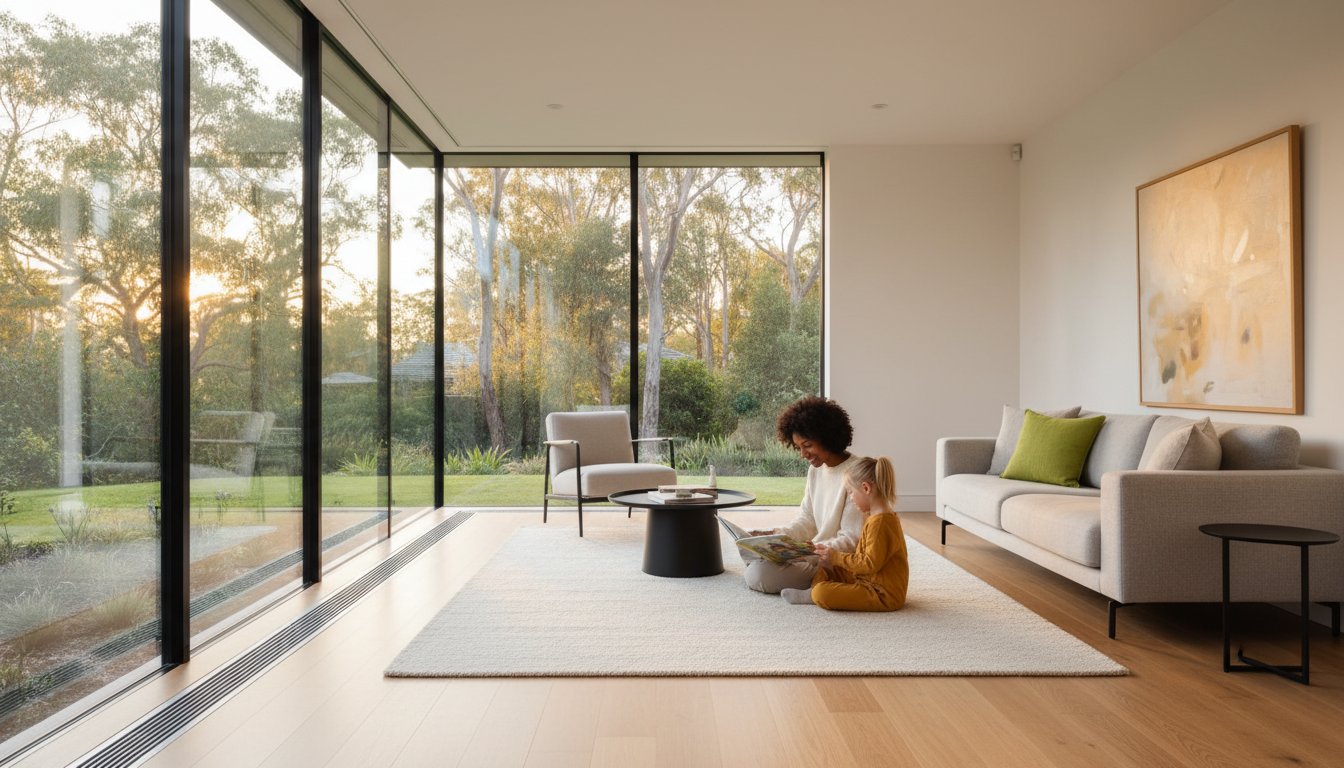
Hydronic trench heating is a sophisticated climate control solution designed specifically for modern homes featuring expansive glass facades. Unlike traditional wall-mounted radiators, this system is recessed directly into the floor, typically positioned along the perimeter of floor-to-ceiling windows. It works by circulating hot water through a high-efficiency copper-aluminium heat exchanger. As cold air settles near the glass, the exchanger warms it through natural convection, causing the air to rise and create a consistent, gentle warmth throughout the room without the noise of fans.
In the context of 2026 residential design, where seamless indoor-outdoor flow is a priority, this technology is no longer just a luxury; it’s a functional necessity. For homeowners in Bayside or the Mornington Peninsula, where coastal winds can drop external temperatures to 5°C overnight, trench heating provides a silent, dust-free barrier. This ensures every square metre of the living space remains usable and comfortable even during the peak of a Melbourne winter.
The “Cold Wall” Effect in Modern Architecture
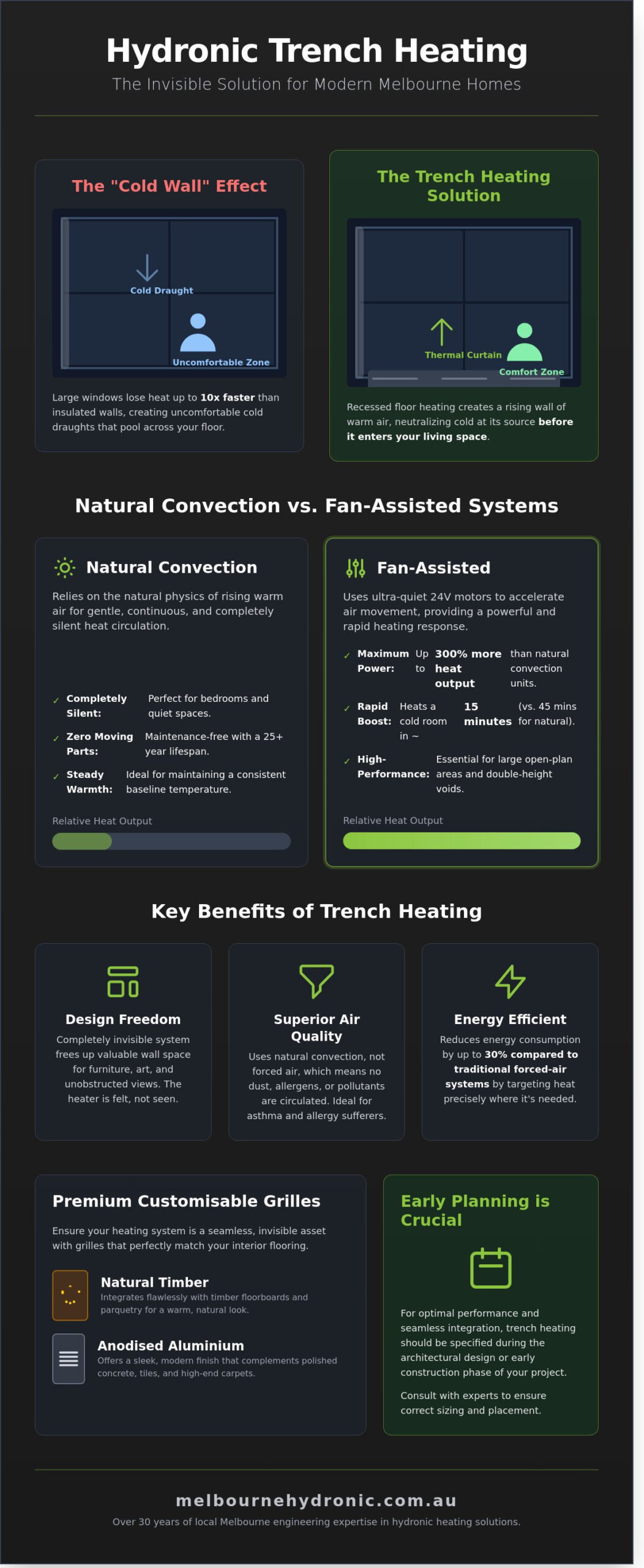
Standard double-glazed windows lose heat up to 10 times faster than a properly insulated wall. This temperature disparity creates “down-draughts,” where heavy cold air slides down the glass and pools across the floor. This “cold wall” effect makes sitting near a window uncomfortable, regardless of how high you turn up a central thermostat. The thermal curtain effect is the primary solution for 2026 home designs. It places a rising wall of warm air between the glass and the room, effectively neutralizing the cold at its source before it can enter the living zone.
Aesthetics vs. Functionality: The Invisible Heater
Melbourne’s luxury property market demands high performance without compromising on interior design. Hydronic trench heating frees up valuable wall space, allowing homeowners to display art or position furniture without worrying about blocking a bulky radiator. The system is virtually invisible, capped with customisable grilles that integrate perfectly with various floor finishes:
- Natural timber floorboards and parquetry.
- Polished concrete or stone tiles.
- High-end carpets with specific edge finishing.
It’s a premium choice for those who value a silent, healthy environment. Because it relies on natural convection rather than forced air, it doesn’t circulate allergens or dust. This makes it a superior option for families managing asthma or respiratory sensitivities, providing a level of air quality that traditional ducted systems can’t match. You get a heating system that’s felt but never seen, maintaining the architectural integrity of your home while delivering unmatched thermal comfort.
Performance & Efficiency: Natural vs. Fan-Assisted Trench Systems
Choosing the right convection method determines how your home responds to a 5°C Melbourne dawn. While both systems utilize the same copper-aluminium heat exchangers, the way they move air defines their best application. Hydronic trench heating works by creating a thermal curtain against glass facades, but the speed of that delivery varies between natural and forced systems.
Natural Convection: The Silent Performer
Natural convection relies entirely on the physics of rising air. As the water from your boiler or heat pump warms the trench element, the air around it becomes less dense and rises into the room. This creates a gentle, continuous cycle. It’s the gold standard for bedrooms and library nooks where total silence is the priority. Because there are no moving parts, maintenance is virtually non-existent over a 25-year lifespan.
These systems perform best when paired with high-temperature water sources, such as gas condensing boilers running at 65°C. In a standard 12-square-metre bedroom, a natural convection trench provides a steady, dust-free warmth that won’t disturb your sleep. It’s a “set and forget” solution that maintains a consistent baseline temperature without any mechanical hum.
Fan-Assisted Units: Maximum Response Time
For Melbourne’s modern luxury builds featuring double-height voids or expansive glass walls, natural convection often lacks the “punch” needed for rapid recovery. Fan-assisted units use small, energy-efficient 24V EC motors to pull air across the heat exchanger. This “forced” method can increase heat output by up to 300% compared to a natural unit of the same size. If you’re looking to optimize your floor plan, our experts can help you select the right trench configuration to ensure every corner stays warm.
- Rapid Boost: These units heat a cold room in roughly 15 minutes, whereas natural convection might take 45 minutes to reach the same set point.
- Heat Pump Compatibility: Modern air-to-water heat pumps often run at lower temperatures (around 45°C to 55°C). Fans compensate for this lower water heat by increasing the volume of air passing over the coils. For homeowners seeking year-round comfort from a single hydronic system, fan coils offer a hybrid solution that delivers both rapid heating and efficient cooling through the same water-based infrastructure.
- Whisper Technology: Modern 24V fans operate at noise levels as low as 19dB(A) on low settings. That’s quieter than a human whisper, making them perfectly acceptable for living areas.
When designing for 2026 energy standards, the trend is moving toward fan-assisted units. They offer the flexibility to run your system at lower, more efficient water temperatures without sacrificing the “instant-on” comfort Melburnians expect during a volatile winter. By using 24V DC power, these systems remain incredibly safe and consume less electricity than a single LED light bulb per meter of trench.
Design Options: Choosing the Right Grilles for Your Interior
While the engineering happens below the floor, the grille is the only component your guests will ever see. It’s the face of your hydronic trench heating system. Choosing the right material isn’t just about looks; it’s about floor integration and structural safety. Most premium grilles in 2026 are rated to withstand between 300kg and 500kg of point-load weight. This ensures they won’t warp or snap under heavy foot traffic or the weight of a designer armchair. You’ll generally choose between two main structural styles:
- Roll-up grilles: These use flexible spacers, allowing you to roll the grille back for easy vacuuming of the trench. This is vital for maintaining the dust-free, allergy-friendly environment Melbourne homeowners expect.
- Linear grilles: These feature rigid bars for a sleek, continuous line. They’re often preferred by architects for minimalist projects where a clean, unbroken aesthetic is the priority.
Timber Grilles: Warmth and Tradition
Timber grilles offer a seamless transition for homes with hardwood floors. We often match grilles to 19mm solid Victorian Ash or Spotted Gum to ensure the heating system disappears into the room’s design. Beyond aesthetics, timber feels neutral to the touch. It’s the perfect choice for bedrooms or lounge areas where you’re likely to walk barefoot. To keep these grilles looking new, we recommend a light application of floor oil every 18 to 24 months. This prevents the natural wood from drying out or losing its lustre near the heat source.
Metal Grilles: Modern and Industrial
Metal options provide a sharper, more contemporary edge. Anodised aluminium is a top choice for 2026 because it comes in finishes like satin, matte black, or deep bronze to perfectly match modern window frames. For commercial spaces in the Melbourne CBD or high-traffic entryways, stainless steel 316 is the industry standard for durability. Metal grilles also offer a slight performance edge; they boast a 12% higher thermal conductivity than wood. This means they begin radiating heat into the room seconds after the hot water starts flowing, which is a welcome relief during a 5°C Melbourne morning.
Planning & Installation: What to Expect in Melbourne
Integrating hydronic trench heating requires a proactive approach; it’s rarely a successful last-minute addition. For new builds, your architect must specify the exact dimensions for the concrete rebate during the slab design phase. A standard trench usually requires a depth of 100mm to 300mm depending on the heat output required. If this isn’t planned, you’ll face structural costs that can exceed A$3,000 in remedial cutting later. Proper insulation is non-negotiable. We install high-density thermal breaks to ensure the heat moves upward into your living space rather than leaching into the cold Victorian soil.
Retrofitting is possible but carries different challenges. For slab-on-ground homes, it involves precise concrete saw-cutting and careful management of the vapor barrier. In Melbourne’s heritage renovations with suspended timber floors, the process is often simpler. The units sit between floor joists, though we occasionally add structural blocking to support the weight of heavy-duty linear grates. A specialist installer ensures the entire system is balanced, so the water pressure remains consistent across all zones, even in large multi-story floor plans.
New Builds vs. Renovations
In a new build, the “rebate” is a pre-formed pocket in the concrete. This allows the heating unit to sit flush with your finished floor level, whether you’re using polished concrete, tiles, or timber. For those updating an existing property, Melbourne Hydronic Heating provides professional design consultations to determine if your sub-floor clearance meets the 200mm minimum requirement for efficient airflow. We’ve found that 85% of timber-floor retrofits in suburbs like Armadale or Hawthorn are compatible with this technology.
Maintenance: Myth vs. Reality
- The Dust Trap Myth: Many homeowners fear trenches collect debris. In reality, you simply lift the grille and vacuum the interior once every six months. It’s significantly cleaner than traditional ducted systems that hide dust in inaccessible pipes.
- Annual Checks: We recommend a quick annual inspection to ensure the heat exchanger fins are straight and free of obstructions. This keeps the convection process moving at peak speed.
- System Longevity: To maintain 95% energy efficiency, your system needs a power flush every 7 to 10 years. This removes magnetite buildup and protects your high-efficiency boiler or heat pump from internal wear.
Ready to integrate invisible warmth into your floor plan? Contact our Melbourne design team for a technical site assessment today.
Why Melbourne Hydronic Heating is the Leader in Trench Solutions
Since 1994, our team has mastered the specific thermal challenges of the Victorian climate. We’ve spent over 30 years refining how hydronic trench heating performs in local homes, especially those featuring the large glass facades popular in modern Melbourne architecture. We don’t just supply parts; we engineer bespoke systems that account for the 15 degree temperature swings common in our state. Our experience ensures that your system provides consistent, silent warmth without the energy waste seen in many older installations.
The industry is moving toward total electrification. By 2026, gas-free homes will be the standard. We lead this transition by specializing in the integration of trench units with high-efficiency electric heat pumps. These systems often achieve a Coefficient of Performance (COP) of 4.0. This means for every 1kW of electricity the system consumes, it delivers 4kW of heat into your living space. It’s a sustainable, future-proof investment that slashes running costs compared to traditional split systems or gas ducted heating. Homeowners looking to extend this efficiency into summer cooling can also explore how fan coils integrate with hydronic heat pumps for year-round climate control in a single, unified system.
Our service model covers every stage of the process. We manage everything from the initial heat load calculations to the final commissioning of the system. This end-to-end approach eliminates the communication gaps that often occur between designers and installers. You receive a seamless, professional experience backed by three decades of technical precision.
Our Local Expertise in Greater Melbourne
We’ve built our reputation across Bayside, the Mornington Peninsula, and the Yarra Valley. Each of these areas presents unique environmental factors, from salt-air corrosion concerns to extreme frost pockets. As a family-owned business, we understand that a home in Brighton requires a different design strategy than a farmhouse in Healesville. We ensure every project strictly adheres to Victorian Building Authority (VBA) standards and the latest AS/NZS energy efficiency codes. Our focus on dust-free, allergen-friendly heating makes us the preferred choice for health-conscious families across Melbourne.
Request a Custom Trench Heating Design
Starting your journey toward invisible comfort is straightforward. Provide us with your architectural floor plans in PDF or CAD format, and our design team will produce a detailed layout. We calculate the exact wattage required for every room to ensure hydronic trench heating eliminates cold spots near your windows. For projects in Cheltenham and surrounding suburbs, we often conduct site visits to verify floor depths and structural clearances before the concrete is poured.
You’ll receive a comprehensive quote that includes everything from the manifold configuration to the custom grille finishes. Book your consultation with Melbourne Hydronic Heating today to secure your installation for the 2026 season.
Future-Proof Your Melbourne Home for 2026
Your home deserves a heating solution that’s as elegant as its architecture. Choosing hydronic trench heating ensures you maintain those stunning floor-to-ceiling views without sacrificing warmth or air quality. It’s a silent, dust-free alternative to traditional forced-air ducted heating systems, making it a vital health choice for the 1 in 9 Australians currently living with asthma. By integrating modern energy-efficient heat pumps with smart thermostat controls for precise temperature management, you can reduce household energy consumption by up to 40% compared to outdated gas-ducted units.
Melbourne Hydronic Heating has spent over 30 years perfecting these installations across Victoria. We’re a family-owned and operated team that understands the specific demands of our local climate. Our specialists focus on technical precision, ensuring every grille and heat exchanger performs at its peak. Whether you’re planning a new build or a major renovation, we provide the expertise needed for a seamless, high-end finish. It’s time to invest in a system that’s felt, not seen.
Get a Professional Hydronic Trench Heating Quote
We’re ready to help you create the most comfortable and healthy version of your home yet.
Frequently Asked Questions
Is hydronic trench heating loud?
Hydronic trench heating is virtually silent because it relies on natural convection rather than noisy blowers or fans. Standard natural convection units produce 0 decibels of sound while they’re operating. If you choose a fan-assisted model for faster heat-up times, the high-quality EC motors typically operate at whisper-quiet levels between 22 and 32 decibels. This makes it an ideal choice for Melbourne bedrooms where undisturbed sleep is a priority.
How do you clean a hydronic trench heater?
You clean a trench heater by simply lifting the removable top grille and using a standard vacuum cleaner with a brush attachment to remove debris. Most Melbourne homeowners perform this maintenance twice a year to keep the heat exchanger free of dust. Because the system doesn’t circulate air through dirty ducts, it won’t spread allergens. You can wipe the internal casing with a damp cloth to maintain its 25-year lifespan.
Can I install trench heating in an existing floor?
You can install trench heating in existing floors, though it’s most common in new builds or major renovations. For timber floors, we cut a channel between the joists to house the 100mm to 200mm deep casing. In concrete slabs, a specialized concrete saw creates the necessary cavity. About 40 percent of our retrofits in older Melbourne homes involve installing these systems near large glass doors to eliminate cold downdrafts.
Is trench heating better than standard radiator panels?
Trench heating is superior to radiator panels in rooms with floor-to-ceiling glazing where wall space is unavailable. While a standard radiator takes up about 1.5 square meters of wall area, trench systems are completely invisible beneath the floor. They create an effective thermal curtain that blocks 100 percent of cold air infiltration from glass doors. This makes them the premium choice for modern architectural designs in 2026.
Do trench heaters work with low-temperature heat pumps?
Trench heaters work perfectly with modern air-to-water heat pumps operating at low flow temperatures of 35 to 45 degrees Celsius. To maximize efficiency with a heat pump, we recommend fan-assisted units which increase heat output by up to 300 percent compared to passive models. This combination reduces energy consumption by 60 percent compared to traditional gas boiler setups. It’s a future-proof solution for sustainable Melbourne homes.
What happens if I spill liquid into the floor trench?
If you spill liquid into the trench, the stainless steel or galvanized casing prevents it from soaking into your subfloor. Most modern units feature a 15mm drainage point or a sealed base that you can easily dry with a sponge. The internal components are designed to withstand moisture, so a standard 250ml glass of water won’t cause any mechanical failure. Just ensure you wipe it out to prevent dust from sticking to the damp surface.
How much does hydronic trench heating cost in Melbourne?
In Melbourne, the supply and installation of hydronic trench heating typically ranges from A$1,200 to A$2,500 per linear meter. A standard 3-meter installation for a living room sliding door usually costs around A$5,500 including the heat exchanger, casing, and designer grille. While the initial investment is 25 percent higher than wall panels, the added property value and reclaimed wall space offer a significant long-term return for homeowners. For a detailed breakdown of costs and available rebates, consider getting a professional hydronic heating quote Melbourne to understand your specific project requirements.
Can I put furniture over a trench heater grille?
You shouldn’t place heavy furniture or thick rugs directly over the trench heater grille. Blocking the grille restricts the natural convection process and can reduce heating efficiency by as much as 80 percent. To maintain optimal performance, keep a clearance of at least 300mm above the unit. If you must place a sofa nearby, ensure the legs are at least 100mm high to allow air to circulate freely into the trench.