Hydronic System Losing Pressure: What to Do for Melbourne & Geelong Homeowners
Imagine waking up on a frosty July morning in Geelong only to find your premium radiators are barely lukewarm. You check the control panel and see the pressure needle resting at zero, a sight that instantly sparks anxiety about expensive boiler repairs or hidden water leaks. It’s a frustrating scenario that many of the 1,200 homeowners we’ve assisted across Melbourne face when the temperature drops below 10 degrees. You want a home that’s consistently warm and healthy, not a system that leaves you guessing and shivering.
If you’re currently facing a hydronic system losing pressure what to do is likely the only question on your mind. We understand that technical gauges can be confusing, but maintaining your system’s 1.5 bar baseline is essential for the energy-efficient, dust-free comfort you invested in. You’ll learn how to diagnose, troubleshoot, and resolve pressure drops to restore your home’s warmth and efficiency through this guide. We’ll examine everything from simple radiator bleeding to expansion tank health so you know exactly when to DIY and when to call a professional technician.
Key Takeaways
- Learn how to identify the “normal” 1.0 to 1.5 bar operating pressure for Melbourne homes to ensure your heating system remains efficient and reliable.
- Follow our expert troubleshooting guide on a hydronic system losing pressure what to do, starting with a simple visual check for “white crust” calcium buildup on radiator valves.
- Uncover why the “Big Three” issues—leaks, expansion vessel failure, and PRV discharge—are the real culprits behind a dropping gauge rather than natural water usage.
- Understand the dangers of the “Corrosion Trap” and why constantly topping up your system with fresh Melbourne tap water can lead to rapid internal rusting and sludge.
- Discover how professional annual maintenance from local Geelong and Melbourne experts prevents system lockouts and protects your home’s dust-free, healthy warmth.
Understanding Your Hydronic System’s Pressure Gauge in Melbourne
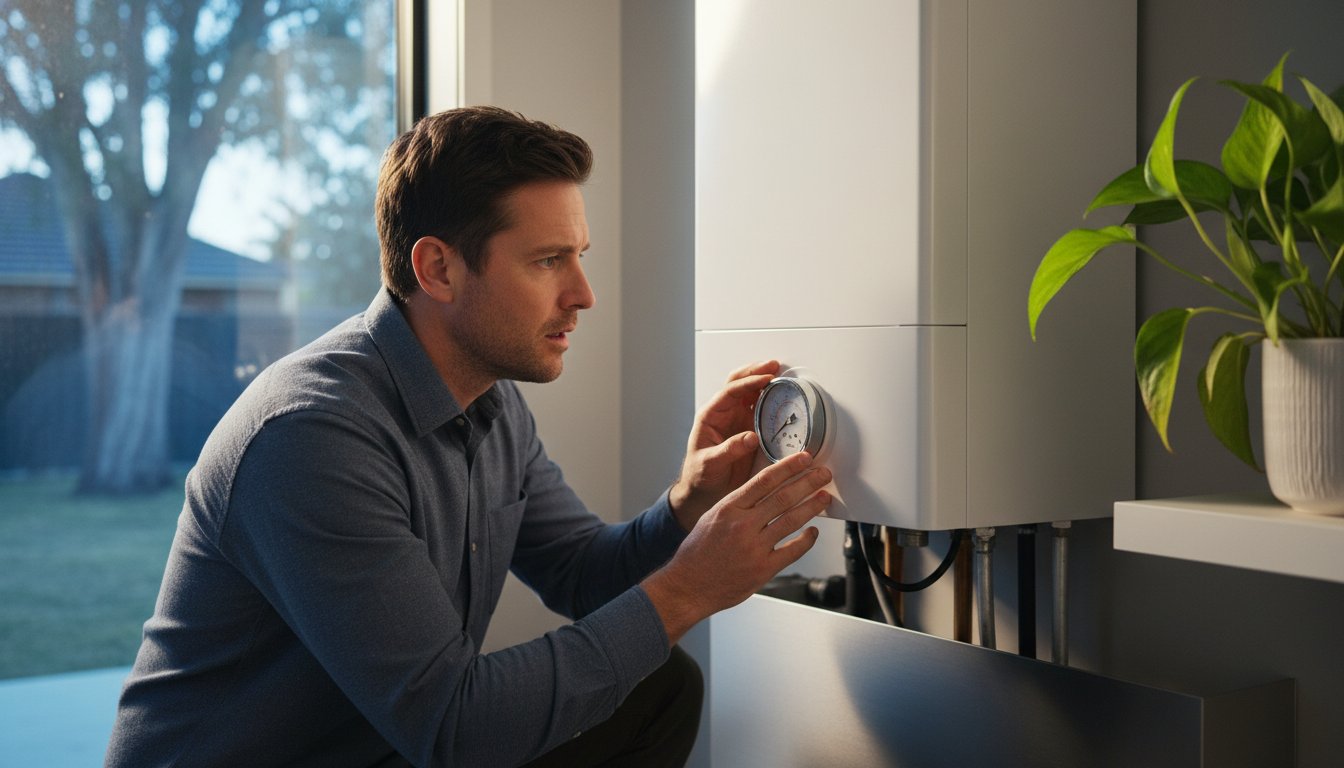
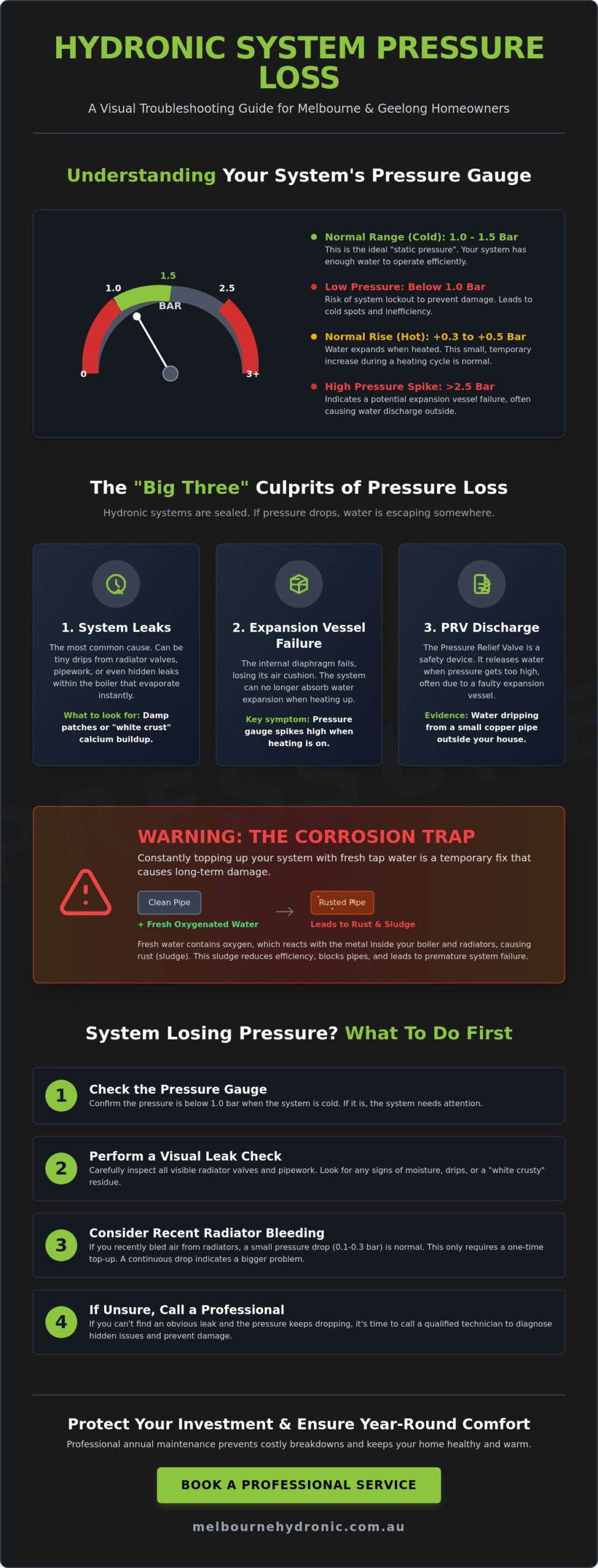
Your boiler’s pressure gauge is the most direct way to monitor the health of your home’s heating. What is a hydronic system? At its core, it’s a sealed network of pipes and radiators that relies on consistent water pressure to move heat efficiently. For most residential systems in Melbourne and Geelong, the “normal” operating pressure should sit between 1.0 and 1.5 bar when the system is cold. This is known as static pressure.
Most modern gauges feature a clear green zone indicating this safe range. If the needle stays within these bounds, your system has enough water to function. If you notice your hydronic system losing pressure what to do becomes a priority, especially if the needle drops toward the red zone at the bottom of the dial. When pressure hits zero, modern European boilers trigger a safety lockout. This feature protects the heat exchanger from overheating or “dry firing,” which could cause permanent damage to the unit’s internal components.
Cold vs. Hot: What is Normal Expansion?
Water expands as it gets hotter. Because your hydronic heating is a sealed loop, this extra volume has nowhere to go but against the internal walls of the system. You’ll see the gauge rise naturally by 0.3 to 0.5 bar during a standard heating cycle. This shift from static to dynamic pressure is normal. Think of the gauge as the heartbeat of your home’s comfort; it should be steady and predictable.
Problems arise when the pressure spikes too high or drops too low. If you see the needle jumping into the upper red zone (usually above 2.5 bar) every time the heat turns on, your expansion vessel has likely failed. This component contains a rubber diaphragm designed to cushion the water’s expansion. When it loses its air charge, the system can’t handle the increased volume, often leading to water dripping from the pressure relief valve outside your home.
The Consequences of Low Pressure
Low pressure introduces air into the pipework, which disrupts the silent, efficient flow of heat. You’ll first notice “cold spots” in your radiator panels. These occur because air bubbles rise to the top of the radiator, preventing hot water from filling the entire panel. You might also hear a “kettling” noise. This sounds like a whistling or banging kettle and happens when air pockets get trapped inside the boiler’s heat exchanger, causing localized boiling. Low pressure leads to pump cavitation and eventual mechanical failure. Without the lubrication and resistance provided by pressurized water, the pump motor burns out prematurely, leading to an expensive replacement that could have been avoided with a simple top-up or leak repair.
The 3 Primary Reasons Your Hydronic System is Losing Pressure
A common misconception among Melbourne homeowners is that hydronic heating systems naturally consume water over time. In reality, these are sealed, closed-loop systems designed to retain the same water for years. If you find yourself wondering about a hydronic system losing pressure what to do, the first step is accepting that water is escaping somewhere. It doesn’t evaporate into thin air without a reason. While a small drop is expected after you bleed air from your radiators, a persistent decline indicates a mechanical issue.
Air pockets often accumulate at the top of radiator panels, causing cold spots. When you use a radiator key to release this air, you’re removing volume from the system. This usually results in a pressure drop of 0.1 to 0.3 bar, which is easily fixed by topping up the system via the filling link. However, if the gauge continues to slide toward zero despite regular top-ups, you’re likely dealing with one of the “Big Three” technical failures. In some cases, internal boiler leaks are the culprit. These are particularly deceptive because the leaking water often drips onto a hot heat exchanger and evaporates instantly, leaving no visible puddle on your floor.
Expansion Vessel Failure: The Silent Pressure Killer
The expansion vessel is a small tank, often hidden inside your boiler or mounted nearby, containing a flexible rubber diaphragm. This diaphragm separates a cushion of compressed air from the system water. As your heating water heats up, it expands. The air cushion compresses to absorb this extra volume. If the diaphragm perishes or loses its air charge, the water has nowhere to go. You’ll notice the pressure gauge spike rapidly toward 3.0 bar when the heating is on, only to crash back to zero once the system cools down. A professional can perform a Schrader valve test to check this. If water escapes from the air valve during testing, the vessel requires replacement to restore your home’s comfort.
The Pressure Relief Valve (PRV) and Discharge Pipes
The PRV is a safety component designed to release water if the pressure exceeds 3.0 bar. You can usually find its discharge point outside your home, characterized by a 15mm copper pipe pointing toward the ground. If you see water dripping from this pipe, it’s a sign the valve is doing its job because of a failed expansion vessel, or the valve itself is faulty. Once a PRV opens to vent excess pressure, tiny bits of system debris or magnetite can get trapped in the valve seat. This prevents it from sealing correctly again, leading to a slow, constant loss of pressure. If your external pipe is damp, it’s time to contact a specialist technician to inspect the valve and system health.
- External Leaks: Check valves, nut joins, and radiator tails for green oxidation or damp carpets.
- Internal Evaporation: Leaks within the heat exchanger that vanish before they hit the floor.
- Debris Interference: Grit preventing safety valves from closing fully after a pressure spike.
Troubleshooting Your Hydronic System Losing Pressure: What to Do First
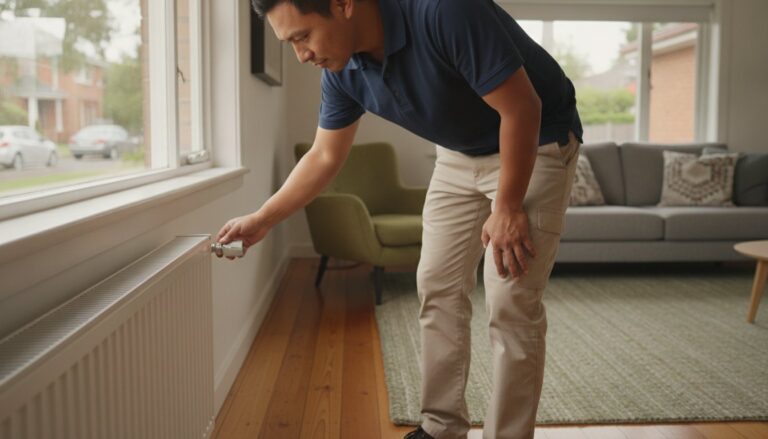
Finding your boiler gauge in the red zone is frustrating, but a methodical approach often reveals the culprit before you need to call in the heavy machinery. If you are wondering about a hydronic system losing pressure what to do, your first step is a comprehensive visual “walk-through” of the entire property. Start by inspecting every radiator valve and join. You aren’t just looking for liquid water; you’re looking for “white crust” or limescale buildup. This calcified residue indicates a slow weep where water evaporates as soon as it hits the air, leaving a powdery trail behind.
Don’t forget to step outside and check the external discharge pipe, usually a small copper pipe protruding through an external wall. If you notice dampness on the ground or active dripping, your pressure relief valve (PRV) might be failing or reacting to a faulty expansion vessel. Inside the house, locate your “Filling Loop” – the silver braided hose usually found under the boiler. Ensure both valves on this loop are turned fully off. If they’re even slightly open or weeping internally, it can cause erratic pressure fluctuations that mimic a leak.
If no obvious signs appear, monitor the pressure gauge over a strict 24-hour period. Note the exact reading at 8:00 AM and again the following morning. A drop of more than 0.3 bar in a single day suggests an active leak that requires immediate professional attention to prevent structural damage.
The Melbourne Home Leak Checklist
Melbourne’s architectural diversity presents unique challenges for leak detection. In Victorian-era homes in suburbs like Carlton or Geelong West, sub-floor access is your best friend. Use a high-powered torch to check pipework under the floorboards for hanging drips. When inspecting stylish hydronic heating panels, avoid pulling them away from the wall; instead, use a small mirror to check the rear connections to protect your paintwork. Be aware of “intermittent leaks” that only occur during a cold 5:00 AM start. As the metal expands during the initial heating cycle, a loose connection might weep for only 10 minutes before sealing itself back up as it reaches operating temperature.
Using the Filling Loop Safely
Restoring pressure is a delicate balance that impacts your system’s longevity. If the gauge is below 1.0 bar, use the filling loop to slowly add water until you hit the 1.2 bar “sweet spot” while the system is cold. Never over-pressurise the unit above 2.0 bar; doing so stresses the seals and may trigger the safety discharge valve. This is particularly critical for underfloor heating manifolds, where excessive pressure can cause unnecessary strain on the flow meters. Always disconnect or firmly close the filling loop immediately after use to ensure you aren’t constantly feeding fresh, oxygenated water into the system, which can lead to internal corrosion.
The Risks of Constant Topping Up: The Corrosion Trap
If you find yourself opening the filling loop every few days, you’re doing more than just restoring pressure. You’re inadvertently feeding a chemical reaction that can destroy your system from the inside out. Melbourne tap water is perfect for drinking, but it’s detrimental to a closed-loop heating system. It contains dissolved oxygen and minerals that are highly reactive when they meet the steel, iron, and copper components of your radiators and pipework.
A healthy hydronic system uses “dead” water. This is water that has been circulated for years, has lost its oxygen content, and has become chemically inert. When your hydronic system losing pressure what to do becomes a cycle of adding “fresh” water, you’re introducing a new supply of oxygen. This oxygen triggers rapid internal rusting. This process creates magnetite, a dense, black metallic sludge that settles in the lowest points of your system, usually your expensive boiler or floor-level radiators.
Magnetite is particularly dangerous for modern, high-efficiency systems. Most contemporary pumps use internal magnets to operate; these magnets attract the black sludge, which eventually seizes the pump or causes it to burn out. Additionally, every time you top up the water, you dilute the concentration of protective corrosion inhibitors. Without these chemicals, the internal surfaces of your system are left completely vulnerable to the corrosive effects of the Victorian water supply.
Why Power Flushing is the Only Cure for Sludge
Once magnetite has taken hold, simply fixing the leak isn’t enough. We recommend power flushing to restore the system to its original state. This process involves connecting a high-velocity pump to your system to force out the accumulated sludge and debris using specialized cleaning chemicals. It’s a deep clean that clears out the “arteries” of your heating network. After the flush, we add high-quality inhibitors to ensure the new water remains stable. A clean, de-sludged system can be up to 25% more efficient than one struggling with internal blockages, as the heat can finally transfer through the metal surfaces without an insulating layer of rust in the way.
The Hidden Cost of Ignoring the Gauge
The financial difference between proactive repair and reactive replacement is staggering. A simple seal repair or expansion tank recharge might cost a few hundred dollars. In contrast, a full boiler replacement can easily exceed A$5,000 depending on the model and installation complexity. Beyond the equipment, small leaks pose a threat to your home’s structure. In many Melbourne and Geelong residences, slow leaks under floorboards lead to timber rot and mould growth that remains hidden for months. This damage often costs more to remediate than the heating repair itself. You’ll also notice the impact of your hydronic system losing pressure what to do in your monthly gas bill. As sludge builds up and pressure fluctuates, the system works significantly harder to circulate heat, driving up energy consumption unnecessarily.
Don’t let a small pressure drop turn into a major structural repair. Contact our expert team at Melbourne Hydronic Heating to protect your home’s comfort and value.
Professional Hydronic Repairs and Maintenance in Melbourne & Geelong
Addressing a hydronic system losing pressure what to do requires more than just a quick DIY fix. With over 30 years of experience in Melbourne’s unique climate, our team understands that a drop in pressure often signals a deeper issue within the sealed loop. Experience matters because modern condensing boilers and older cast iron systems require different diagnostic approaches. We’ve spent three decades refining these techniques to ensure your home stays warm without the risk of emergency breakdowns.
A professional investigation is about more than just refilling the water. Our technicians use specialized diagnostic tools, including thermal imaging and ultrasonic leak detectors, to find pinhole leaks behind walls or under floorboards. This precision prevents unnecessary damage to your property. Every member of our team is a certified, gas-safe technician. This certification provides the peace of mind that your system isn’t just functional, but also operating safely within Australian regulatory standards. When you’re wondering about a hydronic system losing pressure what to do, the answer starts with expert diagnostics that look beyond the surface.
Annual servicing is the most effective way to prevent pressure-related lockouts. These lockouts usually happen on the coldest nights of the year when the system is under maximum load. Regular maintenance ensures the expansion vessel remains functional and the internal components don’t succumb to avoidable wear. It’s a small investment that protects the luxury and comfort of your dust-free heating environment.
What to Expect During a Professional Pressure Investigation
Our diagnostic process is methodical and transparent. We begin by pressure testing individual zones to isolate the leak location. By capping off specific sections of the pipework, we can determine if the issue is restricted to a single radiator or a section of underfloor piping. We also check the expansion vessel. These components must be re-pressurized or replaced according to manufacturer specifications to handle the thermal expansion of the water correctly.
Finally, we analyze the system’s water chemistry. We test for pH levels and the presence of debris. If the water is “hungry” or corrosive, it will eventually eat through heat exchangers and valves. We top up high-quality inhibitors to create a protective barrier inside your pipes, extending the lifespan of your system by years.
Protecting your pipes from internal corrosion is just one part of the puzzle; for broader advice on safeguarding your property’s infrastructure from external threats, Streamline Drains & Pipelines offers a detailed guide on managing invasive tree roots.
Booking Your Melbourne Hydronic Service
We provide comprehensive coverage across Melbourne, Geelong, and the wider Victoria region. Our local knowledge means we understand the specific water conditions and architectural styles common in our area. Don’t wait for the peak of winter to address a dropping pressure gauge. Booking your service during the milder months ensures you avoid long wait times and potential emergency call-out fees. You can book your expert hydronic system repair in Melbourne today to secure your home’s comfort and efficiency before the cold sets in.
Secure Your Home’s Comfort Today
Ignoring a falling pressure gauge often leads to system failure or expensive internal corrosion. While it’s tempting to just add more water, constant topping up introduces fresh oxygen that eats away at your pipes and boiler from the inside. Protecting your investment requires a proactive approach to maintenance. Understanding your hydronic system losing pressure what to do starts with recognizing when it’s time for a professional diagnostic. Our family-owned business brings over 30 years of experience to Melbourne and Geelong homes, ensuring every repair is handled with technical precision. We’re specialists in high-efficiency heat pumps and modern boilers, focusing on delivering the dust-free, silent warmth your family deserves. Don’t let a minor pressure drop turn into a major system replacement. Our local experts are ready to restore your system to peak performance so you can enjoy reliable, healthy heating all winter long. We’ll ensure your home stays warm, safe, and energy-efficient for years to come.
Restore your home’s warmth with an expert hydronic service call
Frequently Asked Questions
Is it dangerous if my hydronic system pressure is at zero?
A zero-pressure reading isn’t inherently dangerous because modern European boilers feature automatic safety shut-off sensors. These systems stop the burner from firing when they detect insufficient water to prevent overheating. However, your heating won’t function, and attempting to run the pump without water can cause internal mechanical damage. When your hydronic system is losing pressure what to do first is check the gauge and avoid forcing a restart until the water level is restored.
How often should I have to top up my hydronic boiler pressure?
You should only need to top up your boiler pressure once or twice a year, typically during your pre-winter maintenance check. If you’re adding water every month, you likely have a slow leak or a faulty expansion vessel that needs professional attention. Constant topping up introduces fresh, oxygenated water into the pipes. This leads to internal corrosion and sludge buildup, which reduces the 25 year lifespan of your premium radiators.
Can I fix a leaking radiator valve myself?
You can often stop a minor weep by gently tightening the gland nut with a spanner. This is a common DIY fix for small drips that occur when the heating is first turned on for the season. If the leak persists after tightening, you’ll need a licensed plumber to drain the system and replace the valve. Attempting complex repairs yourself risks flooding your floors and voiding the manufacturer’s warranty on your high-end heating components.
Why does my pressure gauge go up when the heating is on?
Pressure naturally increases as water expands when heated, typically rising by 0.3 to 0.5 bar during a standard heating cycle. This expansion is managed by the internal expansion vessel, which contains a rubber diaphragm and compressed air. If the needle jumps significantly into the red zone every time the heat starts, it’s a 100% sign that your expansion vessel has failed or lost its air charge. This requires a technician to recharge the vessel or replace it entirely.
How much does it cost to fix a hydronic pressure leak in Melbourne?
Repair costs vary depending on the leak’s location, with standard Melbourne plumbing call-out fees often starting around A$120 to A$180. A simple valve replacement might cost approximately A$250 including parts and labor, while locating a hidden leak under floorboards requires specialized acoustic equipment. Always ensure your technician is VBA licensed to maintain your home’s insurance compliance and guarantee the work meets Australian standards.
What happens if I over-pressurize my hydronic system?
Your system’s pressure relief valve will automatically discharge excess water through a copper pipe to the outside if the pressure exceeds 3 bar. This safety mechanism prevents pipes from bursting, but it can leave your boiler room floor wet if the discharge pipe isn’t routed correctly. If you’ve accidentally overfilled the system, you can safely lower the pressure by bleeding a small amount of water from a radiator using a bleed key.
Will a pressure drop affect my floor heating and radiators differently?
Radiators are usually affected first because they sit higher in the home’s plumbing circuit, leading to cold spots at the top of the panels as air replaces water. In-slab floor heating might continue to operate briefly because the pipes are at the lowest point, but the boiler will eventually trigger a low-pressure lockout and stop all heating. Maintaining consistent pressure ensures your home stays dust-free and warm without straining the circulation pump.
Does a pressure drop mean I need a new boiler?
A pressure drop rarely signifies the need for a new boiler, as 90% of pressure issues stem from external leaks or a depleted expansion vessel. These are standard maintenance items that a qualified technician can resolve in a single visit without replacing the entire unit. Understanding your hydronic system losing pressure what to do can save you from unnecessary replacement costs and restore your quiet, healthy heating environment quickly.