
Heat Pumps for Hydronic Heating: The Ultimate Melbourne & Geelong Guide (2026)
Why are thousands of Melbourne homeowners still paying a premium to pump allergens through their living rooms when the ultimate heating solution is already sitting in the Victorian air? With the Victorian Government’s Gas Substitution Roadmap now in full effect, the era of fossil-fuelled home comfort is rapidly closing. You likely feel the pressure of rising gas connection fees and the nagging worry that your old ducted system is aggravating your family’s seasonal allergies. It’s a common frustration for residents from Geelong to Glen Iris who want a modern, healthy home environment without the eye-watering energy bills.
We believe your home should be a silent sanctuary. This guide explains how a high-efficiency heat pump can transform your hydronic system into a future-proof powerhouse. You’ll discover how to achieve up to 400 percent energy efficiency while eliminating the dust and noise of traditional heating. We will walk you through the technical differences between split systems and hydronic solutions, ensuring you choose the right premium setup for our unique climate in 2026. By the end of this guide, you’ll have a clear roadmap to a dust-free, electric home that delivers luxury warmth through every Victorian winter.
Key Takeaways
- Understand how the Victorian Gas Substitution Roadmap impacts your home and why transitioning to an electric hydronic system is the smartest way to future-proof your heating by 2026.
- Discover how a modern heat pump extracts “free” energy from the Melbourne air to provide high-efficiency warmth, even during the coldest Victorian winters.
- Compare the long-term capital and operational costs of gas boilers versus electric systems to see how a high Coefficient of Performance (COP) translates into significant A$ savings.
- Learn how to maximize your investment by accessing Australian Small-scale Technology Certificates (STCs) and calculating the perfect system size for your home’s specific heat loss.
- Find out why a dust-free, allergy-friendly hydronic system installed by local specialists offers a healthier and more luxurious lifestyle than traditional ducted heating.
The Shift to Electric: Why Melbourne is Trading Gas Boilers for Heat Pumps
For decades, the gas boiler was the standard for Melbourne homes. That era is ending. The modern hydronic heat pump acts as the electric heart of your heating system, circulating warm water through floor pipes or wall panels with surgical precision. Understanding how heat pumps work is simple: they extract ambient heat from the outside air and transfer it to your home’s water circuit. Even when it’s a brisk 5°C morning in Geelong, these systems operate with remarkable efficiency.
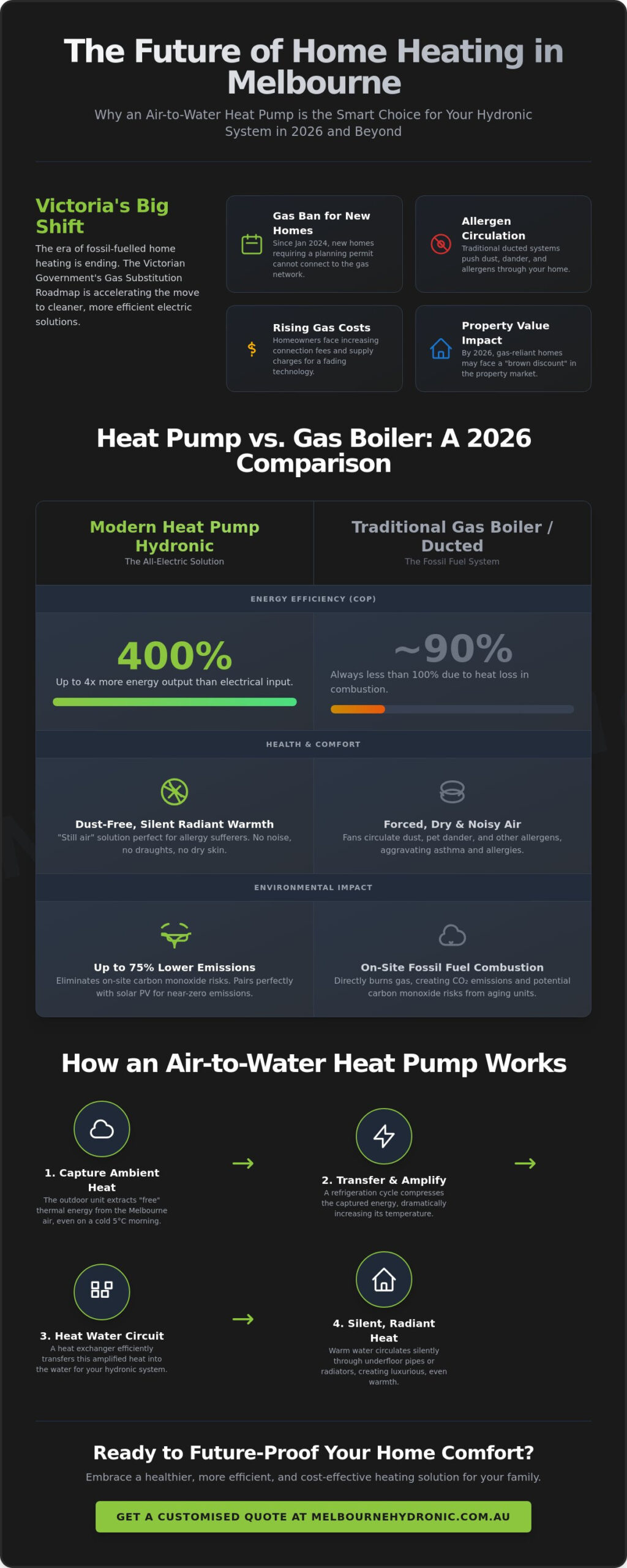
The Victorian Gas Substitution Roadmap has accelerated this transition. Since January 2024, new Victorian homes requiring a planning permit haven’t been allowed to connect to the gas network. By 2026, this shift will be the baseline for the local property market. Homeowners are moving away from combustion because it’s no longer the most cost-effective or logical way to stay warm. Hydronic heating remains the gold standard for luxury, but the fuel source has evolved from fossil fuels to clean electricity.
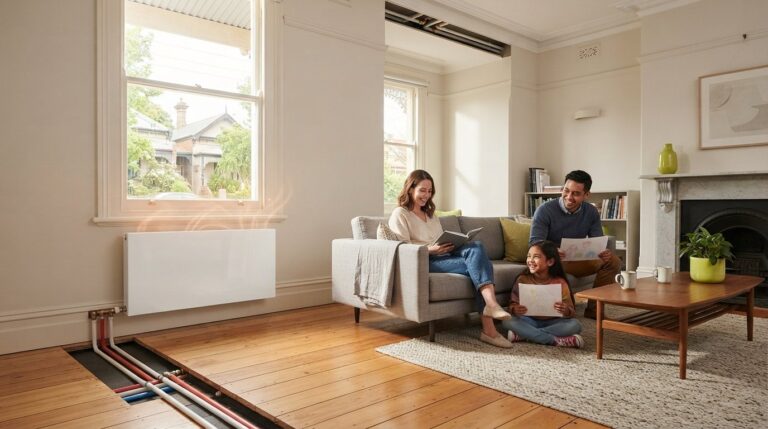
The health benefits for families are a primary driver for this change. Traditional split systems or ducted gas heaters rely on fans that circulate dust, pet dander, and allergens. In a city like Geelong, where asthma rates are a concern for many parents, hydronic heating offers a “still air” solution. There’s no noise, no draughts, and no dry skin. You experience a consistent, radiant warmth that feels like the sun on your back, rather than a blast of hot air.
Future-Proofing Your Home Value in Victoria
Property buyers in premium suburbs like Brighton or Geelong West now place a high premium on all-electric credentials. A home equipped with a high-efficiency heat pump avoids the dual-connection fees and rising supply charges associated with gas. By 2026, gas-reliant homes will likely face a “brown discount” as buyers factor in the future cost of electrification. Moving to electric hydronic heating now ensures your property remains competitive and compliant with Victoria’s long-term energy trajectory.
The Environmental Impact: Hydronic vs. Fossil Fuels
Melbourne’s electricity grid is rapidly decarbonising as more wind and solar projects come online. When you pair a hydronic system with a residential solar PV array, you can essentially heat your home using the energy you’ve generated on your own roof. This synergy turns your home into a self-sustaining thermal battery.
- Eliminate on-site carbon monoxide risks associated with aging gas heaters.
- Reduce household emissions by up to 75% compared to traditional gas boilers.
- Maximise the return on investment for existing solar panel installations.
Decarbonisation in the context of Victorian residential heating is the systematic process of replacing gas-burning appliances with high-efficiency electric alternatives to eliminate on-site carbon emissions.
How Air-to-Water Heat Pumps Work in the Melbourne Climate
A heat pump doesn’t create heat from nothing; it moves it. Using a sophisticated refrigeration cycle, these systems harvest thermal energy from the outside air to warm your home. This process remains effective because “heat” is a relative term in physics. Even on a brisk 5°C morning in Geelong, the air molecules contain significant energy. The system uses a refrigerant with a boiling point as low as -26°C, allowing it to capture ambient warmth even when the weather feels freezing to us.
It’s vital to distinguish between “Air-to-Air” systems and “Air-to-Water” systems. Standard split systems (Air-to-Air) blow recycled, dry air into a room, which can often feel dehydrating and circulate dust. In contrast, an Air-to-Water hydronic system transfers captured energy into a liquid medium. The outdoor compressor unit pressurizes the refrigerant, spiking its temperature. This heat then passes through a high-efficiency heat exchanger, warming the water that circulates through your home. This method provides a consistent, “silent” warmth that doesn’t rely on turbulent air movement.
Melbourne’s specific “damp cold” and high humidity levels are key factors in system design. Unlike dry, alpine climates, our coastal humidity can lead to faster frost accumulation on outdoor coils. Premium units are now engineered with specialized hydrophilic fin coatings to shed moisture quickly and resist corrosion from the salt-laden air common in bayside suburbs. These technical refinements ensure the system maintains a high Coefficient of Performance (COP) regardless of the local dew point.
The Science of Radiant Warmth
Water is a superior thermal conductor, carrying roughly 4 times the heat capacity of air by volume. This energy travels through insulated piping to your hydronic heating panels or slab coils. A critical component in this setup is the internal buffer tank. This tank acts as a thermal battery, preventing the system from “short-cycling” and ensuring a steady temperature across every room. By maintaining a large volume of heated water, the system provides a stable, allergen-friendly environment that avoids the “on-off” temperature swings of traditional heaters.
Performance in Cold Weather: The 2°C Test
A common concern for Victorian homeowners is whether a heat pump can handle a frost. Modern units are rated to function efficiently down to -15°C, which is well below the record minimums for the Greater Melbourne area. When temperatures hover around 2°C and moisture freezes on the outdoor unit, the “Defrost Cycle” activates. The system briefly reverses its operation to melt the ice, a process that typically completes in under 7 minutes.
Because ambient heat exists at all temperatures above absolute zero (-273.15°C), there’s always energy available for the system to extract. This reliability is a primary reason why Victorian Government heat pump rebates have become so prevalent since 2023, as the state pushes for highly efficient, all-electric heating solutions. If you’re looking to upgrade your current boiler, you can consult with our local team to determine the best placement for your outdoor unit to maximize airflow and efficiency.
Heat Pump vs. Gas Boiler: A 2026 Comparison for Melburnians
In 2026, the choice between a traditional gas boiler and a modern heat pump is no longer just about the environment; it’s about long-term financial health. While a gas boiler might have a lower upfront price tag, often costing between A$4,000 and A$7,000, the operational costs tell a different story. A high-efficiency heat pump requires a larger initial investment, typically ranging from A$10,000 to A$18,000 for a full hydronic system. However, over a 15-year lifespan, the savings on energy bills and the removal of gas connection fees often offset this gap. According to the government guide to efficient heating, electric systems are significantly more effective at converting energy into warmth than their combustion-based counterparts.
Maintenance requirements also favor electric technology. Gas boilers involve active combustion, which leads to wear on burners and heat exchangers over time. Electric units are sealed systems, much like a refrigerator, and often outlast gas units by several years with minimal intervention. You don’t have to worry about the loud, mechanical clatter of older gas units either. Modern systems produce a quiet hum, usually measured between 45 and 55 decibels, which is easily masked by ambient neighborhood sounds.
Efficiency and Running Costs
The secret to this technology’s success lies in its Coefficient of Performance (COP). While even the best gas boilers are only 95% efficient, these electric systems achieve ratings of 3 to 5. This means for every 1kW of electricity used, you get 3kW to 5kW of heat. For a standard 4-bedroom home in Melbourne, this translates to annual running cost savings of roughly A$800 to A$1,200 compared to gas. You can maximize these gains by using off-peak electricity rates to pre-heat your home’s thermal mass during the night. This strategy is particularly effective with underfloor heating, as the concrete slab holds heat for hours, reducing the need for power during expensive peak periods.
Installation Complexity and Space Requirements
Installing these units requires careful planning. You’ll need an outdoor space with clear airflow to ensure the evaporator can extract heat effectively. Siting the unit away from bedroom windows or narrow side-passages prevents sound echoing and ensures your neighbors aren’t disturbed. If you’re retrofitting, you can often keep your existing radiators. However, because electric systems operate at lower water temperatures (typically 45-55°C) than gas (70°C), our team may recommend adding extra radiator panels to maintain the same heat output. We also focus heavily on pipe insulation. In Melbourne’s uninsulated sub-floor spaces, heat loss can reach 15% if pipes aren’t properly lagged with high-quality foam or rubber sleeves.
Maximising Your Investment: Rebates and System Sizing
Choosing the right heat pump involves more than just picking a brand. It requires a precise engineering approach to ensure your Melbourne home remains a sanctuary during a July cold snap. We calculate the required kW size by performing a detailed heat loss assessment. This process involves measuring the total volume of your living spaces, evaluating the R-value of your insulation, and accounting for the surface area of your glazing. In a typical 200m² home in Geelong, a 14kW unit might be perfect for a well-insulated modern build, whereas an older Victorian weatherboard might require 18kW to maintain a steady 21°C internal temperature when it’s 2°C outside.
Timing your heating cycle is the secret to slashing running costs. The ‘Solar Sponge’ effect refers to programming your system to do the heavy lifting between 10:00 AM and 3:00 PM. By running your system during these peak solar production hours, you store thermal energy in your floor slab or radiator water using your own free electricity. This strategy reduces reliance on the grid during expensive evening peaks and ensures your home is already warm before the sun goes down.
Victorian Government Incentives in 2026
The transition from gas to electric is heavily supported in Victoria through 2026. Small-scale Technology Certificates (STCs) act as a federal financial incentive where the value of the certificate is usually applied as a point-of-sale discount on your heat pump installation. To qualify for these and the Victorian Energy Upgrades (VEU) program, your installer must be an ‘Accredited Provider’ or work with one to register the carbon certificates. In 2026, rebates specifically target homes decommissioning old gas hydronic boilers, offering significant offsets that can total several thousand dollars depending on the system’s efficiency rating. Always verify your installer’s accreditation before signing a contract to ensure you don’t leave money on the table.
Professional Design: Why Sizing Matters
Precision sizing is the difference between a system that lasts 20 years and one that fails in seven. If a unit is oversized, it suffers from ‘short-cycling,’ where it turns on and off rapidly because it reaches the target temperature too quickly. This causes unnecessary wear on the compressor. Conversely, an undersized unit will run constantly without ever reaching your desired comfort level, leading to high bills and cold nights.
Modern Melbourne homes often benefit from a zoned approach. Integrating smart thermostats allows you to direct heat only where it’s needed, such as bedrooms in the evening and living areas during the day. This level of control is why a custom design from Melbourne Hydronic Heating is superior to an off-the-shelf solution. We tailor the flow rates and water temperatures to your specific floor plan, ensuring a silent, dust-free, and allergy-friendly environment that a generic setup simply can’t match.
Ready to see how much you can save with a correctly sized system? Contact our expert team for a custom heat loss calculation today.
Why Melbourne Hydronic Heating is the Region’s Trusted Specialist
Choosing the right partner for your home’s climate control is a 20-year decision. Melbourne Hydronic Heating brings over 30 years of specialized experience to every project, focusing specifically on the unique residential landscape of Melbourne and Geelong. We don’t just install equipment; we design bespoke solutions tailored to the architectural nuances of Victorian homes. Our team navigates local Victorian building codes and plumbing regulations with absolute precision, ensuring your investment is protected and legally compliant from day one.
We’ve hand-selected premium European technology that’s been specifically adapted for Australian conditions. This ensures your heat pump operates at peak efficiency even during those biting Melbourne winter mornings when temperatures drop toward zero. Our commitment to your comfort doesn’t end at the final bolt. We provide a holistic service model that covers everything from the initial thermal design to annual system servicing to keep your system running like new for decades.
A Family-Owned Legacy of Comfort
As a family-owned business, we prioritize the health and well-being of your household. Our hydronic systems provide a dust-free, allergen-friendly warmth that traditional ducted systems simply can’t match. Expert installation remains the single most important factor in ensuring the 15 to 20 year longevity of your equipment. We’ve helped hundreds of homeowners across the region successfully “cut the gas pipe,” transitioning to fully electric, sustainable living without sacrificing luxury. Our service area is extensive, reaching families from the Mornington Peninsula through to the Surf Coast and Geelong.
- 30+ years of local Victorian engineering expertise.
- Specialists in allergen-friendly, silent heating solutions.
- Comprehensive support for the entire system lifecycle.
- Deep understanding of Geelong and Melbourne coastal climate demands.
Get Your Custom Melbourne Heat Pump Quote
Every home has a unique thermal footprint. During a professional consultation and site audit, we analyze your insulation levels, window orientations, and existing infrastructure. We specialize in complex retrofitting, showing you how to integrate a modern heat pump with your existing radiator panels or luxury towel rails. This seamless integration saves on renovation costs while drastically upgrading your energy efficiency. You’ll receive a detailed plan that outlines the expected performance and energy savings specific to your property.
Ready to experience the gold standard in home comfort? Book a consultation with our Melbourne experts today and take the first step toward a more sustainable, healthier home for your family.
Future-Proof Your Home with Sustainable Melbourne Heating
The transition to high-efficiency electric systems is the smartest move for Victorian homeowners in 2026. By replacing an outdated gas boiler with an advanced air-to-water heat pump, you’re investing in a system that delivers silent, dust-free warmth while significantly reducing energy consumption. These modern solutions integrate perfectly with Melbourne’s unique climate; they provide a healthier, allergy-friendly environment that traditional forced-air systems can’t match. Melbourne Hydronic Heating brings over 30 years of local experience to every project, ensuring your installation meets the highest technical standards.
As an Accredited Victorian Energy Upgrades (VEU) Installer, we help you navigate current government incentives to maximize your return on investment. Our specialists focus on precision sizing and premium European components to guarantee reliable performance through the coldest Geelong winters. It’s time to embrace a cleaner, more cost-effective way to keep your family comfortable year-round.
Request a Professional Heat Pump Design & Quote for Your Melbourne Home
Take the first step toward a more efficient home and enjoy the peace of mind that comes with expert local service.
Frequently Asked Questions
Are heat pumps really effective in Melbourne’s cold winters?
Modern air-to-water heat pumps remain highly effective in Melbourne, even when overnight temperatures drop to 2 degrees Celsius in July. These systems extract heat from the ambient air down to minus 20 degrees, ensuring your living spaces stay a consistent 21 degrees throughout the coldest months. Since our local climate is relatively mild compared to Northern Europe, a heat pump operates at peak efficiency here and often delivers 300% to 400% efficiency.
How much does it cost to install a hydronic heat pump in Melbourne?
Installation costs for a hydronic heat pump system in Victoria typically range from A$12,000 to A$25,000 depending on the property size and system complexity. These figures, based on 2025 industry benchmarks, include the unit, buffer tanks, and specialized plumbing. While the initial investment is higher than gas, the long-term energy savings and removal of gas connection fees provide a clear financial return over 7 to 10 years.
Can I replace my old gas boiler with a heat pump using my existing radiators?
You can often use your existing steel or cast iron radiators, but a technical assessment is essential to ensure they’re sized correctly for lower water temperatures. Standard gas boilers run at 70 degrees, while most heat pumps peak at 45 to 55 degrees. If your current radiators are oversized, they’ll work perfectly. For others, we might recommend upgrading specific panels to high-efficiency models to maintain the dust-free, allergen-friendly warmth you expect.
How noisy are the outdoor heat pump units for neighbours?
Modern outdoor units are remarkably quiet, typically producing between 45 and 55 decibels of sound at a distance of one metre. This is roughly equivalent to the hum of a domestic refrigerator or a quiet conversation. We carefully select installation sites that comply with Melbourne local council noise regulations. This ensures the unit doesn’t disturb your sleep or your neighbours’ peace while it works to keep you warm.
Do I need to upgrade my electrical switchboard for a heat pump?
Most Melbourne homes built before 2010 require a switchboard upgrade to accommodate the 20 to 40 amp dedicated circuit a heat pump requires. Our team evaluates your current electrical capacity during the initial site visit. If you’re also planning for solar panels or EV charging, it’s often more cost-effective to perform these upgrades simultaneously to future-proof your home’s infrastructure and ensure total safety.
What is the lifespan of a hydronic heat pump compared to a gas boiler?
A high-quality hydronic heat pump typically lasts 15 to 20 years with regular annual maintenance. This exceeds the 10 to 12 year average lifespan of traditional gas boilers found in many Geelong homes. Because these systems use premium European components and don’t rely on combustion, they experience less internal wear. This longevity makes them a more sustainable and reliable choice for homeowners seeking a permanent, premium heating solution.
Are there still Victorian government rebates for heat pumps in 2026?
As of 2026, Victorian residents can still access significant financial incentives through the Victorian Energy Upgrades (VEU) program and Solar Victoria. These rebates can reduce the upfront cost by A$1,000 to A$3,000 depending on the specific system and your eligibility. We handle the complex paperwork for you. This ensures you receive the maximum available discount for transitioning away from fossil fuels to a cleaner, electric future.
Can a heat pump also provide cooling for my Melbourne home?
Yes, a reversible heat pump can provide cooling when paired with fan coil units or specialized underfloor systems. Unlike traditional radiators which only heat, fan coils circulate chilled water to lower indoor temperatures during Melbourne’s 40 degree summer peaks. This dual-functionality provides a luxurious, year-round climate control solution. It keeps your home healthy and comfortable regardless of the season without the need for separate air conditioning units.