Cost to Replace Boiler with Heat Pump in Melbourne: 2026 Pricing & Rebate Guide
With Victorian gas usage rates projected to climb by another 15% over the next 18 months, understanding the cost to replace boiler with heat pump Melbourne homeowners face has become a financial priority. You likely value the silent, dust-free warmth of your hydronic radiators but feel overwhelmed by the technical jargon of the state’s electrification push. It’s understandable to wonder if an electric system can truly maintain that premium comfort during a 2-degree July morning in Melbourne without sending your power bills soaring.
This guide provides a transparent breakdown of the 2026 investment landscape, including how to leverage current Solar Victoria rebates to significantly reduce your initial out-of-pocket expenses. You’ll gain total clarity on the difference between domestic hot water units and dedicated hydronic heat pumps. We’ll also provide a clear roadmap for transitioning your home to a sustainable, high-performance heating system that delivers the same luxury warmth you’ve always enjoyed.
Key Takeaways
- Understand the specific investment required for air-to-water systems, distinguishing between hardware costs and the specialized labor needed for seamless system integration.
- Evaluate your home’s compatibility by learning how radiator surface area and flow temperatures impact the efficiency of your new electric setup.
- Navigate the 2026 financial landscape with a detailed breakdown of Solar Victoria rebates and VEU certificates that reduce the total cost to replace boiler with heat pump Melbourne residents can expect.
- Prepare for a smooth transition with our guide to the installation process, including essential heat load audits and the safe decommissioning of legacy gas boilers.
- Discover how to maintain a premium, dust-free, and allergy-friendly environment while upgrading to the latest energy-efficient European heating technology.
The Real Cost of Replacing a Hydronic Boiler with a Heat Pump in Melbourne
Melbourne’s shift toward electrification is accelerating as we approach 2026. For homeowners currently using gas-fired hydronic systems, the transition to an air-to-water system is a significant step toward a carbon-neutral home. The cost to replace boiler with heat pump Melbourne reflects more than just a hardware swap; it’s a comprehensive system upgrade. While a standard gas boiler is a relatively simple combustion device, a heat pump is a sophisticated piece of technology that extracts ambient thermal energy from the outside air to heat your home’s water circuit.
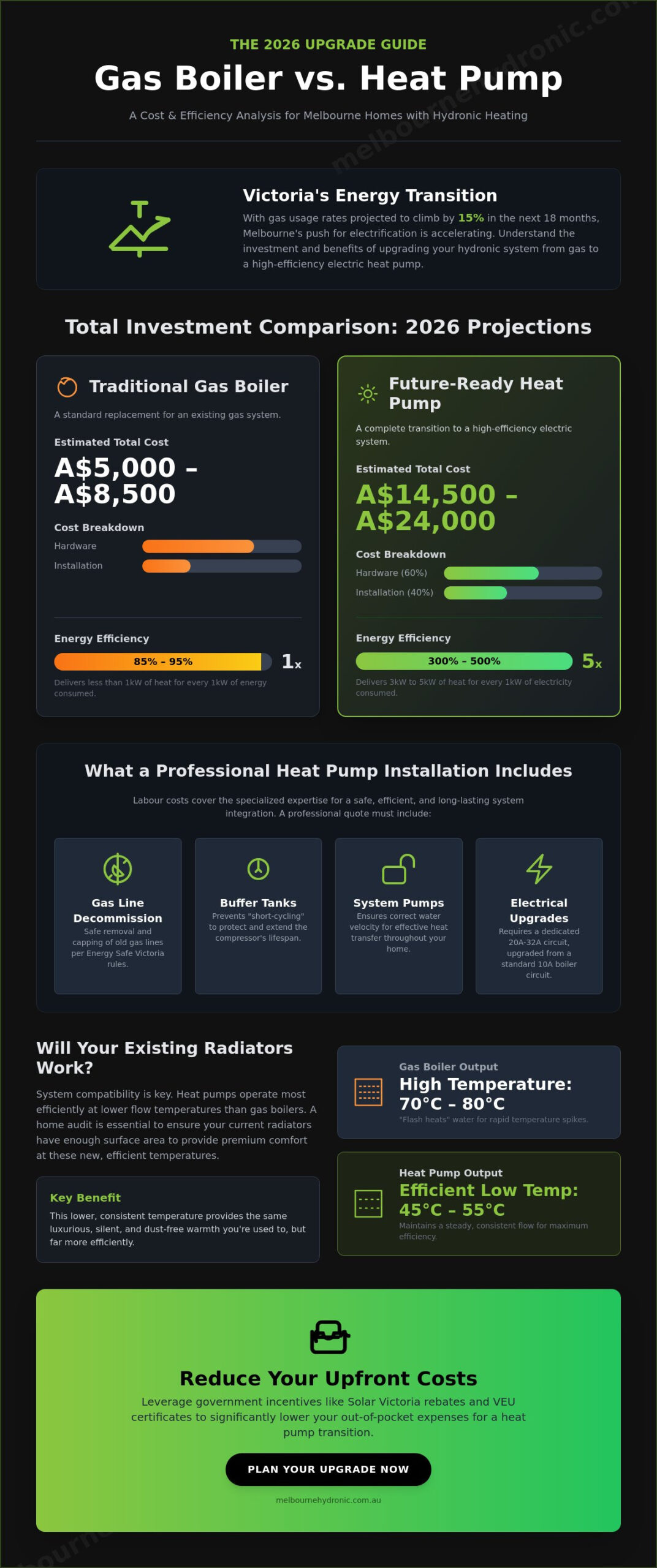
For a typical 3-4 bedroom Melbourne residence, the total investment for a professional retrofit in 2026 generally ranges between A$14,500 and A$24,000. This price variation depends on the complexity of your existing manifold setup and the specific heating load requirements of your property. Unlike standard air-conditioning units, hydronic heat pumps must maintain precise flow temperatures to ensure your radiator panels or floor coils provide that signature dust-free, silent warmth. Investing in this technology eliminates gas connection fees and aligns your home with the healthy, allergen-friendly standards that modern Victorian families expect.
Hardware vs. Installation Labour Costs
Hardware accounts for approximately 60% of your total investment. We prioritise premium European brands like Rehau and Immergas because they’re engineered for the high-performance demands of Melbourne’s damp winters. These units feature advanced compressors and heat exchangers that maintain efficiency even when outdoor temperatures drop toward zero.
Labour costs cover the technical expertise required for a safe transition. This includes decommissioning gas lines according to Energy Safe Victoria regulations and retrofitting your existing hydronic manifolds. Be cautious of “budget” quotes that often omit essential system protection components. A professional installation must include:
- Buffer Tanks: These prevent the unit from “short-cycling,” which extends the lifespan of the compressor.
- Primary and Secondary Pumps: These ensure the water moves at the correct velocity to transfer heat effectively through your home.
- Electrical Upgrades: Most gas boilers run on a standard 10A circuit, while a heat pump typically requires a dedicated 20A to 32A circuit.
Total Investment Comparison
The 2026 Victorian energy efficiency standards have changed the financial landscape for home heating. While the initial capital for a heat pump is higher, the operational efficiency is unmatched. A heat pump can deliver 3kW to 5kW of heat for every 1kW of electricity consumed, whereas a gas boiler never exceeds 1kW of heat per 1kW of energy input.
| Component | Gas Boiler Replacement | Heat Pump Transition (2026) |
|---|---|---|
| Average Hardware Cost | A$3,500 – A$6,000 | A$9,000 – A$16,000 |
| Installation & Integration | A$1,500 – A$2,500 | A$5,500 – A$8,000 |
| Energy Efficiency Rating | 85% – 95% | 300% – 500% |
| Estimated Total | A$5,000 – A$8,500 | A$14,500 – A$24,000 |
The payback period represents the timeframe in which the cumulative energy savings and Victorian government rebates equal the initial price gap between a premium heat pump and a traditional gas boiler. By choosing a heat pump, you’re securing a future-proof system that provides a healthy, pormentes (dust-free) environment for your family.
System Compatibility: Will Your Existing Radiators Work with a Heat Pump?
The primary factor affecting the cost to replace boiler with heat pump Melbourne homeowners face is the compatibility of their current emitters. Most traditional Melbourne homes were fitted with gas boilers designed to “flash-heat” water to 70°C or 80°C. Heat pumps operate differently. They’re most efficient when maintaining a steady, lower flow temperature between 45°C and 55°C. This shift is why Sustainability Victoria identifies electric systems as the most energy efficient, lowest cost heating option for modern households.
Because the water moving through your system is cooler, the surface area of your radiators becomes critical. If you keep your existing small panels, they might not emit enough heat to keep a draughty Victorian terrace warm on a 5°C July morning. To achieve the same heat output as a 75°C gas system, a 45°C heat pump system often requires radiators with approximately 2.5 times the surface area. This doesn’t always mean massive panels; often, we replace single-convector units with double or triple-panel designs that fit the same footprint.
Pipework is the next consideration. Heat pumps require a higher flow rate to move heat effectively at lower temperatures. Our engineering team checks if your existing 15mm or 20mm copper pipes can handle this increased volume. If the pipes are too narrow, you might experience “velocity noise” or reduced efficiency. We use ultrasonic flow meters to verify your home’s infrastructure before any installation begins, ensuring your transition to a dust-free, healthy heating environment is seamless.
Low-Temperature vs. High-Temperature Heat Pumps
For older Melbourne cottages where upgrading every radiator isn’t feasible, high-temperature CO2 heat pumps are a viable alternative. These units can reach 80°C, allowing them to act as a direct “drop-in” replacement for a gas boiler. However, there’s a trade-off. Running at higher temperatures reduces the Coefficient of Performance (COP), meaning the unit uses more electricity. Most modern heat pump hydronic heating designs prioritize low-temp operation to maximize your 2026 energy savings.
The Role of Fan Coils and Trench Heating
If your living area features floor-to-ceiling glass, traditional panels might struggle with the heat loss. Integrating fan coils can provide a faster response time by using a quiet internal fan to distribute warmth. For a minimalist aesthetic, retrofitted trench heating sits flush with your floorboards, creating a thermal curtain against the glass. Even existing hydronic heating panels can be “boosted” with small, clip-on fan units to increase their output without requiring a full replacement.
Understanding these technical nuances is essential when calculating the total cost to replace boiler with heat pump Melbourne residents should expect. If you’re unsure if your current setup is ready for the switch, our team can provide a professional system audit to map out your transition to a cleaner, more sustainable home.
2026 Melbourne Rebates and Financial Incentives
Transitioning to an electric hydronic system isn’t just a move toward a more comfortable home; it’s a strategic financial decision. In 2026, the Victorian government remains committed to its electrification roadmap, providing substantial support for homeowners moving away from gas. When calculating the cost to replace boiler with heat pump Melbourne residents should factor in three distinct layers of financial assistance that can reduce the total investment by thousands of dollars.
The financial landscape for energy upgrades in Victoria is built on a “stacking” principle. You don’t have to choose just one incentive. You can often combine federal certificates, state rebates, and interest-free loans to minimize your out-of-pocket expenses. This approach makes premium, dust-free heating accessible to more households across Melbourne and Geelong, ensuring your family enjoys a healthy, allergen-friendly environment without the heavy upfront price tag.
Solar Victoria Eligibility for Hydronic Upgrades
Solar Victoria continues to lead the charge with the Hot Water Rebate and specific electrification grants. To qualify for these incentives in 2026, your combined household taxable income must be less than A$210,000 per year. Additionally, the property must be valued at under A$3 million, which covers the vast majority of residential homes in the Melbourne metropolitan area.
Applying for the rebate is a streamlined process. First, you’ll need a quote from an authorized installer who is registered with the Solar Victoria program. Once you’ve accepted the quote, your installer uploads the details to the portal, triggering an eligibility check. For a standard gas-to-electric conversion in 2026, the rebate often sits at A$1,000, but this is frequently paired with an interest-free loan of the same amount, spread over four years to further ease the transition.
Maximising VEECs and STCs
The Victorian Energy Upgrades (VEU) program generates Victorian Energy Efficiency Certificates (VEECs) based on the greenhouse gas savings your new heat pump achieves. Because Melbourne is located in a cooler climate zone, the energy savings from replacing an old, inefficient gas boiler are significant. This results in a higher number of certificates. Your specific postcode in Melbourne or Geelong directly influences this value, as the “Zone 4” climate rating determines the expected efficiency gains of the system.
- STCs (Federal): Small-scale Technology Certificates are a federal incentive. The number of STCs you receive depends on the heat pump’s efficiency and the date of installation.
- Registered Providers: You must use a “Registered Provider” to create these certificates. They handle the complex paperwork so you don’t have to.
- Instant Discounts: Most professional installers apply the value of VEECs and STCs as an instant discount on your quote, meaning you don’t have to wait months for a tax refund.
It’s vital to remember that these certificates are market-based. Their value can fluctuate based on supply and demand. By locking in a quote with a specialist who understands the 2026 certificate market, you ensure that the cost to replace boiler with heat pump Melbourne stays within your budget while securing a premium, quiet, and highly efficient heating solution for your home.
The Installation Process: What to Expect During the Transition
Transitioning from a traditional gas system to a modern electric alternative requires a methodical approach to ensure your home remains a sanctuary of dust-free, allergen-friendly warmth. The journey begins with a comprehensive site audit. Our technicians perform precise heat load calculations based on your home’s insulation levels and window orientation to size the unit correctly. We also evaluate your existing pipework to confirm it can handle the specific flow temperatures required for peak efficiency. Understanding the cost to replace boiler with heat pump Melbourne homeowners face involves recognizing that this professional engineering stage prevents undersizing, which can lead to higher running costs later.
Once the design is finalized, the decommissioning phase begins. A licensed gas fitter safely disconnects and removes your old gas boiler, capping the lines in accordance with Victorian safety regulations. We then install the outdoor heat pump unit on a vibration-absorbing base to maintain the quiet, luxury atmosphere your home deserves. The internal hydronic plant room is then configured. This hub contains the circulating pumps, expansion tanks, and smart control systems that act as the brain of your new fufilling heating setup.
Electrical Upgrades and Switchboard Requirements
Many Melbourne homes, especially older properties in the inner-east or bayside suburbs, feature single-phase power. While smaller units might fit this profile, high-capacity heat pumps often require a 3-phase power upgrade to manage the electrical load without tripping breakers. A dedicated 20A or 32A circuit is usually necessary for safety. If you have an existing solar PV system, we integrate the heat pump to prioritize running during peak daylight hours. This strategy can reduce your heating-related grid consumption by up to 35% when paired with a standard 6.6kW solar array.
Timeline and Household Disruption
A standard boiler-to-heat pump swap typically takes between 2 and 5 business days to complete. To manage heating downtime during the chilly Melbourne winter, we often perform the internal plumbing preparation and electrical rough-in before disconnecting the old boiler. This minimizes the period your family spends without warmth. During the final stage, our technicians perform a rigorous air-to-water commissioning process by flushing the entire hydronic circuit, balancing the flow rates at each radiator, and calibrating the weather compensation sensors to ensure the system responds dynamically to external temperature shifts. This precision ensures your investment provides the most comfortable, energy-efficient environment possible from day one.
Ready to upgrade your home’s comfort with a premium, energy-efficient system? Contact our expert team today for a detailed site assessment and quote.
Why Melbourne Hydronic Heating is the Right Choice for Your Upgrade
Selecting the right partner for your home energy transition is just as critical as the hardware you choose. With over 30 years of specialized experience serving Melbourne and Geelong, we’ve seen the evolution of hydronic technology firsthand. We don’t just sell appliances; we provide a Total System Design. This approach is vital because a heat pump operates differently than a traditional gas boiler. It requires a deeper understanding of water flow rates and low-temperature distribution to ensure your home remains a sanctuary during a 5°C Melbourne morning.
Health is at the heart of every system we install. Unlike ducted systems that circulate dust, pet dander, and allergens through vents, our hydronic solutions provide radiant heat. It’s a silent, still, and completely dust-free experience. For families managing asthma or seasonal hay fever, this upgrade represents a significant improvement in indoor air quality. We combine this health-conscious focus with local expertise, ensuring your system is optimized for the specific architectural styles found in Victoria, from Victorian terraces to modern builds.
Our Professional Consultation Process
We begin every project with a comprehensive heat-loss calculation. We don’t rely on “rule of thumb” estimates that often lead to inefficient, oversized equipment. Our technicians analyze your home’s insulation levels, window orientations, and thermal mass to determine the exact kilowatt capacity needed. This precision is essential when evaluating the cost to replace boiler with heat pump Melbourne, as it ensures you don’t pay for capacity you don’t need.
Our designs are tailored to your specific infrastructure, whether you’re looking for underfloor heating in a new extension or a complex radiator retrofit in an existing home. To guarantee longevity, we use premium European components. These parts are engineered to withstand the high-demand cycles of heat pump systems, offering better reliability than cheaper, generic alternatives.
Long-term Maintenance and Peace of Mind
A heat pump is a 20 year investment in your home’s comfort. We protect that investment through our dedicated hydronic heating service Melbourne programs. These scheduled check-ups ensure your system maintains its peak Coefficient of Performance (COP), keeping your running costs as low as possible. Our local technical team provides full warranty support and rapid on-site assistance, so you’re never left in the cold.
Secure Your Home’s Future with Efficient Melbourne Heating
Transitioning to a heat pump system is a strategic investment in your home’s long-term efficiency and air quality. With the 2026 Victorian Energy Upgrades (VEU) program offering significant financial incentives, the timing is perfect to upgrade your hydronic system. You’ll enjoy a dust-free, allergy-friendly environment that traditional forced-air systems can’t match. Most existing radiator networks are compatible with modern heat pump technology, which simplifies the installation process significantly. Understanding the total cost to replace boiler with heat pump Melbourne requires looking at both the upfront price and the substantial energy savings over the next decade.
Melbourne Hydronic Heating brings over 30 years of local experience to every project. As a Victorian Energy Upgrade Accredited provider, we ensure your transition is seamless, quiet, and technically precise. We combine premium European technology with local expertise to deliver a reliable heating solution tailored to the unique Victorian climate. Your family deserves the comfort and health benefits of a modern, sustainable home.
Get a Professional Heat Pump Conversion Quote for Your Melbourne Home
Take the first step toward a warmer, more sustainable future today.
Frequently Asked Questions
Is a hydronic heat pump actually cheaper to run than a gas boiler in Melbourne?
Yes, a hydronic heat pump is significantly cheaper to run because it achieves efficiency ratings of 300% to 400%, while even premium gas boilers top out at roughly 95%. For a typical 150 square meter Melbourne home, switching to an electric heat pump can reduce annual heating energy consumption by over 70%. These savings increase further if you pair the system with a solar PV array to offset daytime running costs.
Can I keep my old radiator panels when I switch to a heat pump?
You can often keep your existing radiator panels, but our technicians must first calculate if their surface area is sufficient for lower water temperatures. Heat pumps typically operate most efficiently at 45°C to 55°C, whereas old gas boilers often ran at 75°C. In about 30% of retrofits, we recommend adding a few larger low-temp panels to ensure your rooms stay perfectly warm during a Melbourne winter.
How much noise does a hydronic heat pump outdoor unit make?
Modern outdoor units produce between 45 and 55 decibels of sound, which is roughly equivalent to a quiet conversation or a modern refrigerator. We select premium European brands designed for high-density living, ensuring the unit won’t disturb your sleep or your neighbors. Proper placement on anti-vibration mounts further reduces noise transfer, making the system barely audible from inside your home while providing a quiet, dust-free environment.
Will I need to upgrade my electrical switchboard for a heat pump?
Most Melbourne homes built before 2000 require a switchboard upgrade or at least a new dedicated 20-amp or 32-amp circuit to handle the heat pump’s load. This ensures your electrical system remains safe and complies with AS/NZS 3000 wiring rules. We assess your current board during our initial site visit to include any necessary electrical work in your fixed-price quote so there aren’t any hidden surprises during installation.
Does the Solar Victoria rebate cover hydronic heating heat pumps?
Yes, the Solar Victoria Home Heating and Cooling Upgrades program provides rebates for eligible households transitioning to energy-efficient heat pumps. As of 2024, eligible residents can access rebates around A$1,000 for heating upgrades, plus additional interest-free loans. This significantly reduces the initial cost to replace boiler with heat pump Melbourne homeowners face when upgrading their systems to a more sustainable, allergen-friendly alternative.
What is the average lifespan of a hydronic heat pump compared to a gas boiler?
A high-quality hydronic heat pump typically lasts 15 to 20 years with regular maintenance, outperforming the 10 to 12-year average lifespan of modern condensing gas boilers. Because heat pumps don’t rely on combustion, they experience less internal thermal stress and corrosion over time. This longevity makes them a more reliable long-term investment for your home’s comfort, providing consistent warmth for nearly two decades.
How long does it take to recoup the cost of switching from gas to electric heating?
Most Melbourne households see a return on investment within 7 to 10 years through reduced energy bills and the removal of the daily gas connection fee. If you have an existing solar system, this payback period can drop to under 6 years. Transitioning to an all-electric, healthy home also adds measurable value to your property as gas phase-outs continue to accelerate across Victoria.
What happens if the temperature in Melbourne drops below zero?
Your heat pump will continue to provide consistent warmth even if Melbourne temperatures drop to -5°C. Modern systems include an automatic defrost cycle to prevent ice buildup on the outdoor coils during frosty mornings. While efficiency dips slightly in extreme cold, the system is engineered to maintain a comfortable, allergen-friendly indoor climate regardless of the frost outside your window.