
Hydronic Heat Pump Systems: The Complete 2026 Melbourne & Geelong Guide
What if your home’s gas connection is the primary reason your winter energy bills are climbing while your indoor air quality declines? You’ve likely noticed Victorian gas prices increasing significantly over the last 24 months, leaving many families searching for a cleaner, more reliable alternative to old, dusty ducted heating. We know how frustrating it is to deal with rising costs and the constant circulation of allergens throughout your living spaces. This guide helps you navigate the transition to a sustainable Hydronic Heatpump system, ensuring you maximise current Victorian Energy Upgrades incentives and Solar Victoria rebates available in 2026. You’ll discover how to create a whisper-quiet, dust-free environment that’s powered by the sun and built to last. We’ll explore the technical efficiency of these systems, the benefits of solar PV integration, and the exact steps to future-proof your home’s value in the Melbourne and Geelong markets.
Key Takeaways
- Learn why Melbourne homeowners are transitioning to sustainable air-to-water systems to future-proof their homes against rising Victorian gas prices.
- Understand how a Hydronic Heatpump delivers maximum efficiency by converting 1kW of electricity into 4kW of heat, even in fluctuating local temperatures.
- Compare the initial investment against long-term operational savings to see why all-electric hydronic heating is the superior choice for 2026.
- Discover how to access Victorian rebates and prepare your home with the “System Approach” for a dust-free, allergen-friendly environment.
- Explore the importance of bespoke heat load calculations and expert design to ensure your system is perfectly tailored to Melbourne’s unique architecture.
What is a Hydronic Heat Pump and Why is Melbourne Switching to Electric?
A What is a Hydronic Heat Pump? At its core, it’s an air-to-water system that serves as the heart of a modern home heating network. Unlike traditional gas boilers that burn fossil fuels to create flame, a Hydronic Heatpump extracts existing thermal energy from the outdoor air. It then amplifies this heat through a refrigeration cycle to warm the water circulating through your floor pipes or wall panels. Even on a 5-degree Melbourne morning, there’s enough ambient molecular energy in the air for these units to operate with incredible efficiency.
The transition toward electric hydronics isn’t just a trend; it’s a structural shift in how Victorians build homes. Since January 1, 2024, the Victorian Government mandated that new planning permits for homes and residential subdivisions cannot include gas connections. This policy, part of the Gas Substitution Roadmap, has accelerated the move toward all-electric living in Melbourne and Geelong. Homeowners are choosing heat pumps to future-proof their properties against rising gas prices and to align with Victoria’s target of net-zero emissions by 2045.
Beyond the environmental impact, the health benefits are a primary driver for local families. Traditional ducted gas heating often creates a “dust-storm” effect, where forced air recirculates allergens and fine particles. Hydronic systems provide silent, radiant warmth that doesn’t move air around. This makes it the preferred choice for the 1 in 9 Australians living with asthma, as it maintains a stable humidity level and keeps the air clean and still.
How Air-to-Water Technology Works in the Victorian Climate
The technology relies on a clever refrigeration cycle. A fan draws outdoor air over an evaporator coil containing a liquid refrigerant. This refrigerant boils at a very low temperature, turning into gas as it absorbs heat from the Melbourne air. A compressor then squeezes that gas, significantly raising its temperature. This heat is transferred to your home’s water circuit via a heat exchanger. While a standard split-system AC blows hot air into a room, a hydronic heat pump transfers that energy into water, providing a much more consistent and comfortable thermal mass.
The Environmental and Health Case for Hydronic Heating
Switching from a gas boiler to an electric heat pump can reduce your heating-related carbon footprint by up to 75% immediately. When paired with a 6.6kW solar array, which is common in Geelong suburbs, your heating costs can drop toward zero during daylight hours. Modern units are also designed for high-density living. Leading European brands now produce units that operate at roughly 45 to 50 decibels, ensuring you won’t disturb your neighbours even in compact inner-city blocks.
Radiant heat stands as the gold standard for allergy management because it warms objects and people directly without circulating dust, pollen, or pet dander through your living spaces.
Efficiency and Performance: Understanding CoP in Melbourne’s Weather
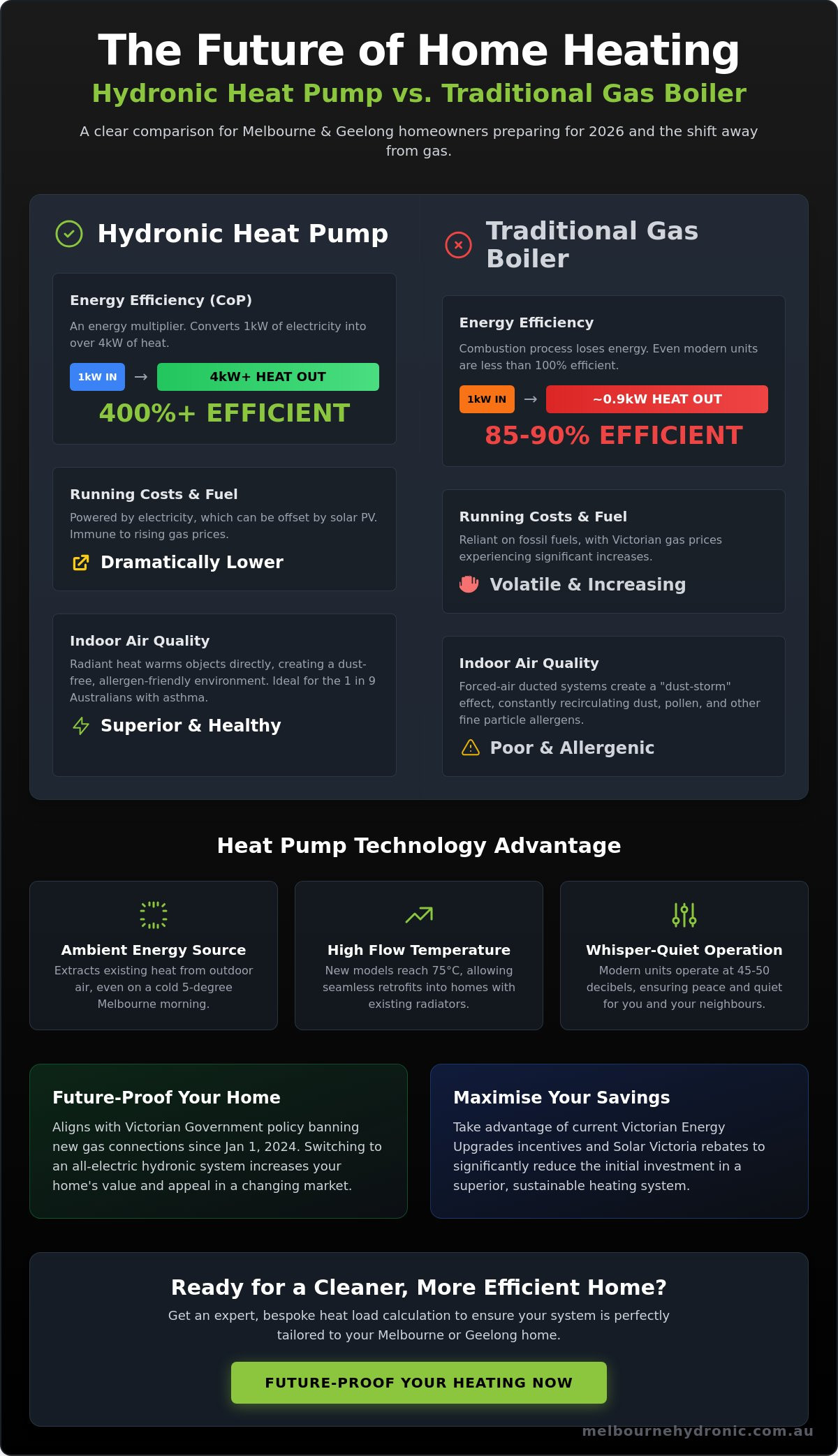
Think of a Hydronic Heatpump as an energy multiplier rather than a furnace. While an old gas boiler might achieve 85% or 90% efficiency, modern heat pumps regularly exceed 400%. This is measured through the Coefficient of Performance (CoP). In practical terms, for every 1kW of electricity the system consumes, it delivers 4kW of heat into your home. This 4:1 ratio is the primary reason Melbourne homeowners are abandoning gas in record numbers.
Performance isn’t static. Melbourne’s high humidity and fluctuating temperatures between 2°C and 15°C during July impact how hard the unit works. Modern inverter technology has solved the “all-or-nothing” problem of older systems. Instead of frequently switching on and off, which wastes energy and wears out components, an inverter modulates its power output. It slows down when your home reaches the desired temperature, maintaining a steady, dust-free warmth that is far healthier for families with asthma or allergies.
The most significant leap for 2026 is the arrival of high-flow temperature units. Older heat pumps struggled to push water past 55°C, often requiring homeowners to install oversized radiators. New premium models now reach 75°C. This allows for a seamless retrofit into existing Geelong or Melbourne homes that were originally designed for high-temperature gas systems, preserving your existing aesthetic while slashing running costs.
Decoding Technical Specs: CoP, SCOP, and R290
When comparing units, the Seasonal Coefficient of Performance (SCOP) is your most reliable metric. While CoP is a snapshot in time, SCOP calculates efficiency across the entire Victorian winter. You should also look for the R290 refrigerant label. This natural propane-based refrigerant has a Global Warming Potential (GWP) of just 3, compared to older refrigerants like R410A which had a GWP of over 2,000. Choosing R290 ensures your system is future-proofed against tightening environmental regulations. Many homeowners qualify for Victorian Rebates when upgrading to these high-efficiency models, significantly reducing the initial investment.
Melbourne Winter Performance: Can It Handle the Cold Snaps?
A common concern in the Dandenongs or colder pockets of Geelong is whether the system will freeze. When temperatures drop near zero, moisture in the air can frost the outdoor heat exchanger. The system then enters a “defrost cycle,” which typically lasts 5 to 10 minutes. To prevent this from cooling your home, we install buffer tanks. These tanks act as a thermal battery, providing a reservoir of hot water so the indoor radiators stay warm even while the outdoor unit is clearing ice. Even at -7°C, a quality Hydronic Heatpump will continue to operate effectively, ensuring your sanctuary remains comfortable through the harshest Victorian cold snaps.
Hydronic Heat Pump vs. Gas Boiler: The 2026 Melbourne Comparison
The Victorian heating landscape shifted permanently on January 1, 2024, when the state government’s ban on gas connections for new homes took effect. This policy makes the choice between a gas boiler and a Hydronic Heatpump a matter of future-proofing your property. While a gas boiler system typically requires a lower upfront investment, the gap closes quickly when you factor in Victoria’s volatile gas prices. Gas retail prices for Victorian households rose by as much as 25 percent in some areas during 2023 and 2024, making electricity the more stable long-term energy source.
Maintenance requirements also differ between these technologies. Gas boilers require specialized gas-fitter servicing every two years to ensure safety and prevent carbon monoxide risks. In contrast, a Hydronic Heatpump functions similarly to a high-end air conditioning unit, requiring basic annual checks of the refrigerant levels and water pressure. Premium European brands like Bosch or Rehau are engineered for a 15 to 20-year lifespan in Australian conditions, provided they’re installed by local experts who understand the specific demands of the Melbourne climate.
Cost-Benefit Analysis for Victorian Homeowners
Calculating the payback period involves more than just comparing monthly bills. While a heat pump system might cost A$5,000 to A$8,000 more than a gas equivalent initially, the savings accumulate through efficiency. A standard gas boiler operates at roughly 90 percent efficiency, but a heat pump can reach 300 to 500 percent efficiency. You can find more details on these financial metrics in our guide to heat pump hydronic heating. When you integrate a solar PV system, you can effectively run your heating for near-zero costs during daylight hours by pre-heating your home’s thermal mass.
Installation Complexity: Retrofit vs. New Build
Installing a system in a new build is straightforward, but retrofitting inner-city Melbourne homes requires a strategic approach. Narrow blocks in suburbs like Fitzroy or Richmond often have limited outdoor space. Modern heat pump units are designed with a slim footprint to fit into side passages without obstructing access. If you’re keeping existing radiator panels, we assess their surface area to ensure they can provide enough warmth at the lower water temperatures heat pumps use.
Efficiency is the core advantage here. Understanding CoP in Melbourne’s Weather
Preparing Your Home: Radiators, Insulation, and Victorian Rebates
Installing a Hydronic Heatpump requires a shift in mindset from traditional gas boilers. We advocate for a “System Approach” where the home’s thermal efficiency is treated as part of the heating hardware. Before the unit arrives at your Melbourne or Geelong property, the thermal envelope needs attention. If your home leaks air through gaps in floorboards or window frames, your heat pump works harder, which drives up electricity consumption. High-quality ceiling insulation, ideally rated at R5.0 or higher, and wall insulation are the foundations of a high-performance setup.
Sizing is the most critical technical hurdle when switching from gas. Gas boilers typically push water through pipes at 70 to 80 degrees Celsius. In contrast, a Hydronic Heatpump is most efficient when heating water to between 45 and 55 degrees Celsius. Because the water is cooler, the radiator panels must have more surface area to emit the same amount of heat into the room. This often means installing larger or double-panel radiators compared to what you would see in an older gas-fed system. Getting this calculation wrong leads to a home that never quite feels warm during a July cold snap in Geelong.
Optimising Your Home for Low-Temperature Heating
Low-temperature heating relies on consistency and thermal mass. Draught-proofing and double-glazed windows act as a heat pump’s best friends by significantly reducing the heat load of each room. When your home retains heat effectively, you can choose from various hydronic heating panels that match your interior aesthetic while providing that signature dust-free, allergen-friendly warmth. This approach ensures the system runs at its lowest possible power setting for the longest possible time.
Navigating Melbourne Rebates and Incentives
The Victorian Government continues to incentivise the transition away from gas. In 2026, the Victorian Energy Upgrades (VEU) program remains a primary pathway for residential heat pump upgrades, offering certificates that lower the upfront cost. It is vital to remember that only “Approved Products” qualify for these Victorian incentives. Using a non-approved unit means forfeiting thousands of dollars in potential savings.
To access the Solar Victoria heating rebate, follow these steps:
- Obtain a formal quote from a registered, licensed installer.
- Verify your household income is below the A$210,000 threshold.
- Ensure the property value is under A$2 million.
- Apply for eligibility through the Solar Victoria portal before work begins.
Local council considerations are also paramount. In densely populated Melbourne suburbs, noise regulations under the Environment Protection Act dictate that outdoor units must stay within specific decibel limits at the property boundary. We prioritize placement that avoids neighbor disputes while meeting all local permit requirements. For a tailored assessment of your property, book a consultation with our local experts today.
Melbourne Hydronic Heating: Expert Design and Installation
We’ve spent over 30 years perfecting the art of home climate control across Melbourne and Geelong. Our team understands that a heritage Victorian terrace in Carlton requires a vastly different approach than a contemporary, glass-heavy build in Torquay. We don’t believe in “off the shelf” packages because every home has a unique thermal footprint. Every project begins with a precise heat load calculation. We measure every window, evaluate wall insulation R-values, and calculate room volumes to ensure your Hydronic Heatpump is sized perfectly. An oversized system wastes energy through cycling, while an undersized one won’t keep you warm when the Melbourne temperature drops toward 2°C in the middle of July.
Our commitment to quality is why we partner with premium brands like Stiebel Eltron and Baxi. These manufacturers lead the industry in decibel reduction and energy COP ratings, making them ideal for the quiet, dust-free environment our clients expect. Our relationship doesn’t end when the thermostat is installed. We provide comprehensive long-term care to protect your investment. This includes:
- Professional power flushing to remove system sludge and debris.
- Annual system health checks to maintain peak efficiency.
- Water quality testing to prevent internal corrosion.
- Thermostat calibration for precise zone control.
The Melbourne Hydronic Installation Process
Your journey starts with a professional consultation and detailed site measure. We examine your existing floor structure and ceiling cavities to find the most efficient pipe runs. Our installers take pride in maintaining a clean, tidy workspace. We use protective floor coverings and ensure minimal disruption to your home life. For detailed information on keeping your system running perfectly for decades, read our hydronic heating service melbourne guide.
Book Your Melbourne or Geelong Consultation
Switching from a traditional gas boiler to an electric Hydronic Heatpump is a significant step toward a sustainable home. We make this transition seamless by handling the technical integration and ensuring your electrical board is ready for the upgrade. Local expertise matters because it ensures your system is designed for the specific humidity and temperature fluctuations of the Port Phillip Bay area. It also means your warranty is backed by technicians who are based right here in Melbourne. Don’t settle for dry, forced-air heating that circulates allergens. Request a hydronic heat pump quote today and experience the silent luxury of radiant warmth.
Future-Proof Your Melbourne Home with Sustainable Comfort
Transitioning to a Hydronic Heatpump isn’t just about following the 2026 Victorian electrification trend. It’s a long-term investment in a healthier, more efficient lifestyle. By leveraging high Coefficients of Performance, these systems deliver up to 400% efficiency, significantly reducing energy consumption compared to aging gas boilers. You’ll enjoy a silent, dust-free environment that’s ideal for families managing asthma or allergies. Our team brings 30+ years of local Melbourne experience to every project, ensuring your system is perfectly calibrated for the unique Victorian climate.
We specialize in VEU rebate-eligible installations and collaborate with premium European hardware partners to guarantee reliability. Whether you’re in Geelong or the leafy eastern suburbs, we provide the technical precision required for a seamless transition to electric heating. Don’t leave your winter comfort to chance when you can secure a system that’s as kind to your wallet as it is to the planet. We’re ready to help you create the warm, allergen-friendly home you deserve.
Get a professional Hydronic Heat Pump quote for your Melbourne home
Frequently Asked Questions
Are hydronic heat pumps loud enough to disturb neighbours in Melbourne?
Modern hydronic heat pumps are exceptionally quiet, typically producing sound levels between 45 and 55 decibels. This is roughly equivalent to the sound of light rain or a quiet office environment. To ensure total compliance with EPA Victoria noise regulations, we carefully position the outdoor unit away from bedroom windows and boundary fences. Most neighbours won’t even notice the system is running, especially when compared to older, louder air conditioning units.
Can I use my existing radiators with a new hydronic heat pump?
You can definitely use existing radiators, though we must evaluate their surface area first. Since a hydronic heatpump operates at lower water temperatures than traditional gas boilers, your radiators need enough surface area to emit sufficient heat. In some retrofits, we might replace one or two key panels with larger versions to maintain your comfort. This ensures your home stays warm without forcing the system to work harder than necessary.
How much can I save on my energy bills by switching from gas to a heat pump?
Transitioning from gas to electric heating can slash your annual energy bills by up to 50%. According to 2025 data from Sustainability Victoria, high-efficiency heat pumps deliver roughly 3 to 4 units of heat for every unit of electricity consumed. If you have a solar PV system installed, your savings can increase even further. You’re essentially moving from a volatile fossil fuel market to a self-sufficient, electrified home.
Does a hydronic heat pump work during a Melbourne power outage?
Your system won’t run during a total power outage because the compressor and circulation pumps require electricity. However, hydronic systems have a distinct advantage due to thermal mass. Concrete slabs or water-filled radiators hold heat for several hours after the power cuts out. If you’re concerned about Melbourne’s grid stability, we can integrate your system with a home battery to ensure your family enjoys uninterrupted warmth and safety.
What is the best temperature to set my heat pump to for maximum efficiency?
Setting your flow temperature between 35°C and 45°C is ideal for maximum efficiency in underfloor configurations. For radiator-based systems, we recommend a setting between 45°C and 55°C. Keeping these temperatures lower allows the hydronic heatpump to maintain a high Coefficient of Performance (COP). This means the system works less to extract heat from the outside air, which directly reduces your monthly electricity consumption and environmental footprint.
How long does it take to install a full hydronic heat pump system in a Melbourne home?
A standard installation in a Melbourne residence usually takes 3 to 5 business days to complete. The first two days involve decommissioning any old gas units and preparing the outdoor site. The remaining time is spent installing the heat pump, connecting the manifold, and commissioning the control system. We prioritize a clean workspace to ensure your home remains healthy and dust-free throughout the entire professional installation process.
Are there still Victorian government rebates available for heat pumps in 2026?
Yes, the Victorian Energy Upgrades (VEU) program still offers significant rebates in 2026 for residents replacing gas heaters with electric alternatives. The Victorian government has set a target to reach net-zero emissions by 2045, making these incentives a core part of the state’s energy strategy. You can typically save between A$1,000 and A$3,000 on upfront costs depending on the specific efficiency rating of the unit you choose for your home.
Is a heat pump better than a gas boiler for underfloor heating?
A heat pump is significantly better than a gas boiler for underfloor heating because it’s designed for low-temperature operation. Gas boilers are often too powerful for underfloor slabs, leading to short-cycling which wastes energy and wears out components. A heat pump’s efficiency reaches 400% in these conditions, whereas even the best condensing gas boilers max out at 95%. It’s the most logical choice for long-term comfort, health, and luxury.