

Geelong Commercial Boiler Maintenance Contract: A 2026 Buying Guide
What if the cheapest-looking boiler maintenance plan leaves the most important work unclear? For Geelong property managers, an unexpected boiler fault can interrupt building operations and affect occupant comfort. Vague inclusions also make it difficult to know what is maintained and what counts as a separate repair. A Geelong commercial boiler maintenance contract should be more than a recurring visit. It should set out a documented, site-specific approach to the boiler and wider hydronic system.
A well-planned maintenance arrangement can help you distinguish routine servicing from reactive repairs, compare the scope with your boiler and operating needs, and keep clear records for follow-up work. This guide explains what to look for in coverage, how to assess exclusions and service documentation, and how to plan maintenance around your property. The right scope depends on the equipment, system and site. Melbourne Hydronic Heating provides commercial system servicing and maintenance in Geelong, tailored to the property’s needs. The aim is practical: support informed decisions about your heating system and its ongoing care.
Key Takeaways
- A Geelong commercial boiler maintenance contract should set out a site-specific schedule and clarify how planned servicing differs from breakdown repairs and separately scoped work.
- Use maintenance notes to track recurring faults, completed work and follow-up needs, helping your facility team plan ahead of peak heating demand.
- Compare contracts like for like by reviewing service scope, visit arrangements, records, exclusions and follow-up processes, rather than relying on the contract label alone.
- Prepare useful site information before arranging a plan: equipment details, access requirements, operating hours, affected zones and reported comfort issues.
- Melbourne Hydronic Heating provides commercial maintenance, repairs, boiler replacements and power flushing in Geelong, with a scope tailored to your boiler, hydronic system and site operations.
What should a Geelong commercial boiler maintenance contract cover?
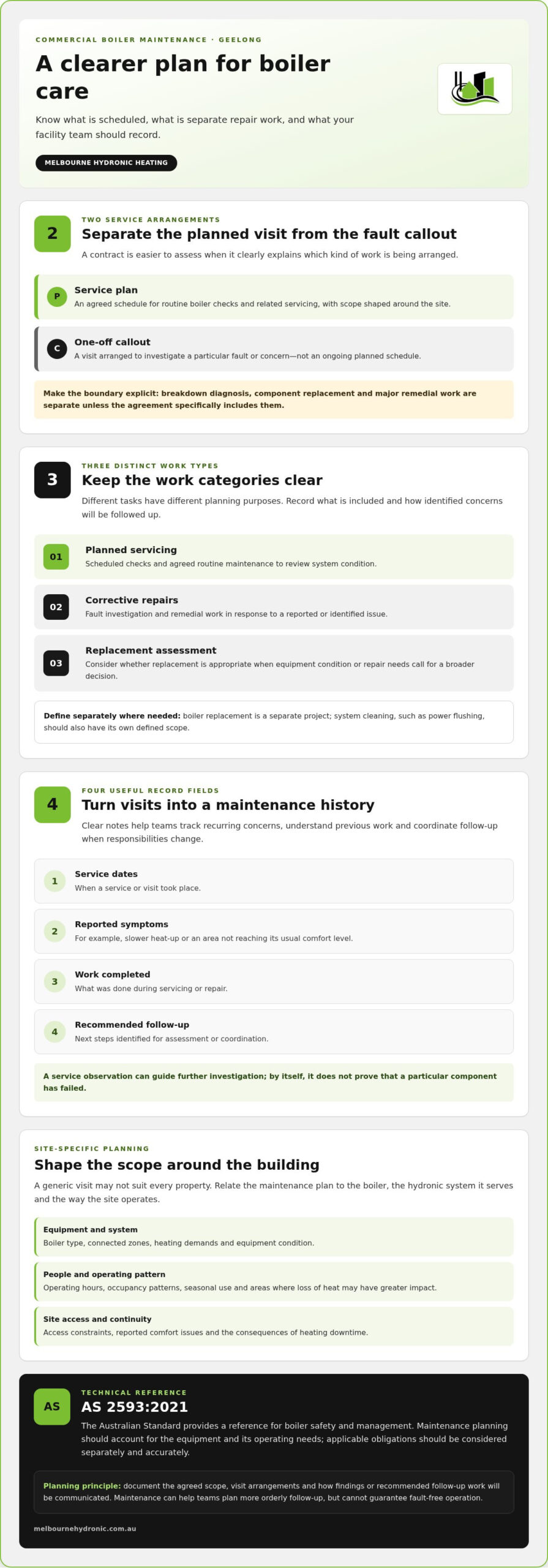
A Geelong commercial boiler maintenance contract should set out an agreed plan for scheduled boiler checks and related servicing. It should explain the planned scope, visit arrangements, and how findings or recommended follow-up work will be communicated. A generic annual visit may not suit every property: the boiler’s role, the hydronic system it serves, and the building’s operating needs all affect what is practical.
Service plan: An agreed schedule for routine boiler checks and related servicing, with the scope shaped around the site.
One-off callout: A visit arranged to investigate a particular fault or concern, rather than part of an ongoing planned schedule.
Documented, scheduled checks give facility teams a clearer basis for planning boiler servicing, tracking findings and organising follow-up work.
Which boiler and hydronic system details shape the contract?
Start with the boiler type and the layout it supports. Note the connected zones and heating demands across the property, including areas where a loss of heat would have a greater operational or occupant impact. A Boiler provides heat for a system, but the equipment is only one part of the site’s overall heating arrangement.
Operating hours, occupancy patterns and seasonal use matter too. A facility with extended operating hours may have different planning needs from a building used intermittently. A site assessment can relate the proposed maintenance scope to equipment condition, access constraints and the consequences of heating downtime, rather than relying on a standard template.
What belongs in planned servicing versus separate repairs?
Planned servicing is the scheduled work agreed for routine inspection and maintenance. The contract should describe its boundaries clearly, rather than implying that every fault or corrective task is included. If checks identify a concern, the next steps can be recorded and assessed separately according to the issue and work required.
Breakdown diagnosis, component replacement and major remedial work are distinct from routine maintenance unless the agreement specifically says otherwise. Boiler replacement is a separate project, while system cleaning, such as power flushing, should also have its own defined scope where needed. This distinction makes it easier to understand what a scheduled visit covers and how unexpected work will be handled. For more detail on fault response and repair considerations, see the commercial hydronic heating service and repair guide.
How does commercial boiler maintenance help Geelong sites plan ahead?
Planned checks give facility teams an opportunity to review boiler and system condition before heating demand increases. A service may bring developing concerns to attention, allowing the team to consider next steps and organise work with less pressure than during an unexpected interruption. Maintenance cannot guarantee fault-free operation, but a considered plan can help reduce avoidable disruption and make follow-up decisions more orderly.
The technical framework matters too. The Australian Standard AS 2593:2021 provides a reference for boiler safety and management. Maintenance planning should account for the equipment and its operating needs, while any applicable obligations are considered separately and accurately.
What can a scheduled boiler service help identify?
A scheduled service provides an opportunity to observe changes in performance, visible leaks, unusual operating behaviour or concerns elsewhere in the hydronic system. For example, a team might report that heating takes longer to come on, or that one area is not reaching its usual comfort level. These observations can guide further investigation, but on their own they do not prove that a particular component has failed.
Why should commercial sites keep service and repair records?
Keep a clear record of service dates, reported symptoms, work completed and recommended follow-up. This history helps property and maintenance teams see whether an issue has returned, understand what was done previously, and share useful context when responsibilities change. For Geelong sites, records can also help teams organise maintenance around seasonal heating demands and building operations.
A maintenance record turns individual service visits into a practical history for planning work, tracking recurring concerns and coordinating follow-up.
| Work type | Planning purpose |
|---|---|
| Planned servicing | Scheduled checks and agreed routine maintenance to review system condition. |
| Corrective repairs | Fault investigation and remedial work in response to a reported or identified issue. |
| Replacement assessment | Consideration of whether replacement is appropriate when repair needs or equipment condition warrant a broader decision. |
A Geelong commercial boiler maintenance contract is more useful when its planned work and record-keeping support the way your facility operates. Melbourne Hydronic Heating provides commercial boiler servicing and system maintenance tailored to the property and its hydronic system. Explore commercial boiler maintenance in Geelong and consider how servicing can be planned around your site’s needs.
How to compare Geelong commercial boiler maintenance contracts
A contract is useful when its scope matches the site, not simply because it is labelled “commercial maintenance”. Compare like for like: a plan covering scheduled boiler checks is not directly comparable with one that also includes wider hydronic system servicing or breakdown attendance. Match each proposal against the building’s equipment, operating hours, access requirements and the impact of heating downtime.
Use a comparison table to make differences visible. Record what is included, what is excluded and how additional work is handled before assessing overall value. The right scope depends on the boiler and property, so pricing also varies with the agreed work and site requirements. No single contract structure suits every facility.
| Comparison area | What to assess |
|---|---|
| Service scope | Which scheduled boiler checks and related servicing are described? Does the scope address the connected hydronic system where relevant? |
| Planned visits | How are visits scheduled, and how does the arrangement account for site access and operating hours? |
| Records | What service findings, completed work and recommended follow-up are documented? |
| Exclusions | Are breakdown attendance, power flushing, replacement parts and major remedial work treated separately? |
| Follow-up | How are concerns identified during a visit recorded, assessed and scoped for further work? |
Which inclusions and exclusions should decision-makers assess?
Look beyond a list of tasks. Check how the planned service is described, what reporting supports the visit, and how the agreement distinguishes routine maintenance from diagnosis and repair. Power flushing, replacement parts and breakdown attendance may be separate items, so the scope should make their treatment clear. Do not assume a particular response time or inclusion is standard; compare the written terms.
How can you assess service capability and local fit?
Hydronic experience helps connect boiler condition with the wider heating system, rather than treating the boiler in isolation. Melbourne Hydronic Heating has more than 30 years of industry experience and provides services across Geelong, including for commercial properties. Its maintenance work is tailored to the property and system, with repairs, boiler replacements and power flushing available as related services where appropriate.
For a practical decision, prioritise the Geelong commercial boiler maintenance contract that clearly reflects your site’s needs and explains how scheduled servicing, records and additional work fit together.
How to prepare your Geelong site for a boiler maintenance plan
A little preparation helps shape a maintenance plan around the equipment and the way your building operates. Before arranging a Geelong commercial boiler maintenance contract, bring together the details your facility team already has. Missing older records do not prevent an assessment; current observations and site information are useful starting points.
What information should a facility manager gather first?
Use this sequence to prepare a clear picture of the site:
- Identify the equipment. Gather available boiler identification details and note the type of boiler and where it is located.
- Describe the system. Provide a system layout if available, including connected heating zones and areas served.
- Summarise operating needs. Note heating hours, building use, occupancy patterns and any seasonal changes in demand.
- Record symptoms. List recurring faults, affected zones, comfort complaints and recent changes in system performance. Include when issues occur and whether they affect one area or several.
- Collect service history. Bring together available records of previous visits, completed work and recommended follow-up.
Specific observations make conversations more useful. “The north office takes longer to warm up” gives a maintenance team a clearer starting point than a general note that heating feels unreliable.
How can maintenance be planned around business operations?
Before a scheduled visit, organise access to the boiler and relevant system areas. Tell the maintenance team about restricted spaces, site entry arrangements, the on-site contact and practical work windows. Share operating hours and occupancy needs so the visit can be planned with the building’s activities in mind.
Agree how findings will be reported and how recommended additional work will be discussed. This helps facility teams understand what was observed, what was completed and which items may need separate assessment, without confusing routine servicing with repair work.
For commercial equipment in Victoria, check applicable safety and licensing requirements against current authoritative guidance. Requirements can depend on the equipment and work involved, so do not rely on an assumed interval or a general checklist as a substitute for current information.
With equipment details, access arrangements and reported issues prepared, Melbourne Hydronic Heating can tailor commercial maintenance to your Geelong property and hydronic system. Review commercial boiler maintenance options in light of your site’s operating needs.
Arrange commercial boiler maintenance in Geelong with Melbourne Hydronic Heating
A useful maintenance arrangement starts with the site, not a generic checklist. Match the service scope to the boiler, the hydronic system it supports and the way the property operates. Consider which areas rely on heating, when the building is occupied, what access is practical and whether past issues need follow-up. This gives facility teams a clearer basis for planning servicing and discussing work that may sit outside routine maintenance.
Melbourne Hydronic Heating provides commercial boiler servicing and system maintenance, as well as boiler repairs, replacements and power flushing. With more than 30 years of industry experience and service across Geelong and wider Victoria, the team tailors its approach to the property and its system. Not every site needs the same work, so a practical plan should reflect the equipment’s condition and the facility’s operational priorities.
What happens when you discuss a commercial maintenance plan?
The discussion can begin with the property’s boiler, connected hydronic system, operating hours and maintenance history. Share what the facility team has noticed, such as repeat faults or heating concerns in particular zones, along with any access constraints. These details help shape a relevant scope. The agreed work should clearly describe planned servicing and how separately recommended work will be considered, without assuming repairs or other tasks are automatically included.
Before discussing a Geelong commercial boiler maintenance contract, gather the equipment details and site observations available to you. A complete history is useful, but current information about building use, heating needs and reported issues can also guide the discussion.
When should a site consider a broader hydronic system assessment?
Repeated faults, uneven heating, visible system concerns or comfort complaints across multiple zones may point to issues beyond a routine boiler service. Maintenance findings can help identify concerns that need further investigation, but they do not by themselves establish the cause or confirm that a particular component has failed. Assessing the boiler alongside the wider hydronic system can help clarify the next step and whether remedial work should be scoped separately.
If replacement is under consideration, the commercial boiler selection guide offers further context for thinking through boiler choices.
Melbourne Hydronic Heating’s commercial maintenance work can be tailored to your property, boiler and operational needs in Geelong.
Build a practical maintenance plan for your Geelong property
A well-matched Geelong commercial boiler maintenance contract should reflect the boiler, connected hydronic system and the way your property operates. Compare the planned servicing scope, records, exclusions and approach to follow-up work, rather than relying on the contract label alone. Preparing equipment details, access arrangements and notes about recurring faults can also make maintenance planning more useful.
Melbourne Hydronic Heating brings more than 30 years of hydronic heating industry experience, with service across Geelong and wider Victoria. Commercial support includes maintenance, repairs, boiler replacements and power flushing, tailored to the property and its system. A clear discussion about your site’s heating demands and operational priorities is a practical first step towards organising appropriate service.
Discuss a maintenance plan for your Geelong commercial boiler with Melbourne Hydronic Heating.
Frequently Asked Questions
What should a commercial boiler maintenance contract include?
A commercial boiler maintenance contract should define the scheduled service scope, visit arrangements, records and follow-up process. It should also make clear how breakdown repairs, replacement parts, major remedial work and system cleaning are treated. The right scope depends on the boiler, connected hydronic system, operating hours and site access. For a Geelong property, compare the written inclusions and exclusions with the building’s heating needs rather than relying on the contract name alone.
How often should a commercial boiler be serviced in Victoria?
There is not one service interval that suits every commercial boiler. The schedule should account for the equipment, manufacturer guidance, how heavily the system operates and any applicable safety or inspection requirements. Keep routine servicing distinct from any legally required inspection, as these may have different purposes. Victorian requirements can depend on the equipment and circumstances, so check current authoritative guidance for your site instead of assuming a standard annual interval applies.
Can a maintenance contract cover boiler repairs as well as servicing?
Yes, a maintenance arrangement can address both, but the written scope needs to explain how. Scheduled servicing covers agreed planned work, while a repair usually responds to a reported fault and may involve diagnosis, parts or additional labour. Some arrangements may include specified repair work; others may scope it separately. For a Geelong commercial boiler maintenance contract, check how additional work is identified, approved and documented so expectations are clear.
How much does a commercial boiler maintenance contract cost?
The cost depends on the agreed scope and the site. Factors include the boiler and connected system, operating demands, access, planned visit arrangements and whether the agreement includes work beyond routine servicing. Repairs, replacement parts or power flushing may be scoped separately, affecting the overall work required. A useful comparison considers what each proposal covers for your property, rather than comparing headline prices without checking that the service scope is like for like.
What happens if a boiler fault is found during scheduled maintenance?
If a concern appears during scheduled maintenance, the finding can be recorded and assessed to determine whether further investigation or corrective work is appropriate. An observation does not automatically confirm that a component has failed. The next step depends on the issue and agreed scope: the team can explain what was found, identify any proposed additional work and clarify how it will be handled. This helps facility managers plan follow-up without confusing it with routine servicing.
Is boiler maintenance different for a commercial hydronic heating system?
Yes. Commercial hydronic maintenance needs to consider the boiler alongside the wider system it serves, including connected zones, heating demands and how the building operates. A concern in one area may need to be considered in the context of the system, not just the boiler. For Geelong properties, a site-specific scope relates servicing to occupancy, operating hours and the impact of reduced heating, supporting practical maintenance planning.
Can power flushing be included in a boiler maintenance contract?
Power flushing can be included if it is agreed as part of the scope, but it is often treated as a separately defined system-cleaning task rather than assumed routine servicing. Whether it is appropriate depends on the hydronic system’s condition and reported performance concerns. A maintenance discussion can distinguish scheduled boiler checks from proposed flushing work, making clear what the task involves and how it relates to the wider system. Melbourne Hydronic Heating provides power flushing for commercial properties.