
Hydronic Heating Cost Melbourne 2026: The Ultimate Price & ROI Guide
What if the most expensive part of your home heating isn’t the installation, but the energy bills you’ve been paying for years? As gas prices continue to climb across Victoria, many Melbourne families feel trapped between rising utility costs and the need for a warm, healthy home. Understanding the true hydronic heating cost melbourne involves looking past the initial quote to see the lifelong value of a system that works with your home, not against your wallet.
It’s natural to feel overwhelmed by technical jargon like air-to-water heat pumps versus traditional boilers, especially when you’re worried about the potential mess of a retrofit in an existing house. We agree that you deserve a clear, honest breakdown of what a premium installation looks like for a standard 3 or 4 bedroom family home. This guide will demystify the investment required and show you how switching to electric heat pumps can slash your running costs by up to 50 percent compared to ducted gas. You’ll learn exactly how to budget for your project, the health benefits for allergy sufferers, and why a professional installation can boost your home’s resale value by up to 6 percent.
Key Takeaways
- Learn how to break down the primary cost components of your system, from high-efficiency heat sources to distribution networks.
- Discover the most accurate way to calculate the hydronic heating cost melbourne by comparing radiator panels against underfloor heating for your specific home layout.
- Understand how Victoria’s gas phase-out affects your investment and why electric heat pumps offer superior long-term energy independence.
- Identify the “Retrofit Premium” and learn how to navigate the technical challenges of installing modern heating in established Melbourne homes.
- Quantify the long-term ROI of a system that lasts twice as long as standard air conditioning while providing a healthier environment for your family.
What Drives Hydronic Heating Costs in Melbourne for 2026?
Hydronic heating represents more than just a way to stay warm; it’s a premium investment in your home’s permanent infrastructure. Unlike standard air conditioning units that circulate dry, dusty air, these systems use water to move thermal energy with silent precision. This level of comfort requires a sophisticated setup. The initial price reflects the high quality of the components and the specialized skill required for a professional installation that lasts for decades.
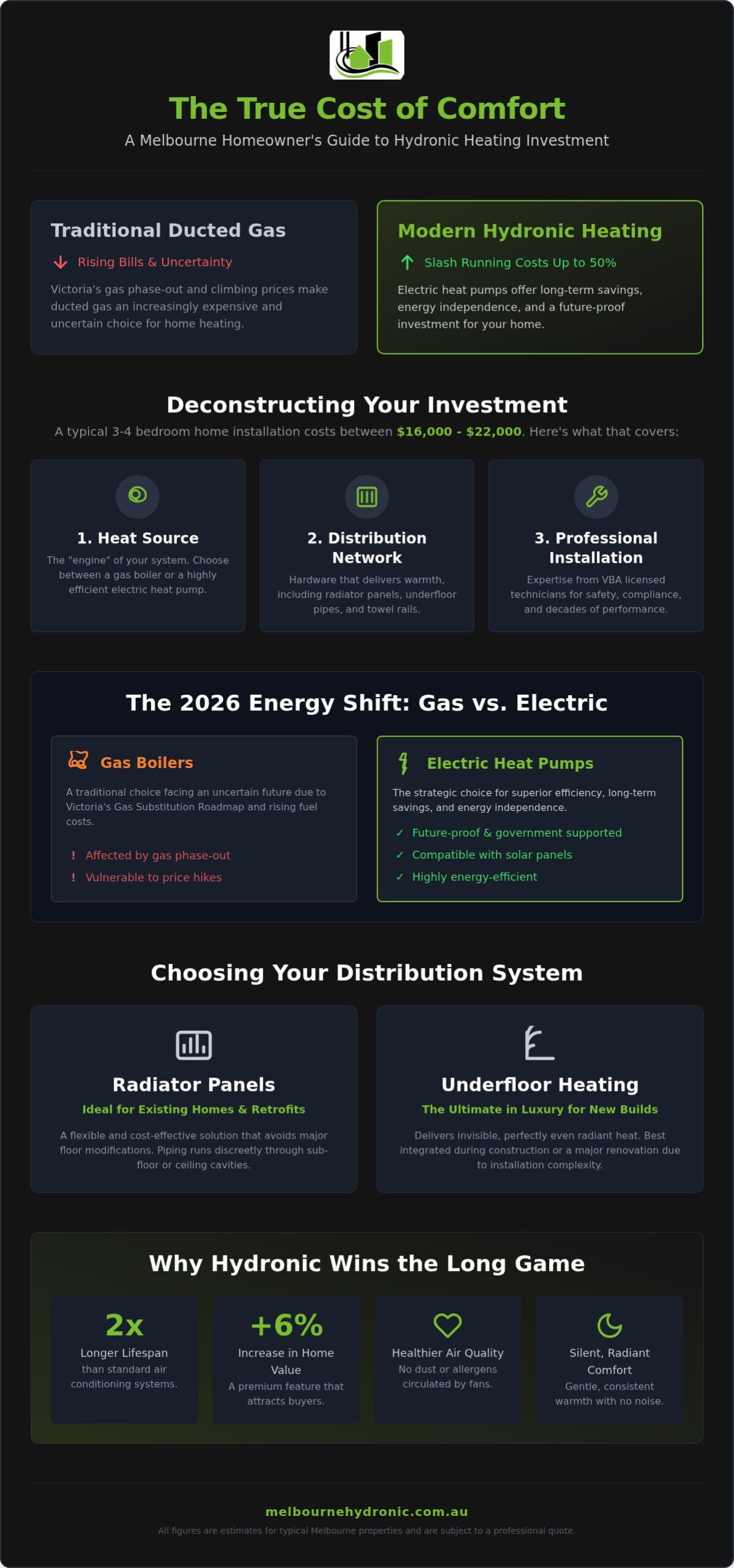
Your total hydronic heating cost melbourne is determined by three core pillars: the heat source, the distribution method, and the labor. The heat source is the engine of the system, whether that’s a high efficiency gas boiler or a modern electric heat pump. Distribution involves the physical hardware in your rooms, such as radiator panels or pipework. Finally, labor costs cover the expertise of VBA licensed technicians who ensure the system is pressurized, balanced, and compliant with Victorian safety standards.
In 2026, the local market is shifting rapidly due to the Victorian Government’s Gas Substitution Roadmap. This policy makes electric heat pumps the strategic choice for new builds and major renovations. While these systems often have a higher upfront price than gas boilers, their efficiency and compatibility with solar power make them the preferred option for long term energy independence. For a typical three bedroom Melbourne home, the entry level hydronic heating cost melbourne generally falls between $16,000 and $22,000 for a professional installation.
The ‘System Type’ Variable
Choosing between radiator panels and Underfloor heating systems is the biggest decision affecting your quote. Radiators are often more cost effective for retrofitting into existing homes because they don’t require major floor modifications. If you’re looking for extra luxury, adding hydronic towel rails or sleek trench heating will increase the base price but significantly enhance the premium feel of your bathrooms and living spaces. We also recommend multi zone controls. They add to the initial hardware cost, but they allow you to heat only the rooms you’re using, which lowers your monthly running bills.
Property Size and Layout Impacts
Size matters, but not always in the way you’d expect. We often see a scale effect where larger homes in Bayside or the Mornington Peninsula enjoy lower per square meter rates because the fixed costs of the boiler and main pipe runs are spread over a larger area. However, double storey homes introduce complexity. Running pipes between floors requires specialized routing and more labor time than a single storey layout. Accessibility is also a major factor. A home with clear sub floor access is much simpler to work on than a house built on a slab on ground, where we must find alternative paths for the distribution network.
Radiator Panels vs. Underfloor Heating: A Price Comparison
Choosing between radiator panels and underfloor systems is often the most significant factor in your total hydronic heating cost melbourne. It’s about more than just the hardware. The labor required to install these systems varies greatly depending on whether you’re building a new home or updating an established property. While both options provide the same silent, healthy warmth, the way they integrate with your home’s architecture dictates the final investment.
Wall mounted radiators are generally the more flexible choice for existing homes. They don’t require you to pull up floorboards or modify your slab. Instead, we run specialized piping through the sub floor or ceiling cavity to each unit. If you’re looking for a bespoke aesthetic, premium designer radiators offer a striking architectural statement, though they naturally carry a higher price point than standard steel panels. For those managing a strict renovation budget, hydronic heating panels provide a modular approach where you can prioritize key living areas first.
The Cost of Hydronic Radiator Systems
The total for a radiator system is calculated based on the number of units and the complexity of the pipe runs. Retrofitting radiators in a classic Melbourne weatherboard home is often highly cost effective because the raised floor provides easy access for our technicians. Beyond the standard panels, many homeowners choose to include hydronic towel rails in their bathrooms. These add a touch of luxury and help keep the space dry and mold free, which increases the overall value of the project and your daily quality of life.
The Investment in Underfloor Heating
For many, underfloor heating in Melbourne is the gold standard of comfort. The installation involves a sophisticated manifold setup and oxygen barrier piping laid directly into the floor. If you’re building a new home, an in slab system is the most economical path because the pipes are tied to the reinforcing mesh before the concrete is poured. In contrast, retrofitting underfloor heating into an existing home requires a “thin set” or in screed system, which involves more labor and specialized materials.
We only recommend “wet” hydronic systems rather than electric floor mats. While electric mats might seem cheaper to install, their running costs are significantly higher and they don’t benefit from the Victorian Energy Upgrades program incentives available for high efficiency hydronic heat pumps. A hydronic system is a long term asset that pays for itself through energy savings and superior durability. To ensure your home is perfectly balanced for the local climate, we suggest starting with a professional system design that accounts for your specific floor plan and insulation levels.
The 2026 Energy Shift: Gas Boilers vs. Electric Heat Pumps
The landscape of home energy in Victoria is undergoing its most significant transformation in decades. When calculating your hydronic heating cost melbourne, the choice of heat source is now the most critical decision for your long term budget. While gas boilers were once the default, the Victorian Government’s Gas Substitution Roadmap has fundamentally changed the math. Homeowners are now looking at their heating systems as a strategic hedge against rising gas tariffs and a way to protect their property’s future resale value.
The primary advantage of modern electric systems lies in their Coefficient of Performance (COP). Most air source heat pumps operate at a COP of 3.5 to 4.0. This means for every 1 kW of electricity the system consumes, it delivers 3.5 to 4 kW of thermal energy into your home. A gas boiler, even a high efficiency condensing model, can never exceed a 1.0 COP because it cannot create more energy than the fuel it burns. This efficiency gap is why heat pump hydronic heating has become the gold standard for energy conscious Melburnians. These systems align with the latest Victorian energy efficiency regulations, ensuring your home remains compliant and attractive to future buyers.
Gas Boiler Installation and Replacement
High efficiency condensing boilers still have a place, particularly in heritage homes where electrical upgrades might be cost prohibitive or when performing straightforward boiler replacements in existing systems. They offer a lower upfront installation price compared to heat pumps. however, you must account for hidden costs. Annual gas connection fees, mandatory venting requirements, and the long term trend of increasing gas prices in Victoria can erode those initial savings. If your current system is over 15 years old, a modern condensing unit will still offer a significant efficiency boost over your old atmospheric boiler.
Electric Heat Pump ROI
The return on investment for an electric heat pump is more attractive than ever in 2026. While the initial equipment cost is higher, the payback period has shortened due to the synergy with rooftop solar. By running your heat pump during peak solar production hours, you can effectively heat your home for free. The thermal mass of your floor or radiators will then hold that warmth well into the evening. To support this transition, the Victorian Government offers incentives through the Solar Homes Program. Currently, rebates of up to $1,000 are available for eligible heat pump boiler installations. When you combine these rebates with a 30 to 50 percent reduction in annual running costs, the electric shift becomes a clear winner for the modern Melbourne household.
Installation Complexity: New Build vs. Melbourne Retrofit
The physical structure of your home plays a decisive role in the final hydronic heating cost melbourne. While the hardware components remain consistent, the labor hours required to integrate them into your floor or walls can vary significantly. Understanding the logistical differences between a fresh construction and a renovation helps you set a realistic budget and avoid unexpected variations during the project.
For those building from the ground up, the most economical path is to install the system during the “frame stage.” This allows us to run pipework through open wall cavities and coordinate directly with your builder before the plaster and flooring are finalized. Integrating hydronic heating at this point minimizes labor because the home is a blank canvas. It also ensures that the system is perfectly optimized for the building’s specific thermal envelope and insulation levels.
New Build Economics
Installing underfloor pipes before the concrete slab is poured is the peak of cost efficiency. We tie the oxygen barrier piping directly to the reinforcing mesh, which requires far less time than any other method. To keep your project on track, clear communication between your hydronic specialist and the slab contractor is essential. This coordination prevents delays and ensures the manifolds are positioned correctly for future connection to your heat pump or boiler. Beyond the immediate comfort, a pre installed hydronic system adds a significant premium to your property’s resale value, as modern Melbourne buyers increasingly prioritize energy efficient infrastructure.
Retrofitting Existing Homes
Retrofitting introduces the “Retrofit Premium,” which accounts for the extra care and time needed to work within an established structure. Melbourne’s iconic Victorian and Edwardian homes often feature high ceilings and timber floors over a sub floor crawl space. This accessibility is a major advantage, as it allows us to run pipework discreetly beneath the house. However, mid century homes built on concrete slabs present a different challenge. In these cases, we might recommend radiator panels with pipework routed through the ceiling or even sleek external copper piping. This can be a stylish architectural choice that saves thousands in labor compared to cutting into an existing slab.
You should also factor in the cost of “making good” after the installation. While our technicians are exceptionally tidy, retrofitting wall mounted radiators occasionally requires minor plaster patches or paint touch ups. To minimize these hidden costs, we recommend a thorough site inspection to identify the most direct pipe routes. If you are planning a renovation, it is best to book a technical assessment early to ensure your heating design aligns with your architectural changes.
- Timber Floors: Generally lower labor costs due to sub floor access.
- Slab on Ground: May require ceiling runs or external pipework to avoid floor demolition.
- Multi Storey: Requires specialized vertical pipe runs, which increases installation time.
- Access: Clear access to the boiler or heat pump site reduces initial site preparation fees.
Total Cost of Ownership: Why Hydronic Wins the Long Game
When evaluating the hydronic heating cost melbourne, it’s easy to focus solely on the initial invoice. However, the true value of this investment reveals itself over decades, not just the first winter. Most standard split systems or ducted gas heaters have an operational life of 10 to 12 years before major components fail or efficiency drops significantly. In contrast, a professionally installed hydronic system is built for a 25 year lifespan. The radiator panels and pipework can often last 40 years or more, meaning you’ll likely replace a split system twice before your hydronic system even reaches middle age.
This longevity fundamentally changes the financial equation. While the upfront price is higher, the “cost per year of comfort” is often lower than cheaper alternatives. You aren’t just buying a heater; you’re installing a permanent piece of home infrastructure that maintains its efficiency and adds tangible value to your property’s title. For long term homeowners in Melbourne, the decision to go hydronic is a move toward financial and operational stability.
Maintenance and Longevity
Keeping your system at peak performance requires minimal but consistent care. We view a regular hydronic heating service in Melbourne as a low cost insurance policy. Annual checks ensure the system remains pressurized and the heat source operates at its maximum COP. Every 5 to 10 years, we recommend power flushing the system to remove any internal build up. This simple procedure protects your high quality European components and ensures that your energy bills stay as low as the day the system was commissioned. By preventing emergency repairs through proactive care, you eliminate the stress and high costs of mid winter failures.
The Health and Comfort ROI
One of the most overlooked aspects of the hydronic heating cost melbourne is the “Health Dividend.” Traditional forced air systems survive by blowing hot air and allergens around your living spaces, which can lead to restless sleep and triggered asthma symptoms. Hydronic systems provide silent, radiant warmth that doesn’t move dust or dry out your skin. For Melbourne families dealing with seasonal allergies, the reduction in medical expenses and the improvement in sleep quality represent a significant, though often unquantified, return on investment. You’re choosing a lifestyle where your home environment actively supports your well being.
The final verdict is clear. While the initial commitment is higher, the combination of a 25 year lifespan, reduced energy consumption, and superior health benefits makes hydronic the most frugal choice for the discerning homeowner. If you’re ready to move away from dry, expensive air and toward a permanent comfort solution, it’s time to take the next step. Request a custom quote for your Melbourne home today and let our experts design a system that pays you back every single day.
Future-Proof Your Home Comfort Today
Investing in your home’s thermal infrastructure is a decision that impacts your family’s health and your financial independence for decades. We’ve explored how the hydronic heating cost melbourne is balanced by a 25 year system lifespan and the superior efficiency of modern electric heat pumps. By moving away from forced air systems, you’re choosing a dust free environment that supports better respiratory health while protecting your property value against Victoria’s shifting energy landscape.
Since 1990, our family owned and operated team has specialized in installing premium European systems across Melbourne and Geelong. With over 30 years of local experience, we understand the specific technical requirements of both heritage retrofits and modern new builds. Don’t settle for a temporary heating fix when you can install a permanent solution designed for lifelong reliability and silent performance.
Ready to transform your living environment? Get a Professional Hydronic Heating Quote for Your Melbourne Property and discover the unmatched comfort of radiant warmth. We look forward to helping you create a healthier, more efficient home that stands the test of time.
Frequently Asked Questions
How much does it cost to install hydronic heating in a 4-bedroom Melbourne home?
The total investment for a four bedroom property depends on your choice between radiator panels and underfloor pipework. Each home requires a bespoke design that accounts for ceiling heights, insulation levels, and window orientation. While the initial hydronic heating cost melbourne is higher than standard air conditioning, it’s a long term investment in your home’s permanent infrastructure that adds significant resale value.
Is hydronic heating cheaper to run than ducted gas heating?
Yes, hydronic systems are significantly more efficient, typically offering running costs that are 30 to 50 percent lower than ducted gas. Electric heat pumps are especially frugal because they use a small amount of electricity to move heat rather than creating it through combustion. This efficiency ensures your home stays warm without the heavy burden of rising Victorian gas tariffs.
Can I install hydronic heating in an existing home without tearing up the floors?
You can easily upgrade an existing home by choosing wall mounted radiator panels. We discreetly run the specialized pipework through your sub floor or ceiling cavity, which leaves your floorboards or tiles completely untouched. This makes it the ideal solution for Melbourne’s period homes where preserving original architectural features is a priority for the homeowner.
How long does the installation of a hydronic system typically take?
Most residential installations are completed within 3 to 7 working days. For new builds, we coordinate with your contractor to install the system in stages that match the construction timeline. Retrofitting an established home is often a continuous process where our technicians work efficiently to minimize any disruption to your family’s daily routine.
What is the price difference between a gas boiler and an electric heat pump in 2026?
Electric heat pumps require a larger upfront investment than gas boilers, but they offer far superior long term ROI. With Victoria’s shift away from residential gas, the heat pump is the more strategic choice for future proofing your property. When you factor in the lower running costs and synergy with solar power, the electric option pays for itself much faster.
Does hydronic heating require a lot of maintenance?
Hydronic systems are remarkably low maintenance and designed for a 25 year lifespan. We recommend a simple annual service to check system pressure and ensure the heat source is operating at peak efficiency. A professional power flush every 5 to 10 years is also advised to keep the internal pipework clear and protect your high quality European components.
Will hydronic heating increase my Melbourne property value?
Yes, a professional installation can boost your property’s resale value by approximately 4 to 6 percent. Melbourne buyers increasingly view hydronic heating as a premium “must have” feature due to its energy efficiency and health benefits. It sets your home apart in the market as a high end, sustainable property with superior comfort levels.
Are there any government rebates for hydronic heating in Victoria?
Incentives are currently available through the Victorian Energy Upgrades program and the Solar Homes Program. These initiatives are designed to support the transition to energy efficient electric systems. For eligible households, these rebates can provide up to $1,000 to help offset the initial hydronic heating cost melbourne when installing a high efficiency heat pump.