
Reducing Heating Bills in Melbourne Winter: The 2026 Efficiency Guide
If the Victorian Default Offer just dropped electricity prices by an average of $84 this July, why does your winter energy bill still feel like a financial burden? Most Melbourne homeowners are tired of the bill shock that arrives with the July frosts, especially when older gas systems leave some rooms freezing while others swelter. It’s a common frustration, but achieving a warm, healthy home shouldn’t mean compromising your budget. We’ve designed this guide to simplify the process of reducing heating bills in Melbourne winter by using a clear, expert-led framework.
You’ll discover how smart habits and professional system maintenance can immediately improve efficiency, alongside a clear look at why high-efficiency hydronic upgrades are the gold standard for modern Victorian living. We’ll also navigate the latest 2026 Victorian Energy Upgrades (VEU) discounts and the transition from gas to electric heat pumps. From understanding the upcoming July 31 gas price changes to mastering your thermostat, you’re about to learn how to stay cozy while keeping your monthly costs firmly under control, which might even allow you to explore Music Tuition Fees for professional lessons in Melbourne.
Key Takeaways
- Learn how to optimize your thermostat and use hydronic radiator valves to heat only active zones, preventing wasted energy in empty rooms.
- Understand how routine servicing and power flushing eliminate internal debris, ensuring your system doesn’t work overtime to combat “bill creep.”
- Discover the long-term financial benefits of reducing heating bills in Melbourne winter by switching to electric heat pumps with 300-400% efficiency.
- See why professional heat load calculations are essential for Melbourne’s unique architecture to avoid the high running costs of generic, oversized systems.
- Identify the specific 2026 energy trends and gas tariff changes that make high-efficiency hydronic upgrades a strategic investment for your home’s wellbeing.
Why are Melbourne heating bills so high in 2026?
Understanding why your energy costs remain high requires looking beyond the numbers on your bill. Melbourne’s winter isn’t just cold; it’s damp. This high humidity increases the perceived cold, forcing your heating system to work harder to achieve a comfortable baseline. While the Victorian Default Offer saw electricity prices decrease for many residential customers by approximately $84 in July 2026, gas prices are scheduled for another shift on July 31. This divergence is a primary reason why many homeowners are now focused on reducing heating bills in Melbourne winter by re-evaluating their reliance on gas.
Melbourne’s Climate vs. Your Energy Meter
The 15 degrees you experience in Melbourne often feels significantly sharper than the same temperature in Sydney. This is due to our high relative humidity, which conducts heat away from the body more quickly. Your heating system doesn’t just fight the temperature; it fights the moisture. When we discuss hydronic heating, we often focus on how radiant heat cuts through this dampness. Unlike forced air that can feel patchy or dry, radiant systems warm the fabric of the building, providing a more stable thermal environment that feels warmer at lower thermostat settings.
Many of our most beautiful suburbs, like Carlton or Geelong, are filled with Victorian-era homes that weren’t built with modern low-energy house design principles in mind. These leaky homes allow expensive heat to escape through floorboards, chimneys, and single-glazed windows. When you combine an unsealed home with an outdated gas boiler, you’re essentially paying to heat the street. Older boilers can lose a significant portion of their energy through the flue, an inefficiency that modern homeowners can no longer afford as gas tariffs continue to fluctuate.
The Gas to Electric Transition in Victoria
The Victorian Government is actively steering households away from gas through the Victorian Energy Upgrades (VEU) program. This initiative provides upfront discounts for those switching to heat pumps, acknowledging that the future of Victorian energy is electric. To succeed in reducing heating bills in Melbourne winter, you must understand your bill’s structure:
- Fixed Daily Supply Charges: The cost just to stay connected to the grid, which remains regardless of usage.
- Variable Usage Rates: The cost per megajoule (MJ) or kilowatt-hour (kWh) you actually consume.
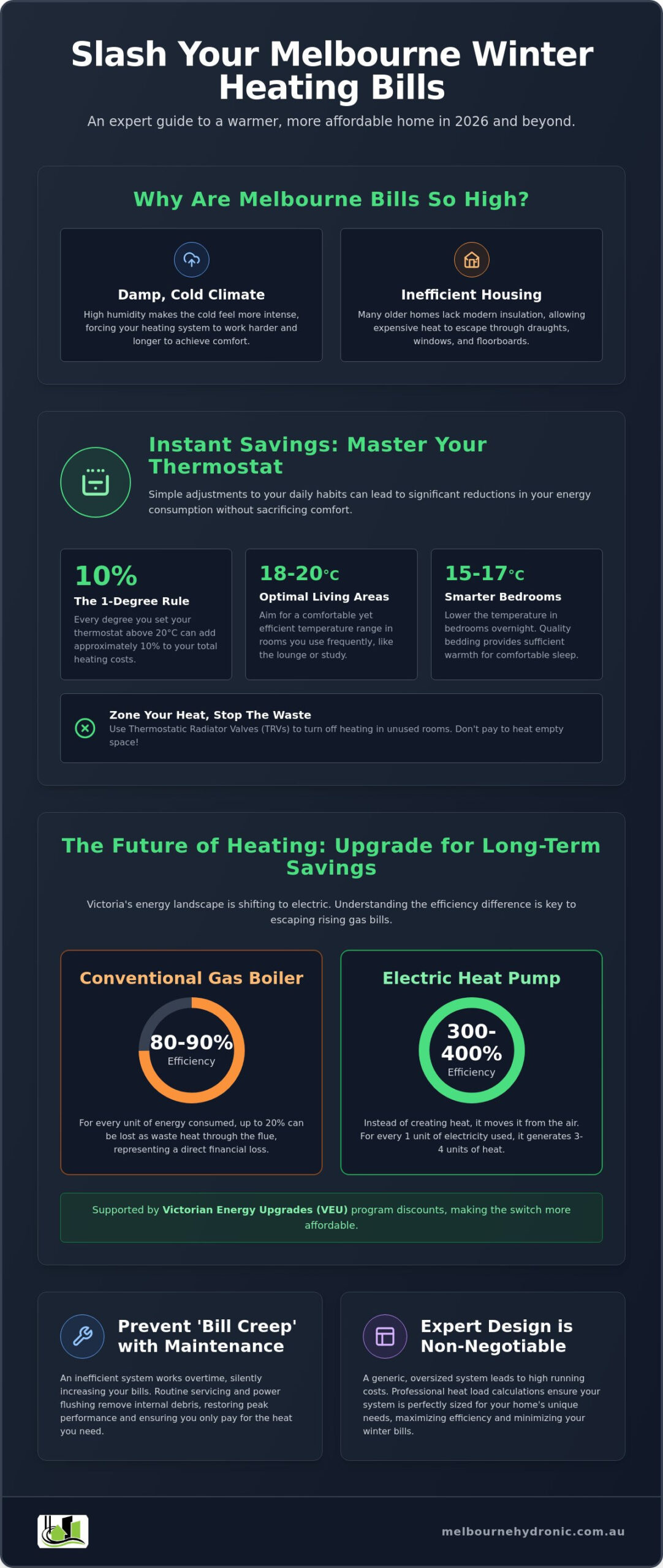
- Efficiency Ratios: Gas boilers are often 80-90% efficient, whereas electric heat pumps can reach 300-400% efficiency.
By shifting to electric alternatives, you aren’t just changing your fuel source; you’re adopting a technology that produces more heat for every dollar spent. This transition is becoming the standard for Melbourne residents looking to escape the cycle of rising winter gas bills.
Immediate habits to slash your heating costs today
Your thermostat is the most powerful tool you have for reducing heating bills in Melbourne winter, yet it’s often the most misunderstood. Many residents treat their heating system like a car accelerator, pushing it higher to get warm faster. In reality, a heating system works at a steady rate to reach a target temperature. Setting your thermostat to 24°C won’t warm the room any quicker than setting it to 20°C, but it will significantly inflate your energy consumption. Every degree you set above 20°C adds approximately 10% to your total heating costs.
Mastering Your Thermostat and Zoning
The secret to a lower bill lies in precision. For living areas, aim for a comfortable 18°C to 20°C. In bedrooms, you can often drop this to 15°C or 17°C, as high-quality bedding provides the necessary warmth. If you have a hydronic system, you have a distinct advantage through Thermostatic Radiator Valves (TRVs). These allow for strategic zoning, meaning you can heat the home office during the day while keeping the guest bedrooms and lounge completely switched off.
The “set and forget” approach is largely a myth for modern efficiency. While you shouldn’t let your home’s core temperature drop so low that the system has to work for hours to recover, you should certainly lower the settings when you leave for work or head to bed. If your valves are difficult to turn or your rooms feel unevenly heated, a professional system servicing and maintenance check can ensure your zoning is actually working as intended.
Retaining Heat with Simple Home Fixes
Even the most efficient heat pump or boiler can’t overcome a “leaky” house. Draught proofing is the low-hanging fruit of home efficiency. In older Geelong cottages or weatherboard homes in the suburbs, gaps around floorboards, door frames, or unmaintained garage seals act like tiny exhaust fans for your expensive warm air. While gap fillers help, professional servicing from We Do Garage Doors ensures larger openings are airtight, which can make an immediate difference in how often your heating system needs to cycle on.
- Window Management: Glass is a major source of heat loss. Close heavy curtains and ensure they have pelmets to stop cold air from “rolling” off the glass into the room.
- Passive Solar Gain: On those rare, crisp sunny Melbourne days, open your north-facing curtains completely. Let the sun warm your thermal mass for free, then shut them tight the moment the sun begins to dip.
- Close the Dead Zones: Don’t pay to heat laundry rooms, bathrooms, or hallways that aren’t being used. Keep internal doors shut to trap heat where you actually live.
By combining these behavioral changes with minor physical adjustments, you create a home environment that retains energy rather than constantly demanding more of it. These steps are the essential foundation for any long-term strategy focused on reducing heating bills in Melbourne winter.
How system maintenance prevents ‘bill creep’
Many homeowners notice a gradual, frustrating increase in their energy consumption year after year, even when their heating habits haven’t changed. This phenomenon, known as ‘bill creep’, is rarely a result of rising tariffs alone. More often, it’s the physical degradation of the heating system itself. Over time, internal components lose their efficiency, forcing the system to run for longer cycles to achieve the same level of warmth. Prioritising preventative maintenance is a fundamental step in reducing heating bills in Melbourne winter, ensuring your investment continues to perform at its peak.
The primary culprit behind this efficiency loss is often ‘sludge’, a build-up of black iron oxide (magnetite) that settles inside radiators and pipes. This debris acts as an unintended insulator, preventing the heat from the water from transferring effectively into your living space. As a result, your pump must work significantly harder to move water through restricted pipes. While a professional service has an upfront cost, it’s almost always cheaper than the cumulative cost of one or two months of wasted gas or electricity caused by a struggling, unmaintained system.
You can manage some of this maintenance yourself through simple tasks like bleeding your radiators. If you notice cold spots at the top of a radiator, it’s likely trapped air preventing hot water from filling the panel. Releasing this air restores the full heating surface area. Additionally, your system’s expansion tank plays a vital role as the “lung” of the setup, maintaining consistent pressure. If the pressure is too low, the system may fail to fire; if it’s too high, it can cause unnecessary wear on valves and seals, leading to expensive repairs and lost efficiency.
The Power of a Professional System Flush
When simple bleeding isn’t enough to fix cold spots, your system likely requires power flushing. This process involves circulating high-velocity water and specialised cleaning agents through the network to dislodge stubborn sludge and corrosion. You’ll know your system is struggling if you hear metallic clicking, noisy pipes, or if the bottom of your radiators remain cold while the top is warm. A clean system can reduce energy use by up to 15%.
Boiler Health and Safety Checks
For those still using gas, the health of the boiler is paramount for both economy and safety. A technician will inspect the burner and heat exchanger to ensure optimal combustion, as even a small amount of soot can hinder heat transfer. Correct boiler pressure is also linked directly to energy consumption; a system that constantly loses pressure is a system that’s leaking energy. In 2026, Victorian safety standards have introduced even higher benchmarks for gas appliance testing, making annual professional checks a necessity for reducing heating bills in Melbourne winter while keeping your family safe and healthy.
Upgrading to heat pump hydronics for long-term savings
While habits and maintenance provide immediate relief, the most significant step toward reducing heating bills in Melbourne winter is transitioning to a modern electric heat pump. Many homeowners are currently weighing the benefits of gas boilers versus electric heat pumps. In our local climate, the choice is becoming increasingly clear. Unlike traditional split systems that circulate dust and allergens, heat pump hydronic heating provides silent, radiant warmth that is ideal for families with asthma or respiratory sensitivities. It’s a sophisticated process that extracts heat from the ambient outside air, even on cold Melbourne days, and transfers it into your water circuit.
A major advantage of this technology is its ability to integrate with your existing hydronic heating panels. You don’t need to renovate your entire home to enjoy the benefits of electrification. By simply replacing an aging gas boiler with a high-efficiency heat pump, you can continue using your current radiators while slashing your carbon footprint. Victorian households can also access significant financial support, including rebates of up to approximately $1,400 through the Solar Homes program and additional Victorian Energy Upgrades (VEU) discounts.
Generic guides often suggest split systems as a quick electric fix. However, they ignore the fundamental comfort and health benefits of radiant heat. For Melbourne’s many asthma sufferers, the lack of forced air and dust circulation makes hydronic systems a vastly superior choice for indoor air quality. It’s a premium lifestyle choice that also happens to be the most economical way to heat a home in 2026.
The Efficiency Math: Gas vs. Electric
The technical term for heat pump efficiency is the Coefficient of Performance (COP). While a premium gas boiler might achieve 90% efficiency, a heat pump typically operates at a COP of 3.5 to 4.0. This means for every unit of electricity consumed, the system produces 3.5 to 4 units of heat. It’s the gold standard for 2026, especially as Victoria moves toward phasing out gas reticulation in new developments. Upgrading now ensures your home remains future-proofed against changing energy regulations and volatile gas tariffs.
Maximising Your Investment with Solar Integration
If you have a rooftop solar PV system, your running costs can drop even further. By scheduling your heat pump to run during peak generation times, usually between 10 am and 2 pm, you’re essentially heating your home for free. Your radiators or concrete slab act as a thermal battery, storing that energy and slowly releasing it throughout the evening. This strategic approach significantly improves your Residential Efficiency Scorecard rating, which can boost your property’s market value in competitive suburbs like Camberwell or Brighton.
If you’re ready to see how a heat pump conversion can transform your home’s comfort and long-term running costs, contact our expert team for a tailored efficiency assessment.
Expert design: the key to a low-bill winter
Many homeowners view a heating system as a simple appliance, similar to a refrigerator or a washing machine. In reality, a hydronic system is a complex piece of precision engineering where the design is just as important as the hardware. Choosing an “off-the-shelf” solution often leads to higher running costs because generic systems aren’t calibrated for your home’s specific thermal profile. Achieving the goal of reducing heating bills in Melbourne winter requires a bespoke approach that accounts for every window, ceiling height, and orientation.
Professional heat load calculations are the foundation of an efficient home. We don’t guess the size of your radiators or heat pump; we calculate the exact energy required to maintain comfort based on Melbourne’s varied architecture. Whether you live in a draughty Victorian terrace or a modern glass-fronted apartment, the math must be right. If a system is oversized, it cycles on and off too frequently, wasting energy. If it’s undersized, it runs constantly without ever reaching the target temperature. Both scenarios lead to unnecessary expenses and premature wear on your components.
Installation quality also dictates your monthly spend. Poorly routed pipework can “bleed” heat into the ground or subfloor before it ever reaches your living spaces. Our technicians prioritise high-grade insulation for all reticulation lines, ensuring every megajoule of energy is delivered exactly where it’s needed. This technical precision doesn’t just lower costs; it supports a healthier home environment. By customising the system to your lifestyle, we eliminate the cold spots and temperature swings that can exacerbate respiratory issues, providing the consistent, allergy-free warmth that only radiant heat can offer.
The Melbourne Hydronic Heating Difference
With 30 years of experience designing systems specifically for Melbourne and Geelong conditions, we understand the local climate better than anyone. We don’t just install panels; we strategically place them to maximise convection efficiency. By positioning radiators under windows, we create a “warm air curtain” that neutralises the chill from the glass before it enters the room. For those embarking on new Victorian builds, our approach to underfloor heating provides the ultimate in luxury and efficiency. We design these systems with zoned manifolds, allowing you to maintain different temperatures in bedrooms and living areas with surgical precision.
Taking the Next Step Toward Efficiency
The path to reducing heating bills in Melbourne winter begins with a professional energy efficiency consultation. During this process, we evaluate your current setup and identify the most impactful upgrades for your specific budget. We also take the stress out of the transition by helping you navigate the complex Victorian government rebate paperwork. From the Solar Homes program to the VEU discounts mentioned earlier, we ensure you receive every cent of support you’re entitled to. Don’t wait for the next cold snap to discover your system is underperforming. Book a service or a comprehensive quote today to secure your home’s comfort and financial wellbeing for the seasons ahead.
Take Control of Your Winter Comfort
Achieving a high-efficiency home is a journey that combines immediate behavioral changes with strategic technical investments. We’ve explored how simple habits like mastering your thermostat and prioritizing system maintenance can stop “bill creep” in its tracks. However, the most effective path to reducing heating bills in Melbourne winter remains the transition to precision-engineered heat pump technology. By moving away from volatile gas prices and embracing electric hydronics, you’re choosing a healthier, more sustainable lifestyle for your family.
Our team brings over 30 years of local Melbourne experience to every project. We are specialists in high-efficiency electric heat pump transitions and employ only VBA licensed and insured installers to guarantee technical precision. Don’t let another winter of high energy costs pass you by. Book your 2026 Hydronic Efficiency Audit with Melbourne’s experts today and discover how a professional design can transform your living environment. You deserve a home that is warm, healthy, and affordable.
Frequently Asked Questions
What is the cheapest way to heat a house in Melbourne?
Electric heat pumps are the most cost-effective solution for Melbourne homeowners in 2026. Because they operate with a Coefficient of Performance (COP) between 3.5 and 4.0, they deliver four units of heat for every one unit of electricity consumed. When paired with a rooftop solar system, you can run your heating during the day for almost zero cost, making it significantly cheaper than traditional gas or electric storage systems.
Is it cheaper to leave hydronic heating on all day?
No, it’s generally more efficient to use a “setback” temperature rather than leaving the system at a high heat all day. Lowering the thermostat by 3 or 4 degrees when you’re away or asleep prevents the home from cooling completely while reducing the workload on your boiler or heat pump. This balance keeps the thermal mass warm without wasting energy during hours when the house is empty.
How much can I save by switching from gas to a heat pump in Victoria?
Switching from gas to a heat pump can slash your running costs because heat pumps are three to four times more efficient than the best gas boilers. This is a primary method for reducing heating bills in Melbourne winter. As gas prices are scheduled to change on July 31, 2026, moving to a system that utilizes ambient air temperature ensures you’re no longer vulnerable to fluctuating fossil fuel tariffs.
Does bleeding my radiators actually lower my heating bill?
Bleeding your radiators lowers your heating bill by restoring the system’s intended heat transfer efficiency. When air is trapped in your radiator panels, the hot water cannot fill the entire surface area, creating cold spots. This forces your system to run longer to reach the desired room temperature. Removing these air pockets ensures your system cycles off sooner, preventing unnecessary energy consumption.
Are there government rebates for hydronic heating in 2026?
Yes, the Victorian Energy Upgrades (VEU) and Solar Homes programs offer significant support for homeowners in 2026. Eligible residents can receive rebates of up to approximately $1,400 for heat pump installations. These programs work through accredited providers to offer upfront discounts, making high-efficiency hydronic systems more accessible. We recommend checking your eligibility before the current funding rounds reach their capacity.
What temperature should I set my heater to in Melbourne winter?
For most Melbourne homes, 18°C to 20°C is the ideal thermostat setting for a balance of comfort and economy. In bedrooms, you can often lower this further to 15°C or 16°C. Since every degree above 20°C adds 10% to your total bill, maintaining a modest temperature is one of the simplest habits for reducing heating bills in Melbourne winter without sacrificing your health.
How often should I service my hydronic system to keep it efficient?
You should book a professional service for your hydronic system once every 12 months, ideally before the winter season begins. Regular maintenance prevents the buildup of internal sludge and ensures your expansion tank is correctly pressurized. An annual check is a small investment that prevents “bill creep” and helps you avoid the high cost of emergency repairs during a cold snap.
Will underfloor heating increase my electricity bill significantly?
Underfloor heating is very efficient when powered by an electric heat pump rather than gas. By using your concrete slab as a thermal battery, you can store heat during the day when solar generation is high and release it slowly at night. This strategic use of thermal mass means your electricity bill won’t spike, provided the system is designed and zoned correctly by a professional installer.