
Hydronic Heating Cost Calculator Australia: 2026 Installation & Running Cost Guide
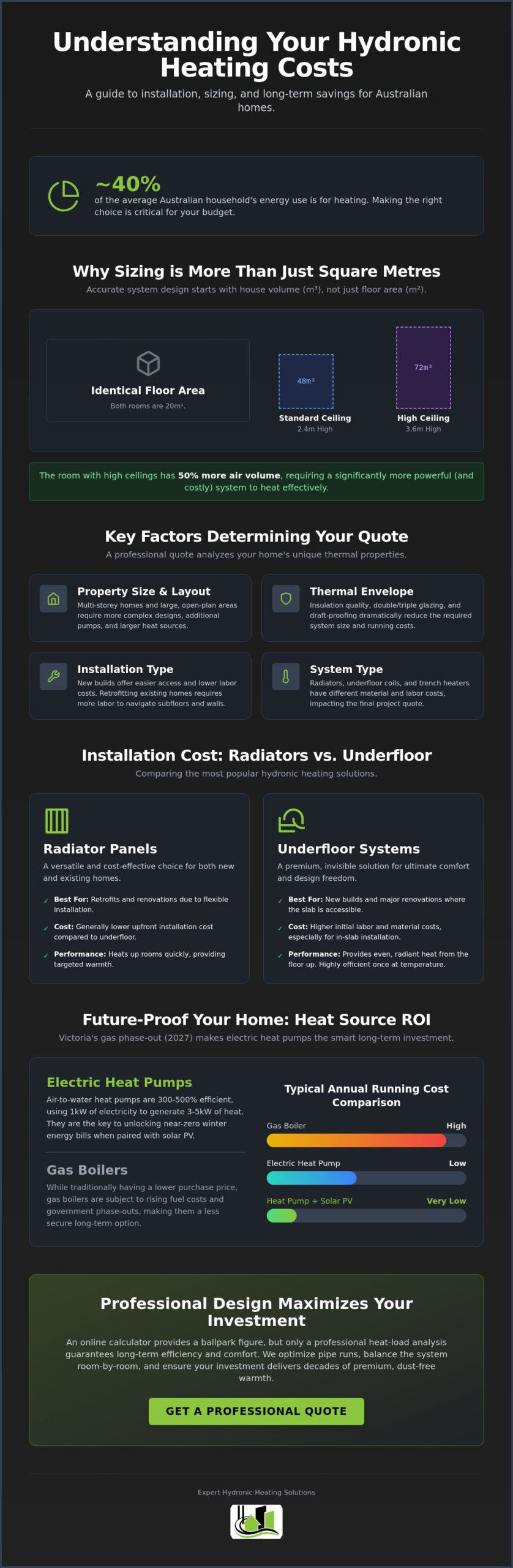
Did you know that heating accounts for roughly 40% of the average Australian household’s energy use? It’s understandable why so many homeowners feel a sense of anxiety when comparing upfront installation prices against long-term utility bills, which is why finding a reliable hydronic heating cost calculator Australia is the first step toward clarity. With Victoria’s residential gas phase-out mandate approaching in 2027, you want a home that offers premium, dust-free warmth without the stress of rising energy prices or outdated technology.
This guide helps you master the complex variables of hydronic pricing by providing a clear framework for installation, sizing, and running costs. We’ll show you exactly what to look for when planning your system to ensure it fits your lifestyle and your budget. We’ll explore the real-world ROI of transitioning to electric heat pumps, the impact of the 2026 National Construction Code updates, and how to choose the most efficient configuration for your home’s unique layout.
Key Takeaways
- Learn why calculating house volume and identifying specific heat loss zones is more critical for system efficiency than simple square metre measurements.
- Understand the limitations of a basic hydronic heating cost calculator Australia and why a professional room-by-room kW analysis is essential for long-term comfort.
- Compare the long-term ROI of gas boilers versus electric heat pumps, including how pairing with solar PV can slash your winter energy bills.
- Identify the key differences in installation costs between radiator panels and underfloor systems to better plan your renovation or new build budget.
- Discover how professional system design optimizes pipe runs and material use, ensuring your investment delivers maximum thermal performance and health benefits.
Variables of Hydronic Heating Costs: What Determines Your Quote?
Most homeowners begin their journey by searching for a hydronic heating cost calculator Australia, hoping for a simple “price per square metre” figure. In reality, professional quotes are built on a detailed heat-load calculation rather than just floor area. To understand what hydronic heating is from a cost perspective, you have to look at how energy moves through your specific structure. Your quote isn’t just a list of parts; it’s a reflection of your home’s ability to retain warmth.
House volume is the primary driver of system sizing. A room with 3.6-metre ceilings contains significantly more air to heat than a standard 2.4-metre room, even if the floor space is identical. This increased volume requires a higher kW output from your heat source and potentially larger emitters. Your thermal envelope also plays a massive role. A home built to the National Construction Code 2025 standards with high-grade insulation and double glazing will require a much smaller, more affordable system than a drafty heritage property in Melbourne’s inner suburbs.
Timing is another critical variable. Installing a system during a new build is generally more labor-efficient because technicians have clear access to the slab or wall cavities. Retrofitting an existing home often involves navigating tight subfloor spaces or carefully removing floorboards, which naturally increases the labor component of the project fee. Even your specific location in Victoria matters; a home in the damp, elevated climate of the Dandenong Ranges requires a more robust setup than a coastal property in Geelong.
Property Size and Layout Complexity
Multi-storey Victorian homes present unique engineering challenges. These projects often require additional pumps and specialized risers to move hot water vertically without losing pressure. Layout also dictates your hardware choices. While bedrooms are easily served by compact panels, large open-plan living areas often need multiple heat sources or larger configurations to ensure even warmth. A professional designer will look at your floor plan to identify “Heat Loss” zones, ensuring you don’t overspend on capacity where it isn’t needed.
System Type: Radiators vs. Underfloor vs. Trench
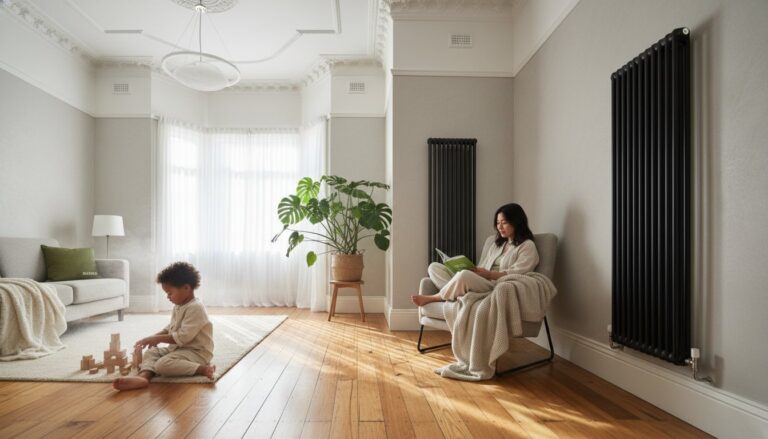
The hardware you choose significantly impacts the final quote. Opting for Hydronic Radiator Panels is a popular, cost-effective choice for retrofits because of their targeted heating and relatively straightforward installation. If you’re starting a new build, underfloor heating offers a premium, invisible solution, though it involves higher initial labor to lay coils within the slab. For modern designs featuring floor-to-ceiling glass, trench heating provides a specialized way to stop cold downdrafts without obstructing your views.
Installation Cost Guide: Radiator Panels vs. Underfloor Systems
When you use a hydronic heating cost calculator Australia, it’s important to understand that quotes are typically presented as a project-based installation fee. Specialist contractors don’t just charge for labor and parts separately; they provide a comprehensive figure that includes the technical design, pressure testing, and system commissioning. This model ensures that the complex network of manifolds and piping is balanced correctly from day one. Material costs represent a significant portion of this investment, particularly the choice between a high-efficiency gas boiler and an air-to-water heat pump. High-grade multilayer piping and brass manifolds are non-negotiable for system longevity, as these components must withstand decades of thermal expansion.
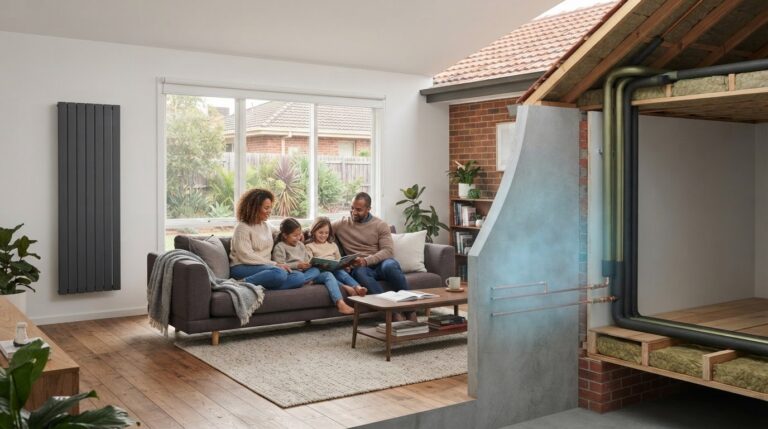
Labor intensity varies wildly depending on your home’s structure. In-slab installations for new builds are relatively streamlined, but retrofitting a system into an existing home requires meticulous planning. If you’re working with timber joists, the labor hours increase as technicians must navigate subfloor spaces to secure pipework. Beyond the obvious hardware, you should account for “hidden” essentials. Smart thermostats, zoning valves, and the labor required for hydraulic balancing are vital for an efficient home. This balancing process ensures every room reaches its target temperature simultaneously. For a deeper look at how these systems compare to traditional options, the Australian government guide to heating provides excellent context on thermal performance across different climate zones.
Radiator System Installation Factors
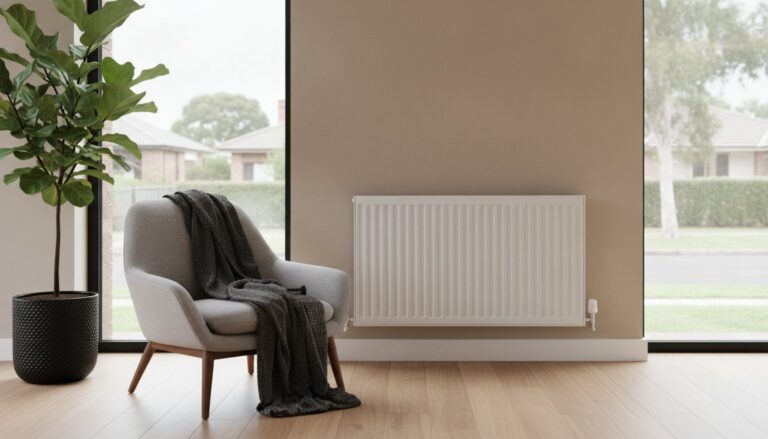
For a standard three-bedroom home in Melbourne, you’ll typically require between seven and nine radiator panels. The price point shifts based on your aesthetic choices; standard steel panels are the functional baseline, while designer vertical radiators act as statement pieces and often require specialized mounting hardware. Pipe routing also dictates the labor cost. Chasing pipes into internal brick walls is a premium, labor-heavy task compared to running lines through a ceiling cavity or under a raised floor. If you’re unsure which configuration suits your floor plan, our team can provide a tailored hydronic system assessment.
Underfloor Heating Installation Nuances
Underfloor systems are categorized by how they’re installed. In-slab systems are the gold standard for new builds, where pipes are tied to the reinforcement mesh before the concrete is poured. In-screed systems are more common for renovations, adding a thin layer of sand and cement over an existing floor. This method increases labor hours due to the precision required in leveling and the necessary drying times. Modern retrofitting solutions, such as thin-bed systems, allow for underfloor comfort without significant floor height increases, though they require specialized materials that can influence the total hydronic heating cost calculator Australia estimate.
The Hydronic Sizing Calculator: How Many kW Does Your Home Need?
Determining the exact kilowatt (kW) requirement for your home is the most critical step in the design process. While a generic hydronic heating cost calculator Australia might use a simple watts per square metre formula, this often fails in the Victorian climate. We look at the specific heat loss of each room to ensure your system performs efficiently when the mercury drops. If you under-size the system, your home won’t reach a comfortable temperature on the coldest July nights. Conversely, over-sizing leads to short-cycling, where the unit turns on and off too frequently; this causes premature wear and higher energy bills. To get this right, we apply Sustainability Victoria climate multipliers, which account for the fact that a home in Ballarat requires significantly more heating capacity than an identical structure in Melbourne’s bayside suburbs.
Step-by-Step Heat Load Calculation
Our technical team follows a rigorous five-step process to calculate your home’s thermal needs. We start by measuring the volume of every room, multiplying length by width and ceiling height. In older Melbourne properties, identifying “Heat Loss” zones is vital. We apply an Insulation Factor that adjusts for your home’s energy rating; a 2-star heritage home loses heat much faster than a modern 7-star build. We also account for window surface area and orientation. North-facing rooms benefit from winter solar gain, while south-facing rooms with large glass panels act as heat sinks, requiring higher-output radiators to maintain equilibrium.
Selecting the Right Heat Source Capacity
Once we have the total kW load for the entire house, we match it to a suitable heat source. If you’re opting for a traditional setup, choosing the best hydronic boiler involves finding a unit that can handle the peak load while operating efficiently at lower outputs. While a 22kW gas boiler is often a standard starting point for many homes, modern heat pump hydronic heating requires even more precise modulation. Heat pumps work best when they run for longer periods at lower temperatures, so the sizing must be exact. We also factor in domestic hot water (DHW) integration. If your system is also responsible for your morning showers, we increase the capacity to ensure you never have to choose between a warm living room and a hot bath.
Running Costs & ROI: Gas Boilers vs. Electric Heat Pumps in 2026
A standard hydronic heating cost calculator Australia usually stops at the installation quote, but the true value lies in the operational return on investment. In 2026, the choice between gas and electricity isn’t just about preference; it’s about future-proofing your home against rising utility rates. For a medium-sized Victorian home of approximately 160 square metres, a gas boiler’s annual running cost sits at roughly $1,657. By contrast, a well-designed electric heat pump system can slash these bills by up to 50%. This gap widens even further when you factor in the ‘Solar Synergy’ effect. By utilizing excess energy from your rooftop PV system to pre-heat your water, the daily cost of electric hydronic heating can drop to negligible levels during sunny winter days.
Beyond the financial metrics, there’s a significant health ROI that simple calculators often miss. Unlike ducted systems that circulate dust, pet dander, and allergens, hydronic systems provide radiant warmth without moving air. This makes it the preferred ‘asthma-friendly’ choice for Melbourne families, improving indoor air quality while maintaining a consistent thermal profile. It’s a premium lifestyle choice that combines silence with superior comfort, ensuring your well-being isn’t compromised by your heating solution.
The Economics of the Electric Transition
The 2026 market is defined by the Coefficient of Performance (COP). Modern heat pumps offer a COP of 3 to 4, meaning for every 1kW of electricity consumed, they deliver 3kW to 4kW of heat. This efficiency is why many homeowners are calculating the payback period for heat pump upgrades today. With Victoria’s 2027 gas phase-out policy mandating all-electric new builds, choosing electric now also protects your property’s long-term resale value. Most families find that the higher initial investment is offset by energy savings within five to seven years, especially as gas prices continue to fluctuate.
To help manage the upfront costs of this transition, you can visit The Home Loan Partners for guidance on financial products tailored for home improvements.
Maintenance and System Longevity
Reliability is a cornerstone of this technology. While high-quality European radiator panels are designed for a 25-plus year lifespan, regular hydronic heating service melbourne is essential to maintain peak efficiency. Over time, magnetite sludge can build up in the pipes; this acts as an insulator that forces your heat source to work harder. Professional power flushing removes these deposits, restoring the system’s hydraulic balance and extending the life of your heat pump or boiler. This preventative care ensures your investment continues to deliver silent, dust-free warmth for decades.
Ready to see the potential savings for your specific floor plan? Book a professional system assessment to secure your home’s comfort for the next decade.
Designing Your System: Why a Professional Quote Beats a Basic Calculator
While an online hydronic heating cost calculator Australia serves as a helpful starting point for ballpark figures, it cannot account for the architectural nuances of a Victorian home. Generic tools often overlook the “structural hurdles” that dictate the actual labor and material requirements of a project. A digital tool won’t see the restricted subfloor access in an Edwardian cottage or the specific cold bridges in a modern glass-heavy renovation. Professional design is about more than just matching kW to floor space; it’s about engineering a system that integrates seamlessly with your home’s unique skeleton. By performing a detailed site inspection, we identify these variables early, preventing the “budget creep” that often occurs with less rigorous estimations.
Our design process focuses on hydraulic optimization. We don’t just guess where pipes should go; we map out the most efficient routes to reduce material waste and minimize pressure drops. This precision ensures that every radiator panel or underfloor circuit receives the exact flow rate required to operate at peak efficiency. This level of detail is what separates a functional system from a high-performance one that delivers the silent, dust-free comfort hydronic heating is famous for. Moving from a rough estimate to a fixed-price installation quote gives you the financial certainty needed for such a significant home improvement.
The Melbourne Hydronic Design Advantage
We bring over 30 years of experience to every project, focusing specifically on the unique climate challenges of Melbourne and Geelong. Whether you are preserving the character of a heritage property or pushing the boundaries of a 7-star new build, our designs are tailored to your lifestyle. We don’t just install hardware; we build long-term relationships through comprehensive system servicing and safety checks. This proactive approach protects your ROI, ensuring your heat pump or boiler operates reliably for decades. Our local expertise means we understand how a southerly wind off Port Phillip Bay affects your home’s heat load, allowing us to size your system with surgical precision.
Requesting Your Fixed-Price Quote
To move from a general idea to a concrete plan, we recommend having your floor plans and any known insulation details ready. Knowing your current energy source and your goals for the electric transition helps us refine the design brief. Our consultation process is methodical; we take the time to understand your comfort requirements before presenting a final, transparent commission. This ensures there are no surprises during the installation phase. If you’re ready to experience a new standard of home wellbeing, Book a Professional Hydronic Consultation with Melbourne Hydronic Heating today.
Secure Your Home’s Future Comfort Today
Choosing the right heating system is an investment in your family’s well-being and your property’s long-term value. While a basic hydronic heating cost calculator Australia provides a helpful starting point, true efficiency comes from a system designed for Melbourne’s unique climate. By prioritizing precise room-by-room sizing and embracing the transition to electric heat pumps, you ensure your home remains a sanctuary of silent, dust-free warmth for decades to come. Professional design eliminates the guesswork, protecting your budget from the hidden costs of over-sizing or poor hydraulic balance.
At Melbourne Hydronic Heating, we bring over 30 years of local experience to every project. As a family-owned and operated Victorian contractor, we specialize in high-efficiency electric heat pumps that integrate perfectly with your lifestyle. We don’t just install systems; we engineer comfort that respects both your budget and the environment. Our team is ready to help you navigate the 2026 energy landscape with confidence and technical precision.
Get an Accurate, Professional Hydronic Quote for Your Melbourne Home
Let’s work together to create a healthier, more efficient home for your future. We look forward to helping you achieve the premium living environment you deserve.
Frequently Asked Questions
Is hydronic heating more expensive to install than ducted gas heating?
Hydronic systems generally require a higher initial investment than standard ducted gas heating. While the upfront quote is larger, these systems are estimated to be up to 35% more cost-effective to run. You aren’t just paying for hardware; you’re investing in a dust-free, silent environment that doesn’t circulate allergens throughout your home.
How much does it cost to run hydronic heating per year in Melbourne?
Annual running costs vary by fuel type, with a medium-sized Melbourne home of approximately 160 square metres spending roughly $1,657 on a gas boiler system. Switching to an electric heat pump can reduce this by up to 50%, especially when paired with solar PV. This efficiency makes a hydronic heating cost calculator Australia a vital tool for long-term financial planning.
Can I use an online calculator to size my own radiator panels?
Basic online calculators provide a rough estimate but shouldn’t be used for final system sizing. They often ignore critical Victorian factors like ceiling height, window orientation, and drafty heritage windows. A professional heat-load calculation ensures you don’t end up with an under-sized system that fails to perform during a cold July night.
Are there Victorian government rebates for switching from gas to heat pump hydronics?
Several rebates are available in Victoria for homeowners transitioning to electric heat pumps. The Solar Homes Program offers up to $1,000, or $1,400 for locally made products, provided your household income is below the $150,000 threshold. You can also access discounts through the Victorian Energy Upgrades (VEU) program based on current certificate pricing.
How does ceiling height affect the cost of my hydronic system?
Ceiling height directly increases the volume of air that needs to be heated, which raises the required kilowatt capacity. A room with 3.6-metre ceilings contains significantly more air than a standard 2.4-metre room. This extra volume requires larger radiator panels or a higher-output heat pump to maintain a comfortable temperature across the entire space.
Is it cheaper to install hydronic heating in a new build or a renovation?
Installing hydronic heating is typically more labor-efficient in a new build because technicians have clear access to slabs and wall cavities. Retrofitting during a renovation is often more expensive due to the complexity of navigating existing subfloor spaces or chasing pipes into brick veneer walls. Timing your installation with a new build saves significant labor hours.
What is the maintenance cost for a hydronic system in Australia?
Maintenance focuses on annual servicing and preventative care such as power flushing. Regular servicing protects your investment by ensuring the heat pump or boiler operates at peak efficiency. Power flushing removes magnetite sludge from the pipes, which prevents the system from working harder than necessary and extends the lifespan of your high-quality components.
How much extra does it cost to add hydronic towel rails to a system?
Adding hydronic towel rails involves additional material costs and specialized plumbing labor for the bathroom zones. These rails are integrated into the main system loop, providing both luxury warmth and functional drying. While they increase the initial quote, they offer a premium lifestyle benefit and superior efficiency compared to standard electric rails.