Hydronic Heating System Pressure Keeps Dropping: Causes & 2026 Repair Guide
Every time you turn that filling loop because your hydronic heating system pressure keeps dropping, you’re doing more than just adding water; you’re inviting fresh oxygen to corrode your pipes from the inside out. It’s exhausting to wake up in a freezing house because your boiler locked out overnight, leaving you staring at a confusing pressure gauge in the dark. We know the anxiety that comes with wondering if a hidden leak is slowly damaging your home or why your radiators are making those disruptive gurgling noises. You aren’t alone in this frustration, and you shouldn’t have to settle for a system that requires constant manual intervention.
This 2026 repair guide will help you identify exactly why your system is losing its prime and how to stop the cycle of constant top-ups before expensive damage occurs. You’ll learn how to stabilize your pressure between the ideal 1.0 and 1.5 bar range and understand the critical role your expansion vessel plays in maintaining a healthy environment. We’ll break down the technical causes behind pressure loss and provide a clear path toward a quiet, efficient, and reliable heating setup. By following these expert insights, you’ll regain the peace of mind that comes with a professionally maintained home and a system that simply works when you need it most.
Key Takeaways
- Maintain your system’s “heartbeat” by keeping cold pressure readings between 1.0 and 1.5 bar for optimal performance.
- Identify the specific reasons why your hydronic heating system pressure keeps dropping, from visible valve leaks to discharge pipe drips.
- Stop the cycle of manual top-ups to prevent fresh oxygen from entering the sealed loop and causing internal corrosion.
- Learn how professional pressure testing isolates your boiler or heat pump to find hidden faults without unnecessary guesswork.
- Protect your system’s longevity with annual maintenance and magnetic filters to ensure quiet, energy-efficient heating all winter.
Understanding Hydronic System Pressure in Melbourne Homes
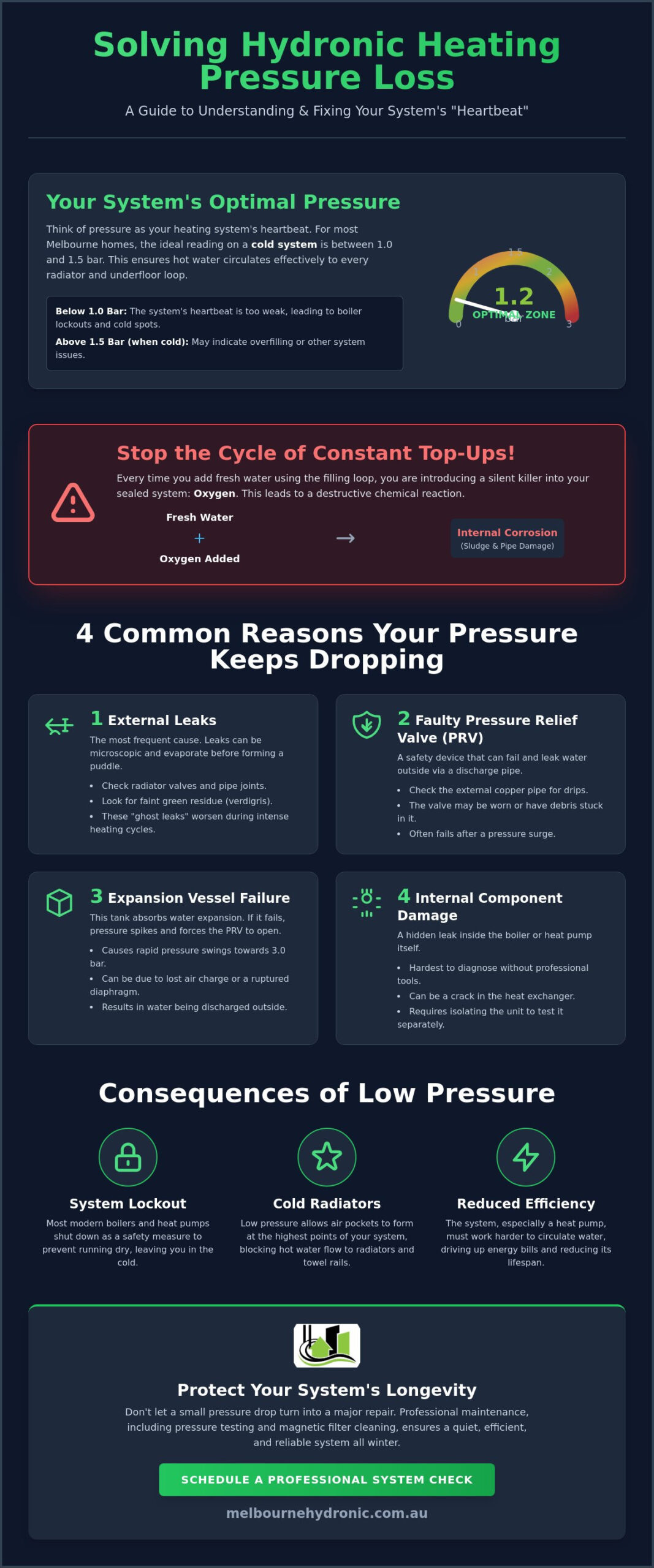
Think of your home’s heating as a living, breathing circuit. The water circulating through your Hydronics setup is its lifeblood, and the pressure is its heartbeat. In a sealed system, this pressure is the force that ensures hot water reaches every radiator panel and underfloor loop with enough momentum to transfer heat effectively. For the vast majority of Melbourne residences, the gold standard for a cold system is a reading between 1.0 and 1.5 bar. A bar is the standard metric unit of measurement used on Australian hydronic gauges to indicate the internal force within the pipework.
It is vital to distinguish between static pressure and expansion pressure. Static pressure is the reading you see when the system is cold and the pump is off. This is your baseline. Expansion pressure occurs when the water heats up and physically expands. If your hydronic heating system pressure keeps dropping below that 1.0 bar threshold while the system is cold, the “heartbeat” becomes too weak to function. This triggers a cascade of performance issues that compromise your comfort and the system’s longevity.
Why Pressure Matters for Your Comfort
Precision is everything when it comes to modern climate control. When pressure falls too low, most gas boilers and electric heat pumps will trigger a safety lockout. This is a protective measure designed to prevent the pump from running dry, which would cause permanent mechanical failure. It’s the primary reason homeowners wake up to a freezing house despite the thermostat being set correctly.
Low pressure also allows air pockets to gather at the highest points of your home, such as upstairs radiator panels or towel rails. These pockets act as blockages, preventing hot water from entering the unit and leaving you with cold spots. For those utilizing modern heat pumps, maintaining precise pressure is even more critical. These units require specific flow rates to maintain a high Coefficient of Performance (COP). If your hydronic heating system pressure keeps dropping, your heat pump has to work significantly harder, which drives up your energy bills and reduces the system’s overall efficiency.
The Normal Pressure Swing
Water naturally expands as its temperature rises. You should expect to see your gauge increase by approximately 0.3 to 0.5 bar once the water reaches its operating temperature of 60°C. This is a healthy sign of a functional system. However, you must be able to identify when a normal swing becomes a dangerous surge. If the needle jumps rapidly toward the 3.0 bar mark, it usually indicates that your expansion vessel has lost its air charge or the internal diaphragm has failed.
Melbourne’s unique climate adds another layer of stress. Our winter days often involve rapid temperature drops at sunset, forcing the system to ramp up from stone-cold to maximum heat in a very short window. This thermal expansion puts immense pressure on seals and joints. We often find that small, microscopic weeps in the pipework only open up during these intense heating cycles, leading to that frustrating slow decline in pressure that many homeowners struggle to locate without professional help.
Identifying the Culprit: 4 Reasons Your Pressure Keeps Dropping
When your hydronic heating system pressure keeps dropping, it’s rarely a mystery to a trained eye. The issue almost always stems from one of four primary mechanical failures: external leaks, a faulty pressure relief valve, expansion vessel failure, or internal component damage. Identifying these common boiler problems early is the best way to prevent a minor weep from turning into a major flood. Most homeowners find that the drop is gradual, losing just enough pressure over a week to trigger a system lockout, which suggests a slow but persistent fault.
External leaks are the most frequent offenders. These usually occur at the radiator valves, tails, or where the pipework joins the unit. You might not see a puddle; instead, look for a faint green residue known as oxidation or “verdigris” around the nuts. This indicates a “ghost leak” where water escapes so slowly that it evaporates before hitting the floor. If you suspect your system is losing its prime, a professional system check can help isolate the exact joint before it fails completely.
The PRV Diagnostic Test
The Pressure Relief Valve (PRV) is a vital safety component designed to release water if the internal pressure exceeds 3.0 bar. To test this, find the small copper discharge pipe on the exterior of your Melbourne property, usually located directly behind where the boiler is mounted. Place a dry cup or a small plastic bag over the end of this pipe and leave it for 24 hours while the heating is running. If you find water in the cup, the valve is weeping. This “drip of death” is often a sign that the valve has been forced open too many times or has a piece of grit stuck in its seal.
Locating Hidden Leaks in Melbourne Installs
In many local residences, pipework is tucked away behind skirting boards or under floorboards. Carefully inspect the area around your hydronic heating panels for damp patches, warped timber, or peeling paint. While leaks within concrete slab underfloor heating are exceptionally rare, they are serious and require specialized thermal imaging to locate. If you can’t find a visible leak but your hydronic heating system pressure keeps dropping, the culprit might be an internal crack in the heat exchanger. In this scenario, the water leaks directly into the condensate drain, making it completely invisible from the outside of the unit.
The Danger of Constant Top-Ups: Why You Must Stop Adding Water
If your hydronic heating system pressure keeps dropping, your first instinct is likely to reach for the filling loop. While this provides a temporary fix, it’s actually the fastest way to destroy your boiler’s internal components. A hydronic system is designed to be a sealed, closed-circuit loop. Unlike a swimming pool, it doesn’t lose water to evaporation. Under normal conditions, the same water should circulate through your home for years, eventually becoming chemically inert and harmless to the metal surfaces it touches.
The real danger lies in what we call the “Oxygen Ingress Trap.” Fresh tap water in Melbourne is highly oxygenated. When you introduce this fresh water into your system, that oxygen immediately begins to react with the steel radiators and copper pipework. This process of internal oxidation creates iron oxide, which eventually settles as a heavy, black metallic sludge. By constantly topping up, you’re essentially feeding a slow-motion chemical fire inside your walls. Every time you open that valve, you’re restarting the corrosion cycle.
Beyond oxygen, you’re also diluting the protective corrosion inhibitors that were added during your last professional service. These chemicals are the only thing standing between your expensive heat pump or boiler and total failure. Once the concentration of inhibitor drops too low, the rate of internal damage accelerates exponentially. If your hydronic heating system pressure keeps dropping, you aren’t just losing water; you’re losing the chemical shield that keeps your system healthy.
The Hidden Cost of Sludge
Magnetite sludge is more than just a nuisance; it’s a thief of efficiency. Industry data indicates that significant sludge buildup can reduce your heating efficiency by up to 15 percent. This happens because the black “mud” forms an insulating layer inside your radiator panels, preventing the heat from reaching the room. If you notice cold spots at the bottom of your radiators, it’s a clear sign that heavy debris has settled and you likely require professional power flushing. This debris also causes pump cavitation, where the pump struggles to move the thickened water, leading to noisy operation and premature mechanical burnout.
When to Step Away from the Filling Loop
Professional Troubleshooting for Boilers and Heat Pumps
When we arrive at a property where the hydronic heating system pressure keeps dropping, our first task is to isolate the energy source from the distribution network. By closing the isolation valves under the boiler or heat pump, we can determine if the pressure loss is occurring within the unit itself or somewhere in the kilometres of pipework buried in your walls. It’s a precise science that eliminates guesswork and prevents unnecessary invasive work. If the pressure holds steady on the unit but drops on the house side, we know the fault lies within the radiator panels or floor loops.
Some modern Melbourne installations feature an automatic filling valve. While this sounds convenient, it can often mask a significant leak by constantly adding fresh water to maintain the bar reading. This bypasses the safety lockout but accelerates the internal corrosion we discussed earlier. We also pay close attention to local water quality. While Melbourne’s water is generally soft, it can still react with varied metals in older systems, making professional testing of the system’s chemical balance a non-negotiable part of any repair.
Heat Pump Specific Pressure Faults
Modern heat pump hydronic heating systems have unique requirements compared to traditional gas boilers. These units are highly sensitive to flow rate drops; even a minor dip in pressure can cause the heat pump to cycle inefficiently or throw a “low flow” error code. We often find hidden pressure loss within the buffer tank or the primary loop that connects the outdoor unit to the indoor manifolds. In regions like Geelong, where frost nights are common, maintaining the correct glycol levels in the outdoor pipework is essential. Glycol not only prevents freezing but acts as a secondary sealant for the system’s internal gaskets.
The Professional Repair Toolkit
Locating a leak doesn’t always mean pulling up floorboards. We use advanced thermal imaging cameras to “see” through surfaces, identifying the exact heat signature of escaping water in wall cavities or under timber flooring. Once the leak is sealed, we don’t just pump in air. We re-pressurise the expansion vessel with dry nitrogen. Nitrogen molecules are larger than oxygen molecules and don’t permeate through the rubber membrane, ensuring your system stays stable for much longer. Finally, we dose the circuit with high-grade inhibitors to neutralise any fresh oxygen introduced during the repair. If you’re tired of the constant top-ups, it’s time to book a professional diagnostic session to protect your investment.
Prevention and Maintenance with Melbourne Hydronic Heating
Maintaining a stable reading on your gauge is about more than just immediate comfort; it’s about protecting your home’s infrastructure for the long term. While it’s tempting to ignore the needle until the house gets cold, a proactive hydronic heating service in Melbourne is the best insurance against catastrophic component failure. We’ve seen how fresh oxygen and mineral buildup can erode a system from the inside. Moving from reactive top-ups to a proactive maintenance schedule ensures that your system remains a premium asset rather than a constant source of stress.
One of the most effective upgrades for any modern system is the installation of a high-quality magnetic sludge filter. These devices sit in the return pipework and physically pull metallic debris out of the water before it can reach your boiler or heat pump. It’s a simple, high-return investment that significantly extends the lifespan of your pump and heat exchanger. If your hydronic heating system pressure keeps dropping, a magnetic filter is often the final piece of the puzzle that prevents future blockages and keeps the water circuit clean and efficient.
Our Comprehensive System Health Check
Our health check goes beyond a surface inspection to address the root causes of instability. We test the expansion vessel’s air charge, verify the PRV’s integrity, and conduct a full water chemistry analysis to ensure your inhibitor levels are optimal. For older systems in heritage Melbourne terraces or established Geelong homes, we often recommend a power flush if the pressure instability has already led to significant sludge buildup. This process restores the system to its original design performance, ensuring every radiator panel heats evenly from top to bottom. We provide custom solutions tailored to the unique demands of your specific property and heating layout.
The Melbourne Hydronic Advantage
With over 30 years of local experience, we understand the specific installation quirks of Melbourne’s varied architecture. Our expertise spans both traditional gas boilers and the latest energy-efficient electric heat pumps, allowing us to provide advice that is both technically precise and environmentally conscious. We focus on professional design and installation practices that minimise future leak points, giving you a system that operates quietly and reliably year after year. Don’t wait for the next cold morning lockout to address the issue. Book your hydronic system pressure diagnostic with Melbourne Hydronic Heating today.
Restore Lasting Comfort and System Stability
A stable pressure reading is the foundation of a healthy, efficient home. While it’s tempting to keep turning the filling loop, remember that a system where the hydronic heating system pressure keeps dropping is sending a clear signal that it needs professional attention. By addressing the root cause, whether it’s a weeping valve or a depleted expansion vessel, you stop the internal corrosion cycle and protect your investment from expensive long-term damage. You deserve a heating system that operates silently and reliably without the need for constant manual intervention.
As a family-owned and operated Victorian business with over 30 years of local experience, we specialize in the technical precision required for both gas boilers and modern electric heat pumps. We understand the unique challenges of Melbourne’s climate and the importance of a properly balanced water circuit for your family’s well-being. Book a Professional Hydronic System Repair in Melbourne with our expert team to ensure your home stays warm and protected all year round. Let’s get your system back to its peak performance today.
Frequently Asked Questions
Is it normal for my hydronic boiler to lose pressure over time?
It’s not normal for a sealed system to lose pressure frequently. While a tiny drop over a year might happen due to microscopic air release, if your hydronic heating system pressure keeps dropping every few weeks, you have a leak or a component failure. Constant topping up introduces fresh oxygen that accelerates internal pipework damage and reduces the lifespan of your investment.
How do I top up the pressure on my hydronic heating system?
You can top up the pressure by locating the filling loop, which is typically a flexible silver hose under the boiler. Slowly open the valve until you see the needle on the gauge reach the 1.0 to 1.5 bar range. Always ensure the system is cold before performing this task to get an accurate static reading and avoid overfilling the circuit.
Can a faulty expansion vessel cause my pressure to drop?
A faulty expansion vessel is a very common cause of pressure loss. When the internal rubber membrane fails, the vessel can no longer absorb the expanding water as it heats up. This force triggers the pressure relief valve to dump water outside your home; this leaves the system with no pressure once the water cools down and the cycle repeats.
Why does my boiler pressure go up when the heating is on?
Pressure naturally increases as water molecules expand when heated to operating temperatures. A small rise of roughly 0.3 to 0.5 bar is a healthy sign of a functional system. If the needle jumps significantly higher or hits the red zone, your expansion vessel likely needs to be re-pressurised with nitrogen by a professional to restore its buffering capacity.
How much does it cost to fix a hydronic heating leak in Melbourne?
Repair costs depend entirely on the location and severity of the fault. A simple radiator valve replacement is a straightforward fix, while locating a leak beneath a concrete slab requires specialized thermal imaging equipment. We recommend a professional diagnostic to identify the most cost-effective path forward for your specific property and prevent further water damage to your home.
What happens if I ignore the low-pressure warning on my boiler?
Ignoring a low-pressure warning usually results in a total system lockout to prevent the pump from running dry. Beyond the lack of heating, low pressure allows air to enter the circuit, which causes rapid corrosion and the formation of metallic sludge. This eventually leads to expensive repairs like heat exchanger replacements and significantly higher energy bills due to reduced efficiency.
Can air in the radiators cause the system pressure to drop?
Air trapped in your radiators directly impacts the gauge because it displaces the water volume. When you bleed the air out of a radiator panel, the overall pressure in the sealed loop will drop. You must always check the gauge and top up the water level after venting air to maintain the correct balance and ensure heat reaches every room.
Does a hydronic heat pump lose pressure differently than a gas boiler?
While the physics of water expansion remain the same, heat pumps are often more sensitive to pressure-related flow issues. Because they operate at lower temperatures than gas boilers, they require precise flow rates to maintain their high efficiency. If your hydronic heating system pressure keeps dropping, a heat pump will likely throw a “low flow” error and stop heating much sooner than a traditional boiler.