Hydronic Trench Heating for Large Windows: The 2026 Melbourne Guide
Imagine sitting by your floor-to-ceiling windows on a crisp July morning in Melbourne, but instead of enjoying the view, you’re shivering as cold air “pours” off the glass and onto your feet. It’s a frustrating reality for many local homeowners who’ve invested in beautiful, glass-heavy architecture only to find their living spaces plagued by icy downdrafts and persistent condensation. Traditional radiators often aren’t an option when wall space is at a premium, and standard heating often fails to address the unique thermal challenges of high-ceiling rooms. This is why hydronic trench heating for large windows has become the gold standard for modern Melbourne builds in 2026.
You’ll discover how to create a permanent thermal barrier that effectively eliminates cold spots while keeping your heating system completely out of sight. We’ll show you how this technology integrates seamlessly with the latest air-to-water heat pumps to meet NCC 2022 energy efficiency standards. This guide provides a clear look at maintaining architectural integrity without sacrificing comfort, covering everything from grille finishes that match your flooring to the technical precision required for a high-performance installation in our unique local climate.
Key Takeaways
- Learn how hydronic trench heating for large windows creates a “thermal curtain” to stop icy downdrafts and glass condensation.
- Discover the technical differences between natural and fan-assisted convection to choose the right heat output for your specific room volume.
- Identify the best grille materials—from natural timber to anodized aluminum—to ensure your heating system complements your flooring and architectural vision.
- Understand the critical installation requirements, including necessary trench depths and the differences between concrete slab and timber floor setups.
- See how expert system design uses window U-values to maximize energy efficiency and long-term performance in Melbourne homes.
Solving the “Cold Glass” Problem with Hydronic Trench Heating
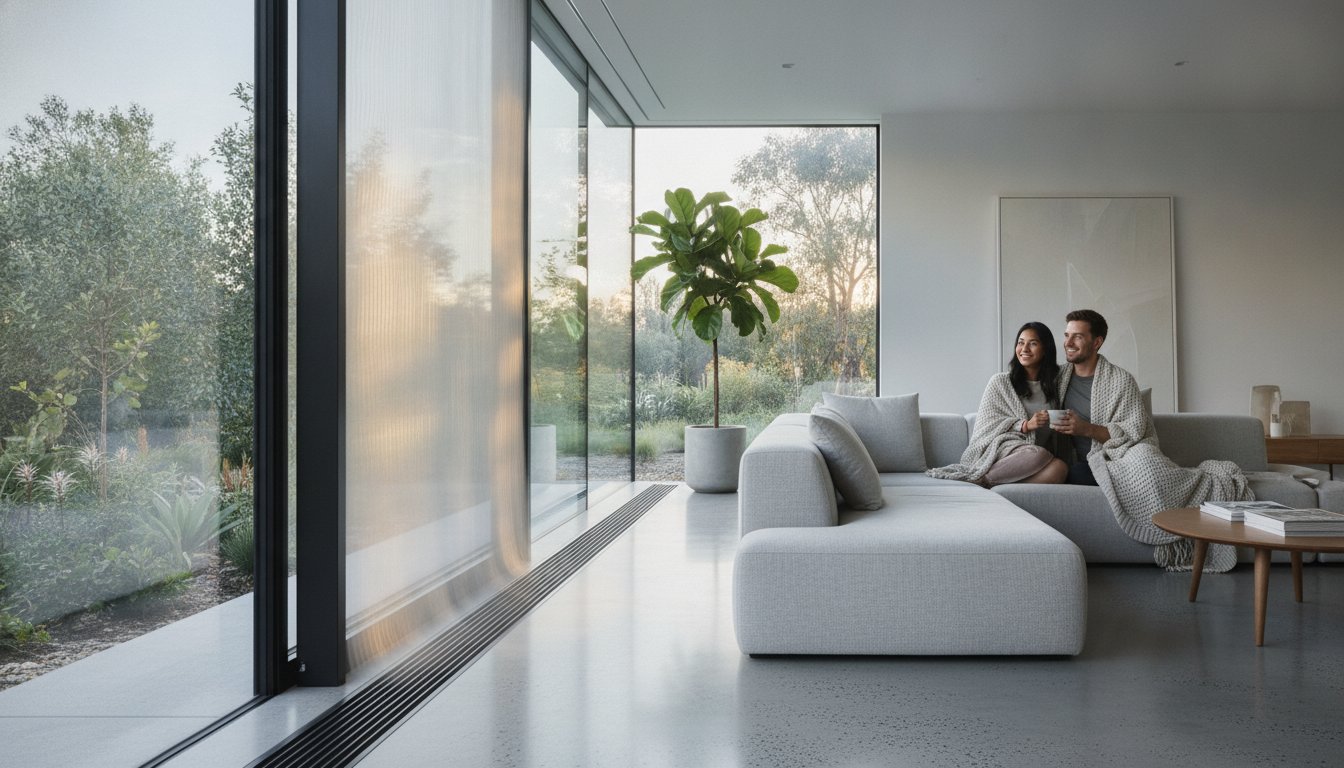
Modern Melbourne homes celebrate light and space with expansive glass facades. However, these architectural features create a unique thermal challenge that standard systems often fail to address. Hydronic trench heating for large windows is a sub-floor convection system designed specifically to sit at the perimeter of these glass walls. By installing the heating element within a recessed trench, you eliminate the need for bulky wall-mounted units that disrupt architectural lines. It’s the “invisible” hero of premium residential builds, providing high-performance warmth without compromising the view.
Understanding how convection heaters work is essential to appreciating this solution. As warm water from a heat pump or boiler flows through the trench’s copper pipes, it heats the surrounding air. This warm air becomes less dense and rises naturally, creating a consistent flow of heat exactly where it’s needed most. It effectively turns the entire window area into a source of comfort rather than a source of discomfort.
This specifically addresses the “cold glass” problem. Large windows act as giant heat sinks. Even high-quality glazing can feel icy to the touch during a Melbourne winter. When warm room air hits the cold glass, it cools rapidly, becomes heavy, and “falls” toward the floor. This creates a drafty, uncomfortable zone near the window, often making the most beautiful part of the room unusable during the colder months.
The Science of the Thermal Air Curtain
Trench systems solve the downdraft issue by creating a vertical “air curtain.” The rising heat forms a protective barrier that intercepts cold air before it reaches the living space. This process also significantly reduces condensation. By keeping the glass surface warmer than the dew point, you prevent the dampness and fogging that often obscure views during Melbourne’s damp winters. The Coanda effect describes the tendency of the rising air stream to stay attached to the glass surface, ensuring the thermal barrier remains intact from the floor to the ceiling.
Why Large Windows Require a Specific Heating Strategy
Large windows require more than just general room heating. The heat loss through glass is significantly higher than through an insulated wall, regardless of whether you’ve chosen double or triple glazing with low U-values. While radiant panels are excellent for warming objects in a room, they can’t stop a cold downdraft in its tracks. Hydronic trench heating for large windows provides an active convective response that radiant heat simply can’t match. It preserves the “indoor-outdoor” flow central to Victorian architecture by hiding the technology beneath the floor, leaving only a stylish, flush-mounted grille visible to the eye.
How Trench Convectors Work: Efficiency and Natural Convection
At the heart of every system is the heat exchanger. It’s a sophisticated piece of engineering typically consisting of high-grade copper tubes and aluminum fins. Copper’s superior thermal conductivity ensures heat transfers instantly from the water to the exchanger. Meanwhile, the aluminum fins create a massive surface area, allowing the air to absorb heat efficiently as it passes through. This design is what makes hydronic trench heating for large windows so effective at neutralizing cold zones before they affect your comfort.
The system relies on fundamental physics rather than mechanical force. This technical resource explains the principle of natural convection, where air movement is driven by density differences. In a trench heater, the cool air near the floor is drawn into the recessed trench. As it warms, it rises. This cycle creates a silent, continuous flow of warmth. Unlike standard split systems that use noisy blowers and fans, hydronic systems operate in near-total silence. This makes them the perfect choice for master bedrooms or quiet study areas where background noise is unwelcome.
Natural Convection vs. Fan-Assisted Units
Choosing between these two depends on the room’s size and the window’s height. Natural convection units are entirely silent and rely solely on the buoyancy of warm air. They’re ideal for standard residential spaces. However, for high-volume areas or massive triple-height glass facades, fan-assisted units provide a significant boost. These modern units use low-voltage EC motors that are incredibly energy-efficient. While they do use a small amount of electricity, the increased heat output allows for shallower trenches, which can be a lifesaver during a complex renovation.
Low Water Content (Low H2O) Benefits
One of the biggest advancements in 2026 is the shift toward low water content heat exchangers. Older hydronic systems often suffered from thermal lag, taking a long time to warm up because of the large volume of water in the pipes. Modern trench convectors use much less water. This means the system responds to your thermostat almost instantly. It’s a perfect match for modern air-to-water heat pumps. These heat pumps operate most efficiently at lower flow temperatures, and low H2O exchangers are designed to extract every bit of warmth from that water without wasting energy.
Precision control is another hallmark of these systems. By integrating smart thermostats, you can manage individual zones throughout your home. You don’t have to heat the whole house just to stay warm in the lounge. If you’re planning a new build, it’s worth seeing how Melbourne Hydronic Heating can tailor a zoned system to your specific floor plan. This level of control ensures you only use the energy you need, keeping running costs low while maintaining peak comfort across every room.
Selecting Grilles and Finishes for Architectural Integration
While the technical components do the heavy lifting, the grille is the only part of the system you’ll actually see. Choosing the right finish is essential for maintaining the clean lines of a modern home. When designing hydronic trench heating for large windows, the goal is often to make the heating disappear. This requires a balance between aesthetic appeal, durability, and the physical requirements of your floor plan.
One of the most important decisions involves the grille structure. Roll-up grilles are popular because they allow for easy access to the trench for seasonal cleaning. You can simply roll them back to vacuum out any dust or debris that has settled near the heat exchanger. Linear grilles, on the other hand, offer a more rigid, architectural look. For high-traffic areas, particularly near large sliding doors leading to a deck or pool, load-bearing capacity is paramount. High-quality grilles are engineered to be “walk-over” safe. This means they won’t flex, bend, or rattle under the weight of foot traffic, providing both safety and a premium feel underfoot.
Timber Grilles for a Seamless Floor Look
For homes with hardwood floors, timber grilles offer an unmatched level of integration. We often match these with local favorites like Victorian Ash or Spotted Gum, as well as European Oak. Because timber is a natural material, it reacts to the heat differently than metal. High-quality timber grilles use seasoned wood and specific spacing to manage the natural expansion and contraction that occurs when the system is active. To keep them looking new, a simple light sand and re-oil every few years is usually all that’s required to prevent the wood from drying out in the warm airflow.
Metal Grilles for Modern and Industrial Designs
Metal finishes provide a sleek, contemporary edge and are incredibly robust. Stainless steel is the preferred choice for coastal properties in Melbourne or Geelong, where salt air can be a factor. It resists corrosion and maintains its luster for decades. Anodized aluminum is another versatile option, available in various shades to match modern window frames or neutral floor tiles. Metal grilles provide superior airflow efficiency due to their thinner profiles and high open-area ratios. For a truly bespoke look, aluminum grilles can be powder-coated to virtually any color, ensuring the hydronic trench heating for large windows blends perfectly with your interior palette.

Installation Requirements and Retrofitting in Melbourne
Installing hydronic trench heating for large windows requires precise early-stage planning, particularly in new builds. The typical trench dimensions range from 100mm to 300mm in depth and width, depending on the heat output your specific room volume requires. In concrete slab constructions, we coordinate directly with your builder to ensure the formwork is positioned accurately before the pour. For suspended timber floors, the process is often more flexible. We utilize the space between floor joists to house the convectors, ensuring the finished grille sits perfectly flush with your floorboards.
Effective insulation within the trench is a non-negotiable step for energy efficiency. Without high-quality thermal lining, a significant portion of your warmth is lost into the ground or the subfloor cavity. We use specialized insulation materials to ensure that every kilowatt of heat is directed upward through the grille. This technical precision is essential to meet the NCC 2022 energy efficiency standards now active across Victoria. It ensures your system provides maximum comfort while keeping your running costs as low as possible.
Retrofitting Trench Heating in Existing Homes
Many homeowners in established Melbourne suburbs assume trench systems are strictly for new builds. While cutting into an existing concrete slab in an older home is a technical challenge, it’s a service we successfully provide using specialized diamond-cutting equipment. If you have a timber sub-floor, the process is much simpler, as we can often work between the existing joists. In cases where floor depth is restricted, we recommend low-profile trench units. These specialized models provide high heat output with minimal excavation, making them a practical solution for premium renovations.
Heat Source Compatibility: The 2026 Shift
The landscape of home heating in Victoria has shifted toward sustainability. Hydronic trench heating for large windows is now recognized as the perfect partner for electric heat pumps. These systems are designed to operate at lower water temperatures, which aligns perfectly with the high-efficiency heat exchangers found in modern trench units. Moving away from traditional gas boilers toward electric solutions allows you to capitalize on solar PV systems and lower electricity tariffs. To maintain this efficiency, regular system servicing is vital. Professional maintenance ensures that your heat exchangers remain clear of dust and that the water chemistry is balanced to prevent internal corrosion.
If you’re planning a renovation or a new build and want to ensure your heating system is both invisible and highly effective, reach out to our Melbourne-based team for a technical assessment of your floor plan.
Designing Your System with Melbourne Hydronic Heating
Choosing the right technology is only half the battle; the other half is ensuring it’s sized and placed with engineering precision. With over 30 years of experience designing specialized systems for Melbourne and Geelong homes, we understand that no two floor plans are identical. When we plan hydronic trench heating for large windows, we don’t use “rule of thumb” estimates. We perform detailed calculations that account for the specific U-values of your glazing, the total room volume, and the local thermal gradients unique to the Victorian climate. This ensures your system provides consistent warmth without wasting energy on over-heating.
Professional design is also critical to prevent “short-circuiting” of the airflow. This occurs when the rising warm air is immediately drawn back into the intake of the convector before it has a chance to circulate through the room. Our technicians ensure the placement and trench geometry promote a healthy, continuous cycle of air. Beyond efficiency, this method offers significant health benefits. Because hydronic systems don’t rely on high-velocity fans, they don’t circulate dust, pollen, or allergens. It’s a tamer, cleaner way to heat your home that supports better indoor air quality for your family.
The Melbourne Hydronic Design Process
Our process begins with a deep dive into your architectural plans. We calculate the exact heat loss through your glass surfaces to determine the required wattage per linear metre. We then collaborate closely with your architects and builders during the “rough-in” stage to ensure the floor recesses are prepared with millimetre accuracy. This early-stage coordination is what allows the final installation to look so effortless. We also focus on future-proofing every system we install. By designing for lower water temperatures from the outset, we ensure your trench heaters remain compatible with the next generation of renewable energy sources and heat pump technologies.
Local Support and Workmanship Warranty
As a family-owned and operated business, we take a long-term view of every project. We aren’t just installers; we’re your local consultants for the life of your system. Our specialized focus on hydronic heating in Melbourne means we’ve seen every architectural challenge our city has to offer, from heritage renovations in Armadale to modern glass pavilions in Torquay. We back our technical expertise with a robust workmanship warranty, giving you the peace of mind that your investment in comfort is protected. If you’re ready to eliminate cold drafts and enjoy your views year-round, request a professional consultation and quote for your trench heating project today.
Secure Your View and Your Comfort for the Future
Your home’s large glass walls should be a source of inspiration, not a source of winter drafts. By choosing hydronic trench heating for large windows, you’re investing in a sophisticated thermal barrier that preserves your architectural vision while delivering silent, energy-efficient warmth. We’ve explored how these systems neutralize the cold glass problem and integrate perfectly with modern, sustainable heat pump technology. Whether you’re selecting a custom timber grille to match your European Oak floors or planning a complex retrofit in an established Melbourne suburb, the focus remains on technical precision and lifestyle quality.
As a Victorian family-owned and operated business with over 30 years of Melbourne experience, we specialize in large-scale architectural glass solutions. We understand the specific climate challenges of the region and provide the engineering expertise required for a flawless installation. Don’t let cold downdrafts dictate how you use your living space. Book a Design Consultation with Melbourne’s Trench Heating Experts today and experience the difference that professional hydronic design makes to your home’s wellbeing.
Frequently Asked Questions
Is trench heating hard to clean and maintain?
Can trench heating be installed under existing timber floors?
Yes, retrofitting hydronic trench heating for large windows is very common in Melbourne homes with timber sub-floors. We work between the existing floor joists to house the heating units, ensuring the finished grille sits flush with your floorboards. If your joist depth is limited, we utilize low-profile convectors that provide high heat output without requiring extensive structural modification.
Does trench heating provide enough warmth for a large, open-plan room?
Yes, it can effectively heat large spaces when sized correctly by a professional. For massive open-plan areas or triple-height glass facades, we often recommend fan-assisted convection units. These use small, energy-efficient motors to boost the warm air circulation, ensuring that every corner of the room maintains a consistent, comfortable temperature even during the peak of winter.
Are the grilles safe to walk on with bare feet?
Absolutely, the grilles are designed with safety and comfort in mind. Unlike traditional radiators that can become quite hot to the touch, trench grilles stay at a mild, comfortable temperature. They are also engineered to be “walk-over” safe, meaning they are structurally reinforced to handle heavy foot traffic without bending or rattling, making them ideal for high-traffic sliding door areas.
Can I use a heat pump to power my trench heating system?
Yes, trench heaters are an ideal match for modern air-to-water heat pumps. These heat pumps are incredibly efficient, often producing 3.5 to 4.0 kW of heat for every 1 kW of electricity consumed. Because modern trench convectors feature low water content and high-efficiency aluminum fins, they extract maximum warmth from the lower water temperatures provided by heat pump technology.
How much depth is required in the floor for a trench heater?
The required depth typically ranges from 100mm to 300mm. The exact measurement depends on the heat output required for your room volume and the specific model of convector used. In new builds, we coordinate this with your builder during the slab pour or joist installation. For renovations with limited space, we offer specialized shallow-trench units that fit into tighter floor cavities.
Does trench heating help with window condensation?
Yes, this is one of the primary benefits of the system. By creating a curtain of warm air that rises directly in front of the glass, it keeps the window surface temperature above the dew point. This effectively prevents the dampness and fogging that often obscure views in Melbourne’s winter, protecting your window frames and improving the overall hygiene of your living environment.
Is trench heating better than underfloor heating for large windows?
Trench heating is more effective at specifically neutralizing cold downdrafts from glass. While underfloor heating provides a lovely ambient warmth, it often has a significant thermal lag and cannot create the immediate “air curtain” needed to stop cold air from “falling” off large windows. Many premium Melbourne homes use a combination of both to achieve the ultimate level of comfort and architectural integration.