
Hydronic Heating Troubleshooting Melbourne: The 2026 Homeowner’s Diagnostic Guide
That unsettling, metallic “kettling” sound echoing through your hallway at 2 AM isn’t just a minor annoyance. It’s often the first sign that your premium heating system is struggling against internal debris or air-locks. You likely chose hydronic heating for its silent, dust-free warmth and asthma-friendly benefits, so when cold spots appear on your radiator panels or bills start to spike without extra warmth, it’s natural to feel concerned. Effective hydronic heating troubleshooting melbourne homeowners can perform starts with understanding that 2026 energy standards and climate shifts demand higher precision than ever before.
We understand that you want to protect your investment and avoid unnecessary component replacements while maintaining a healthy, premium home environment. This expert-led diagnostic guide provides a clear framework for assessing your system’s health before the peak of the 2026 winter. We’ll walk you through identifying common pressure issues, recognizing when a power flush is essential, and understanding how Melbourne’s unique climate impacts your system’s efficiency. By the end of this guide, you’ll have the technical confidence to restore your home’s comfort or know exactly what to tell a specialist to ensure a fast, accurate fix.
Key Takeaways
- Learn the “Rule of Three” framework to quickly verify power, pressure, and thermostat settings before you book a professional service call.
- Identify the difference between “cold top” and “cold bottom” radiator issues to determine if you’re dealing with trapped air or systemic sludge.
- Decode unusual system noises like kettling and whistling to understand the health of your gas boiler or modern electric heat pump.
- Master the essential steps for hydronic heating troubleshooting melbourne residents can use to ensure their systems remain efficient and reliable throughout the 2026 winter.
- Discover the critical signs that indicate your system requires professional intervention, such as a power flush or water quality analysis to prevent internal corrosion.
The 2026 Hydronic Heating Troubleshooting Framework
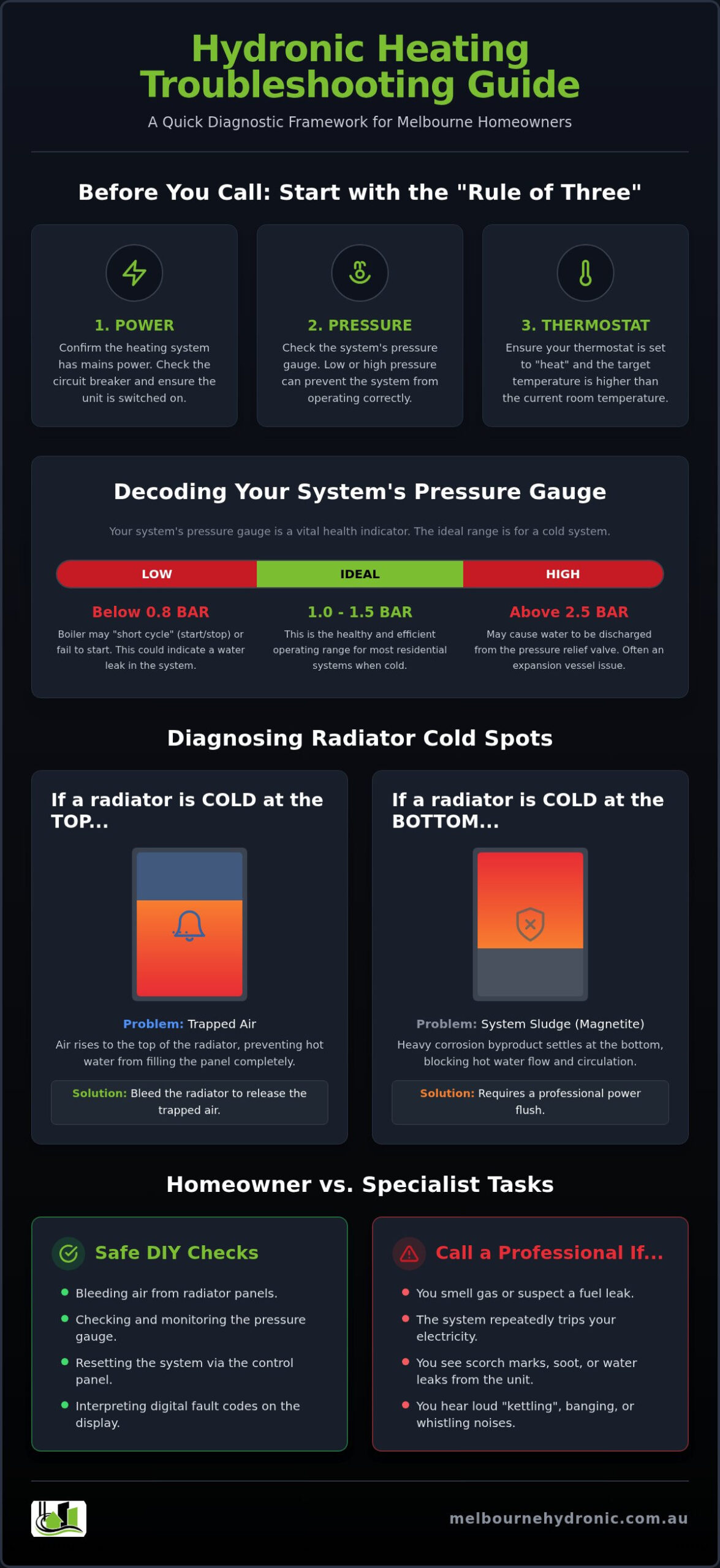
Effective hydronic heating troubleshooting melbourne homeowners can rely on begins with a logical, three part process. Think of your system as a connected loop: the heat source (your boiler or heat pump), the distribution network (the pipes and pumps), and the emitters (your radiator panels or underfloor coils). What is Hydronic Heating? Essentially, it is the transfer of thermal energy using water as the medium. When one part of this loop fails, the entire home’s comfort is compromised. In 2026, troubleshooting has evolved significantly. Modern systems now feature integrated smart controls that provide specific fault codes, making our “Rule of Three” framework even more critical. Before you book a technician, verify three things: power, pressure, and the thermostat status. This simple check often resolves many common “no-heat” scenarios without a service fee.
Homeowner vs. Specialist: Setting the Boundary
You can safely handle basic maintenance tasks that don’t involve the internal mechanics of your system. This includes bleeding radiator panels to remove trapped air or interpreting digital display codes on your control panel. These actions are non invasive and help maintain system hygiene. However, Victorian safety standards draw a firm line at internal components. Never attempt to open a gas boiler casing or adjust internal heat pump circuitry. If you notice symptoms like a heavy smell of gas, scorch marks on the unit, or persistent electrical tripping, you must isolate the system at the main switch immediately. Our 30 years of experience in the Melbourne and Geelong regions has shown that early professional isolation prevents minor faults from turning into expensive component replacements.
Understanding System Pressure Basics
Your system’s pressure gauge is the most important diagnostic tool at your disposal. For most Melbourne homes, the ideal operating range is between 1.0 and 1.5 bar when the system is cold. If the pressure drops below 0.8 bar, your boiler or heat pump may “short cycle.” This means it starts and stops rapidly without ever reaching the required temperature to warm your home. Conversely, if the pressure climbs above 2.5 bar, you’ll likely see water discharging from the pressure relief valve outside. High pressure usually indicates an issue with the expansion vessel or a filling loop that hasn’t been fully closed. Monitoring this gauge helps you catch leaks early, which is vital for protecting your home’s premium finishes and ensuring your system’s long term health.
Diagnosing Radiator Panel and Underfloor Issues
Once you’ve verified the “Rule of Three” from the previous section, it’s time to inspect your emitters. Radiator panels are the most common point of failure for home comfort, but the symptoms they exhibit tell a very specific story. If you notice a panel is cold at the top but warm at the bottom, air has likely become trapped inside. This is a simple fix. However, if the panel is warm at the top but cold or lukewarm at the bottom, you’re likely dealing with system sludge. This “magnetite” is a byproduct of internal corrosion, often exacerbated by Melbourne’s specific water mineral content in older suburbs. This sludge settles at the base of panels, creating a thick barrier that prevents hot water from circulating effectively.
Underfloor heating troubleshooting requires a different approach since the pipes are hidden. Instead of feeling for cold spots, we look at the manifold and flow meters. If an entire room remains cold, the culprit is often a failed thermal actuator or a seized pin in the manifold valve. In 2026, we increasingly use thermal imaging cameras to diagnose these “cold zones” without invasive floor inspections. This technology allows us to see exactly where the flow stops, ensuring that hydronic heating troubleshooting melbourne stays precise and non-destructive. Referencing the official guide to heating systems highlights that while these systems are incredibly efficient, maintaining clear flow paths is essential for keeping running costs low.
How to Correctly Bleed a Hydronic Radiator
Bleeding your radiators is the first step in restoring silent, even warmth. It’s a task most homeowners can handle safely to improve system hygiene and performance.
- Step 1: Turn off your heating system and allow it to cool completely to avoid any risk of scalding.
- Step 2: Locate the bleed valve, usually found at the top corner of the radiator panel, and use a radiator key or a flat-head screwdriver to slowly turn it anti-clockwise.
- Step 3: You’ll hear a hissing sound as air escapes. Keep a cloth ready, and as soon as a steady stream of water appears, close the valve firmly.
- Step 4: Check your system’s pressure gauge. Bleeding radiators often causes the pressure to drop, so you may need to top it up to the 1.0 to 1.5 bar range we discussed earlier.
System Balancing for Even Heat Distribution
Does your living room feel like a sauna while the back bedroom stays freezing? This usually happens because water takes the path of least resistance. Radiators closest to the boiler or heat pump “steal” the most flow, leaving distant panels with nothing but lukewarm water. You can regulate this using the lockshield valve, which is the valve on the opposite side of the manual or thermostatic control. By slightly closing the lockshield on radiators that get hot too quickly, you force more water toward the colder areas of the house. If your home still feels uneven after these adjustments, a professional hydronic heating service melbourne can perform a full hydraulic balance to ensure every room reaches its peak comfort level. It’s a simple way to protect your well-being and ensure your system operates at maximum efficiency.
Boiler and Heat Pump Faults: Noise and Performance
When your system speaks, it’s usually trying to tell you something specific about its internal health. A gentle humming sound is often just the circulation pump doing its job, but banging or whistling suggests a more systemic issue that needs attention. For those with 2026-standard European units like Baxi or Immergas, these sounds are often accompanied by specific error codes on the digital display. Decoding these early is a core part of hydronic heating troubleshooting melbourne homeowners should master to maintain their premium home comfort and avoid a cold night. Understanding the difference between a minor operational quirk and a serious mechanical failure is the key to a long-lasting, efficient system.
Melbourne’s climate presents unique challenges, especially during the 2026 winter season. On a typical 4°C morning, your system is under its highest load. This is when faults usually manifest, whether it’s a gas boiler failing to ignite or an electric heat pump struggling with frost. By applying the “Rule of Three” we established earlier, you can often narrow down whether the issue is a simple external factor or something requiring a specialist’s intervention. Modern systems are designed with high-precision sensors, so even a small deviation in gas pressure or airflow can trigger a safety shutdown to protect the unit’s internal circuitry.
Gas Boiler Ignition and Pilot Issues
Gas boilers remain a staple in many established Melbourne homes. If your unit won’t ignite, start by checking the external gas supply and ensuring the reset button hasn’t been tripped by a power surge. “Kettling” is a particularly distinct sound, it sounds like a kettle boiling inside your wall. This usually indicates localized overheating caused by scale buildup or restricted flow. It’s a sign that the heat exchanger is struggling. Whistling, on the other hand, often points to a failing pump or a stubborn air-lock that hasn’t been cleared through standard bleeding. These noises aren’t just annoying; they’re warnings that your system’s efficiency is dropping and your energy bills may soon rise.
Electric Heat Pump Efficiency Drops
As Melbourne transitions toward electrification, troubleshooting electric hydronic heat pumps has become a new priority for many households. On those frosty 4°C Victorian mornings, you might notice your heat pump’s fan stop while the unit continues to hum. This isn’t a fault; it’s the “defrost mode” working to clear ice from the external coils. However, if the unit remains in this state for hours, check for obstructed airflow. Fallen leaves, garden debris, or even a poorly placed outdoor storage box can choke the fan unit, forcing it to work harder for less warmth. For those looking for deeper technical specifications on these modern systems, our Heat Pump Hydronic Heating Guide offers a comprehensive breakdown of 2026 performance standards and maintenance requirements.
Controls, Thermostats, and Zoning Failures
Your thermostat is the brain of your entire system. When it fails, the rest of the network remains dormant, regardless of how well your boiler or heat pump is performing. A blank screen is a common starting point for hydronic heating troubleshooting melbourne homeowners, yet the solution isn’t always as simple as a battery change. While a “no power” state often points to expired AA batteries, it can also signal a blown fuse in the master wiring center or a communication break between the unit and the heat source. For households requiring expert electrical support to resolve these power issues, synergytrades.com.au offers specialized maintenance services. In 2026, many Melbourne properties utilize wireless smart controls that rely on radio frequency. If you’ve recently moved large furniture or installed new electronic devices, you might be accidentally shielding the signal that tells your system to ignite.
System efficiency often hinges on a technical setting called “hysteresis.” This is the temperature differential that determines when your heating kicks in. If your home feels like it’s constantly fluctuating between “too hot” and “too cold,” your hysteresis might be set too wide. Conversely, a setting that is too tight causes “short cycling,” where the boiler fires up every few minutes, causing unnecessary wear on the internal circuitry. We’ve spent 30 years refining these settings for the Victorian climate to ensure your system provides a steady, premium lifestyle experience without wasting energy.
The physical location of your sensor is just as vital as its software settings. A thermostat placed in direct afternoon sunlight or near a draughty front door will provide false readings, causing your radiators to shut down while the rest of the house is still freezing. Most modern digital controllers include an “Offset” or “Calibration” feature. This allows you to adjust the displayed temperature to match the actual ambient heat in the center of the room. Efficient hydronic heating relies on precise ambient sensing to maintain that signature dust-free warmth. If your readings feel “off,” checking for external heat sources nearby is your first diagnostic step.
Manifold Actuator Failures in Underfloor Systems
In multi-zone underfloor systems, the manifold acts as the traffic controller. Each zone is managed by a small plastic component called an actuator. You can visually check these by looking for a small indicator pin that “pops up” when a room calls for heat. If your thermostat says the heating is on but the floor remains cold, the actuator may have failed or the internal valve pin could be seized. A seized pin is a mechanical failure that no amount of digital resetting will fix. If your screen is blank or specific zones are unresponsive despite your best efforts, book a diagnostic check with our technical team to restore your home’s balance.
When Troubleshooting Fails: Professional Solutions
Sometimes, even the most diligent hydronic heating troubleshooting melbourne homeowners can perform reaches a technical limit. If your radiators consistently pass the “Rule of Three” checks but still exhibit cold bottoms, you’ve confirmed the presence of system sludge through the “Sludge Test.” This heavy, black iron oxide settles in the lowest points of your system, creating a thermal barrier that your boiler or heat pump simply cannot overcome. While Melbourne’s water is relatively soft, internal corrosion in older systems can still produce significant magnetite buildup over time. Professional water quality analysis is the only way to identify this corrosion early, allowing us to treat the “illness” before it causes a total pump failure or heat exchanger blockage. For homeowners interested in maintaining high water standards throughout their property, you can discover Tradewinds Water Filtration to learn about advanced treatment for your domestic supply.
In 2026, we often help clients weigh the ROI of ongoing repairs versus a full boiler replacement. If your gas boiler is over 15 years old and requiring frequent part replacements, transitioning to a high-efficiency condensing boiler or a modern electric heat pump often makes more financial sense. With the Victorian government’s push toward electrification and the potential for lower running costs, upgrading an aging unit can reduce winter energy consumption by up to 28%. Annual maintenance remains your best defense, acting as a preventative troubleshooting strategy that ensures your system’s health for the long term.
Power flushing is the most effective way to restore a system that has been “choked” by sludge. We use a specialized, high-velocity pumping station to circulate water and cleaning chemicals through your entire network at high speed but low pressure. This process physically strips away the magnetite and debris that bleeding and standard draining cannot reach. The results are usually immediate. You’ll notice a significant drop in fuel bills as the system regains its efficiency, and those unsettling metallic noises often disappear completely. It’s a deep clean that breathes new life into your pipes and emitters, protecting your premium lifestyle and home comfort.
Booking a Specialist Diagnostic
When you call for a professional diagnostic, having specific information ready can significantly speed up the repair process. Note down any error codes displayed on your unit, the age of the system, and exactly which rooms are experiencing “cold zones.” It’s essential to use a technician who understands the specific hydraulics of hydronic heating panels and manifolds, as general plumbing knowledge isn’t always enough for these specialized systems. Before your technician arrives, ensure there is clear access to the boiler or heat pump, the manifold, and at least one radiator in each zone. This preparation allows us to apply our 30 years of technical expertise quickly, ensuring your home returns to its signature dust-free warmth without delay.
Securing Your Home’s Comfort for the 2026 Winter
Mastering the basics of hydronic heating troubleshooting melbourne allows you to maintain a premium, dust-free environment while protecting your system’s long-term health. By applying the systematic checks we’ve discussed, you can distinguish between simple air-locks and more complex issues like internal magnetite buildup. Understanding these signals ensures you don’t waste energy or ignore warning signs that could lead to costly component failures. A proactive approach today prevents the stress of a breakdown when the temperature drops.
When local adjustments aren’t enough, relying on professional expertise is the safest way to restore your system’s peak performance. Our team brings 30+ years of Melbourne experience to every diagnostic visit. As licensed gas fitters and electricians, we are specialists in sludge removal and power flushing, ensuring your system operates with the precision it was designed for. We focus on a “fix-first” mentality to protect your investment and your family’s well-being.
Don’t let a minor fault compromise your home’s comfort. Book a Specialist Hydronic Diagnostic with Melbourne Hydronic Heating today to ensure your system is ready for the cold months ahead. We’re here to help you maintain a warm, healthy home.
Frequently Asked Questions
Why are my hydronic radiators cold at the top but hot at the bottom?
This specific temperature gradient indicates that air has collected at the top of the panel, displacing the hot water. It’s a common issue that prevents the radiator from reaching its full thermal capacity. You can usually resolve this by using a radiator key to bleed the air until water flows steadily. If the problem persists across multiple rooms, it may signal a deeper pressure issue within your system’s expansion vessel.
How do I re-pressurise my hydronic boiler in Melbourne?
Locate the filling loop, which is typically a flexible silver hose with two small valves underneath your boiler. Slowly open both valves until you hear water entering the system while monitoring the pressure gauge. Once the needle reaches the 1.0 to 1.5 bar range, close both valves firmly. Maintaining correct pressure is vital for hydronic heating troubleshooting melbourne households, as low pressure prevents the unit from igniting safely during cold Victorian winters.
What does a loud banging noise in my hydronic pipes mean?
Loud banging, often called water hammer, usually occurs when air is trapped in the pipework or when a pump is set to a speed that is too high for the system’s design. It can also indicate that the pipes haven’t been secured correctly with proper clips, allowing them to vibrate against floor joists. If the noise is accompanied by a whistling sound, your circulation pump might be struggling against a blockage or internal debris.
Can I troubleshoot my own underfloor heating if a zone is cold?
You can safely perform basic checks by verifying your thermostat settings and inspecting the manifold actuators. Look for the visual indicator on the manifold to see if the specific zone is “calling for heat” when the thermostat is active. If the actuator pin doesn’t move, the component may have failed. However, if the manifold feels hot but the floor remains cold, the issue might be a seized internal valve pin or an air-lock.
How often should I bleed my hydronic radiator panels?
Most systems only require bleeding once a year, ideally at the start of the autumn season before you rely on the heating daily. Constant air buildup is not normal and often points to a small leak or a failing expansion vessel that is drawing air into the loop. If you find yourself bleeding the same radiator every few weeks, it’s time to stop troubleshooting and request a professional water quality analysis to check for corrosion.
Why is my hydronic heating pump running but the radiators are cold?
This scenario often indicates a major air-lock in the main flow pipe or a pump that has “seized” after sitting idle during the summer months. You can sometimes hear the pump humming without actually moving water. Check that all isolation valves are fully open and that the system pressure hasn’t dropped below 0.5 bar. If the pump is hot to the touch but the outgoing pipes are cold, the internal impeller may be blocked by sludge.
Is it normal for my electric heat pump to emit steam in winter?
Yes, this is perfectly normal and is actually a sign of a healthy system. On frosty Melbourne mornings, your heat pump enters a “defrost cycle” to melt ice buildup on the external coils. This process releases harmless water vapor that looks like steam or smoke. The fan will typically stop spinning during this short cycle. If the unit remains in this state for more than 15 minutes, check the external unit for any physical obstructions.
When should I stop troubleshooting and call a professional?
You should contact a specialist if you smell gas, notice water leaking from the boiler casing, or if the system keeps losing pressure after you’ve topped it up. Persistent electrical tripping or “kettling” noises also require expert attention. Our licensed gas fitters and electricians have over 30 years of experience in hydronic heating troubleshooting melbourne, ensuring that complex mechanical faults are resolved safely without risking your home’s premium finishes or your system’s long-term efficiency.