
Commercial Hydronic Heating Melbourne: The 2026 Business Infrastructure Guide
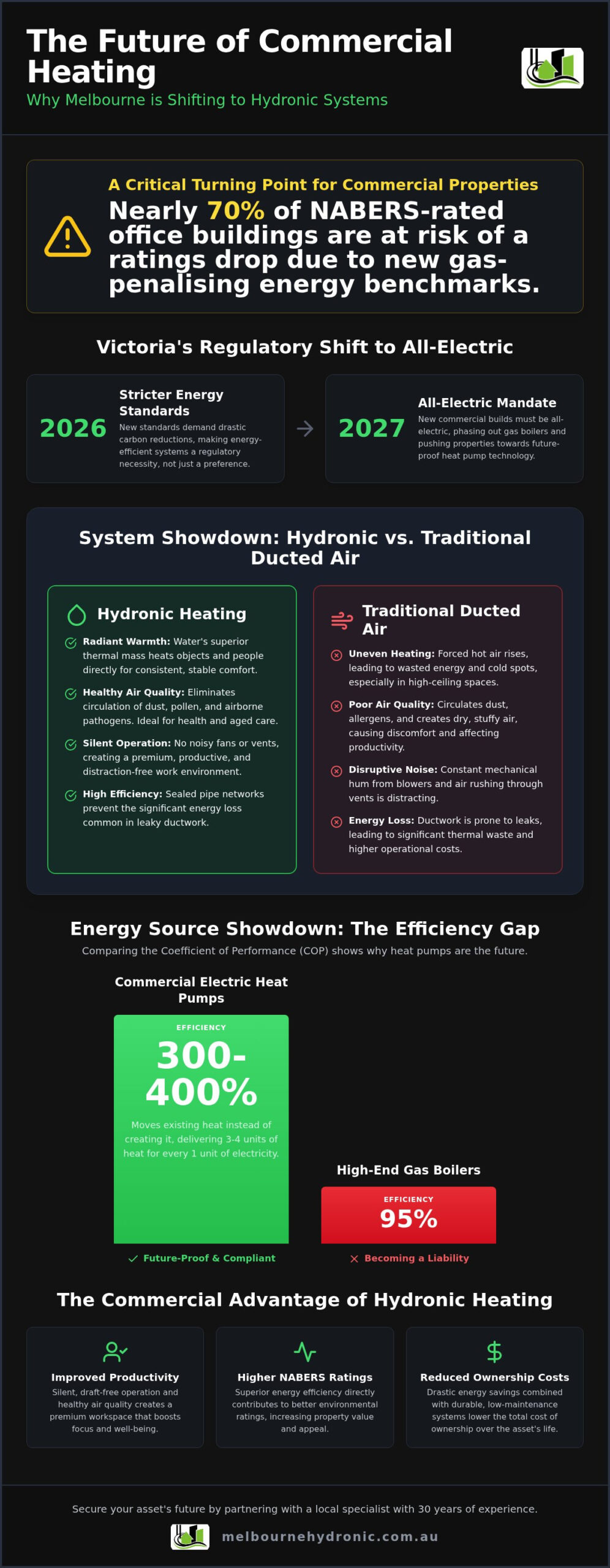
Did you know that nearly 70% of NABERS-rated office buildings are currently at risk of seeing their energy ratings plummet due to new gas-penalising benchmarks? In a city where climate control is a major operational expense, investing in commercial hydronic heating Melbourne systems is no longer just about comfort; it’s a critical strategy for protecting your property’s value. You’ve likely felt the sting of rising gas tariffs or dealt with tenant complaints about dry, dusty air and noisy vents. It’s frustrating to manage a facility where the infrastructure feels like it’s working against your bottom line and modern sustainability goals.
This guide shows you how switching to hydronic technology can transform your commercial property into a high-performance, future-proof asset. We’ll explore the shift toward all-electric heat pump technology, the significant health benefits of radiant warmth, and how to align your building with the strict 2026 Victorian energy standards. By the end, you’ll understand why Melbourne’s leading businesses are moving away from traditional HVAC to a silent, efficient, and healthy alternative that meets the demands of the next decade.
Key Takeaways
- Learn how the 2026 Victorian energy standards are reshaping commercial infrastructure and why water-based thermal distribution is replacing inefficient forced-air systems.
- Compare the long-term efficiency of high-capacity electric heat pumps against traditional gas boilers to prepare your property for the 2027 all-electric mandate.
- Explore how commercial hydronic heating Melbourne improves workplace productivity through silent operation and allergen-free climate control in shared environments.
- Understand the critical role of professional heat load calculations and multi-storey zoning in reducing your building’s total cost of ownership.
- Discover the security of partnering with a local specialist who brings 30 years of experience to ensure your system meets the highest standards of technical precision.
The Shift to Commercial Hydronic Heating in Melbourne
Melbourne’s commercial landscape is undergoing a quiet revolution. Since Victorian building regulations have tightened and the 2027 all-electric mandate for new commercial builds approaches, facility managers are looking beyond traditional forced-air systems. Commercial hydronic heating Melbourne represents a sophisticated shift toward water-based thermal distribution. Unlike air-handling units that push heated air through bulky vents, these systems use a network of pipes to circulate hot water to radiator panels, underfloor coils, or fan coils.
The technology, often referred to as Hydronics, relies on the superior thermal mass of water. Water carries nearly four times more heat than air by volume. This physical advantage allows commercial buildings to maintain precise temperatures with far less energy consumption. With 2026 energy standards demanding drastic carbon reductions, this efficiency isn’t just a preference; it’s a regulatory necessity for Victorian businesses.
Hydronic vs. Ducted Heating for Melbourne Businesses
Traditional ducted systems are notorious for energy loss. Leaks in ductwork and the natural tendency for warm air to rise and escape through ceilings often result in significant waste. In contrast, hydronic systems deliver radiant warmth directly to the objects and people in a room. This method eliminates the circulation of dust, pollen, and airborne pathogens. It’s the primary reason many aged care and medical facilities are leading the transition to cleaner heating.
For large-scale open-plan layouts, understanding what is hydronic heating can be the key to better tenant retention. There are no draughts, no dry eyes, and the system is completely silent. In a Melbourne CBD office environment, the removal of mechanical hum and the presence of healthy air quality create a premium workspace that justifies higher commercial rents.
Melbourne’s Climate and Thermal Comfort Standards
Our city is famous for its erratic temperature swings. A standard HVAC system often struggles with short-cycling, where the unit turns on and off rapidly to keep up with changing external conditions. Hydronic systems provide a stable thermal battery. The heat stays in the water and the structure of the building, providing a consistent temperature that doesn’t fluctuate every time a lobby door opens.
High-ceiling spaces, such as converted warehouses or modern foyers, benefit most from radiant heat. While forced air gathers at the ceiling, radiant panels or underfloor systems keep the warmth where it’s needed: at the floor level. Meeting modern commercial office grading standards requires this level of precision. By investing in commercial hydronic heating Melbourne properties can achieve higher NABERS ratings and ensure long-term operational stability.
Core Technologies: Commercial Heat Pumps vs. Gas Boilers
The engine room of any hydronic system determines its long-term viability and operational cost. Since the Victorian Government announced that most new commercial buildings must be all-electric from January 1, 2027, the choice between heat pumps and boilers has become a matter of regulatory compliance. Transitioning to commercial hydronic heating Melbourne requires a clear understanding of how these thermal sources interact with your building’s existing or planned infrastructure. The right choice today prevents your asset from becoming a stranded gas-reliant liability by the end of the decade.
The Rise of Commercial Electric Heat Pumps
Electric air-to-water heat pumps are the gold standard for modern efficiency. They work by extracting ambient heat from the outside air and transferring it to the water circuit. The primary metric here is the Coefficient of Performance (COP). While a high-end gas boiler might reach 95% efficiency, a heat pump often achieves 300% to 400% efficiency by moving heat rather than creating it. This significantly boosts the energy efficiency of heating and cooling across large floorplates.
For businesses aiming for net-zero, pairing heat pump hydronic heating with on-site solar PV arrays can virtually eliminate heating costs during daylight hours. This synergy is particularly effective in Melbourne’s CBD, where corporate ESG targets are driving the demand for fossil-fuel-free operations. High-capacity heat pumps are now capable of delivering the high-temperature water required for radiator circuits, making them a direct replacement for older plant equipment.
Condensing Boilers for Retrofit Projects
Natural gas isn’t entirely off the table for existing structures, especially heritage Melbourne buildings where electrical grid upgrades are cost-prohibitive. In these scenarios, high-efficiency condensing boilers remain a powerful solution. These units capture latent heat from exhaust gases that traditional boilers simply waste. When choosing the best hydronic boiler for a retrofit, we focus on modular, wall-mounted units that save precious plant room space while meeting high-demand radiator loads.
To bridge the gap between seasonal needs, many Victorian businesses are now integrating fan coils into their hydronic loops. These units allow the same pipework to provide radiant warmth in winter and active chilled-water cooling in summer. It’s a versatile approach that simplifies maintenance and reduces the number of mechanical systems you need to manage. If you’re unsure which technology fits your current floorplan, a professional assessment from the team at Melbourne Hydronic Heating can clarify your best path forward for the 2026 energy landscape.
Why Melbourne’s Commercial Sectors Choose Hydronic Solutions
While the initial capital outlay for a hydronic setup can be higher than traditional forced-air systems, savvy Melbourne property owners focus on the Total Cost of Ownership (TCO). A well-designed system lasts decades, not just years. Because water-based systems have fewer mechanical components exposed to wear and tear, maintenance costs remain low over the asset’s lifecycle. In a market where energy prices are volatile, the efficiency of commercial hydronic heating Melbourne provides a predictable, lower-cost operational model that protects your bottom line.
Aged Care and Healthcare: The Hygiene Advantage
In sensitive environments like Victorian aged care facilities, air quality is paramount. Traditional heating that blows air around shared spaces can spread bacteria, dust, and allergens. Hydronic systems use radiant heat, which doesn’t rely on air movement at all. This keeps the environment cleaner and more comfortable for residents with respiratory issues. We also install safe-to-touch radiator panels, ensuring that residents are protected from accidental burns while enjoying consistent, gentle warmth that aids in psychological well-being and recovery.
Educational Facilities and Schools
Schools present a unique challenge with high-traffic zones and large volumes. For gymnasiums and assembly halls, underfloor heating is the most efficient way to manage thermal comfort. It turns the entire floor into a low-temperature radiator, providing even heat without the cold spots common in high-ceiling buildings. Our radiator panels are also designed for durability, standing up to the rigours of student environments. For new school builds, these systems are a key component in achieving high Green Star ratings, demonstrating a commitment to sustainability that parents and the community expect in 2026.
Choosing the right system for your sector requires a balance of technical performance and practical durability. Whether it’s the hygiene needs of a clinic or the robustness required for a primary school, hydronic technology offers a versatile solution that outlasts and outperforms traditional HVAC alternatives.
Planning and Installing Commercial Hydronic Systems
Successful commercial hydronic heating Melbourne projects begin long before the first pipe is laid. The engineering phase is where we define the system’s efficiency for the next thirty years. We start with rigorous heat load calculations that go beyond simple square meterage. Our team analyses glass-to-wall ratios, insulation R-values, and specific occupancy patterns. A system that’s oversized wastes energy through constant cycling, while an undersized system will fail to maintain comfort during a Victorian cold snap. Precision at this stage is the difference between a high-performance asset and a costly liability.
Retrofitting these systems into existing commercial structures requires creative engineering. While piping is significantly less invasive than bulky ductwork, it still requires professional routing to avoid structural interference. We often utilise existing service risers or ceiling voids to minimise disruption to your business operations. Once installed, the focus shifts to longevity. Investing in a regular hydronic heating service in Melbourne is essential. This ensures that pumps operate at peak efficiency and that water chemistry is balanced to prevent internal corrosion within the radiator panels or underfloor coils.
System Zoning and Controls
For multi-storey Melbourne office buildings, zoning is your most powerful tool for reducing operational costs. Modern Building Management Systems (BMS) allow facility managers to monitor and adjust temperatures across individual floors or even specific departments from a central dashboard. By using manifold setups as distribution hubs, we ensure balanced flow rates across large-scale circuits. This means you aren’t paying to heat an entire floor for a single team working late on a Saturday.
Integrating Heat Recovery Ventilation (HRV)
Modern commercial buildings are designed to be airtight to prevent thermal loss. However, this can lead to poor indoor air quality if not managed correctly. We integrate Heat Recovery Ventilation (HRV) alongside our hydronic systems to solve this. HRV units extract stale air while capturing its thermal energy to pre-warm incoming fresh air. It’s a holistic approach that maintains a healthy building ecosystem without sacrificing the energy gains of your radiant heating. This combination is particularly effective for meeting the 2026 Victorian energy standards for sustainable infrastructure.
Ready to upgrade your building’s infrastructure with a custom-engineered solution? Contact the specialist team at Melbourne Hydronic Heating to discuss your project requirements today.
Partnering with Melbourne Hydronic Heating for Your Project
Selecting the right partner for your building’s thermal infrastructure is a decision that dictates your operational efficiency for the next thirty years. At Melbourne Hydronic Heating, we bring over 30 years of local industry experience to every project. We’ve seen the evolution of the Victorian market firsthand, from the early days of gas boilers to the current 2026 shift toward all-electric heat pump technology. This history allows us to act as more than just installers; we’re consultants who understand how to future-proof your asset against changing regulations and rising energy costs.
Our commitment to commercial hydronic heating Melbourne is anchored in what we call signature workmanship. This isn’t a marketing slogan. It’s a set of internal quality control guidelines that ensure every manifold is perfectly balanced and every pipe run is optimised for flow. We work closely with developers and architects during the early design phases to ensure the hydronic system integrates seamlessly with the building’s structural and aesthetic requirements. This collaborative approach prevents the bolt-on feel of many traditional HVAC installations, resulting in a cleaner, more professional finish.
From Design to Commissioning
We handle the entire lifecycle of your system, from the initial heat load calculations to the final commissioning and handover. This end-to-end service ensures that nothing is lost in translation between the design and the actual installation. Because we’re a family-owned Victorian business, our support doesn’t end when the project is signed off. We provide ongoing local maintenance and technical support, ensuring your investment continues to perform at its peak. If you’re planning a new build or a major retrofit, requesting a tailored commercial quote is the first step toward a more sustainable, energy-efficient future.
Geelong and Regional Victoria Coverage
Future-Proofing Your Commercial Infrastructure for 2026 and Beyond
Investing in commercial hydronic heating Melbourne is more than a comfort upgrade; it’s a critical move to protect your property’s market value. As we approach the 2027 all-electric mandates, the shift toward high-capacity heat pumps and radiant distribution ensures your building remains compliant and cost-effective. You’ve seen how these systems eliminate noise and dust while slashing energy bills through superior thermal mass. It’s the most reliable way to meet modern NABERS benchmarks and tenant expectations for a healthy, premium workspace.
With over 30 years of experience as local Melbourne and Geelong specialists, we understand the technical precision required for large-scale installations. Our team of energy-efficient design experts is ready to help you navigate the transition from outdated HVAC to a sustainable, silent alternative. Don’t let your building fall behind as energy standards tighten. Request a Commercial Hydronic Heating Consultation today to secure your facility’s long-term operational success. Your journey toward a more efficient and comfortable business environment starts with a professional partnership you can trust.
Frequently Asked Questions
How much does commercial hydronic heating cost to install in Melbourne?
The investment for commercial hydronic heating Melbourne varies based on your building’s specific heat load and the chosen thermal technology. While the initial capital expenditure is often higher than traditional split systems, the long-term total cost of ownership is significantly lower. We provide custom quotes after a detailed engineering assessment to ensure the system matches your facility’s requirements and 2026 energy targets.
Can hydronic heating be retrofitted into an existing Melbourne office building?
Yes, hydronic systems are highly adaptable for retrofitting into existing commercial structures. Because the system uses small-diameter piping rather than bulky ductwork, it’s often easier to route through ceiling voids and service risers in heritage buildings. This allows you to upgrade your building’s infrastructure without the massive structural modifications required for modern air-handling units or forced-air systems.
What is the expected lifespan of a commercial hydronic system?
A professionally installed commercial hydronic system typically has a lifespan of 25 to 30 years or more. This is significantly longer than standard forced-air systems, which often require major overhauls after 10 to 15 years. The durability comes from high-quality radiator panels and the fact that the primary mechanical components are housed in a central plant room, protected from the elements.
How much can a business save on energy bills by switching to hydronic heat pumps?
Businesses can see a drastic reduction in operational costs by switching to electric heat pumps. These units achieve a Coefficient of Performance (COP) of 3.0 to 4.0, meaning they produce up to four units of heat for every unit of electricity used. When paired with commercial solar arrays, some Melbourne facilities can reduce their heating-related energy expenditure by more than 50% compared to older gas-fired systems.
Is hydronic heating better for offices than ducted reverse cycle systems?
Hydronic systems offer superior comfort and health benefits compared to ducted reverse cycle units. They provide silent, radiant warmth without the draughts or dust circulation common in forced-air setups. This makes them ideal for shared office spaces where air quality and noise levels directly impact staff productivity and overall workplace wellbeing. It’s a premium choice that often leads to better tenant retention.
Does commercial hydronic heating require frequent maintenance?
Commercial systems require an annual professional service to maintain peak efficiency. This maintenance includes checking water chemistry, inspecting pumps, and ensuring the control logic is optimised for the current season. Regular servicing prevents internal corrosion and ensures the system continues to meet the strict 2026 Victorian energy standards for commercial buildings. It’s a proactive approach that ensures long-term reliability.
Are there Victorian government rebates for commercial heat pump installations in 2026?
In 2026, the Victorian Energy Upgrades (VEU) program has proposed new incentives specifically for businesses transitioning from gas to electric hydronic heat pumps. These rebates are designed to support the state’s move toward all-electric commercial infrastructure. We recommend checking the latest VEU program updates as the response to the public consultation on these specific activities is finalised in late 2026.
Can hydronic systems provide cooling as well as heating for commercial spaces?
Yes, by integrating fan coils and reversible heat pumps, a hydronic loop can provide both heating and cooling. This approach allows the same pipework infrastructure to deliver radiant warmth in winter and active chilled-water cooling in summer. It’s a versatile solution that simplifies mechanical plant management for large-scale Melbourne office developments while maintaining a high level of thermal control throughout the year.